
Most offer messaging does not fail because the offer is terrible. It fails because the explanation is mush.
You know the type: “I help purpose-driven founders scale with clarity, alignment, and impactful systems.” Sounds polished. Says almost nothing. Nobody reads that and thinks, yes, that is exactly what I need.
If you want better conversions, stronger positioning, and fewer awkward moments where people ask, “Wait, what do you actually do?” then you need better tools and better templates. Not more fluff. Not a brand voice workshop that ends with twelve adjectives and a moodboard. Actual working material.
This guide covers the best templates and tools for offer messaging & positioning if you want to sharpen what you sell, who it is for, why it matters, and how to say it without sounding like a consultant trapped in a pitch deck. We will cover what each template helps you do, where tools can speed things up, and where they absolutely cannot save you.
If you are still piecing together your core messaging, it also helps to understand the larger category this sits inside. You can explore more foundational articles in website conversion copy and the broader website core copy section, especially the main guide to offer messaging and positioning.
Want the broader roadmap? Start with the parent guide.
What good offer messaging and positioning actually need to do
Before you grab a template, worth stating the obvious thing people skip: messaging is not decoration.
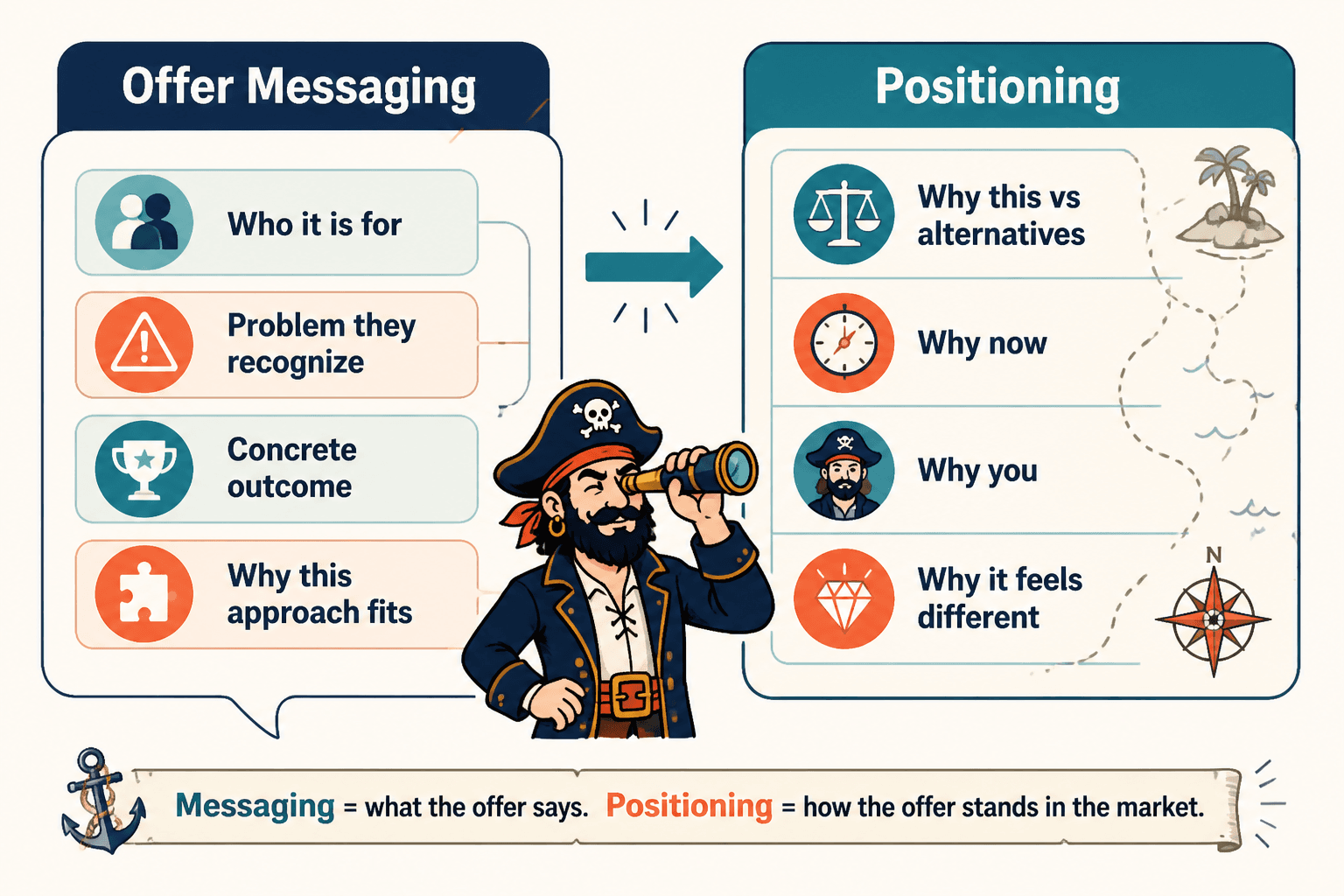
Your offer messaging needs to do four jobs fast:
- Show who the offer is for
- Name the problem in a way the buyer recognizes
- Make the outcome feel concrete and valuable
- Explain why your approach is the right fit
Your positioning then adds the market context around it. It answers the deeper layer:
- Why this offer instead of the alternatives?
- Why now?
- Why you?
- Why should this feel different from the vague sea of similar promises?
That is why random headline generators and “fill in the blank” taglines usually disappoint. They give you wording before they give you clarity. And wording without clarity is just better-dressed confusion.
The best templates for offer messaging and positioning
Templates are useful when they force sharper thinking. They are useless when they produce copy that could belong to literally anyone.
Here are the templates worth keeping in your stack.
1. The audience-problem-outcome template
This is the cleanest place to start when your messaging is still too broad.
I help [specific audience] solve [specific problem] so they can achieve [specific outcome].
Simple, yes. Basic, also yes. Still useful, definitely. The point is not to publish this exact sentence forever. The point is to stop hiding behind fog.
Weak version: I help business owners grow online.
Stronger version: I help solo consultants turn unclear service offers into sharp website messaging that gets more qualified leads.
Now we have an audience, a problem, and an outcome. Already less beige.
2. The “we are not for everyone” positioning template
Good positioning often gets stronger when you define who you are not trying to attract.
This offer is for [ideal buyer] who want [result], but not for people looking for [misaligned expectation or shortcut].
This works because it creates contrast. And contrast is where positioning starts to feel real.
Example: This offer is for creators with strong expertise who want clearer positioning and better conversion copy, but not for people looking for a magic headline that fixes a weak offer.
That last clause matters. It filters. It signals standards. It quietly tells the right buyer, “You are in the right place,” while warning off the people who were going to become annoying clients anyway.
3. The problem-agitation-clarity template
This is useful when your audience knows something feels wrong but has not named it cleanly yet.
You are not struggling because [common assumption]. You are struggling because [real issue]. That is why [current effort] keeps leading to [frustrating result].
Example: You are not struggling to sell because your audience hates spending money. You are struggling because your offer sounds interchangeable. That is why your traffic keeps turning into “sounds interesting” messages instead of qualified leads.
This type of framing is excellent for sales pages, landing page intros, email sequences, and LinkedIn posts about your offer. It helps people feel understood without drifting into melodrama.
4. The differentiated-method template
If your offer has a process, approach, or philosophy that genuinely changes the experience or result, use it.
Unlike [common alternative], this offer helps [audience] get [result] through [specific method], which makes it easier to [practical benefit].
Example: Unlike generic copy audits that dump feedback into a giant doc, this offer helps service businesses improve conversions through live message strategy and page-by-page rewrites, which makes it easier to actually publish the better version instead of admiring the notes forever.
That is positioning doing its job. Not louder. Just clearer.
5. The objection-flip template
Some of the best messaging comes from answering the reason people hesitate.
If you think [objection], that usually means [reframe]. This offer is built for people who need [what actually matters].
Example: If you think your problem is “I need more traffic,” that usually means your current message is not converting the attention you already get. This offer is built for people who need sharper positioning before they pour more effort into promotion.
Useful on sales pages. Useful in email nurture. Very useful in discovery-call follow-up. People bring objections with them anyway. You may as well meet them before they leave.
6. The offer stack clarity template
A lot of offer messaging gets messy because the offer itself has too many moving parts. This template helps organize what is included and why it matters.
You get [deliverable 1] so you can [benefit]. You also get [deliverable 2] so you can [benefit]. The goal is not more stuff. The goal is [core transformation].
Example: You get a positioning workshop so you can clarify the message before touching the copy. You also get homepage and offer page rewrites so you can actually turn that clarity into a stronger buying experience. The goal is not more words. The goal is a site that makes your offer easier to understand and easier to trust.
That last line is doing heavy lifting. Features explain. The transformation sells.
7. The “why now” urgency template
This is for offers that solve an expensive delay problem. Not fake scarcity. Real urgency.
The cost of waiting is not just [surface problem]. It is also [hidden cost]. The sooner you fix [core issue], the sooner you can [valuable outcome].
Example: The cost of waiting is not just a homepage that feels a bit off. It is also weeks or months of losing qualified leads because your best-fit buyers cannot quickly tell why your offer is right for them. The sooner you fix that message, the sooner your marketing stops leaking attention.
That is urgency without acting like a used car lot in a blazer.
If you want more practical frameworks built around this kind of thinking, see simple offer messaging and positioning problem framing templates for busy creators and best offer messaging and positioning ideas and examples for creators.
The best tools for offer messaging and positioning
Tools help in two ways: they speed up thinking, and they help organize the mess. They do not magically create a smart position for a dull offer. Important distinction.
So instead of pretending there is one perfect platform, here are the tool categories that are actually useful.
AI drafting and rewriting tools
These are useful for rough draft generation, variation testing, rewriting clunky lines, and helping you compare messaging angles. They are especially helpful once you already know:
- Who the offer is for
- What problem it solves
- What proof or mechanism makes it credible
- What tone you do and do not want
What AI tools do well:
- Generate multiple headline directions fast
- Rewrite copy for different levels of directness
- Turn bullet points into rough page sections
- Help compare short versus long messaging angles
- Surface obvious repetition and vagueness
What they do badly:
- Original positioning
- Taste
- Understanding buyer nuance without good inputs
- Sounding meaningfully different from the internet slurry
- Knowing which promises your audience already mistrusts
If you use AI here, use it as a sparring partner, not your head of strategy. For more on that side of the stack, read best AI tools for offer messaging and positioning.
Voice-of-customer research tools
If your messaging sounds generic, there is a decent chance you are writing from your own assumptions instead of your audience’s language.
Research tools help you gather:
- Customer interview notes
- Sales call transcripts
- Survey responses
- Testimonials
- Support questions
- Comments, reviews, and objection patterns
This is where your best copy usually comes from. Not from staring at the cursor hard enough. From listening.
Good messaging often sounds obvious after the fact because it uses the buyer’s real words. That is not accidental. It is research doing its job.
Message testing and CRO tools
If you already have website traffic, email traffic, or consistent profile visits, testing tools can help you learn which message lands better. This is where offer messaging stops being purely theoretical.
Useful things to test:
- Headline angle
- Problem framing
- CTA wording
- Offer naming
- Proof placement
- Objection-handling sections
Just do not test ten things at once and then pretend the result means something. People love calling random chaos “data.”
For deeper work in this area, check best messaging frameworks and CRO tools for offer messaging and positioning.
Workspace and organization tools
Unsexy category. Very useful category.
You need somewhere to store:
- Offer versions
- Headline options
- Audience notes
- Objections
- Testimonials
- Competitor observations
- Page messaging drafts
If your messaging process lives in seventeen tabs, three sticky notes, and your own memory, it is going to stay inconsistent. A basic doc, database, or swipe file system can do a lot of work here.
The trick is not finding the fanciest setup. The trick is making one place where your message gets refined instead of restarted every month.
A practical workflow for using templates and tools together
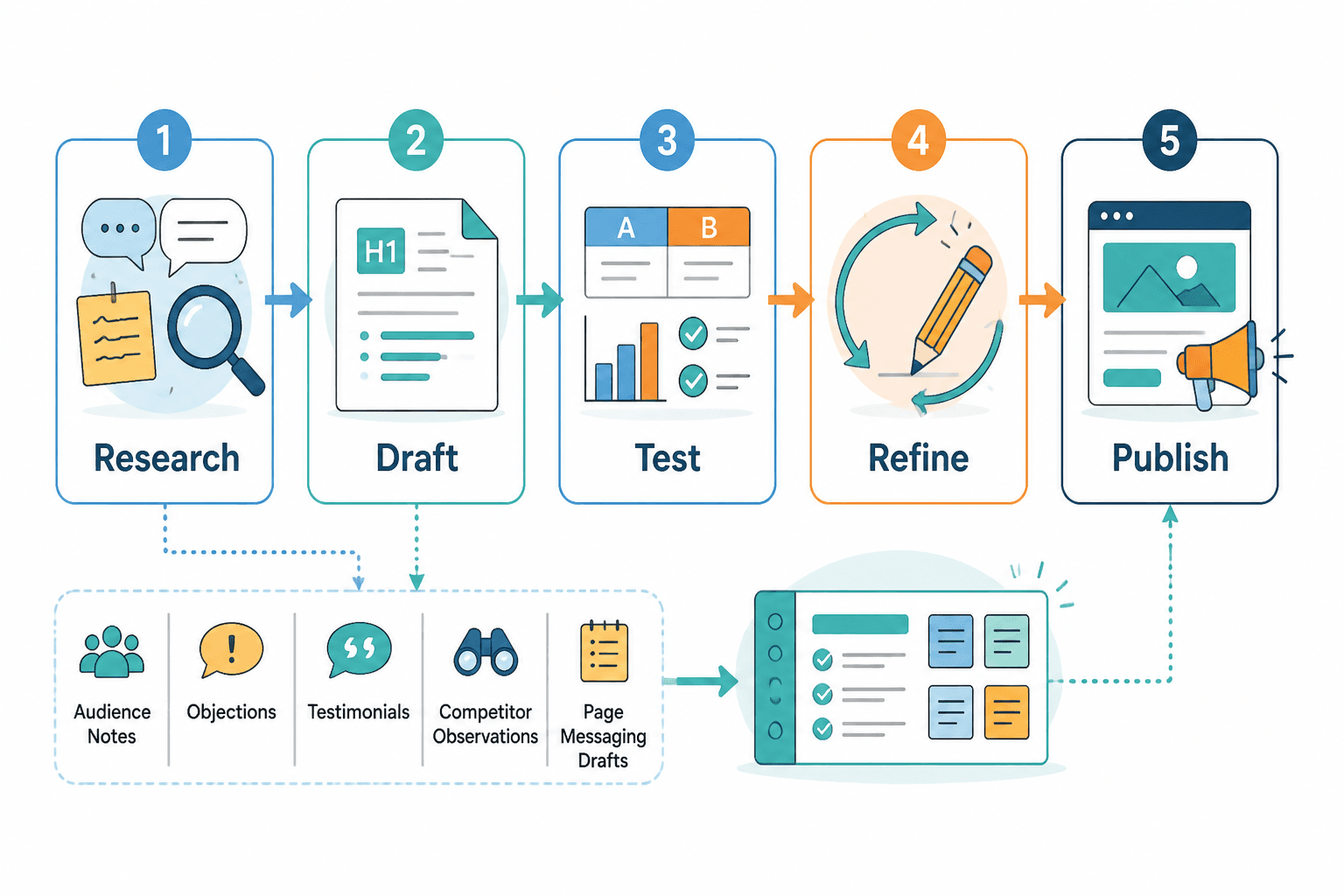
The best templates and tools for offer messaging & positioning work when they support a sequence. If you use them out of order, you usually end up polishing nonsense more efficiently.
Here is a workflow that is actually sane.
Step 1: Gather raw buyer language
Pull from discovery calls, testimonials, DMs, surveys, support messages, emails, and comments. Look for patterns in:
- What people want
- What they are frustrated by
- What they have already tried
- What words they use for success
- What makes them hesitate
Step 2: Clarify the offer in plain English
Before you make it pretty, make it clear.
Answer these questions in one sentence each:
- Who is this for?
- What problem does it solve?
- What result does it help create?
- What is included?
- What makes this different from alternatives?
Step 3: Run the offer through 2 to 3 templates
Do not use every template in existence. Pick the ones that expose weak spots.
For example:
- Use audience-problem-outcome to tighten the basic message
- Use differentiated-method to clarify why your approach matters
- Use objection-flip to handle the biggest buying hesitation
Step 4: Use AI to generate variations, not truth
Feed your strongest raw material into a drafting tool and ask for:
- 5 headline variations with different tones
- 3 versions aimed at different buyer priorities
- Shorter rewrites with stronger specificity
- CTA options that sound direct, not salesy
Then edit like an adult. Keep what sharpens the message. Delete the rest.
Step 5: Put the message where it matters
Your offer messaging should not live only in a nice strategy doc that nobody sees.
Apply it to:
- Homepage hero section
- Offer page headline and intro
- Social bios
- Pitch decks
- Lead magnet landing pages
- Email welcome sequence
- LinkedIn profile and featured section
- Sales call follow-up messages
Step 6: Test and refine
Watch what happens when the new message goes live.
- Do people understand the offer faster?
- Are better-fit leads replying?
- Are discovery calls spending less time on basic clarification?
- Are landing pages converting better?
- Are objections changing?
If the answer is no, that does not mean messaging does not matter. It usually means you still have one of three problems: the message is unclear, the audience fit is off, or the offer itself needs work.
How to choose the right template or tool for your stage
Not every creator or business needs the same setup.
| Stage | Best focus | Most useful templates or tools |
|---|---|---|
| Early-stage offer | Clarity | Audience-problem-outcome, buyer language research, simple docs |
| Offer getting interest but weak conversions | Positioning | Differentiated-method, objection-flip, CRO testing tools |
| Established offer with traffic | Optimization | Headline tests, page experiments, proof placement analysis |
| Multiple offers causing confusion | Offer architecture | Offer stack clarity, comparison messaging, centralized messaging system |
If you are early, do not overcomplicate this. You probably need clear language more than a sophisticated testing stack.
If you are established, do not hide behind “still refining the message” forever. At some point, the page has to go outside and meet real humans.
Common mistakes people make with messaging templates and tools
Using templates as final copy
Templates are scaffolding. If your homepage reads like a worksheet answer, that is a problem.
Confusing polished language with clear positioning
Fancy wording can make weak strategy sound briefly impressive. Briefly is doing a lot of work there.
Letting AI smooth away all personality
A lot of AI-assisted copy sounds technically fine and commercially dead. If your message could belong to any coach, consultant, or agency with a Canva subscription, it needs revision.
Skipping proof
Positioning gets stronger when it is backed by something real: a result, a case study, a process, a body of work, a clear point of view, or visible expertise.
Trying to appeal to everyone
This one keeps surviving for some reason. Broad messaging feels safer. It usually converts worse. Buyers do not reward vagueness because it was trying to be inclusive.
A simple example of messy messaging becoming usable
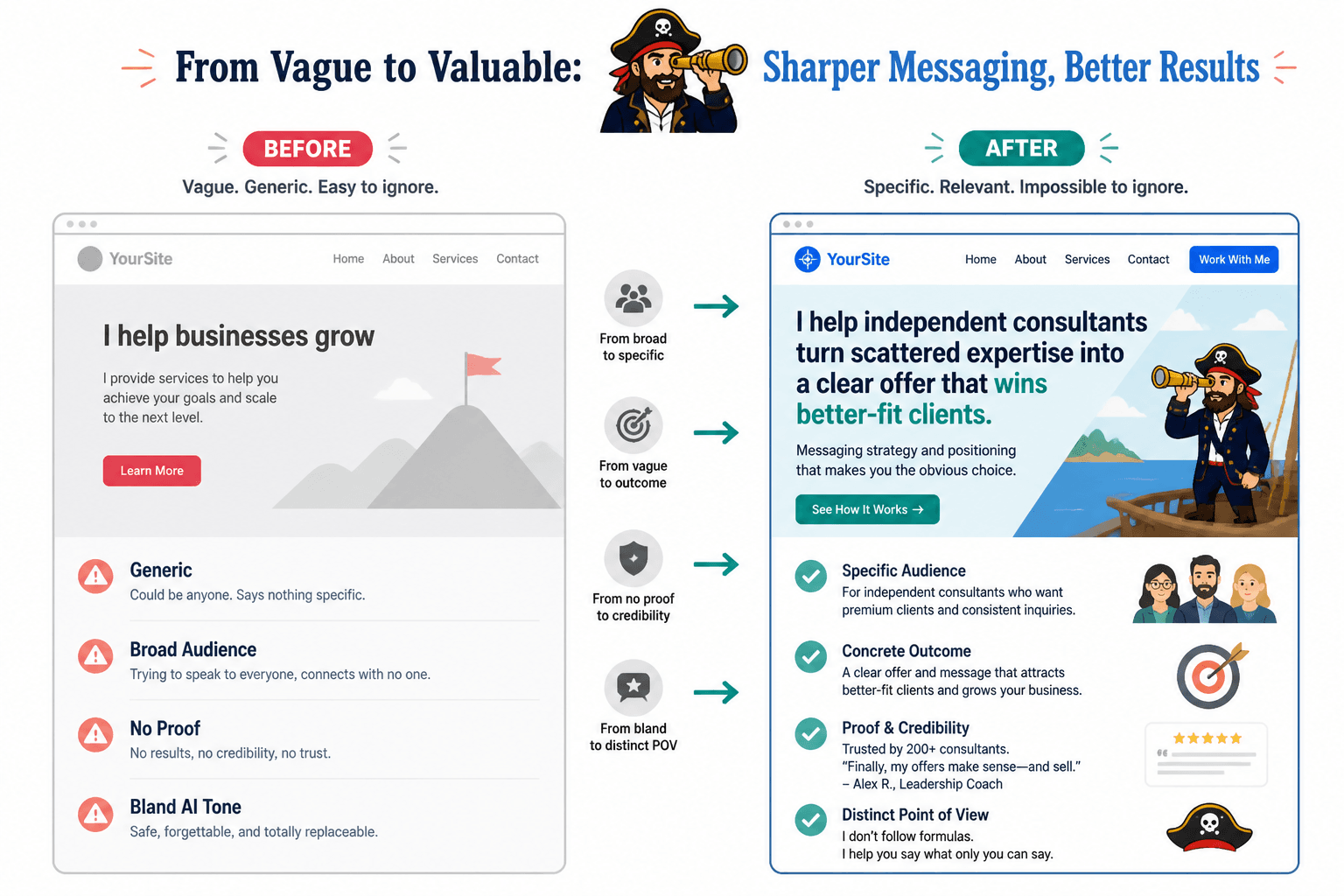
Here is a rough before and after to show how the pieces work together.
The bigger point is simple: clearer structure and clearer writing make the piece more useful. That is usually what makes the ending land better too.