
Most sales pages do not sound “salesy” because they are trying to sell.
They sound salesy because they are trying too hard to compensate for weak thinking. So they pile on hype, fake certainty, inflated promises, vague pain points, and copy that sounds like it was stitched together from 400 tired templates and one mildly aggressive webinar.
And robotic? That usually happens when the writer is so focused on “conversion” that they forget an obvious detail: a real person has to read this thing without wanting to leave.
If you want to learn how to write sales pages without sounding salesy or robotic, the fix is not “be less persuasive.” It is to be more specific, more honest, better structured, and much more grounded in what your reader actually needs to see before they trust you.
That means clearer claims. Better proof. Less posturing. Fewer drama-soaked declarations about “finally stepping into the life you deserve.”
Here is how to write a sales page that still sells, but sounds like a smart human with a useful offer instead of a funnel bot wearing borrowed confidence.
For the main guide behind this topic, visit the parent guide.
Why sales pages start sounding bad in the first place
Bad sales copy usually comes from one of four problems:
- The offer is not clear, so the copy gets fluffy
- The writer does not trust the offer, so they overcompensate with hype
- The audience is vaguely defined, so everything sounds generic
- The page is based on “sales page best practices” instead of actual buyer psychology
This is why so many pages end up sounding like they were assembled from the same box of stale phrases:
- “Imagine waking up every day feeling aligned…”
- “This proven framework will transform your business…”
- “Spots are limited…”
- “If you are ready to invest in yourself…”
None of that is persuasive on its own. It is just familiar. And familiar copy is often mistaken for effective copy because people have seen it a lot. That is not the same as trusting it.
A good sales page does not need to perform persuasion theatrically. It needs to reduce doubt, answer questions, show relevance, and make the next step feel sensible.
That is a very different job.
Start with a real promise, not a dramatic one
If your headline sounds like it belongs on a motivational poster, you are already in trouble.
The strongest sales page promises are specific enough to be believable and useful enough to matter. They do not need to scream. They need to land.
Weak promise
Transform your brand and unlock effortless growth with my signature method.
Stronger promise
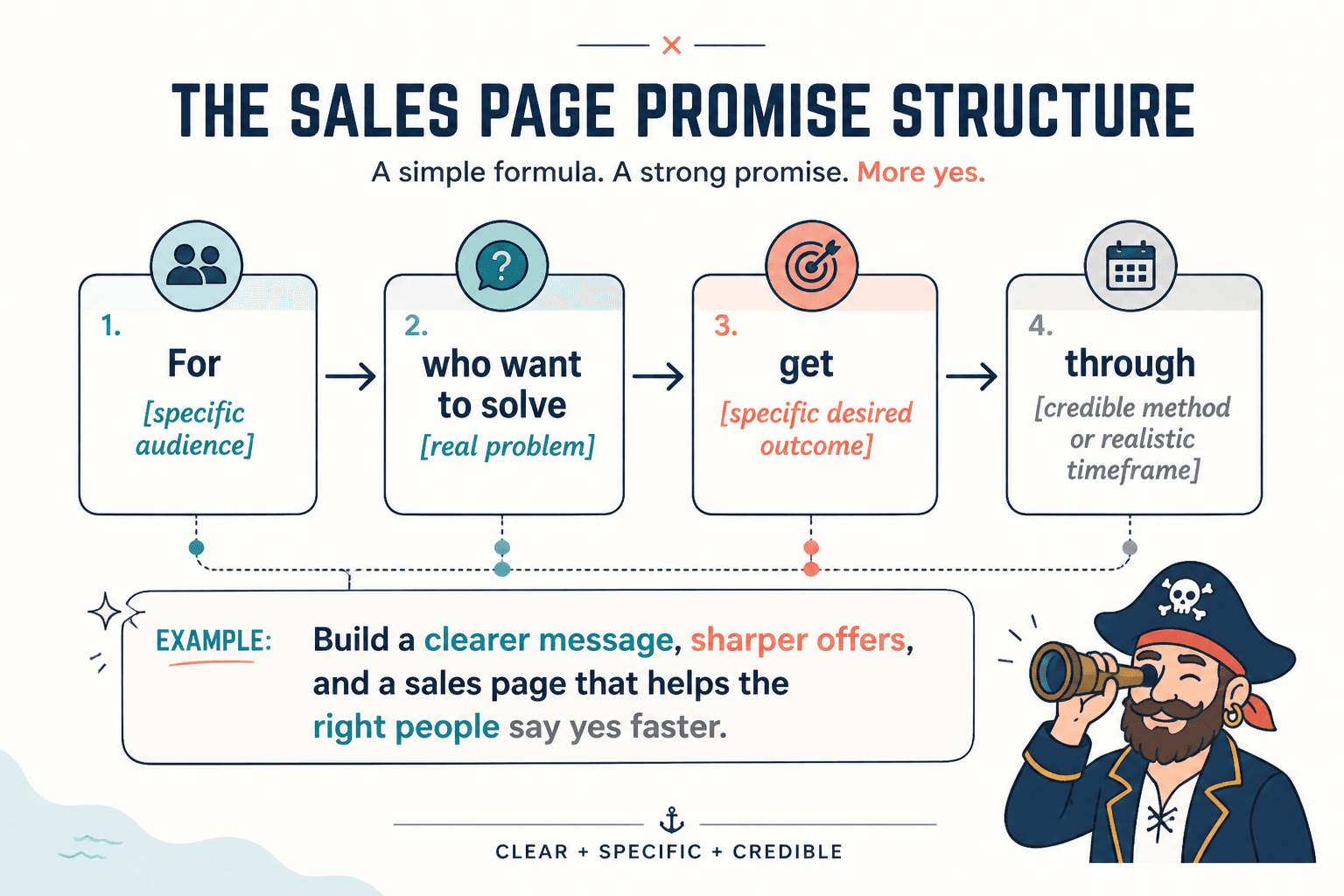
Build a clearer message, sharper offers, and a sales page that helps the right people say yes faster.
See the difference? The second one gives the reader something they can picture. It sounds like a person who knows what the work actually involves.
If you are stuck, pressure-test your main promise with these questions:
- Can the reader understand it in one read?
- Does it describe an outcome they actually want?
- Is it specific enough to feel credible?
- Would I say this out loud to a prospect without cringing?
If not, the promise needs work before the rest of the page does.
Write like you are clarifying, not performing
One of the fastest ways to make a sales page sound robotic is to write as if “sales page voice” is a separate language.
It is not. It is still just writing. The goal is not to become more polished than a human should reasonably sound. The goal is to become easier to trust.
That usually means writing with slightly more precision and structure than you would in conversation, but not with a totally different personality.
What this looks like in practice
| Sounds robotic | Sounds human and clear |
|---|---|
| Our proprietary system empowers ambitious professionals to achieve meaningful results. | This process helps consultants tighten their message, improve their sales page, and convert more of the traffic they already have. |
| You will receive a transformational experience unlike anything else on the market. | You will leave with a stronger offer, sharper copy, and a page that is much easier for buyers to say yes to. |
| If you are truly ready to step into your next level, this is for you. | If your offer is solid but your page still feels vague, flat, or too polished to trust, this is probably a fit. |
Notice what changed:
- Less abstract language
- More concrete outcomes
- Fewer inflated claims
- More buyer-relevant detail
Good sales pages are not less persuasive because they sound normal. They are more persuasive because they do.
Talk to the right reader, not to “everyone who might buy”
Generic pages sound robotic because they are written for imaginary crowds.
When you are afraid to exclude anyone, you end up describing no one in a meaningful way. Then the copy fills the gap with broad statements that technically apply to lots of people and emotionally convince none of them.
Instead of trying to sound universally relevant, aim for specific recognition.
Too broad
This offer is for entrepreneurs who want to grow their business and make a bigger impact.
Better
This is for coaches, consultants, and service providers with a real offer, some audience traction, and a sales page that still reads like it was written to avoid making a clear point.
The second version does a few useful things at once:
- It names the audience
- It hints at stage of business
- It defines the problem sharply
- It creates recognition without melodrama
Your reader should feel a small jolt of, “Yes, this is about me.” Not a vague spiritual fog of possibility.
Use pain carefully or you will sound manipulative fast
A sales page should absolutely address pain points. But there is a difference between naming friction and emotionally mugging the reader.
Too many pages take a normal business problem and write about it like a disaster film. Suddenly a weak homepage is “silently stealing your dream life,” and a clunky offer description is “keeping you trapped in a cycle of burnout and invisibility.” Relax.
You do not need to intensify the problem beyond recognition. You need to describe it clearly enough that the reader feels understood.
Overcooked pain point
You are exhausted, overwhelmed, underpaid, and stuck in a soul-crushing cycle of content chaos.
Useful pain point
You have an offer people want, but your sales page still makes them work too hard to understand why it is worth buying.
That is the sweet spot. It names a real problem without sounding like you are trying to trigger a breakthrough in aisle four.
Make your page do the job of trust, not just persuasion
People do not buy because a page “sounds convincing.” They buy because the page helps them believe four things:
- This is for me
- This solves a problem I actually care about
- This person seems credible
- This feels worth the cost and next step
Most robotic copy skips straight to “buy now” language before the page has done enough to support those beliefs. That is why the whole thing starts to feel pushy. It is asking for commitment before earning confidence.
A better sales page builds trust in sequence.
A simple trust-building flow
- Open with a clear promise people can understand fast
- Name the problem accurately without melodrama
- Explain the offer simply and what is inside
- Show proof that this works or has worked
- Handle objections before they become silent drop-offs
- Present the CTA clearly without pressure-theater
If your page is not converting, the issue is often not that it is too soft. It is that it is trying to close before it has built enough clarity and trust.
For a deeper look at stronger structure, see how to write better sales pages and the broader sales pages content hub.
Replace vague claims with proof that feels real
Nothing makes a page sound more like generic sales machinery than unsupported claims.
If you say your offer is powerful, proven, transformational, high-converting, or results-driven, the reader will immediately ask one fair question: according to whom?
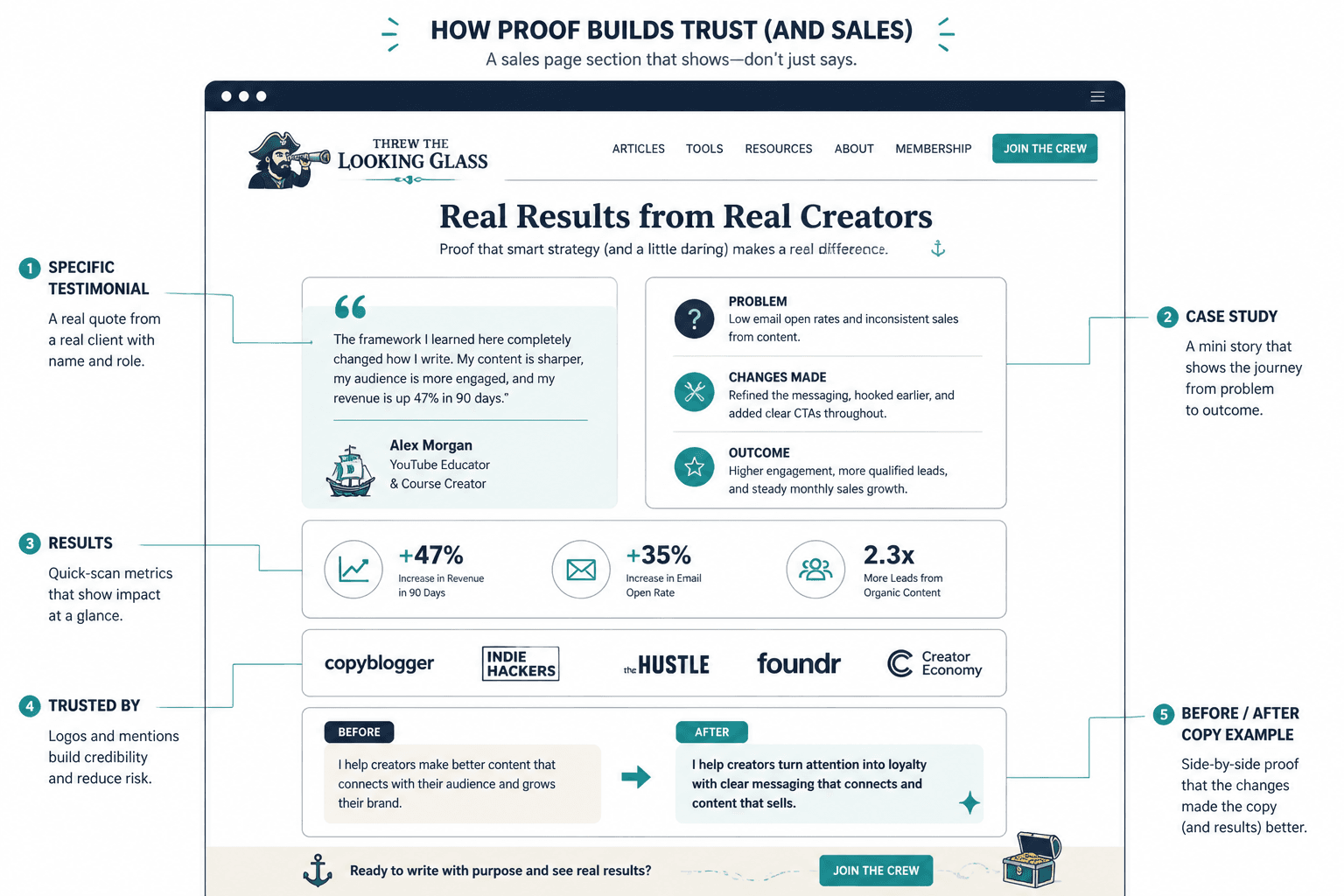
You do not always need giant testimonials or dramatic case studies. But you do need something more useful than adjectives complimenting themselves.
Proof can look like this
- Specific client outcomes
- Before-and-after examples
- Short testimonials with detail
- Process transparency
- Why your method works differently
- Examples of what changed after implementation
For example, compare these two lines:
My clients get incredible results.
Clients usually come in with pages that sound polished but vague. We tighten the offer, rewrite the opening, sharpen proof, and make the CTA easier to act on. That usually improves both inquiry quality and conversion clarity fast.
The second one is stronger because it shows what “results” actually means in context.
If your proof section still sounds like every testimonial was written under gentle duress, read how to improve sales pages proof sections without sounding generic.
Stop writing CTAs like an internet marketer from 2018
Your CTA does not need to sound like it is trying to corner someone near the checkout aisle.
Pushy CTA copy is one of the main reasons sales pages start sounding fake. Not because directness is bad, but because artificial urgency and emotional manipulation are easy to spot.
Weak CTA styles
- Ready to finally step into your next level?
- Claim your spot before it is gone forever
- If you are serious about success, join now
Better CTA styles
- If you want a sales page that sounds clearer, sharper, and more credible, you can book here.
- If this fits where your business is right now, apply for the program here.
- Read through the details, and if the approach makes sense for you, the next step is below.
These work better because they are direct without sounding needy. They do not bully the reader into proving their ambition. They just make the next step clear.
And yes, urgency can still work when it is real. A deadline, limited capacity, cohort start date, or seasonal offer can all be legitimate. Just do not fake scarcity because some old launch template told you to. Readers can smell that from orbit.
Use structure to reduce friction
Sometimes a page sounds robotic not because of the words, but because the structure is clumsy. It asks readers to work too hard.
A strong sales page flows. It answers the next question at the moment the reader is likely thinking it.
A clean sales page structure that usually works
- Headline with a believable promise
- Short opening that sharpens the problem
- Offer overview
- Who it is for and who it is not for
- What is included
- Benefits tied to real outcomes
- Proof and examples
- Objection handling
- Pricing or application details
- Clear CTA
This is not the only valid structure, but it works because it follows buyer logic instead of copywriter ego.
If your opening is weak, bloated, or trying to warm up for three paragraphs before saying anything, read how to start sales pages without a weak opening.
Keep personality, but do not turn the page into a performance
People often hear “sound human” and swing too far in the other direction. Now the sales page is full of winky asides, overdone irreverence, and paragraphs clearly trying to prove the brand has a personality.
Personality helps when it supports clarity. It hurts when it distracts from the offer.
A little edge is fine. A little dryness is fine. A sharp line here and there can make the page feel alive. But the point is still to help someone understand, trust, and act.
Think of voice as seasoning, not the meal. Nobody wants to chew a tablespoon of paprika.
A simple rewrite process for salesy or robotic copy
The bigger point is simple: clearer structure and clearer writing make the piece more useful. That is usually what makes the ending land better too.
The bigger point is simple: clearer structure and clearer writing make the piece more useful. That is usually what makes the ending land better too.