
Most X threads do not fail because threads are dead, the algorithm is cruel, or people suddenly lost the ability to read more than one post.
They fail because the first post is weak, the structure is mushy, and the writer confused “more posts” with “more value.” A thread is not automatically useful just because you broke it into 12 parts.
If you want better results from X threads, you need three things: a sharper promise, a cleaner sequence, and a payoff that actually earns the reader’s time. That is what this X Threads Guide for Creators Who Want Better Results is here to fix.
We’re going to cover what makes a thread work, what usually tanks it, how to structure one without sounding like a “build in public” clone, and how to write threads that get attention without turning into a 17-post hostage situation.
For the broader learning path, visit our parent guide.
What an X thread is actually good for
X is better at sharp, compact ideas than long explanations. That is obvious. But there are still plenty of times when one post is not enough.
A thread works when you need a sequence. Not just more space. A sequence.
Good threads help you do one of these things:
- Walk someone through a process
- Make an argument step by step
- Break down examples
- Tell a story with momentum
- Teach something with enough context to be useful
- Turn one strong idea into a guided reading experience
Bad threads, on the other hand, are usually just bloated posts wearing a “thread” costume. They repeat themselves. They hide the point. They save the useful part for post 11 like readers owe them rent.
If one post can say it cleanly, write one post. If the idea improves when each post logically pulls the reader into the next, write a thread.
That one decision alone will save you from a lot of thread bloat.
The real job of the first post
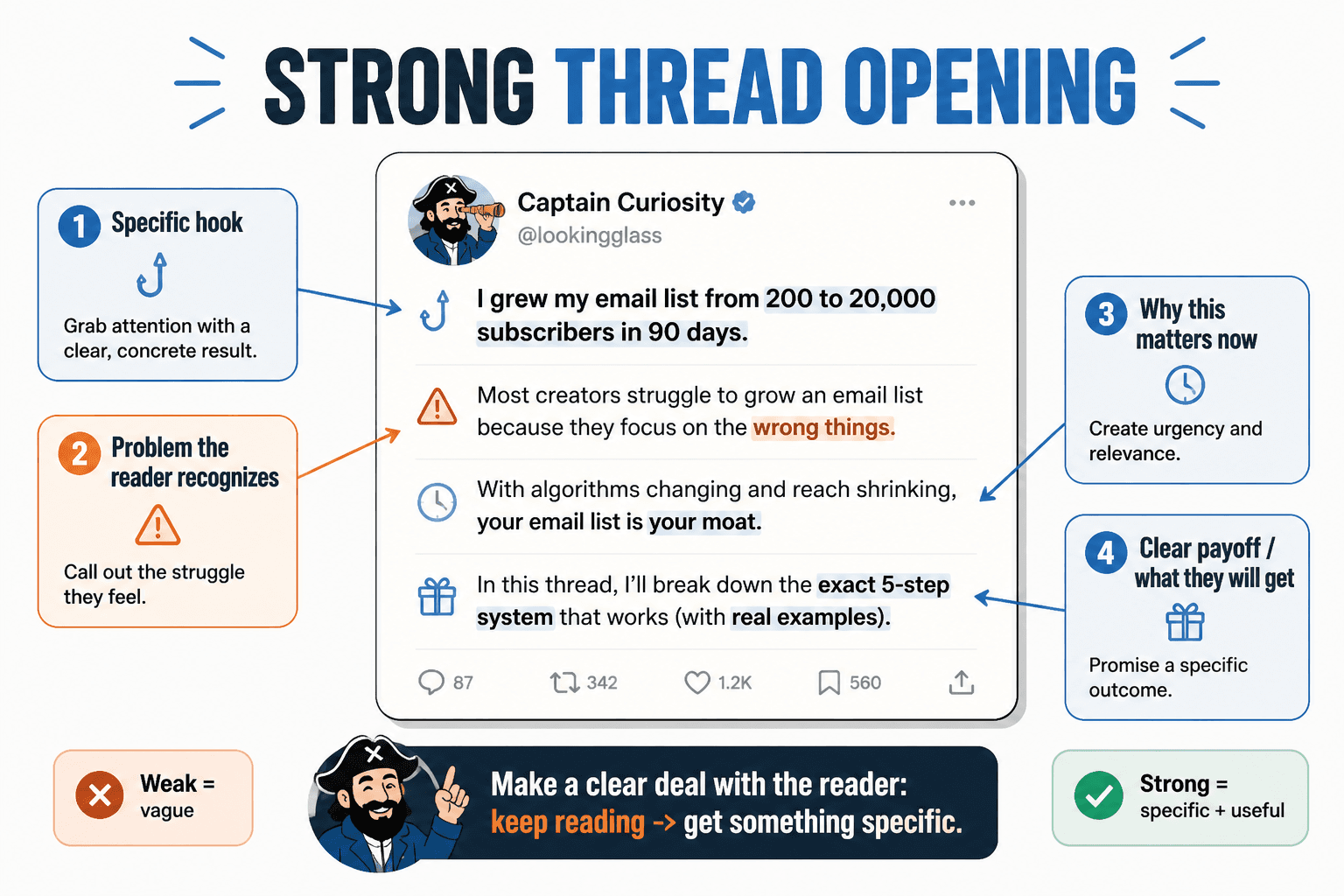
The first post does not need to be mysterious. It needs to make a credible promise.
On X, people decide fast. Your opening post has to answer some version of: why should I keep going?
The best thread openings usually do at least two of these things:
- Name a specific problem
- Promise a useful outcome
- Signal clear relevance to the right audience
- Create tension or contrast
- Hint at structure or proof
That does not mean you need clickbait drama. It means you need a point.
Weak thread hooks vs stronger ones
Weak: Here are some thoughts on content creation.
Stronger: Most creators do not need more content ideas. They need 5 repeatable thread formats that do not collapse after post 3.
Weak: A thread on building your brand.
Stronger: If your content sounds smart but nobody remembers you, your personal brand probably has a positioning problem. Here’s how to fix it on X.
Weak: 10 lessons from my journey.
Stronger: I reviewed 100+ creator posts that got ignored. The pattern was not “bad writing.” It was weak packaging. Here are 10 fixes that actually matter.
A good opening post does not try to sound wise. It makes a clean deal with the reader: keep reading, and you will get something specific.
A simple structure for X threads that do not wander off
Most creators do better with structure than with “creative freedom.” Not because they lack ideas. Because X punishes drift.
Here is a simple thread structure that works for educational, strategic, and opinion-led threads.
- Hook: make a specific promise
- Context: frame the problem quickly
- Main points: one idea per post
- Examples or proof: make it real
- Wrap-up: land the point
- Next step: give the reader one clear action
That’s it. Not glamorous, but very useful.
What “one idea per post” actually means
One post in a thread should not try to explain three sub-points, a life philosophy, and a side note about authenticity. That is how readers start skimming and then vanish.
Each post should do one job. Make one point. Add one useful example. Create one turn in the argument. If a post feels crowded, split it or cut it.
The thread should feel like guided momentum, not a pile of related notes.
A quick structure example
Say your topic is thread writing itself.
- Post 1: Promise the reader a practical framework for better threads
- Post 2: Explain why most threads fail
- Post 3: Cover what a strong opening does
- Post 4: Explain one idea per post
- Post 5: Show how examples increase retention
- Post 6: Explain how to end without a limp CTA
- Post 7: Wrap the lesson and point to a useful next step
That sequence moves. It earns attention. It has shape. That matters more than squeezing the thread to a magical number of posts.
How long should an X thread be?
There is no holy number. Sorry to everyone selling certainty in neat little carousels.
The right length depends on the idea, the goal, and how much proof or explanation is needed. But practical ranges help.
| Thread type | Useful range | Best for |
|---|---|---|
| Quick tactical thread | 5–8 posts | Tips, frameworks, short lessons |
| Educational thread | 7–12 posts | Explaining a process or concept clearly |
| Story thread | 6–15 posts | Case studies, narrative lessons, breakdowns |
| Deep authority thread | 10–18 posts | Detailed arguments, advanced strategy, proof-heavy ideas |
If your thread needs 20+ posts, ask yourself a rude but helpful question: is this a thread, or did you just avoid writing an article?
Long threads can work. But they need pace. If every post feels equally weighted and equally wordy, the thing starts dragging fast.
The 5 thread formats creators can keep reusing
You do not need a new structure every time. Reusable formats make content easier to produce and easier for readers to follow.
1. The mistake-to-fix thread
Start with the common mistake, then unpack what to do instead.
Good for: writing advice, positioning, content strategy, audience growth, conversion mistakes.
Basic flow: mistake → why it fails → better approach → examples → takeaway.
2. The process thread
Walk readers through a repeatable system step by step.
Good for: workflows, research methods, writing systems, client onboarding, content planning.
Basic flow: promise → step 1 → step 2 → step 3 → pitfalls → CTA.
3. The breakdown thread
Analyze an example, strategy, campaign, post, profile, or piece of content.
Good for: showing expertise without chest-thumping about your genius.
Basic flow: what you’re breaking down → what works → what fails → lessons → how to apply it.
4. The story-with-a-point thread
Tell a story, but do not just narrate events. Build to a lesson worth stealing.
Good for: client transformations, personal turning points, business experiments, content tests.
Basic flow: setup → tension → turning point → lesson → practical takeaway.
5. The opinion thread
Lead with a clear point of view, then support it with reasoning.
Good for: standing out, attracting aligned readers, shaping your brand voice.
Basic flow: opinion → why most people get it wrong → evidence or logic → what to do instead.
If you want more specific formats, examples, and prompts, read Best X Threads Ideas and Examples for Creators and Simple X Threads Story Threads Templates for Busy Creators.
Why many threads feel boring even when the advice is good
This part matters because a lot of creators are not short on expertise. They are short on packaging.
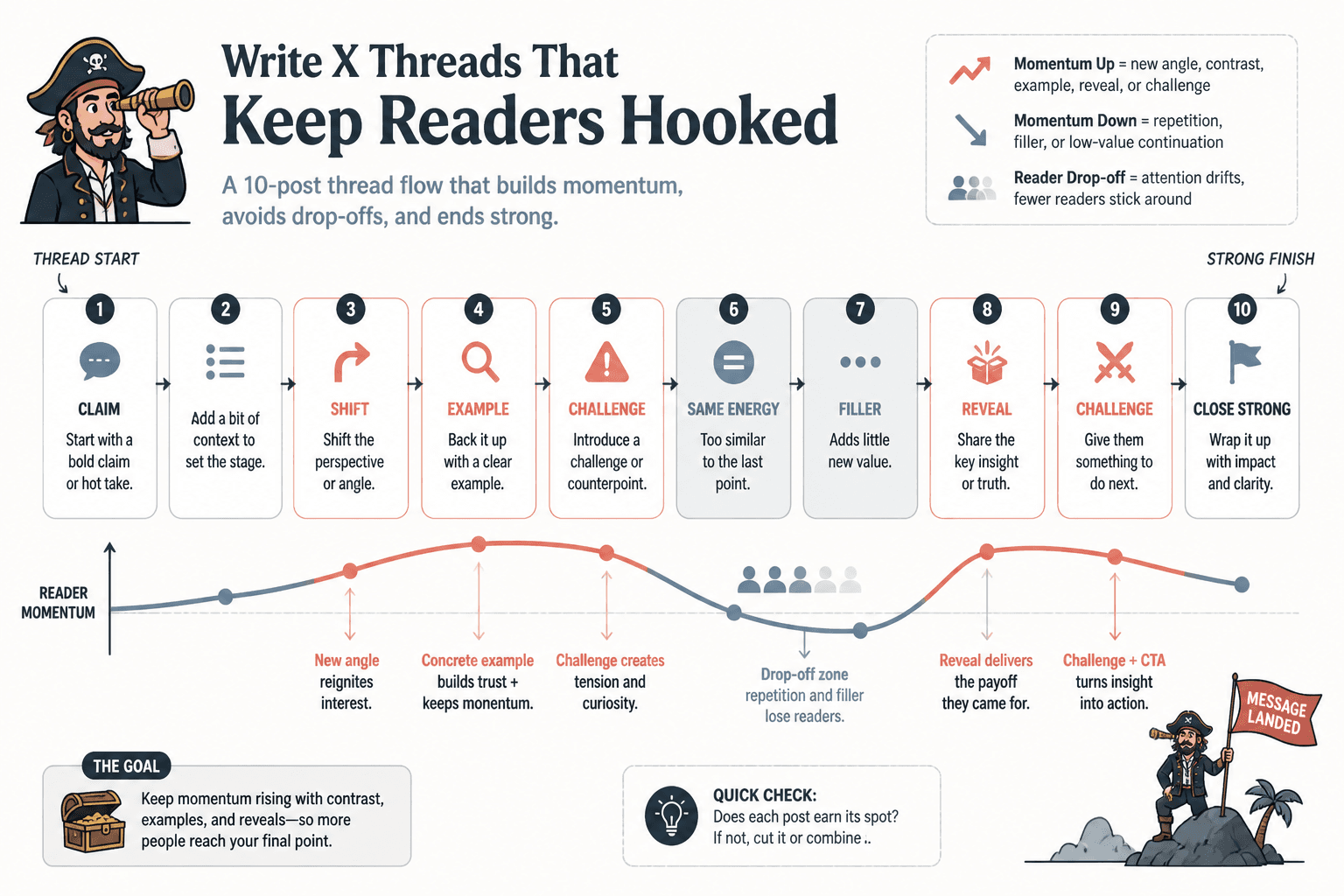
A thread becomes boring when it does any of these:
- Takes too long to get specific
- Repeats the same point in slightly different words
- Uses vague claims instead of examples
- Sounds like polished business mush
- Has no rhythm or tension
- Front-loads filler and hides the useful part later
One of the easiest fixes is adding contrast. Contrast creates movement.
- What people think vs what actually works
- Bad example vs better rewrite
- Old approach vs updated approach
- Popular advice vs practical reality
Threads become more readable when each post makes a distinct move. A claim. A shift. An example. A challenge. A reveal. Something.
If every post has the same energy, readers drift. Not because they are shallow. Because the thread has no pulse.
How to write an X thread faster without making it worse
Speed matters. Not because you should churn out content like a haunted factory, but because overcooking often makes threads flatter.
Here is a faster process that still produces clean threads.
- Start with the point. What is the one thing this thread helps the reader understand, do, or avoid?
- Write the opening post. Make the promise specific.
- List 5–10 supporting points. One line each.
- Put them in logical order. Not the order they occurred to you.
- Add one example, contrast, or proof point every few posts.
- Trim overlap. Threads get bloated when posts are doing the same job.
- Write the ending. Land the point and suggest one next action.
This is also where tools can help. Drafting, outlining, repurposing, and organizing thread ideas? Very useful. Replacing taste, point of view, and audience understanding? Not happening.
If you want practical options, workflows, and tool categories, check Best Templates and Tools for X Threads.
Examples of thread endings that do not feel cheap
A lot of endings ruin decent threads. The advice is solid, then the final post lurches into “follow me for more value” like a robot intern grabbed the keyboard.
Your ending should match the thread’s purpose.
If the goal is engagement
Ask for a specific response, not a lazy one.
Weak: Thoughts?
Better: Which part of your thread writing breaks first: the hook, the structure, or the ending?
If the goal is authority
Land the point cleanly.
Example: The best threads do not feel long. They feel inevitable. Each post earns the next one.
If the goal is traffic or conversion
Point readers to a relevant next step without pretending the thread was not leading there.
Example: If you want more thread formats you can steal and adapt, I’ve put together a fuller breakdown here: X Threads.
The ending should feel like a continuation, not a bait-and-switch.
The mistakes that quietly wreck thread performance
These are the common ones.
- Weak first post: no clear promise, no reason to continue
- No sequence: points are decent but arranged randomly
- Too many ideas: the thread tries to teach everything at once
- No examples: all claims, no texture
- Thread bloat: 14 posts that should have been 6
- Generic language: smart-sounding sentences that say very little
- Soft ending: no landing, no next action, no memorable final note
And here is the sneaky one: writing for imaginary virality instead of real readers.
When creators chase virality too hard, they start flattening nuance, overselling bland points, and writing hooks that promise more than the thread delivers. You might get clicks. You will not build much trust.
Better results come from being clear, useful, and distinct often enough that the right people start recognizing your work.
X threads for small creators: what matters more than reach
If your audience is still small, do not copy giant accounts with giant momentum and giant margins for nonsense.
Smaller creators get more from threads when they focus on relevance over spectacle.
- Write for a specific type of reader
- Use examples from your actual work or observations
- Make the thread practical enough to save
- Pick angles bigger accounts often ignore because they are too broad
- Start conversations in replies after posting
A smaller but relevant audience can do a lot for you if the content is useful and memorable. A giant audience of random drive-by readers who liked one spicy hook and forgot you by lunch is less impressive than it looks.
For more on that, read X Threads for Creators with Small Audiences.
A practical thread template you can adapt today
Here is a flexible template that works for many creator, coach, consultant, and solo founder topics.
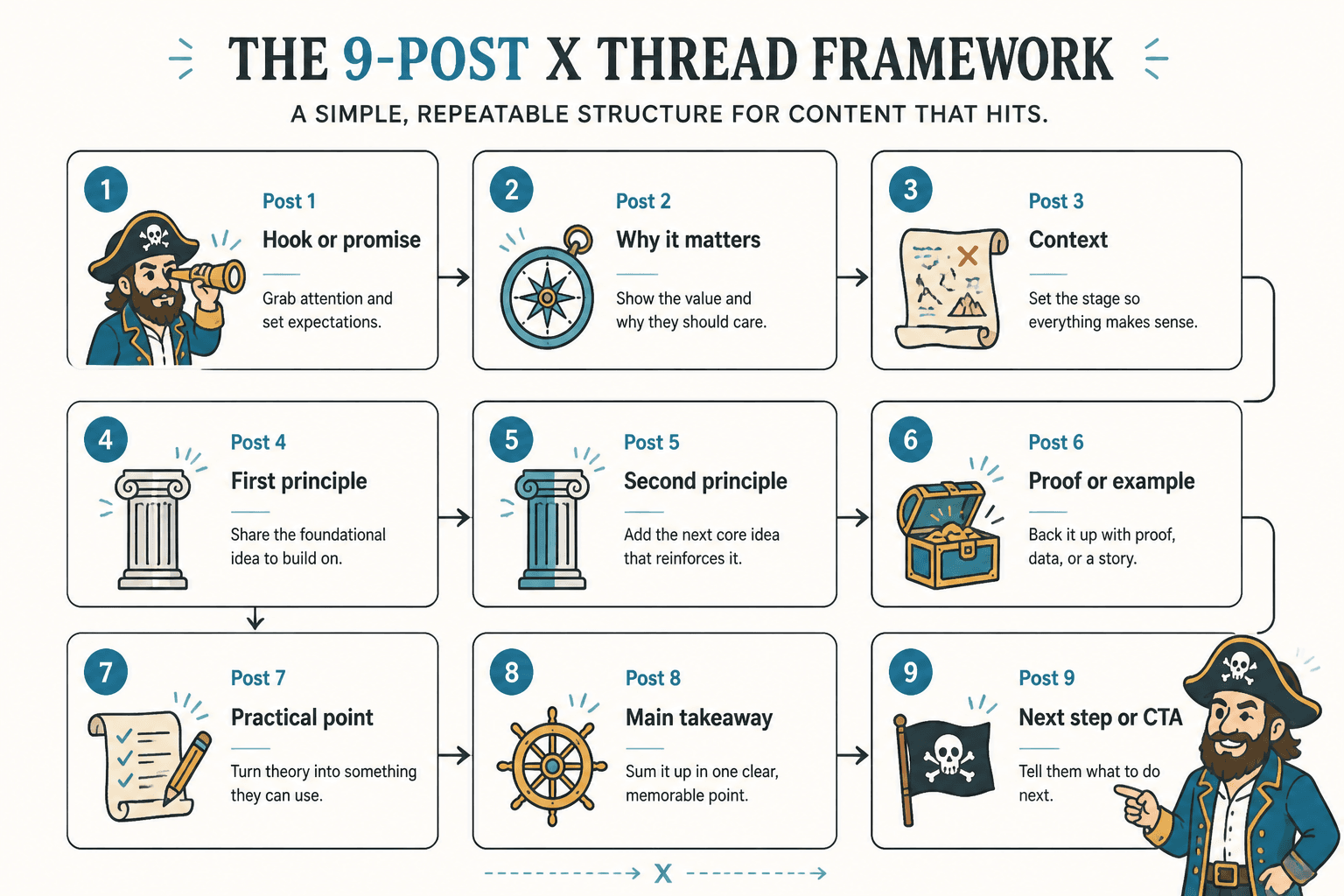
Thread template: teach one useful shift
- Post 1: Name the problem and promise the shift
Example: Most creators do not need more ideas. They need a better way to turn one idea into a thread people actually finish. - Post 2: Explain the common mistake
Example: The usual mistake is stuffing 8 half-developed ideas into one thread and calling it value. - Post 3: Reframe the issue
Example: A strong thread is not a list. It is a sequence. - Post 4: Introduce the first principle
Example: Start with a first post that makes a clear promise. - Post 5: Introduce the second principle
Example: Give each post one job. - Post 6: Add proof or example
Example: Compare a vague opening with a stronger rewrite. - Post 7: Add another practical point
Example: End before the thread gets repetitive. - Post 8: Land the lesson
Example: Better threads are usually tighter, clearer, and more specific than people expect. - Post 9: Give the next step
Example: If you want more plug-and-play thread formats, grab the related guide.
This works because it teaches one useful shift instead of trying to become the encyclopedia of thread writing in a single post chain.
Where this article fits if you want to go deeper
If you are building out your X writing system, these related pieces will help:
- Social media writing and X writing resources
- X Threads hub
- Best X Threads Ideas and Examples for Creators
- Simple X Threads Story Threads Templates for Busy Creators
- Best Templates and Tools for X Threads
- X Threads for Creators with Small Audiences
FAQ
How many posts should an X thread have?
Usually 5 to 12 is a strong practical range. Go longer only if the idea genuinely needs it and the pacing holds.
Do X threads still work for creators?
Yes, if they are specific, structured, and useful. Bad threads underperform. That is not the format’s fault.
Should every creator use threads?
No. Use them when the idea needs sequence, explanation, story, or proof. Some ideas are better as a single post.
What makes people stop reading a thread?
Weak hooks, repetition, vague claims, no examples, and posts that feel disconnected from each other.
Should a thread end with a CTA?
Often, yes. But keep it relevant and light. A clear next step works better than a needy sales shove.
Final thought
The bigger point is simple: clearer structure and clearer writing make the piece more useful. That is usually what makes the ending land better too.
Threads usually land better when each step builds cleanly and the ending makes the whole point feel worth the read.