
Most website bio copy fails in one of two ways.
It either reads like a dry corporate hostage note, or it swings hard in the other direction and becomes a vague cloud of “I help ambitious humans step into alignment” with no real clue what the person actually does.
That is the problem with a lot of Bio & Profile Copy for Websites Examples for Coaches, Consultants, and Personal Brands. The examples sound polished, but they are not useful. They tell you how to sound impressive, not how to sound clear, credible, and worth contacting.
If your website bio has to do any work at all, and it does, it needs to answer a few basic questions fast. Who are you for? What do you help with? Why should anyone trust you? And what should they do next?
This article will show you how to write website bio and profile copy that does not feel robotic, puffed-up, or weirdly self-important. You’ll get examples, simple structures, and rewrites you can steal and adapt for your own site.
If you want the bigger picture first, start with this main guide on bio and profile copy for websites. If not, keep going. We’re fixing the actual words.
For the main guide behind this topic, visit the parent guide.
What good website bio and profile copy actually needs to do
A bio is not there to win a high school award for Most Professional Sentence Structure.
It has a job. Usually several:
- Build trust quickly
- Position you clearly
- Show relevance to the reader
- Give a reason to keep reading
- Make the next step feel obvious
That means your website bio should not just be about you. It should connect your experience to their decision.
A lot of people miss this and write bios like mini memoirs. Nice for your therapist. Less helpful for the person trying to decide whether to hire you, book you, read your stuff, or trust your recommendation.
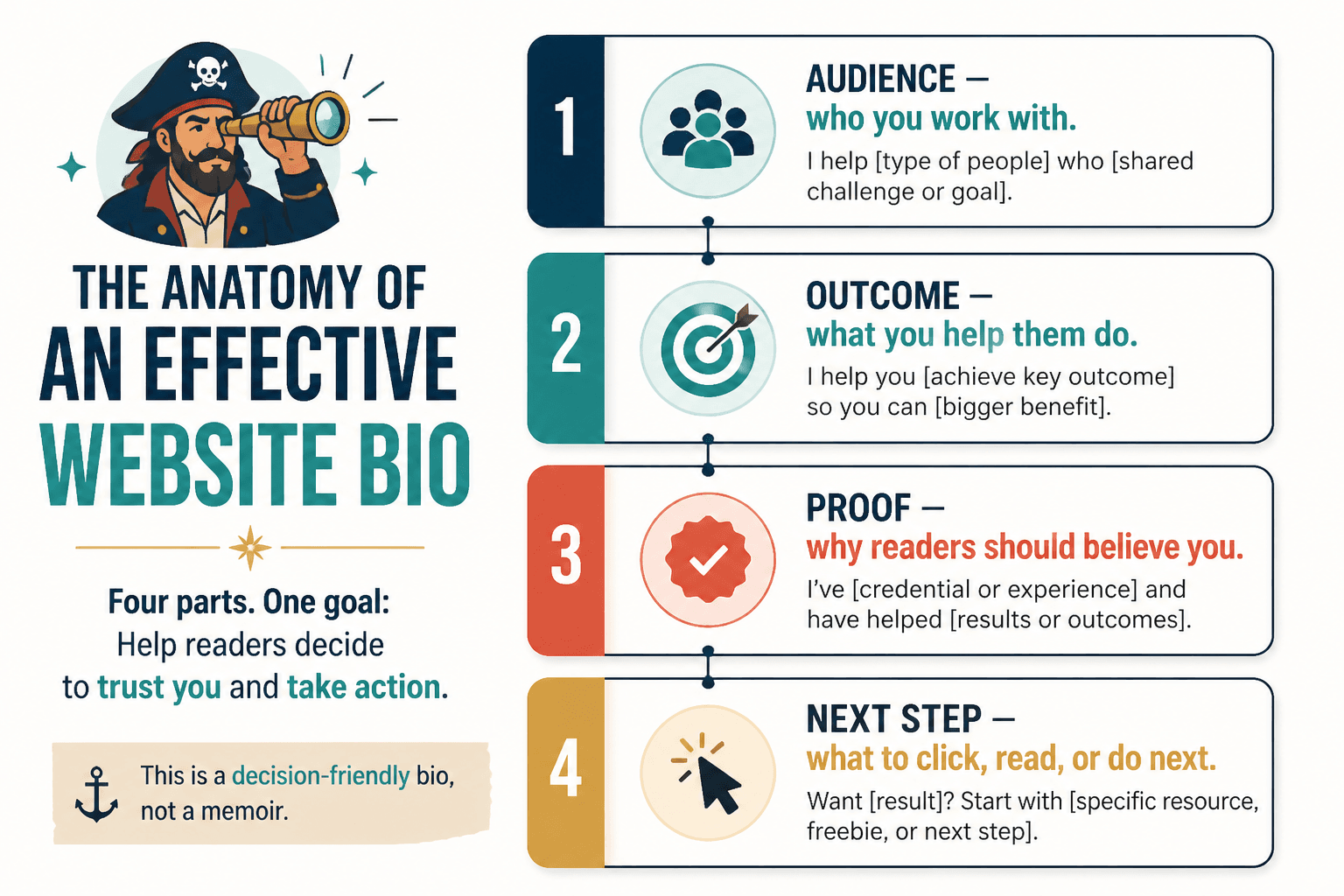
The best bios usually include four things:
- Audience: who you work with
- Outcome: what you help them do
- Proof: why they should believe you
- Direction: what to click, read, or do next
Miss one, and the whole thing gets wobblier than it needs to be.
A simple structure you can use for almost any website bio
If you are staring at a blank page, use this structure:
- Positioning line: who you help and what you help them do
- Credibility line: experience, results, background, or relevant perspective
- Personality line: a light human detail or voice line, if it fits your brand
- CTA line: tell them where to go next
That’s it. Not revolutionary. Just functional. Which is more than can be said for a lot of About pages.
Here is the basic template:
I help [audience] do [specific outcome] without [pain/friction].
I’ve [proof, experience, results, or relevant credibility].
[Optional personality line that sounds human, not random.]
[Clear next step or call to action.]
If you want stronger trust signals, this piece on credibility lines for personal brands will help sharpen the proof part.
Website bio and profile copy examples by type
Now for the useful bit: examples that sound like someone you might actually hire.
Example 1: Business coach
Weak version:
I am a passionate business coach dedicated to helping entrepreneurs unlock their full potential and scale with confidence.
Better version:
I help service-based founders simplify their offers, sharpen their messaging, and sell with less awkwardness. Over the past 8 years, I’ve worked with coaches, consultants, and small agencies who were good at the work but far too vague on the page. If your business sounds smarter in your head than it does on your website, start here.
Why it works: clearer audience, clearer outcome, more believable tone, and an actual pain point. Also, no one “unlocked their full potential,” which is always a nice touch.
Example 2: Leadership consultant
Weak version:
I partner with visionary leaders to create transformational change through customized leadership development solutions.
Better version:
I work with founders and senior teams who need their leadership to stop being the bottleneck. My focus is practical leadership development: clearer communication, better decision-making, and less internal chaos disguised as “fast growth.” I’ve led executive training, advised scaling companies, and built programs that people actually use after the workshop ends.
This version has an opinion, a clear audience, and proof that isn’t trying too hard.
Example 3: Personal brand writer
Weak version:
I help thought leaders amplify their voice with compelling content across multiple digital touchpoints.
Better version:
I help founders, consultants, and personal brands turn half-formed expertise into sharp content people remember. That includes website copy, platform content, and messaging that sounds like a real person instead of a beige content machine. If you know your work is solid but your words are lagging behind, I can help fix that.
Notice how the better version still sounds professional. It’s just not suffocating under fake polish.
Example 4: Health or mindset coach
Weak version:
I guide women on a journey of empowerment, alignment, and holistic transformation.
Better version:
I help high-functioning women who look fine on paper but feel fried in real life rebuild their energy, routines, and capacity without adding another impossible wellness checklist. My coaching combines behavior change, recovery habits, and realistic support for people with actual calendars. If you’re tired of advice that assumes you have three free hours and a Himalayan salt cave, you’ll probably like my approach.
This one is more specific, more vivid, and much easier to trust.
Short bio examples for homepage, sidebar, and about page intros
You do not need the same length everywhere. In fact, using the same chunk of copy across your whole site is lazy and usually less effective.
Here are a few formats you can adapt.
One-line bio
I help consultants turn fuzzy expertise into clear website messaging that earns more trust and better leads.
Two-line bio
I work with coaches, consultants, and personal brands who are good at what they do but far too hard to understand online. Through strategy and conversion copy, I help them sound sharper, clearer, and more worth hiring.
About page intro bio
I help experts explain what they do in a way that sounds credible, human, and commercially useful. Most of my clients do not need better ideas. They need better language for the ideas they already have. My work focuses on messaging, website copy, positioning, and content that makes trust easier to earn.
The key is matching the amount of copy to the moment. A homepage bio should orient. An About page can deepen trust. A sidebar blurb should be quick and clean.
Before-and-after rewrites that fix common bio problems
If your current bio feels off, it’s usually not because it needs “more personality.” That advice gets thrown around too casually. The real issue is often one of these:
- Too vague
- Too self-focused
- Too inflated
- Too generic
- No proof
- No next step
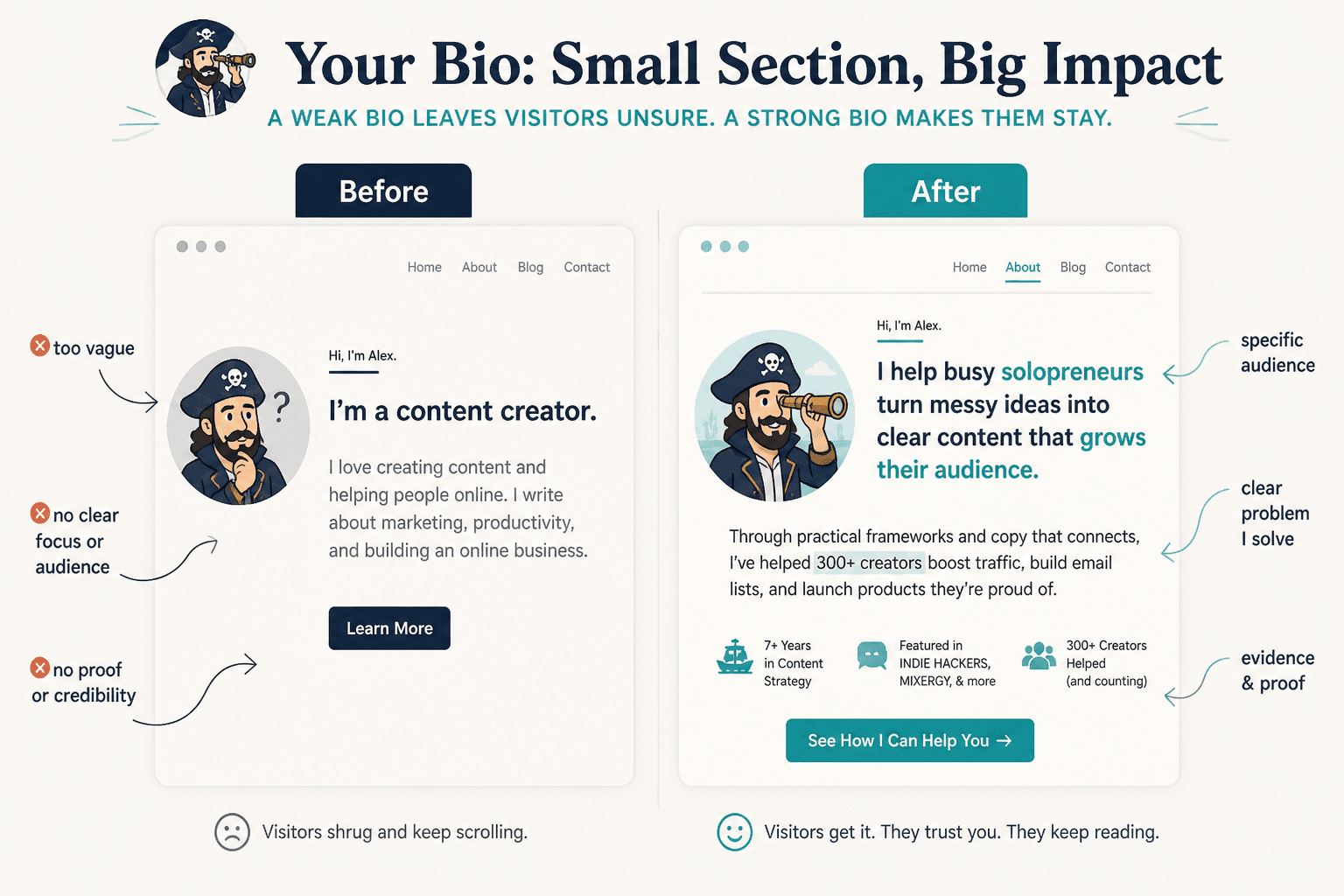
Problem: too vague
Before:
I help people create meaningful change in business and life.
After:
I help independent consultants tighten their offer, pricing, and messaging so they stop sounding experienced but oddly hard to hire.
The second one gives the reader something to grab onto. “Meaningful change” tells us almost nothing.
Problem: too self-focused
Before:
I’m a strategist, speaker, entrepreneur, creator, mentor, consultant, and lifelong learner with a passion for helping others.
After:
I help experts turn scattered ideas into clear offers and stronger marketing. My background spans consulting, strategy, and brand messaging, but the work is simple: make it easier for the right people to understand why you’re worth paying.
Readers do not need your entire identity stack in the first sentence. Pick the parts that help them decide.
Problem: no proof
Before:
I help business owners grow with confidence and clarity.
After:
I help service business owners tighten their messaging and sales path so growth doesn’t depend on random referrals and crossed fingers. I’ve worked with coaches, consultants, and niche service brands to clarify offers, improve conversion copy, and turn more website traffic into actual conversations.
No need to invent giant claims. Just give enough evidence that you are not freestyling.
What coaches, consultants, and personal brands should emphasize differently
These groups overlap, but the strongest website bio and profile copy examples usually reflect slightly different trust triggers.
For coaches
Emphasize:
- Who the coaching is for
- What kind of change you help create
- Your approach or philosophy
- Why your style is different from generic coaching fluff
Do not make it sound mystical unless your audience genuinely wants mystical. A lot of coaching bios drift into soft-focus nonsense because the writer is afraid of being direct.
For consultants
Emphasize:
- Business problem solved
- Relevant expertise
- Type of clients or industries served
- Practical outcomes
Consultant bios usually need a little more proof and precision. People are often buying judgment, not just personality.
For personal brands
Emphasize:
- Clear niche or perspective
- What your content or work helps with
- A bit of voice and identity
- A next step that fits your business model
Personal brand bios can be more voice-driven, but they still need clarity. “Internet person sharing ideas” is not a positioning strategy. It is a hobby description.
If your tone keeps veering too polished or too stiff, this guide on how to write bio and profile copy without sounding salesy or robotic should help.
A practical fill-in framework you can adapt today
Here is a slightly more flexible formula than the usual lifeless templates.
Line 1: I help [specific group] do [specific outcome].
Line 2: My work focuses on [what you actually do or how you help].
Line 3: I’ve [proof, background, results, or relevant credibility].
Line 4: If you want [desired next step], [CTA].
Filled in example:
I help consultants and service-based founders make their websites easier to trust and easier to buy from. My work focuses on positioning, conversion copy, and cleaning up the vague bits that quietly kill leads. I’ve written messaging and site copy for personal brands, niche experts, and online businesses that needed sharper words, not more noise. If that sounds like your website, start with the About page or get in touch.
You can shorten this. You can make it warmer. You can make it more premium. But keep the bones.
Where to place bio and profile copy on your website
Good bio copy is not just for the About page.
You can use variations of it on:
- Homepage intro sections
- About page opening
- Sidebar author boxes
- Service pages
- Contact page trust section
- Lead magnet pages
- Footer profile summary
The trick is not pasting the exact same paragraph everywhere. Adapt it to the page’s job.
On a homepage, keep it quick and directional. On an About page, add more context and perspective. On a service page, tie your bio directly to the service outcome. On a contact page, use it to remove doubt right before action.
If your site is meant to generate leads, not just look respectable, pair your bio copy with a clear next step. This guide on turning bio and profile copy into more leads or sales goes deeper on that part.
Common mistakes that make a website bio weaker than it should be
- Listing too many roles: pick the ones that matter to the buyer
- Using inflated language: “visionary,” “trailblazing,” and “impact-driven” rarely help
- Writing for peers instead of clients: clever is not the same as clear
- Adding personality with random trivia: your coffee order is not a brand strategy
- Forgetting the reader’s problem: your background matters most when it connects to their decision
- No CTA: if they finish reading and stall out, the copy did not finish the job
A quick note on personality, because this gets mangled a lot: yes, your bio should sound human. No, that does not mean stuffing it with quirky filler. Personality is usually better expressed through phrasing, perspective, and confidence than through “fun fact” clutter.
The bigger point is simple: clearer structure and clearer writing make the piece more useful. That is usually what makes the ending land better too.