
Most post CTAs fail for one very simple reason: they ask for the wrong thing at the wrong time.
Personal brands do this constantly. They write a decent post, build a little trust, maybe even land a solid insight, and then close with something like “Book a call,” “DM me for more,” or “Follow for more tips.” Which is a bit like having a normal conversation with someone and ending it by shoving a brochure into their hand.
Better post CTAs for personal brands are not louder. They are better matched. Better timed. Less needy. More specific. They fit the post, the audience, and the level of trust you have actually earned.
If your posts get views but not replies, likes but not leads, or polite attention with absolutely no momentum after the final line, your CTA is probably the leak. Not the only leak, but a very common one.
Here’s how to write post CTAs that feel natural, convert better, and do not make your personal brand sound like it learned sales from an overcaffeinated funnel template.
For the main guide behind this topic, visit the parent guide.
What a post CTA is actually supposed to do
A CTA is not just “the thing at the end.” It is the bridge between attention and action.
That action can be small or large:
- Leave a comment
- Reply with a keyword
- Visit your profile
- Read the next piece
- Join your email list
- Download a resource
- Send a DM
- Book a call
The mistake is treating all of those actions like they require the same amount of trust.
They do not.
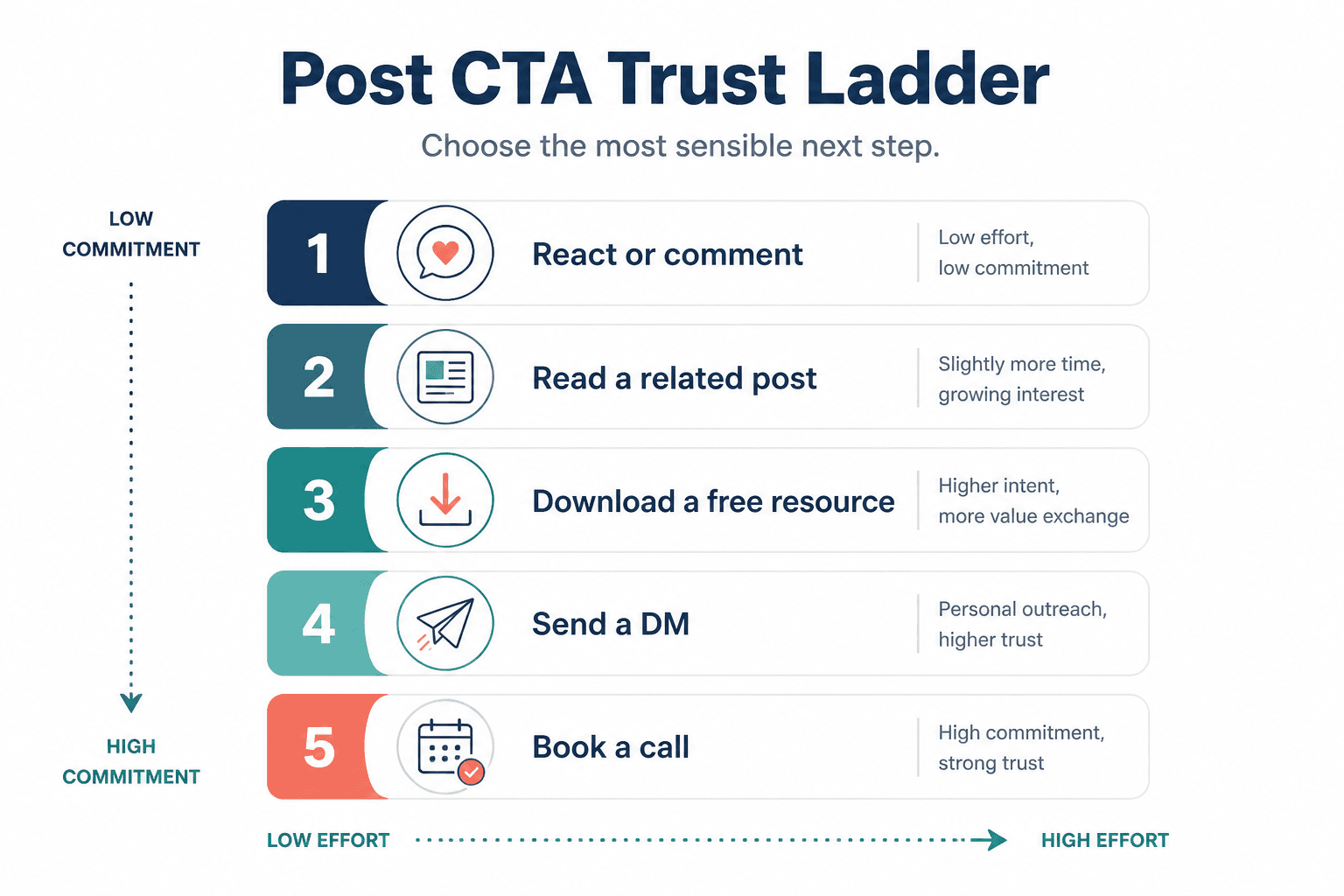
If someone just discovered you through one post, asking them to buy, book, or bare their soul in your DMs is often too much, too soon. But asking them to react to a sharp point, read a related piece, or grab a useful free resource can make complete sense.
So the job of your CTA is not “close harder.” It is to create the most sensible next step.
That sounds obvious. Yet a lot of content still ends like a panicked intern took over for the last sentence.
Why most personal brand CTAs feel awkward
Usually, it is one of these problems:
- The CTA is too generic
- The ask is too big for the post
- The action is unclear
- The CTA does not match the topic
- The wording sounds stiff, automated, or weirdly thirsty
- The post gives value, then the CTA swerves into a hard pitch
For example, if your post is a quick lesson on fixing weak homepage copy, “What do you think?” is lazy. It wastes the momentum. But “If your homepage still opens with vague fluff, start by fixing the first 2 lines” is not a CTA either. That is just another statement.
A useful CTA gives the reader a clear next move and a reason to take it.
Good CTAs do not interrupt the post. They complete it.
Start by matching the CTA to the goal of the post
Before you write the CTA, get clear on what the post is trying to do. Because a trust-building post and a lead-generation post should not end the same way.
Common post goals and better CTA matches
| Post goal | Better CTA direction |
|---|---|
| Start conversation | Ask a specific opinion or experience question |
| Build authority | Invite profile visit, article read, or newsletter signup |
| Generate soft leads | Offer a resource, keyword comment, or DM prompt |
| Sell directly | Use a clear offer CTA, but only if the post earns it |
| Test an idea | Ask for a sharp reaction, not broad feedback |
| Nurture existing audience | Point them to a related post, framework, or next step |
This is where better post CTAs for personal brands usually start improving fast. Not with clever wording. With better alignment.
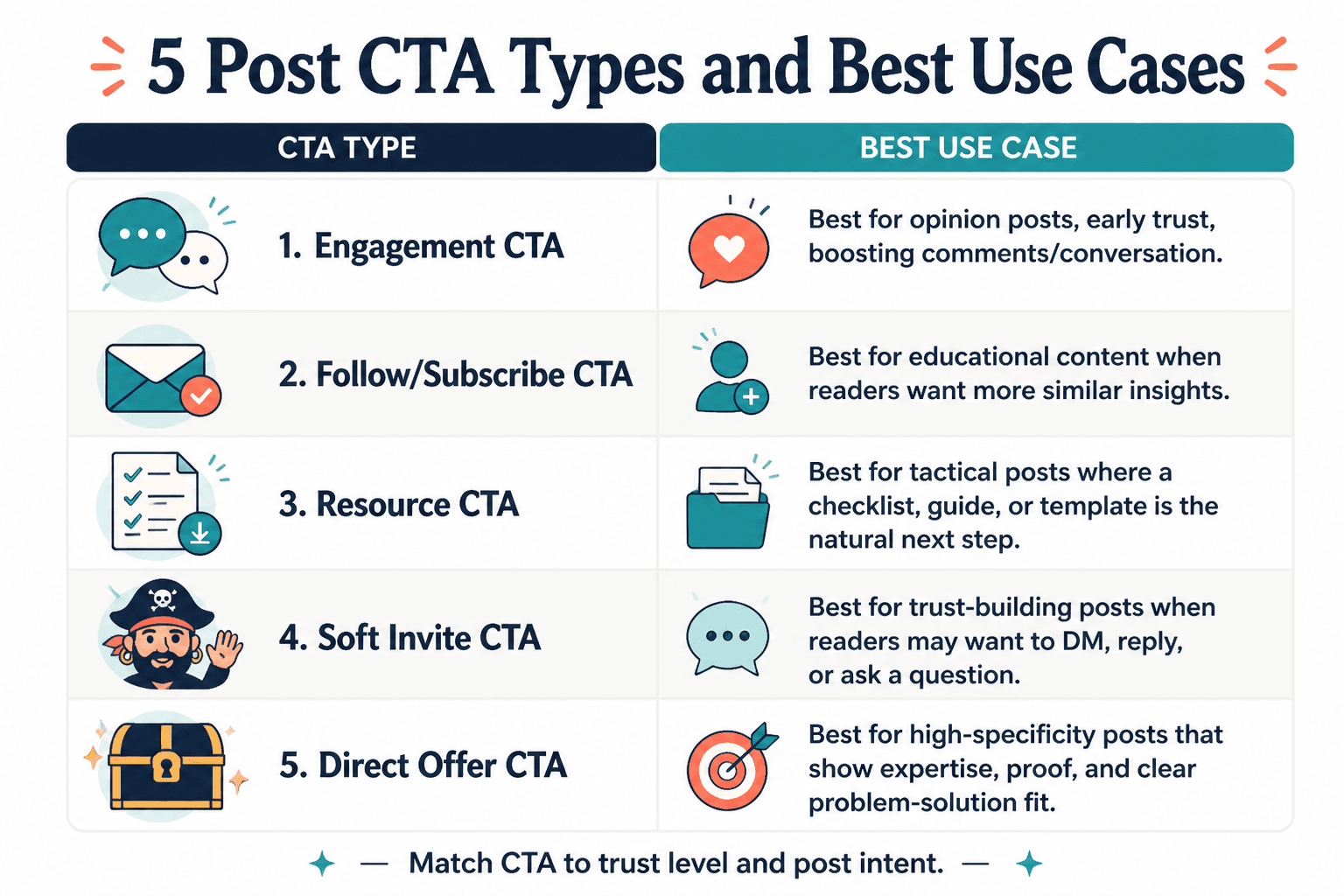
The 5 types of post CTAs personal brands should actually use
You do not need 37 CTA formulas. You need a handful that fit different moments.
1. Conversation CTAs
These are for engagement, feedback, and relationship building. They work best when the question is easy to answer, specific, and connected to the post.
Weak: What do you think?
Better: Which part trips people up more in your experience: the hook or the CTA?
Better: Do you prefer posts that teach one clear point or posts that unpack a full process?
Why it works: It narrows the reply. People can answer fast. And fast answers get more answers.
2. Soft lead CTAs
These invite the next step without turning the post into a mini sales ambush. They are especially useful for coaches, consultants, service providers, and experts with trust-based offers.
Examples:
- If you want the checklist I use for tightening post endings, comment checklist and I’ll send it.
- I’ve got a simple framework for this. If you want it, send me CTA.
- If your posts are useful but the action step keeps falling flat, my guide on how to write better CTA writing will help.
Soft CTAs work because they lower friction. They do not demand a commitment that the reader has not earned yet. If you want more on that, this piece on soft CTAs without sounding generic goes deeper.
3. Profile-path CTAs
Sometimes the smartest CTA is simply guiding attention to your profile, where your positioning, proof, and offer can do their job.
Examples:
- If this is the kind of content you need more of, the rest is on my profile.
- I write about content, conversion copy, and cleaner messaging here every week.
- If your site copy is doing the corporate shrug, start with the resources in my profile.
This works well when the post is strong but not meant to sell directly.
4. Content-bridge CTAs
These move the reader from one piece of content to another. Very underrated. Very useful.
Examples:
- If your CTA wording is the bigger issue, these CTA writing examples for coaches, consultants, and personal brands will save you time.
- If the click is happening but the button copy is weak, here are some button copy examples creators can adapt fast.
- For the broader strategy behind all this, the main CTA writing guide is worth bookmarking.
This kind of CTA is especially good for authority-building content. It keeps people in your ecosystem without forcing a leap.
5. Direct offer CTAs
Yes, you can ask for the sale. No, you should not do it under every post like a mall kiosk worker with a quota.
Direct offer CTAs work best when the post has done at least one of these:
- Shown a real problem clearly
- Demonstrated expertise
- Included proof or specificity
- Made the offer feel like a natural solution
Examples:
- If your content gets attention but not action, I help personal brands fix that in their posts, profiles, and site copy. Message me if you want to talk.
- I’m opening a few consulting spots for people who want sharper conversion copy without the usual bro-funnel nonsense. If that’s you, reach out.
Notice what is missing: fake urgency, dramatic scarcity, and vague “transform your brand” fluff. Beautiful.
How to write a CTA that fits the post instead of fighting it
A solid way to do this is to build the CTA from the post backward.
A simple 4-part CTA check
- What did the post just do?
Teach, challenge, persuade, entertain, or prove? - What trust level does that create?
Cold attention, growing trust, or ready-to-buy interest? - What is the easiest sensible next step?
Comment, click, follow, DM, download, or book? - Can the CTA be made more specific?
Specific beats broad almost every time.
Example:
Post topic: Why generic homepage headlines fail
Bad CTA: Follow me for more content
Better CTA: If your homepage still leads with “we help businesses grow,” fix that line first. And if you want examples, I’ve got more on my profile.
That CTA fits the topic, extends the lesson, and points to a next step that does not feel bolted on.
Before-and-after CTA rewrites
This is usually where the problem becomes obvious fast.
Rewrite 1: generic engagement bait
Before: Agree?
After: Do you think short posts underperform because they are short, or because most of them say very little?
Why it is better: It gives people an actual thought to react to.
Rewrite 2: premature pitch
Before: Book a free consultation today
After: If your content is getting attention but your posts are not turning that into inquiries, that is exactly the gap I help clients fix. Message me if you want to see whether it is the CTA, the offer, or both.
Why it is better: It speaks to a specific problem and lowers the pressure.
Rewrite 3: weak profile CTA
Before: Follow for more
After: I write about cleaner messaging, stronger CTAs, and content that pulls its weight. If that is useful to you, there is more on my profile.
Why it is better: It says what “more” actually is.
Rewrite 4: vague resource offer
Before: DM me if you need help
After: I made a short checklist for fixing weak post endings. If you want it, comment endings and I’ll send it over.
Why it is better: It makes the help concrete and easy to request.
What makes a CTA convert better without sounding pushy
A lot of personal brands assume the only options are weak or salesy. That is not true. The middle ground is where most good CTAs live.
Here are the traits that usually improve response:
- Clarity: The reader instantly understands the next step
- Specificity: The action and benefit are concrete
- Relevance: The CTA matches the topic they just read
- Low friction: The ask feels easy enough to take now
- Natural tone: It sounds like a person, not funnel residue
One underrated trick: make the CTA feel like a continuation of the insight, not a separate sales sentence.
For example, if your post argues that creators bury their best insight in paragraph five, your CTA can continue that same thread:
If you want, I can post a few before-and-after hook rewrites next.
That works because it feels connected. It also makes the next action easy: say yes, comment, engage, continue.
Common CTA mistakes personal brands should stop repeating
- Using the same CTA on every post
Your audience can smell autopilot. - Asking for too much too early
Cold readers rarely want to “jump on a quick call.” Shocking, I know. - Ending with a vague question
“Thoughts?” is not a strategy. - Making the CTA more generic than the post
If the post is specific but the CTA is broad, momentum drops. - Forgetting the business goal
Engagement is nice. Movement is better. - Sounding like a template
If it sounds imported from someone’s 2021 lead magnet funnel, rewrite it.
A simple CTA framework you can reuse
If you want a repeatable structure, use this:
When [problem or situation], [specific next step].
Examples:
- When your post is doing well but nobody is clicking through, tighten the last two lines before you blame the algorithm.
- If your content sounds smart but leads nowhere, start fixing the CTA, not just the hook.
- If you want better examples to swipe and adapt, start with these CTA writing examples.
Or use this one:
The bigger point is simple: clearer structure and clearer writing make the piece more useful. That is usually what makes the ending land better too.