Most website bios are not too short. They are too swollen.
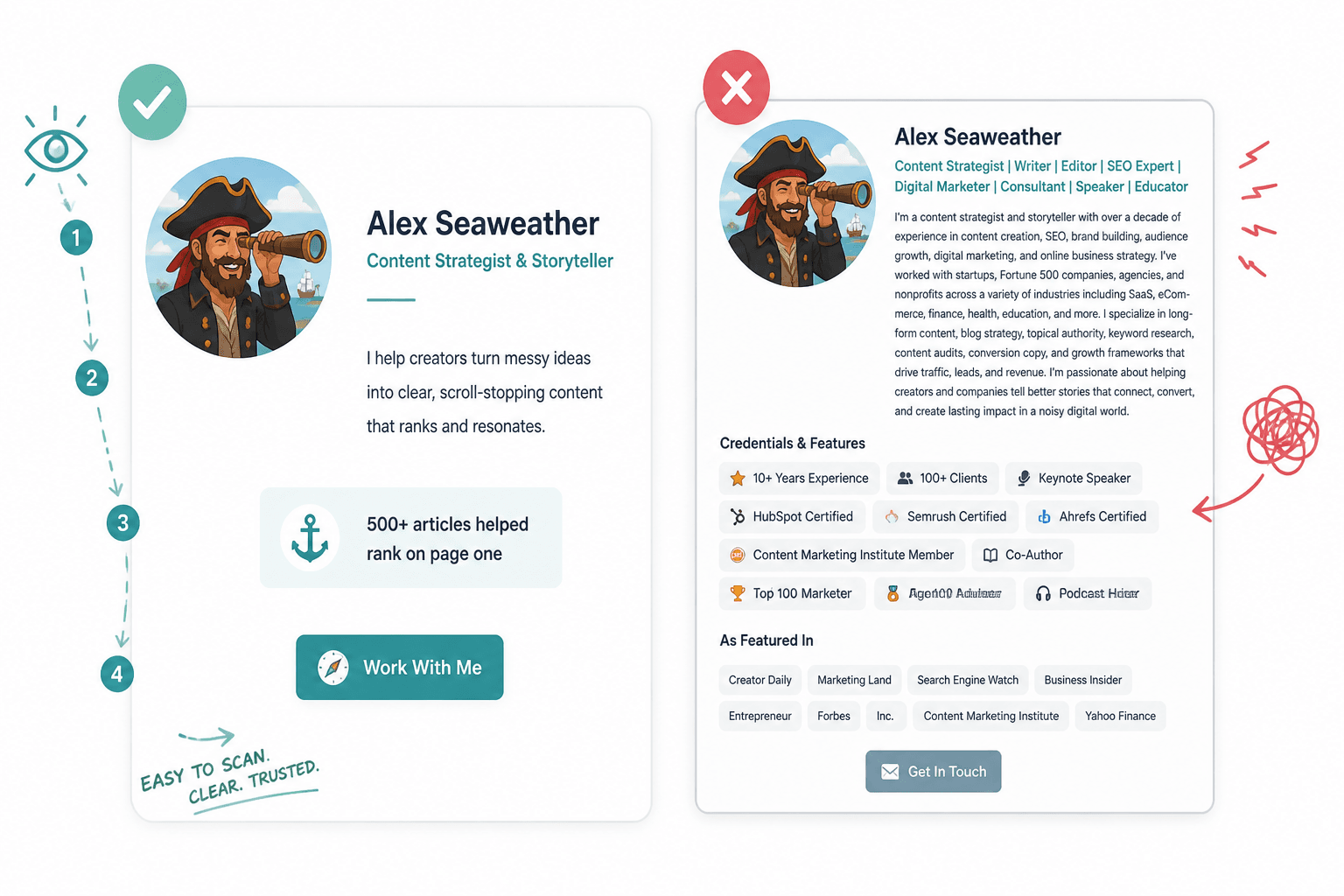
They try to sound impressive, cover every credential, explain every pivot since 2016, and prove depth by becoming a minor hostage situation on the page. Meanwhile, the visitor just wants a quick answer to a few basic questions: who are you, who are you for, why should they care, and what should they do next.
That is why When Short Website Bio and Profile Copy Beat Long Ones is not really a style debate. It is a conversion question. In plenty of cases, the shorter version works better because it gets to the point faster, creates less friction, and helps the right people self-identify without digging through a personal museum exhibit.
If your website bio is trying to do all the emotional labor of a homepage, sales page, founder story, and résumé at the same time, it is probably doing none of them especially well. Here’s how to know when short wins, when long still earns its place, and how to tighten your bio without sanding all the personality off it.
Want the broader roadmap? Start with the parent guide.
Why short bio and profile copy often works better on websites
Short copy wins when the reader does not need your full life story to make the next decision.
That next decision is usually small. Keep reading. Click the offer. Check your services. Join your email list. Book a call. Follow your work. If your bio helps them do that quickly, it is doing its job.
Longer copy can absolutely work. But length only helps when it adds clarity, trust, proof, or useful context. If it mainly adds autobiography, throat-clearing, or a very intense relationship with adjectives, shorter tends to perform better.
- Short bios reduce friction. People can scan them fast.
- Short bios clarify positioning. You are forced to say the actual thing.
- Short bios improve page flow. They do not hijack the page from the main conversion path.
- Short bios feel more confident. Strong positioning usually needs fewer words, not more.
- Short bios work better on high-intent pages. Especially when visitors are already close to a decision.
There is also a trust issue here. Bloated bios often read like someone trying a little too hard to establish credibility. A concise bio with one clear promise and a bit of proof usually feels cleaner and more believable.
Not because short is magically better. Because clarity is. Short just makes it harder to hide from it.
When short website bio and profile copy beat long ones
Shorter bio copy tends to win in a few very common situations.
1. When the reader is deciding fast
If someone lands on your homepage, about preview, sidebar profile, author box, or service page, they are usually not settling in with tea and a blanket to study your origin story. They are scanning.
In scan mode, short copy has an advantage because it respects how people actually read websites. They look for signals, not essays. A clean two to four line bio often beats a 300-word block because it tells them what they need before their attention wanders off to another tab.
2. When your offer is already clear elsewhere on the page
Your bio does not need to explain everything if the page already does that.
For example, if your homepage hero already states what you do and who it is for, your bio can focus on trust, personality, and one small layer of proof. It does not need to repeat the entire business model like a nervous intern presenting quarterly numbers.
3. When you serve a specific audience with a specific outcome
The more specific your positioning, the less copy you usually need.
If you help consultants turn expertise into better website copy, you can say that quickly. If you help “purpose-driven visionaries step into aligned authority across the digital ecosystem,” then yes, you may need 11 extra lines, mostly because nobody knows what you mean.
4. When the goal is navigation, not persuasion
Some website bios are there to orient the visitor, not fully convince them. Think author box, footer bio, sidebar profile, speaker page snippet, or top-of-page intro. In those cases, brevity is usually the smarter play.
The bio just needs to create enough clarity and trust to move the reader to the next relevant step.
5. When your credibility can be shown in fewer, stronger details
A short bio with one useful proof point often beats a long bio with six mushy ones.
Compare these:
I am a passionate strategist, educator, consultant, and thought leader with years of experience helping brands thrive through authentic messaging and meaningful connection.
I help coaches and consultants tighten their website messaging so more visitors turn into inquiries. My copy has supported six-figure launches, cleaner positioning, and better lead flow without making brands sound like everyone else.
The second one is not tiny, but it is still compact. More importantly, it says something.
What long bios often get wrong
Long bios are not bad by default. But most of them are packed with things the reader does not need yet.
- Too much backstory before the current relevance
- Too many roles and identities
- Vague values instead of concrete positioning
- Credentials without context
- Repeated claims dressed in slightly different wording
- No clear next step
The deeper issue is that people often use long bios to avoid making sharper choices. It feels safer to include everything than to decide what matters most. But on a website, indecision in copy usually shows up as clutter.
And clutter does not make you look more accomplished. It usually makes you look less clear.
Signs your website bio should probably be shorter
If you are not sure whether your bio needs trimming, start here.
- You mention your childhood, your career pivot, and your mission before saying what you do now.
- You list so many roles that the reader cannot tell your main offer.
- Your bio is longer than the section around it and steals attention from the actual CTA.
- The same idea appears three different ways.
- You sound polished but not specific.
- Your proof is generic: experienced, passionate, dedicated, results-driven.
- Your reader still has to hunt for what to do next.
If two or three of those apply, your shorter version is probably waiting under the fluff somewhere.
When longer bio copy still earns its keep
This is not an argument for chopping every bio down to 40 words and calling it modern. Sometimes longer is the right move.
Longer bios can work well when trust needs more scaffolding. That is especially true if your service is expensive, your process is nuanced, your credibility depends on depth, or your audience wants a stronger sense of your philosophy before they buy.
For example, a therapist, executive coach, consultant, strategist, or educator may need more room than a designer with a straightforward offer. A founder with a strong point of view may also benefit from a longer about page bio if that perspective helps qualify the right clients.
But even then, longer copy should still be structured, intentional, and easy to skim. Long does not excuse muddy. It just gives you more room to be useful.
- Use longer copy when the reader needs context to trust you.
- Use longer copy when your background directly supports the sale.
- Use longer copy when your philosophy meaningfully affects fit.
- Use longer copy when the page itself is designed for deeper consideration.
If you want a fuller breakdown of ideal bio length by page type and goal, see How Long Should Bio and Profile Copy for Websites Be in 2026.
How to make a short bio work harder
A short bio is not just a long bio with random lines deleted. It needs tighter structure. Every sentence has to pull its weight.
A useful short website bio usually covers four things:
- Who you help
- What you help them do
- Why you are credible
- What the reader should do next
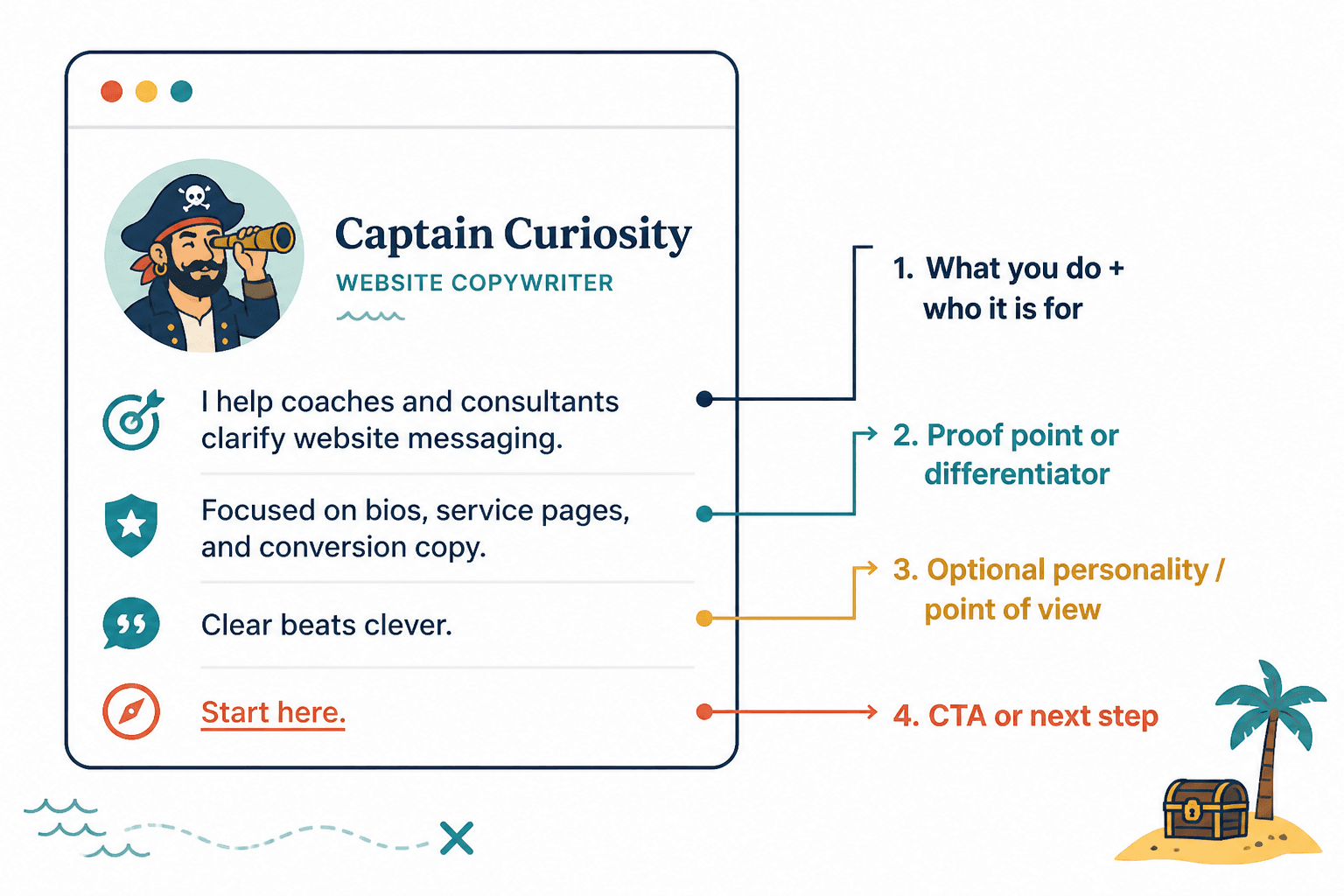
A simple short bio structure
- Line 1: what you do and for whom
- Line 2: one proof point, specialty, or differentiator
- Line 3: optional personality or point of view
- Line 4: CTA or next step
Example:
I help coaches and consultants turn unclear website messaging into cleaner positioning and better conversions.
My work focuses on bios, service pages, and core website copy that sounds sharp without sounding synthetic.
If your site is getting traffic but not enough action, start here.
That is not flashy. Good. Bios are not there to win poetry contests. They are there to orient, position, and move people forward.
Before and after: trimming a long website bio
Here is what this usually looks like in practice.
Before
I am a multi-passionate entrepreneur, writer, speaker, mentor, and brand consultant with a deep passion for helping ambitious business owners step into their most authentic voice online. After spending over a decade working across industries and learning the ins and outs of digital communication, I discovered that many brilliant people struggle to express their value in a way that truly connects. My mission is to empower purpose-driven founders to communicate with confidence, clarity, and impact through strategic messaging solutions that align with who they are and where they want to go.
This is not criminal. It is just trying to do too much while saying very little clearly.
After
I help founders and experts sharpen their messaging so their websites sound clearer, stronger, and more convincing.
My focus is strategic copy that improves positioning without flattening personality.
Need the words to finally match the expertise? Start with your core website copy.
Shorter. Clearer. Easier to trust. Easier to act on.
The key move was not “make it shorter.” The key move was “find the actual point.” That is usually the real job.
How to decide what to cut
If you are tightening your own bio, use this filter on every sentence:
- Does this help the reader understand what I do?
- Does this improve trust in a concrete way?
- Does this help qualify the right fit?
- Does this support the next action?
If the answer is no, cut it or move it somewhere else.
That “somewhere else” matters. A detail that is too much for a homepage bio might fit perfectly on an About page, media page, founder note, or longer profile section. You do not need to delete everything. You just need to stop making one small bio carry your entire identity on its back.
For stronger examples across different business types, see Bio and Profile Copy for Websites Examples for Coaches, Consultants, and Personal Brands.
Short bios are especially useful for smaller brands
If you have a small audience, short bios often help even more.
Why? Because smaller brands usually do not need to impress a massive, mixed audience. They need to resonate with the right few people. That means specificity beats breadth. A concise bio that says exactly who you help and how is usually more effective than a broad, credential-heavy block trying to look bigger than the business actually is.
There is also a confidence issue. Small brands often over-explain because they worry they have not “earned” brevity yet. But clear positioning is not reserved for famous people. You do not need 12 paragraphs before you are allowed to say what you do.
If that sounds familiar, read Bio and Profile Copy for Websites for Creators With Small Audiences.
Where short bios work best on a website
- Homepage intro sections
- About page previews
- Sidebar profile boxes
- Author bios under blog posts
- Service page expert intros
- Footer profile snippets
- Speaker page summaries
- Lead magnet landing page intros
In these spots, the bio is usually supporting a larger page goal. It should not become the main event unless that page is specifically designed for your deeper story.
If your broader messaging needs work, the main bio and profile copy for websites hub is a good place to keep going. You can also explore more on website conversion copy and website core copy.
How short bios support leads and sales better
A shorter bio can improve conversions for one simple reason: it helps the reader get to the next step without extra drag.
The bigger point is simple: clearer structure and clearer writing make the piece more useful. That is usually what makes the ending land better too.