Most website bios are not weak because you have nothing to say. They are weak because you’re trying to write them from scratch like a tiny hostage note to the internet.
That is usually the wrong move.
If you’ve been posting, emailing, writing articles, sharing client lessons, recording podcasts, or answering the same questions in calls, you already have raw material. Buried in that pile is the language you use when you’re clear, credible, and not trying too hard to sound “professional.” That is exactly what better website bio and profile copy needs.
How to Turn Old Content Into Better Bio & Profile Copy for Websites is really a filtering job. You are not inventing a persona. You are pulling out the strongest signals of who you help, what you help them do, why people should trust you, and what they should do next.
Here’s how to do that without ending up with another vague paragraph about “helping ambitious brands grow with authentic strategy-driven solutions,” which sounds impressive right up until a real human tries to figure out what you actually do.
To see how this fits into the wider strategy, open the parent guide.
Why old content is usually better source material than a blank page
When people write website bios from scratch, they tend to drift into résumé mode, buzzword mode, or weirdly formal TEDx mode.
Old content is often better because it contains your natural language under pressure. It shows what you repeat, what you care about, what clients respond to, and what stories or claims you can actually support.
A good bio does not need more polish. It needs stronger signal.
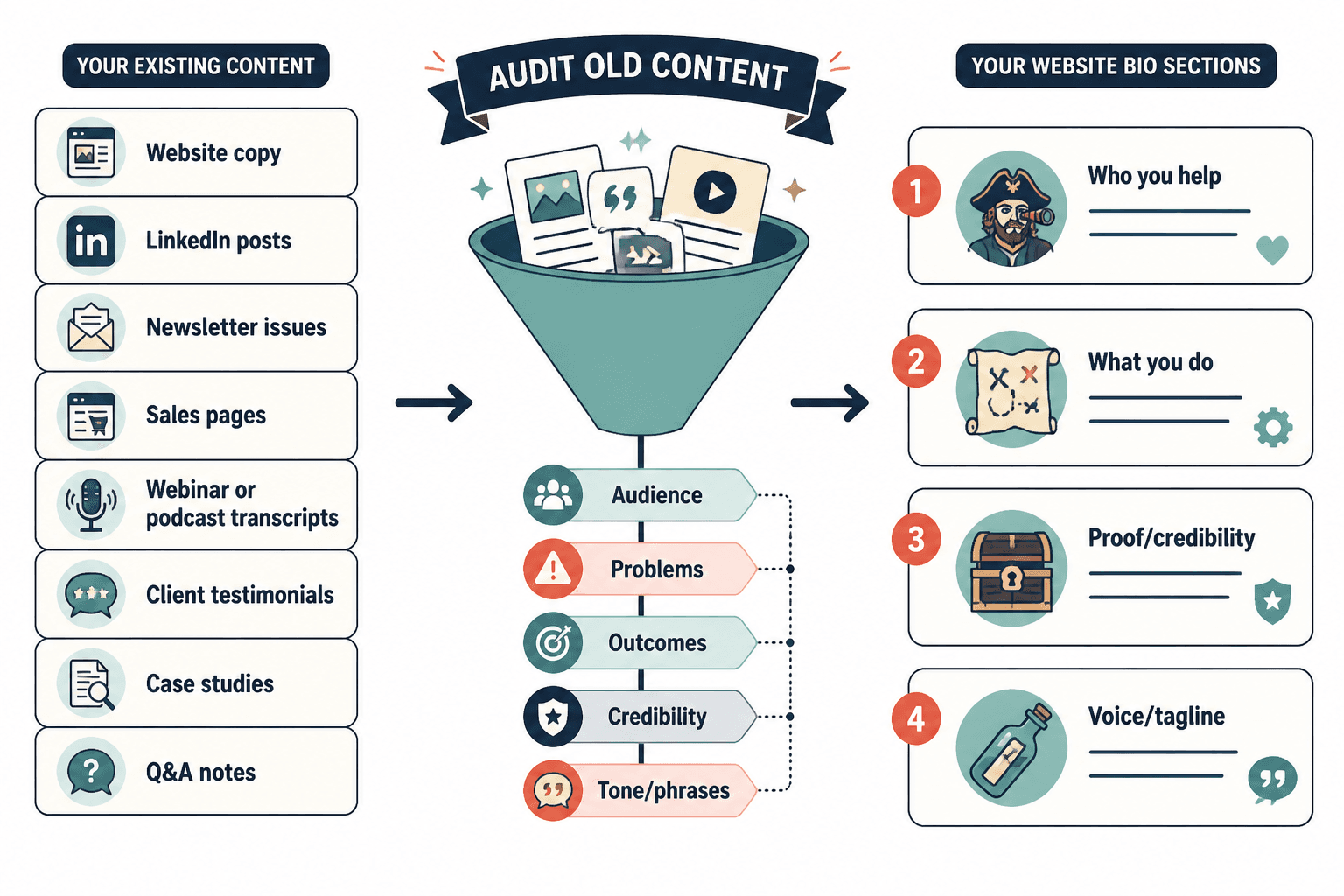
Your old content can reveal:
- the audience you talk to most clearly
- the problems you describe best
- the outcomes you mention repeatedly
- your strongest credibility points
- the tone that sounds like you instead of corporate wallpaper
- the phrases clients actually use when describing your work
If you want a broader foundation first, this bio and profile copy for websites guide is the useful umbrella version. This article is the practical scavenger hunt version.
What counts as “old content” for bio and profile copy
More than people think.
You’re not only looking at polished thought leadership pieces. Some of your best bio material is sitting inside casual posts, email replies, workshop intros, webinar descriptions, proposal language, call transcripts, and the little explanations you give when somebody asks, “So what do you actually do?”
Good sources to mine
- website copy you wrote before your current version
- LinkedIn posts or About sections
- newsletter issues
- sales pages and service pages
- podcast or webinar transcripts
- client testimonials
- case studies
- Q&A call notes
- DMs or emails where prospects asked what you do
- talk descriptions, workshop blurbs, or speaker bios
Do not only collect your polished content. Polished content often hides your best lines under too much smoothing. Sometimes the clearest sentence you’ve ever written is buried in a scrappy email sent between meetings.
The 4 things your website bio actually needs
Before you start harvesting lines, know what you’re looking for. Most website bio and profile copy needs four jobs done quickly:
- Audience: who you help
- Value: what you help them do
- Credibility: why someone should believe you
- Next step: what they should do after reading
That’s it. Not your life story. Not every role you have held since 2014. Not a dramatic monologue about passion.
If your current copy misses one of those four pieces, it will usually feel fuzzy, flat, or strangely unfinished. That is why repurposing old content works well here: you’re searching for proof and precision, not decorative wording.
How to Turn Old Content Into Better Bio & Profile Copy for Websites: the process
Here’s the clean way to do it.
1. Gather 10 to 20 pieces of old content
Pull from different formats if possible. A mix gives you better range.
You’re looking for places where you explained your work, shared an opinion, taught something useful, described a client outcome, or answered a common question.
2. Highlight anything that sounds clear, specific, and alive
As you review the material, copy lines into a working doc. Keep anything that does one of these:
- names your audience clearly
- describes a pain point well
- states the result of your work
- shows a sharp opinion
- proves experience or expertise
- sounds more like a human than a brochure
At this stage, don’t worry about whether the line is “bio-ready.” You’re collecting ingredients.
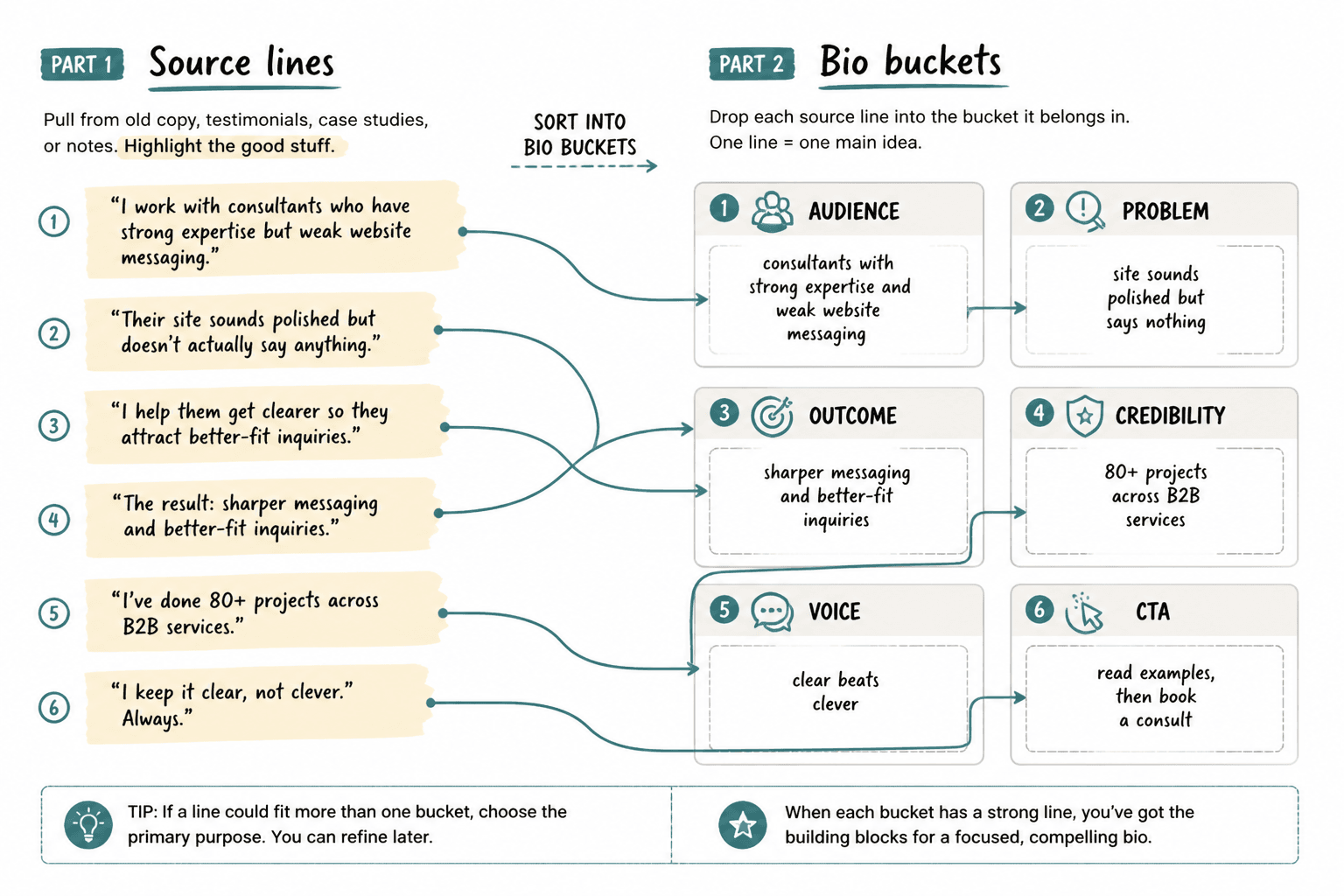
3. Sort the material into four buckets
Create four simple sections in your doc:
- Who I help
- What I help them do
- Why people trust me
- What people should do next
Then drop your highlighted lines into the right bucket.
This step matters because it stops you from writing a bio that is all personality and no positioning, or all credentials and no relevance. A lot of bios fail by having too much of one thing and none of another.
4. Look for repeated patterns
Once your lines are sorted, read through and notice what keeps showing up.
- Which audience appears most often?
- Which problem do you explain best?
- Which result keeps repeating?
- Which credibility points show up naturally without forcing them?
- What phrases sound most like your real voice?
Patterns matter more than one clever sentence. If you mention helping consultants simplify their message in twelve different places, that is not an accident. It is probably core positioning trying to get your attention.
5. Turn the patterns into a rough bio structure
Now build a simple draft using this order:
- who you are and who you help
- what specific outcome you help them get
- one or two credibility lines
- a clear next step
Very often, your best website bio is just a cleaner arrangement of things you’ve already said well elsewhere.
6. Rewrite for the website context
A social post can be looser. A podcast intro can be longer. A website bio has to earn its keep faster.
So once you’ve drafted the bio, tighten it for scan speed. Cut repetitions. Replace broad claims with concrete ones. Remove anything that only exists to make you sound important.
If your draft still feels beige, this related guide on how to rewrite boring bio and profile copy for websites will help you sharpen it without making it weird.
What to extract from old content, specifically
Some lines are far more useful than others. Here’s what to hunt for.
Audience language
Find the places where you naturally describe the people you help.
Weak: “I work with purpose-driven entrepreneurs.”
Stronger: “I help coaches, consultants, and personal brands turn messy expertise into clearer website copy that earns trust faster.”
Broad audience labels are usually too soft to carry a bio. Pull from old content where you were being more precise because precision usually sneaks out when you are teaching, selling, or solving.
Problem language
Good bios don’t just say what you do. They hint at the problem you solve.
Look for old lines where you described the stuck point well:
- “People know their work is good, but their site still sounds generic.”
- “Most experts are too close to their own process to explain it clearly.”
- “They’ve got proof, but the website buries it under bland copy.”
That kind of language gives your bio more bite. It helps the right visitor think, yes, that’s my issue.
Outcome language
Old content often reveals the real result of your work more clearly than your About page does.
Look for practical outcomes, not floaty aspirations:
- clearer positioning
- better leads
- more trust
- faster conversions
- stronger inquiries
- easier sales conversations
- less confusion on the site
If you need help connecting your bio to actual business results, read how to turn bio and profile copy for websites into more leads or sales. A bio is not just an identity paragraph. It should pull weight.
Credibility lines
Your old content probably contains trust-building details you forgot to use.
Look for:
- years of experience
- types of clients served
- notable project volume
- recognizable outcomes
- specialist angles
- repeatable methods
- specific proof from testimonials or case studies
Just make sure your credibility sounds useful, not chest-thumpy. “Trusted by 200+ founders” can work. “World-class visionary thought leader” can go directly into the sea.
For more on this piece, see better bio and profile copy for websites credibility lines for personal brands.
A simple extraction worksheet you can use
If you want to make this fast, use a table while reviewing your old content.
| What to look for | Questions to ask | Example of useful material |
|---|---|---|
| Audience | Who am I clearly talking to here? | “Consultants with strong expertise and weak website messaging” |
| Problem | What frustration or bottleneck am I naming? | “Their site sounds polished but says nothing” |
| Outcome | What result am I helping create? | “Sharper messaging that brings better-fit inquiries” |
| Credibility | What proof appears naturally? | “Worked across 80+ positioning and website projects” |
| Voice | Which lines sound most like me? | “Clear beats clever when people are deciding whether to trust you” |
| CTA | What next step fits this person? | “Read the examples, then book a consult if the fit is right” |
Before and after: turning old content into bio copy
Here’s a simple example.
Old content snippets
- “Most consultants do not have an expertise problem. They have a clarity problem.”
- “I help service businesses turn complicated offers into cleaner messaging and pages that convert.”
- “Clients usually come to me after they’ve rewritten their homepage five times and it still sounds like everyone else.”
- “Over the last 6 years, I’ve worked on website messaging, bios, and conversion copy for coaches, consultants, and solo founders.”
Weak bio draft
“I’m a strategic copywriter passionate about helping ambitious entrepreneurs elevate their online presence through compelling messaging and authentic brand storytelling.”
That tells us almost nothing. It’s smooth in the way airport flooring is smooth.
Stronger bio draft from the old material
I help coaches, consultants, and solo founders turn fuzzy website messaging into clearer copy that builds trust and brings in better-fit leads. Most of my clients do not need more ideas. They need sharper positioning, simpler language, and pages that stop sounding like everybody else. Over the last 6 years, I’ve worked on website messaging, bios, and conversion copy for service businesses that want their sites to sound credible without sounding stiff.
Same person. Better signal. Less perfume.
How to keep the bio from sounding stitched together
One risk of repurposing old content is ending up with a Franken-bio: technically assembled, emotionally off, and full of mismatched tone.
The bigger point is simple: clearer structure and clearer writing make the piece more useful. That is usually what makes the ending land better too.