
Most weak CTAs do not fail at the end. They fail in the first few words.
That is the bit people tend to miss. They spend time polishing the button text or tweaking the final ask, then open with something limp like “If you’d like to learn more” or “Feel free to reach out.” Which is polite, sure. It is also easy to ignore.
If you want to know how to start a CTA without a weak opening, the fix is not making it louder. It is making it clearer, more relevant, and less allergic to conviction. A strong CTA opening gives the reader a reason to care before you ask them to do anything.
This is where better conversion copy starts paying rent. You do not need to sound pushy. You do not need fake urgency. You just need to stop opening your CTA like you are interrupting someone at a funeral.
For the full path around this topic, head to the parent guide.
Why most CTA openings feel weak
A weak CTA opening usually has one of three problems:
- It starts with apology language
- It starts with vague filler
- It starts with the action before the reason
That is why phrases like “If you want,” “Feel free,” “You can always,” and “Click here” so often underperform. Not because those words are banned, but because they usually show up in copy that has no tension, no specificity, and no clear value.
Readers do not respond to CTAs because they spotted a button. They respond because the next step feels relevant and worth taking. The opening of your CTA is where that feeling starts.
A CTA opening should not sound like permission. It should sound like the natural next move.
What a strong CTA opening actually needs
Before we get into formulas and rewrites, here is the core idea: the opening of a CTA works best when it bridges from the reader’s current problem to the next useful action.
In plain English, do not begin with the ask. Begin with the relevance.
A strong CTA opening usually does at least one of these:
- Names the outcome they want
- Names the problem they are stuck in
- Highlights what they will get next
- Creates a clean transition from the content into the action
- Makes the action feel low-friction and useful
That is the real answer to how to start CTA writing without a weak opening. Start from their situation, not your request.
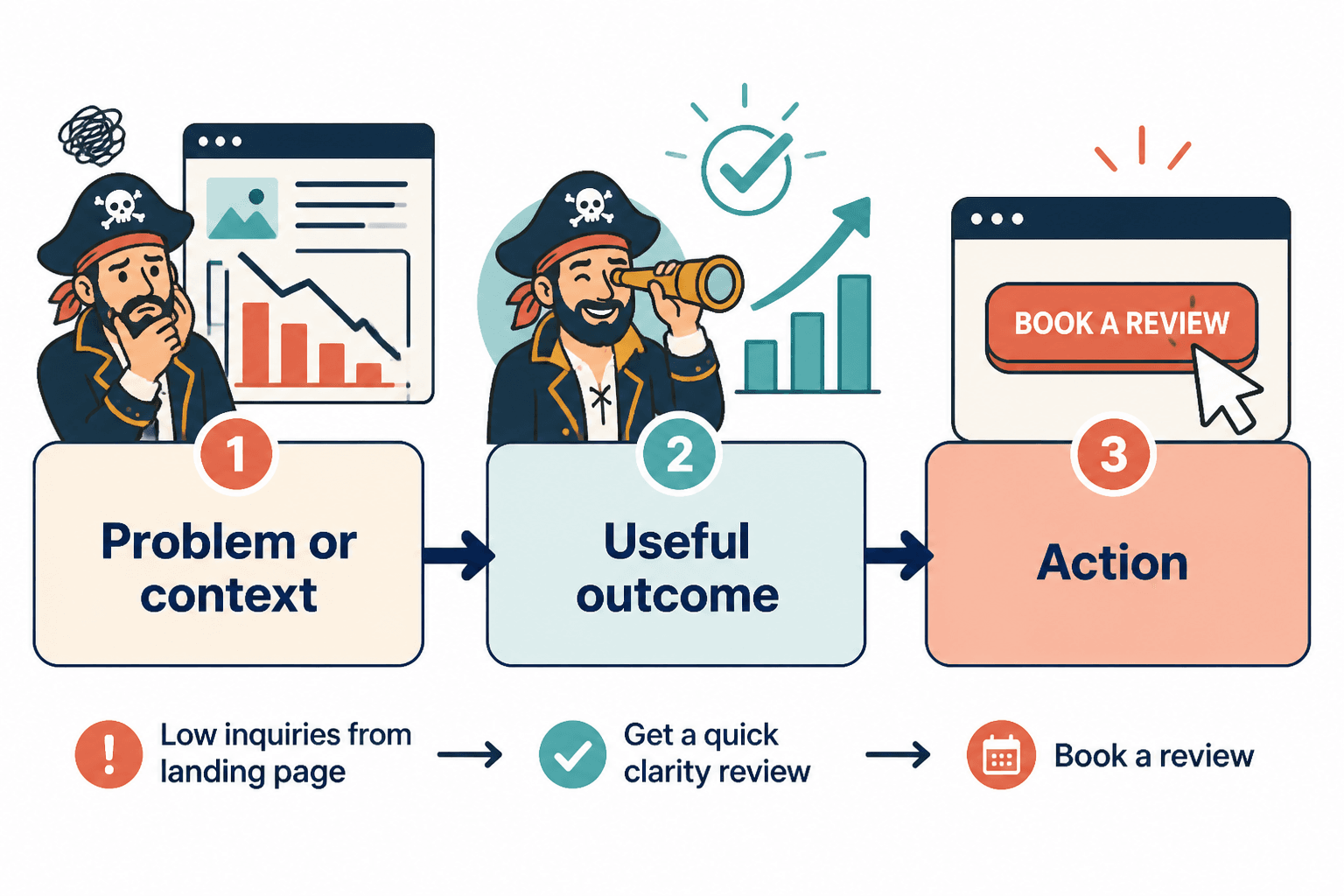
There is a big difference between “Book a call” and “If your landing page gets traffic but not inquiries, book a quick review.” One is an instruction. The other is connected to a real problem. Guess which one earns more attention.
How to start a CTA without a weak opening
Here is the practical structure:
- Start with the reader’s context
- Connect that context to a useful outcome
- Then give the action
That sounds simple because it is. The hard part is resisting the urge to write generic mush around it.
1. Start with the reader’s context
Open your CTA by showing you understand where they are, what they want, or what is getting in the way.
Examples:
- Need sharper homepage copy before your next launch?
- If your emails get opens but not clicks, this will help.
- Ready to turn that traffic into actual leads?
- Still stuck with a bio that sounds professional but says nothing?
These work because they do not begin with your desired action. They begin with the reader’s situation.
2. Connect that context to a useful outcome
Once you have their attention, tell them what the next step helps them do.
Examples:
- Get a clearer CTA framework you can use across your site.
- See where your current conversion copy is losing people.
- Steal a simpler structure for turning readers into inquiries.
This is the bridge. Without it, the CTA can feel abrupt. With it, the ask feels earned.
3. Then give the action
Now you can ask for the click, reply, booking, download, or sign-up.
Examples:
- Book a copy review.
- Grab the template.
- Read the guide.
- Start here.
- See how it works.
Notice the order. Situation first. Value second. Action third.
Weak CTA openings vs stronger ones
Here is where this gets easier. A lot of weak CTA openings are not evil. They are just lazy defaults. Once you see the pattern, they are pretty easy to fix.
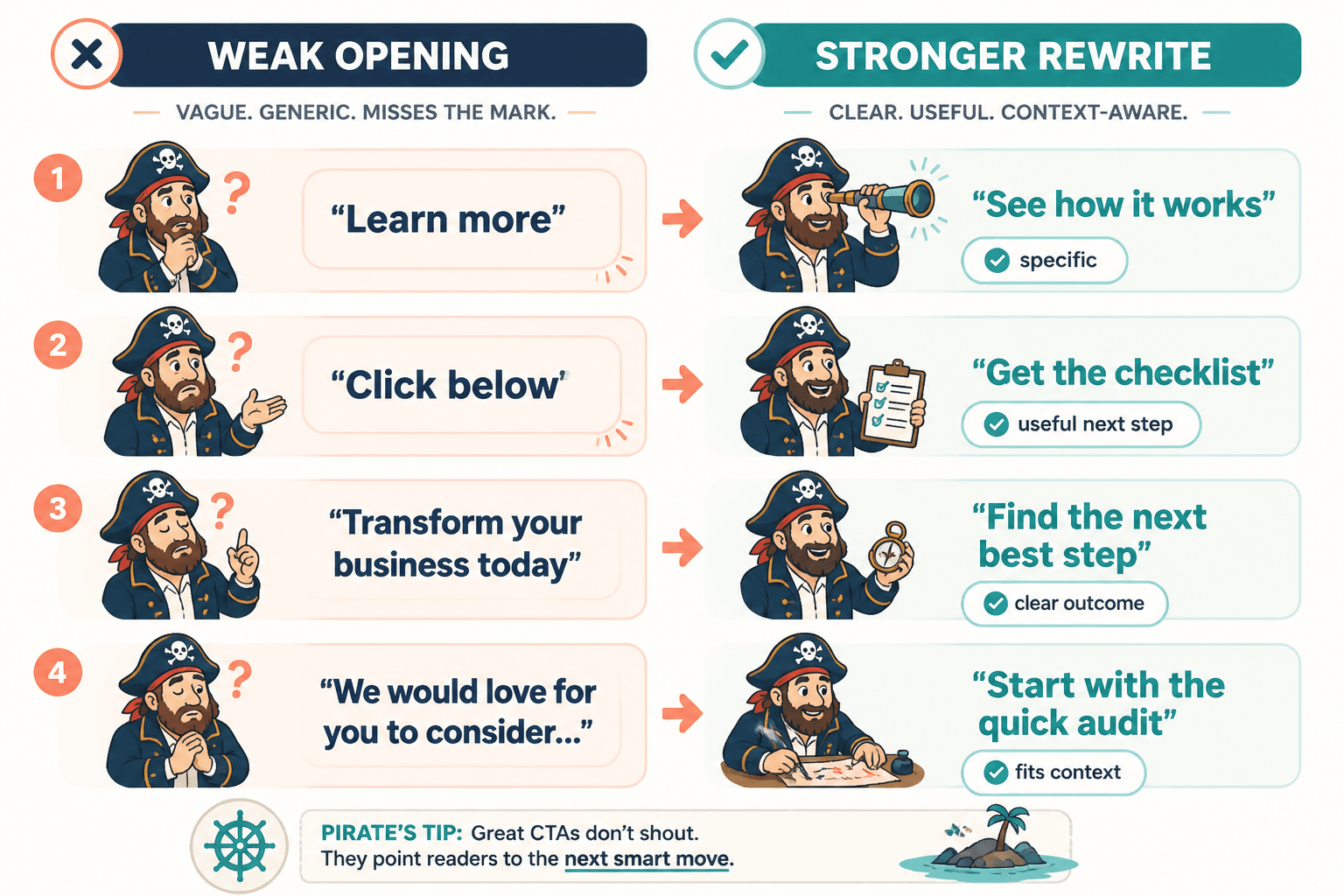
| Weak opening | Why it falls flat | Stronger rewrite |
|---|---|---|
| If you’d like to learn more, click here. | Vague, passive, says nothing about why | Want a simpler way to write CTAs that actually get clicks? Read the full guide. |
| Feel free to book a call. | Sounds optional in the least compelling way possible | If your site gets attention but not inquiries, book a quick CTA review. |
| Contact us today. | Generic and disconnected from reader intent | Need sharper conversion copy before your next launch? Get in touch. |
| Click below to get started. | No value, no context | Ready to stop losing people at the point of action? Start with the CTA template below. |
| Sign up for our newsletter. | Centered on your asset, not their benefit | Get weekly fixes for bland copy, weak CTAs, and pages that almost convert. |
What changed? The stronger versions do not just tell the reader what to do. They make the action mean something.
Five reliable ways to open a CTA well
You do not need fifty formulas. You need a handful that work across pages, emails, posts, and lead magnets.
1. Open with the problem
This works when the pain point is clear and familiar.
- If your CTA gets seen but ignored, fix the opening first.
- Still ending strong pages with weak asks? Start here.
- If readers are dropping off before the click, your transition may be the problem.
2. Open with the outcome
This works when the result is desirable and concrete.
- Get stronger CTA clicks without sounding pushy.
- Write call-to-action copy that feels clear, not needy.
- Turn more readers into leads with a sharper final ask.
3. Open with a turning point
This works when the CTA marks the next logical step after the content.
- Ready to apply this to your own site?
- When you are done guessing, use this template.
- Once your message is clear, this is the next fix to make.
4. Open with a benefit-plus-action hybrid
This is compact and especially useful for buttons, banners, and short page sections.
- Get the CTA template
- See the rewrite examples
- Fix your homepage CTA
- Book your copy review
5. Open with a soft but specific invitation
Soft CTAs are fine. Weak CTAs are not. There is a difference.
- Want a second set of eyes on your CTA?
- If you want help tightening this up, start here.
- Curious where your current CTA is losing people? Take a look at this.
If you want softer CTA language without falling into vague mush, this pairs well with how to improve CTA writing soft CTAs without sounding generic.
What to avoid in the first line of a CTA
Some openings weaken the CTA before it has any chance to work. They signal hesitation, irrelevance, or recycled copy. Not ideal.
- Apology language: “Feel free,” “If you’d like,” “Whenever you’re ready”
- Meaningless filler: “For more information,” “Learn more,” “Click below”
- Over-politeness: trying so hard not to offend that the CTA vanishes
- Generic hype: “Transform your business today” and its beige cousins
- Too much throat-clearing: a long sentence before the actual point
To be clear, any phrase can work in the right context. But if your CTA opening is weak, these are common suspects.
A lot of marketers overcorrect here and think the answer is aggression. It is not. “Buy now before it’s gone” is not automatically stronger than “Learn more.” It is just a different flavor of bad when the context does not support it.
The point is not to sound intense. The point is to sound useful.
A simple formula for stronger CTA openings
If you want one reusable formula, use this:
If/When [reader situation], [useful next step] so you can [clear outcome].
Examples:
- If your sales page explains everything except why to act, use this CTA rewrite checklist so you can tighten the final push.
- When your content gets attention but not action, review your CTA opening so readers actually see a reason to click.
- If your offer is solid but the ask feels limp, start with these CTA examples so the next step sounds worth taking.
You can simplify the formula for tighter spaces:
- Need more inquiries? Fix your CTA.
- Want clearer clicks? Start here.
- Ready to improve conversion copy? See the guide.
If your current calls to action sound stiff or overengineered, you might also want how to write CTA writing without sounding salesy or robotic.
Before and after: rewriting weak CTA openings
Let’s make this less abstract. Here are a few common weak openings and how to improve them.
Example 1: homepage CTA
Before: Learn more about our services.
After: Need copy that turns interest into inquiries? See how we help.
The rewrite adds a specific problem and makes the click feel more relevant.
Example 2: lead magnet CTA
Before: Download our free guide here.
After: Want stronger CTAs without sounding like a funnel goblin? Grab the guide.
Now the reader knows what the guide helps with. Also yes, a little personality helps when it fits the brand.
Example 3: booking CTA
Before: Contact us today to get started.
After: If your site sounds good but does not convert, book a quick review.
This removes the generic business-brochure tone and replaces it with a real use case.
Example 4: article CTA
Before: For more tips, read our other articles.
After: If this CTA still feels a bit limp, start with how to rewrite boring CTA writing and sharpen the wording fast.
Specific next step. Specific value. Much stronger.
How the right CTA opening changes by context
Not every CTA should open the same way. A homepage banner, a checkout prompt, an email footer, and a blog post CTA all have different jobs.
On landing pages
Be direct. The reader is already deciding whether to act. Lead with the problem or outcome and keep friction low.
- Need better conversion copy? Book a strategy call.
- Ready for a cleaner message and stronger CTA? See the process.
In blog posts
The CTA should feel like a natural continuation of the article, not a random sales trapdoor. Start with what the reader now knows or still needs.
- If your CTA opening is still too generic, use these rewrite examples next.
- Want to turn this advice into actual leads? Read how to turn CTA writing into more leads or sales.
In emails
Email CTAs often work best when they are compact and conversational. Less brochure voice. More clean next step.
- Need the template? Grab it here.
- Want me to review your CTA? Reply and send it over.
In buttons
You have less room, so the opening and action often collapse into one line. In that case, lead with value-loaded verbs or outcomes.
- Get the template
- Fix my CTA
- See examples
- Book review
If you are building your broader CTA skills, the parent resource on CTA writing is a useful next stop, along with the broader conversion copy section.
The bigger point is simple: clearer structure and clearer writing make the piece more useful. That is usually what makes the ending land better too.