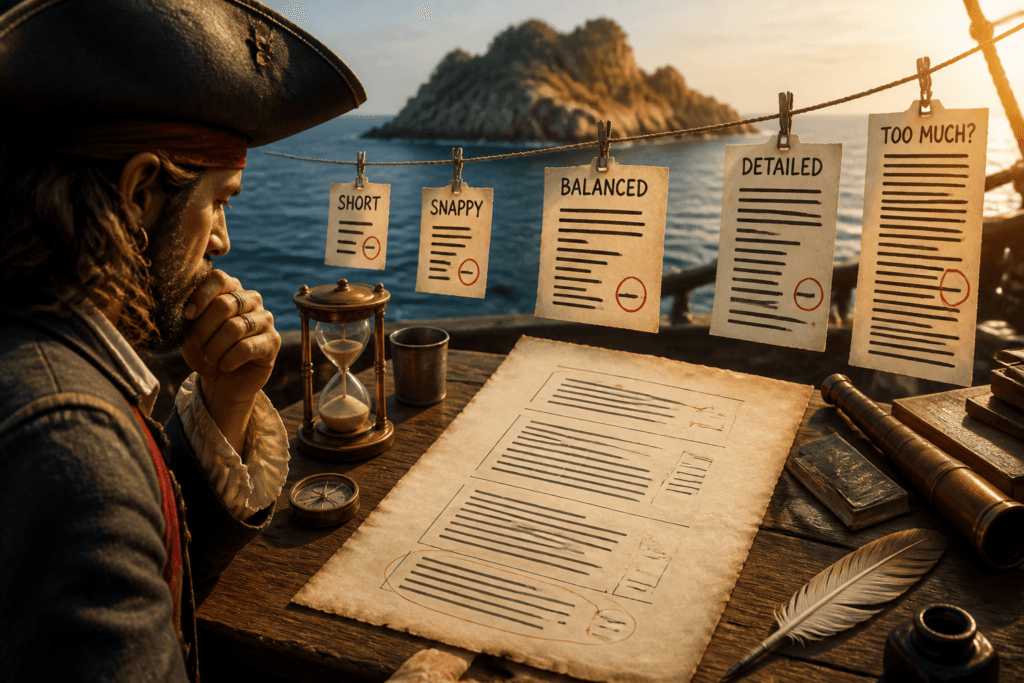
Most offer messaging is not weak because it is too short. It is weak because it says too little of value, or too much with no hierarchy.
That is the real answer behind How Long Should Offer Messaging & Positioning Be in 2026? People keep asking for a word count when what they actually need is a structure. If your message is vague, bloated, or trying to explain every possible detail at once, making it longer will not save it. It just gives the confusion more room to stretch out.
In 2026, good offer messaging needs to do two things at the same time: get understood fast and support trust once someone wants more. That means the right length depends on where the message appears, how aware your audience already is, how expensive or complex the offer is, and how much proof a buyer needs before they move.
So no, there is not one magic length. Annoying, I know. But there are very usable guidelines. This article will help you figure out how long your offer messaging and positioning should be across headlines, hero sections, sales pages, profile copy, emails, and short-form content, without turning your website into a wall of explanation nobody asked for.
Want the broader roadmap? Start with the parent guide.
How long should offer messaging & positioning be in 2026? The short answer
It should be as short as possible to create clarity and as long as necessary to create trust.
That sounds a bit neat and tidy, but it is true. Offer messaging has two jobs:
- Help the right person quickly understand what you do, who it is for, and why it matters
- Give enough detail, specificity, and proof to make the offer feel credible and worth considering
If your messaging only does the first job, it may sound clean but flimsy. If it only does the second, it usually becomes a rambling pile of context, process, and throat-clearing.
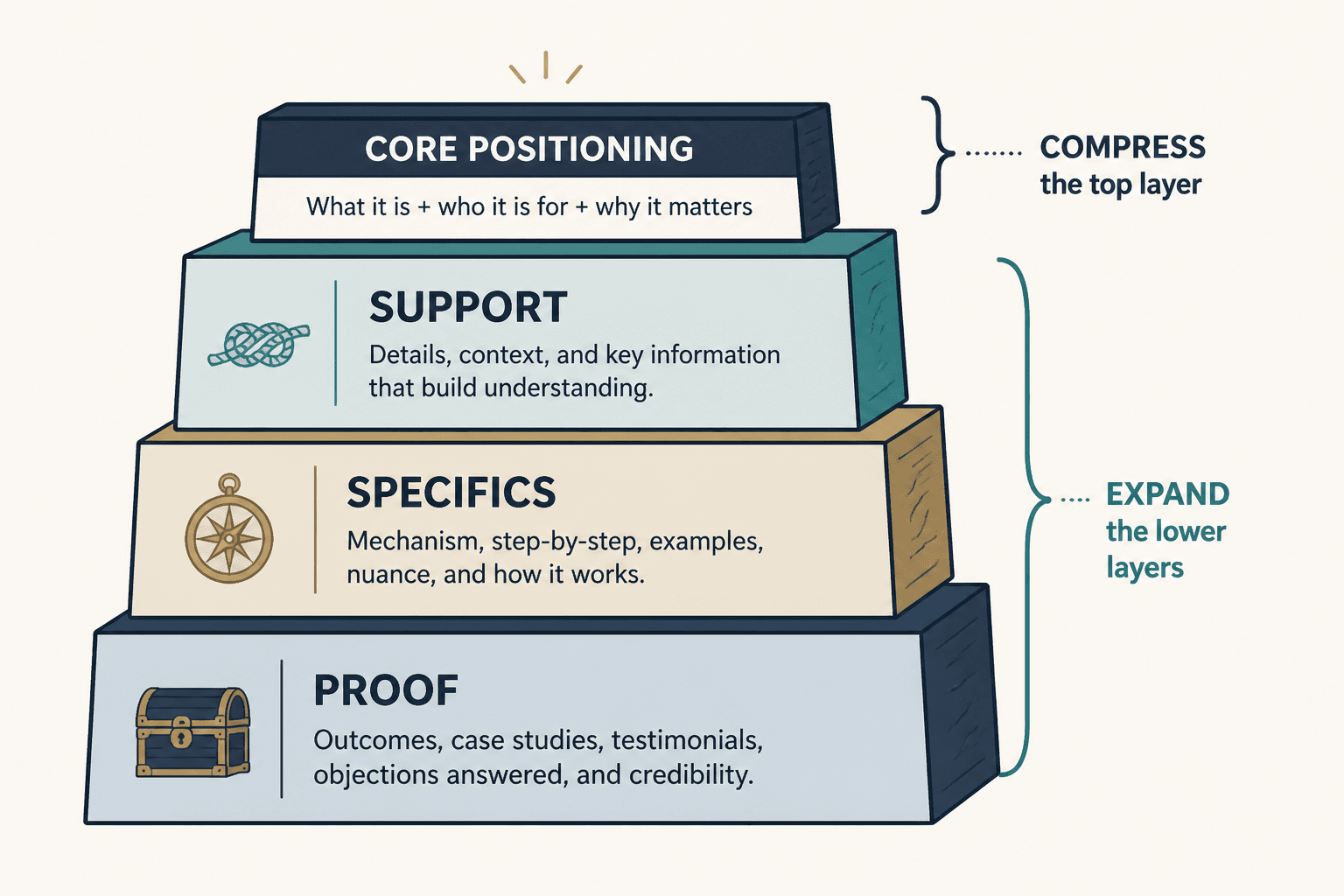
Better rule: compress the top layer, expand the lower layers. Your core positioning should be brief. The support underneath it can be longer.
Why people get offer length wrong
Most people make one of two mistakes.
1. They write tiny messaging that sounds polished but says almost nothing
This is the land of “I help visionary founders scale with clarity” and other elegant little clouds of nothing. Short is not automatically strong. Short and vague is just underwritten.
2. They write a full emotional autobiography before getting to the offer
This usually happens when someone is afraid of being misunderstood, so they try to explain every angle, every credential, every audience, every method, and every possible objection in one go. The result is heavy, slow, and weirdly hard to trust.
People do not need the whole attic tour before they know what room they are in.
Good positioning has a front door. It does not begin with a maze.
The right length depends on where the messaging lives
Offer messaging is not one block of copy. It appears in layers across your website and marketing. Each layer has a different job, so each layer needs a different length.
| Placement | Best length guideline | Main job |
|---|---|---|
| Homepage hero | 1 headline, 1 supporting line, 1 CTA | Fast clarity |
| Offer page opening | Short headline + 2 to 4 short paragraphs | Orient the reader |
| Offer overview section | 100 to 250 words | Explain what it is and who it is for |
| Problem/solution section | 150 to 400 words | Build relevance and tension |
| Process/method section | 3 to 6 short steps | Make the offer feel concrete |
| Proof/results section | Multiple short examples or testimonials | Support trust |
| FAQ | 4 to 8 concise answers | Handle friction cleanly |
| Social bio/profile summary | 1 to 3 lines | Quick positioning |
| Email pitch section | 100 to 300 words | Create interest without overload |
If you try to make every section do every job, your messaging gets long in all the wrong places. That is usually why pages feel tiring. The issue is not total word count. It is poor distribution.
Use the 3-layer rule for offer messaging
A simple way to decide length is to build your messaging in three layers.
Layer 1: The sharp version
This is the shortest expression of the offer. Usually a headline, one-liner, positioning statement, or short intro.
- 5 to 15 words for a headline
- 10 to 30 words for a one-line positioning statement
- 1 short sentence for a bio-style version
Its job is not to explain everything. Its job is to make the reader think, “Yes, this sounds like it might be for me.”
Layer 2: The useful version
This is where you expand slightly. You clarify the audience, the problem, the outcome, the offer type, or the difference in your approach.
- 50 to 150 words for a homepage support section
- 100 to 250 words for an offer overview
- 2 to 4 short paragraphs for a page intro
This layer carries more of the selling work than people realize. A lot of websites fail because they jump from broad headline straight to call-to-action, with no useful bridge in between.
Layer 3: The trust-building version
This is where longer copy belongs. Not at the top. Lower down.
- Specific examples
- Proof and results
- Common objections
- What is included
- What makes your approach different
- Who should and should not buy
This is the section people read after they are interested. It can absolutely be longer, especially for higher-ticket, custom, strategic, or more sophisticated offers.
How offer complexity changes ideal length
The more complex the offer, the more explanation you usually need. But even then, the top of the message should stay tight.
Shorter messaging often works best when:
- The offer is simple and familiar
- The audience already knows the problem well
- The price point is relatively low
- The result is easy to picture
- You are speaking to warm traffic
- Your positioning is already narrow and specific
If you want more on that, this breakdown on when short offer messaging and positioning beat long ones is worth reading.
Longer messaging is usually needed when:
- The offer is strategic, custom, or high-ticket
- The audience is skeptical or comparison-shopping
- The problem is nuanced
- The process needs demystifying
- The transformation is valuable but not instantly obvious
- You are selling expertise, not a simple commodity
That said, longer does not mean looser. You still need clean structure, useful subheads, and copy that earns its place. A 1,500-word sales page can work. A 1,500-word fog machine cannot.
How audience awareness affects length
Not all readers need the same amount of explanation. This is where a lot of copy gets overgrown. You are writing for people at different levels of awareness, then blaming the page length for the mess.
For problem-aware readers
They know something is wrong, but they may not know what kind of solution they need. Your messaging can be moderately detailed. You need enough length to frame the problem properly and show your angle.
For solution-aware readers
They already know they want a coach, consultant, service, template, or strategic partner. They need less education and more differentiation. In this case, the messaging can be shorter upfront, with stronger proof lower down.
For offer-aware or warm readers
They may have seen your content, email, social posts, or previous offers. They need less scene-setting. Often, concise messaging works better because the trust has already been built elsewhere.
This is one reason creators and consultants should think across the whole journey, not just one page. Sometimes your website does not need to carry every ounce of persuasion because your content has already done part of the work.
For a broader foundation, see the main offer messaging and positioning guide.
What the top of your offer page should actually look like
If your opening section is too long, people bounce. If it is too thin, they stay confused. The sweet spot is usually:
- A headline that states the offer or result clearly
- A short supporting paragraph that adds audience, problem, or method context
- One clean CTA
- Optional proof signal nearby
Example of a too-short version:
Strategic messaging for bold brands.
Looks polished. Tells us almost nothing.
Stronger version:
Offer messaging and positioning for coaches, consultants, and personal brands who are tired of sounding polished but forgettable.
I help you clarify what you sell, who it is for, and how to explain the value without writing a six-page manifesto nobody finishes.
Not wildly long. Just actually useful.
If your openings tend to sag, read how to start offer messaging and positioning without a weak opening.
Recommended length by section
Here are practical ranges that work well for most service businesses, consultants, coaches, solo founders, and personal brands. These are guidelines, not commandments etched into a content stone tablet.
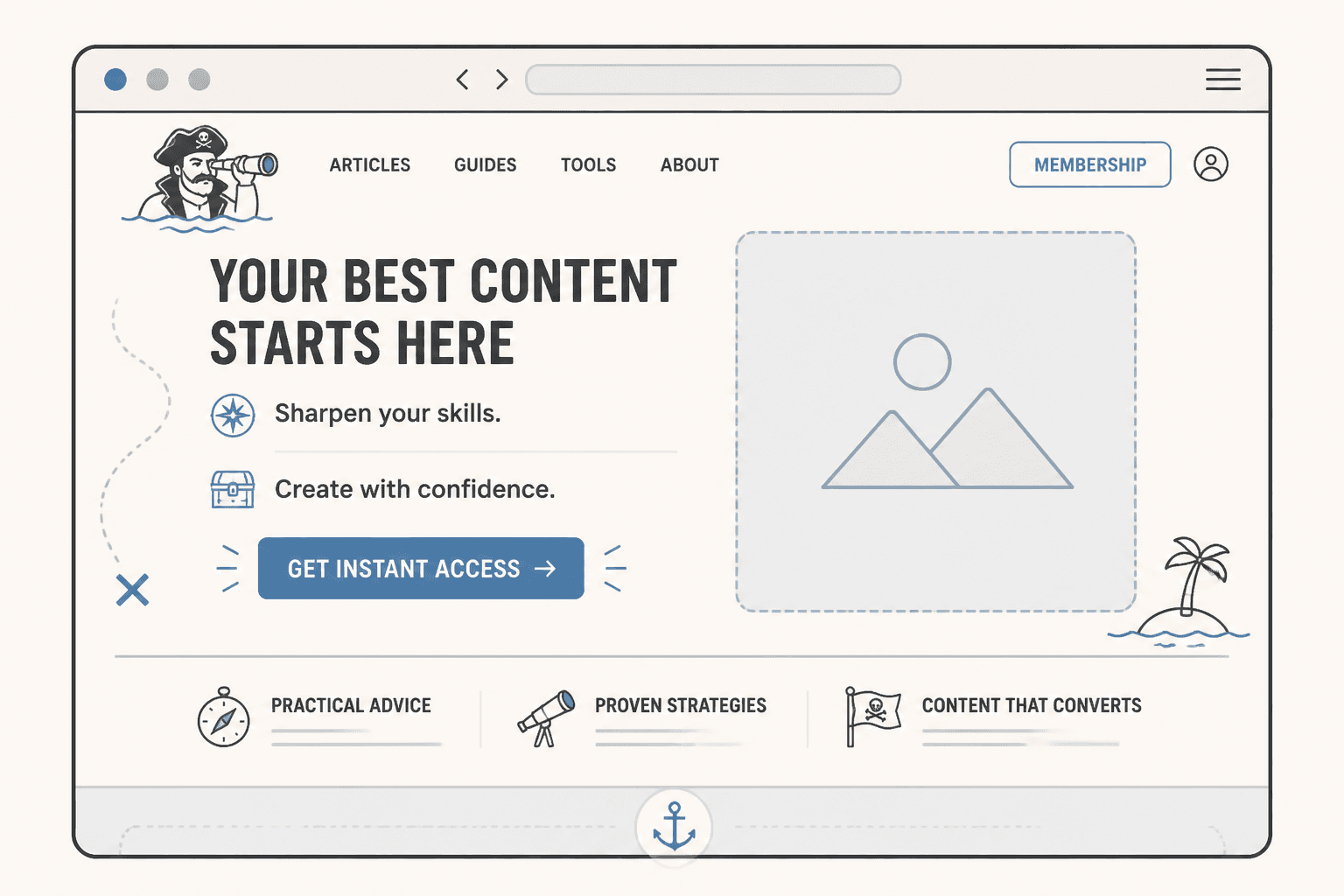
Homepage hero
- Headline: 6 to 14 words
- Support copy: 15 to 40 words
- CTA: 2 to 6 words
Your homepage hero is not the place for your whole philosophy.
Offer overview
- 80 to 200 words
- 1 clear subhead
- 2 to 4 short paragraphs or 3 to 5 bullets
This section should help the reader understand what the offer is, who it is for, and what they can expect.
Problem and stakes section
- 150 to 300 words
- Can be broken into bullets, short paragraphs, or a blend
Useful if the buyer needs to feel seen before they trust your solution.
Method or framework section
- 3 to 6 steps
- 1 to 3 sentences per step
Enough detail to feel real. Not a mini textbook.
Proof section
- 3 to 8 proof points, depending on page length
- Use short testimonials, examples, metrics, outcomes, or mini case studies
This is one area where more can help, if it stays readable.
FAQ
- 4 to 8 questions
- 2 to 5 sentences per answer
Keep it tight. FAQ sections die when every answer turns into a hostage paragraph.
Signs your messaging is too short
- People ask what you actually do after reading your page
- Your copy sounds clever but not concrete
- Your offer could apply to almost anyone
- You have no explanation of what is included or how it works
- The CTA asks for too much trust too quickly
- Readers bounce because nothing feels grounded
Short messaging fails when it removes friction by removing meaning.
Signs your messaging is too long
- The core point does not appear quickly
- Your headline needs a nap halfway through
- You repeat the same promise in slightly different outfits
- You explain your process before explaining why it matters
- The page reads like you are trying to pre-answer every possible objection
- Your CTA is buried under an avalanche of context
Long messaging fails when it tries to earn trust through sheer volume. That is not persuasion. That is copy-based cardio.
A simple editing rule: trim the claim, expand the proof
If your page feels too long but you do not know what to cut, start here: shorten the broad claims and expand the concrete support.
Weak long copy often sounds like this:
I help purpose-driven entrepreneurs align their vision, voice, message, and market positioning for sustainable growth and meaningful impact.
Very important-sounding. Very slippery.
Better:
I help coaches and consultants tighten their offer messaging so the right buyers understand the value faster and hesitate less.
That usually means fixing vague positioning, bloated website copy, and sales pages that explain everything except why the offer is worth buying.
Notice what changed:
- Narrower audience
- Clearer problem
- More visible outcome
- Specific friction points
Not necessarily shorter overall. Just sharper. If you want help building that kind of clarity, read how to write better offer messaging and positioning.
What 2026 changes, and what it does not
In 2026, people are even more used to scanning, comparing, and making fast judgments. AI-generated sameness has also made generic copy easier to produce and easier to ignore. That means your offer messaging needs stronger specificity up top. Readers are less patient with fluffy intros because they have seen too many of them already.
But this does not mean every page should be tiny. If anything, strong pages now need a better mix of fast clarity and deeper substance. People want to understand quickly, then verify carefully. So the structure matters more than the absolute word count.
The bigger point is simple: clearer structure and clearer writing make the piece more useful. That is usually what makes the ending land better too.