
Most weak offer messaging does not fail in the middle. It fails in the first few lines.
You get a vague promise, a puffed-up positioning line, or a soft little intro that sounds like it is warming up for the real point. By the time the reader reaches the part where you finally say something useful, they are gone.
If you want to know how to start offer messaging & positioning without a weak opening, the fix is not “sound more confident” in some abstract branding workshop sense. The fix is simpler and less glamorous: lead with the actual problem you solve, who it is for, and why your angle is worth caring about.
This is where a lot of smart people get weirdly timid. They know their work. They know the result they help create. Then they open with something foggy like “I help ambitious businesses thrive through strategic transformation.” Which is a lovely sentence if your goal is to make people feel nothing at all.
Here is how to open your offer messaging with more clarity, more bite, and a lot less beige. If your homepage intro, offer page, sales page, bio, or positioning statement feels weak, this will help you tighten it fast.
If you want the bigger picture, start with the parent guide.
What a weak opening actually looks like
A weak opening usually has one or more of these problems:
- It talks about you before it talks about the reader
- It uses abstract words instead of real problems
- It sounds polished but says almost nothing
- It hides the offer behind vague “brand” language
- It takes too long to reveal who the offer is for
- It tries to sound impressive instead of useful
And no, this is not just a homepage issue. Weak openings show up in hero sections, LinkedIn intros, service pages, workshop sales pages, lead magnet pages, and even DMs. Anywhere you need someone to quickly understand what you do, weak opening copy becomes expensive.
The annoying part is that weak openings often sound professional. Clean. Brand-safe. Nicely arranged. Which is exactly why they survive so long. Nobody reads them and thinks, “This is terrible.” They read them and think, “I guess that sounds fine.” Then they leave.
If your opening could belong to 500 other coaches, consultants, freelancers, or agencies, it is not positioning. It is wallpaper.
What a strong opening needs to do instead
A strong opening does not need to be dramatic. It needs to be clear fast.
When someone lands on your page or reads your first lines, they are trying to answer a few basic questions:
- Is this for someone like me?
- Do they understand the problem I actually care about?
- What do they help with?
- Why this approach instead of the usual recycled nonsense?
- Do I want to keep reading?
Your opening should help them answer those questions without making them work for it.
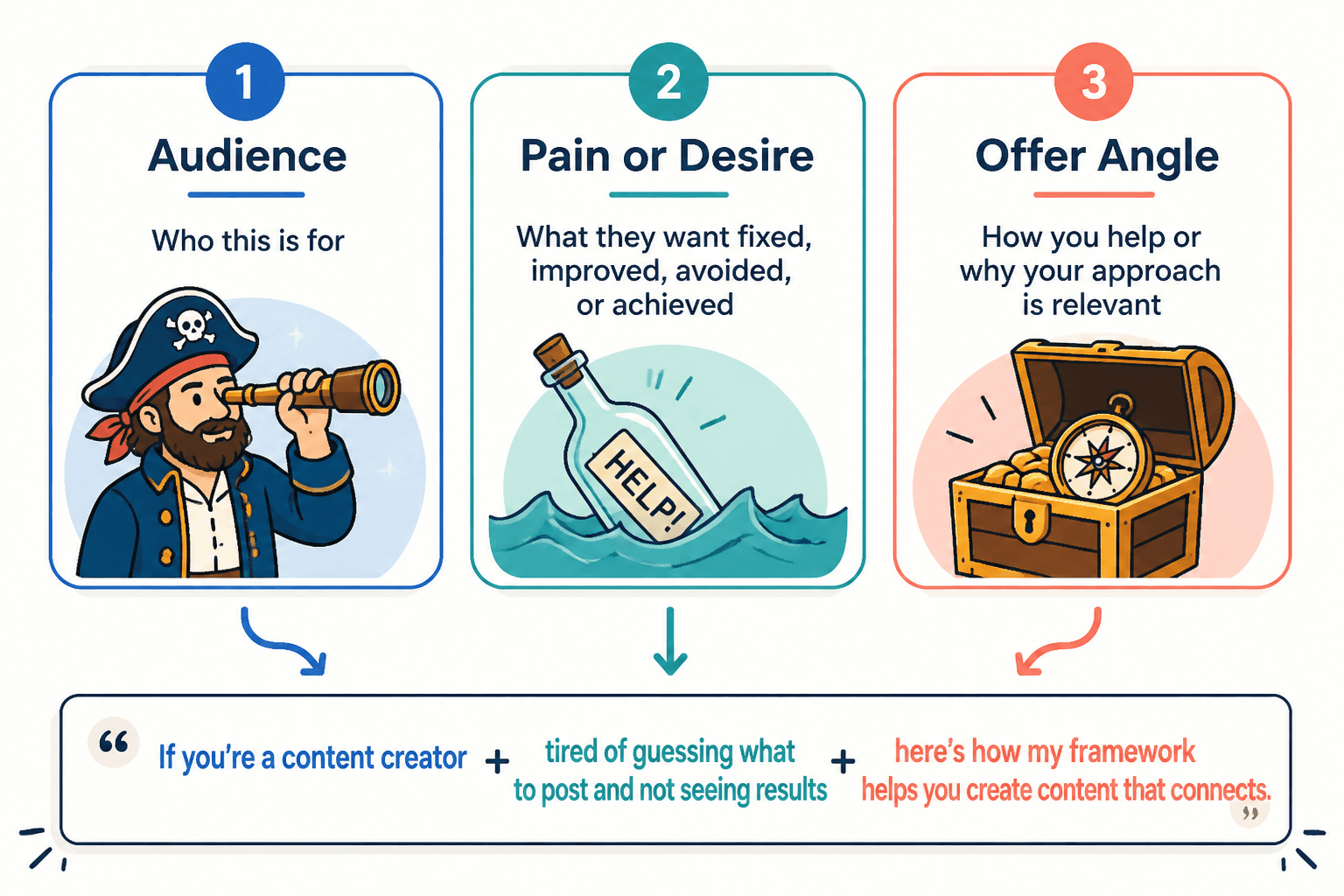
That means your start should usually contain some version of these three things:
- The audience: who this is for
- The pain or desire: what they want fixed, improved, avoided, or achieved
- The offer angle: how you help, or what makes your approach relevant
Not every opening needs all three in one sentence. But if none of them show up early, you are probably drifting into vague territory.
Start with the pain, not your process
One of the fastest ways to kill an opening is to begin with your methodology, philosophy, or service mechanics before the reader even knows why they should care.
People do not show up hoping to admire your process map. They show up because something feels off, stuck, slow, messy, unclear, or underperforming.
So start there.
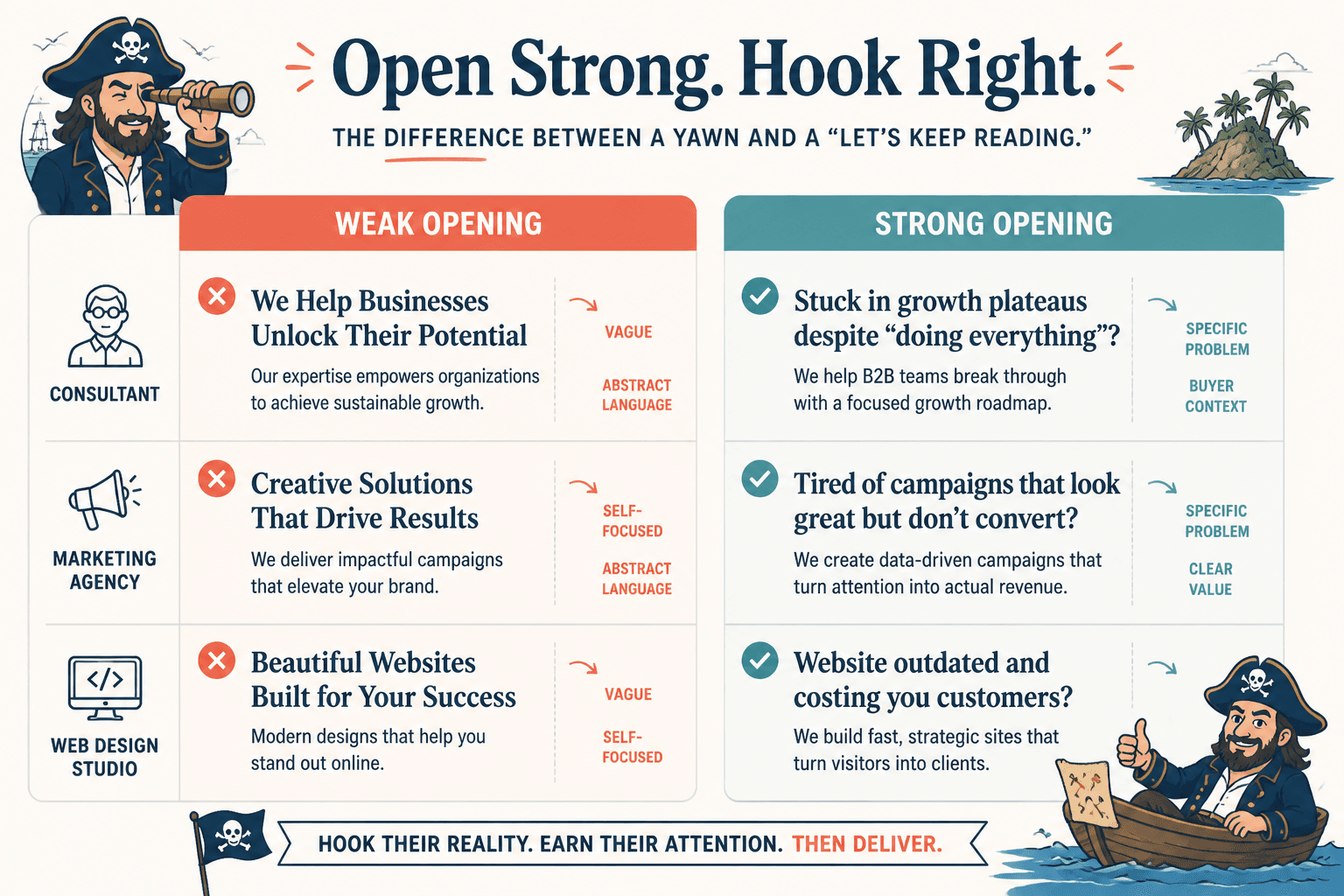
Weak
I use strategic messaging frameworks to help brands clarify their voice and align their offers.
Stronger
If your offer sounds polished but still does not make people care, the problem usually is not your design. It is your messaging. I help service businesses turn vague positioning into clear offers people actually understand and buy.
The second version works better because it starts where the reader already is. Confused conversions. Weak response. Polished surface, unclear message. That is a real problem. Then it names the fix.
There is room for process later. But opening copy should earn attention before it explains mechanics.
Use specific tension, not broad ambition
A lot of opening lines lean on giant vague goals: grow, scale, thrive, elevate, stand out, unlock, transform. The issue is not that these words are illegal. The issue is that they are too broad to create recognition.
Specific tension is what gives your opening traction. It shows the reader you understand what is actually frustrating, costly, or getting in the way.
Compare these:
- Broad ambition: Help your business grow with better messaging
- Specific tension: Stop losing good-fit leads because your offer takes too long to understand
- Broad ambition: Build a brand that stands out
- Specific tension: Fix the generic positioning that makes your business sound interchangeable
- Broad ambition: Attract aligned clients
- Specific tension: Make your offer clear enough that the right people self-identify faster
This is one of the simplest ways to improve your opening: trade broad aspiration for specific friction.
Lead with the reader’s reality
If your opening sounds like a mission statement, it will probably feel distant. Strong offer messaging usually sounds closer to the reader’s lived problem.
That does not mean being melodramatic. It means naming what is happening in language the reader would actually recognize.
Examples of reader-reality openings
- Your offer is solid. Your messaging is what keeps making it sound ordinary.
- If people keep asking what you do after reading your homepage, your positioning is too soft.
- You do not need more traffic yet. You need an offer people can understand in one pass.
- If your service is good but your sales page feels foggy, the opening is probably where things start slipping.
These lines work because they mirror a recognizable problem. They are grounded. They create a small jolt of identification. That is often enough to keep someone reading.
A simple structure for how to start offer messaging & positioning without a weak opening
If you want a practical formula, use this:
- Name the problem or friction
- Make clear who it affects
- Show the result or shift you help create
- Add a distinguishing angle if needed
That can look like this:
For [audience] dealing with [specific problem], I help [result] through [clear offer or angle].
Yes, that is a formula. No, you should not use it like a cardboard template and call it a brand voice. The point is structure, not robotic repetition.
Filled examples
- For consultants whose expertise keeps getting buried under generic website copy, I help sharpen offer messaging so the right clients understand the value faster.
- I help coaches with messy service pages turn vague positioning into clear, credible offers that sound human and convert better.
- When your offer is good but your messaging opens weak, I help you fix the first lines, positioning, and page flow so interest does not die on contact.
If you want more help tightening the actual language, this guide on improving positioning lines without sounding generic pairs well with this one.
What to avoid in the first lines
Here are the usual offenders.
| Avoid this | Why it weakens the opening | Try this instead |
|---|---|---|
| “Welcome to my website” | It wastes prime attention | Start with the problem or promise |
| “I’m passionate about helping…” | The reader does not care yet | Lead with what changes for them |
| “We provide innovative solutions…” | Generic corporate fog | Name the actual service and outcome |
| “Helping ambitious entrepreneurs…” | Too broad and overused | Define the audience by problem or stage |
| Long backstory before the offer | Delays clarity | State the offer first, context later |
| Fancy brand language with no tension | Sounds polished but empty | Use reader-recognizable friction |
A lot of this comes down to restraint. You do not need to say everything at once. You just need to say the right thing first.
Before-and-after rewrites
Sometimes the fastest way to fix weak openings is to see the difference on the page.
Example 1: coach
Before: I help ambitious women step into their power and build aligned businesses through mindset and strategy.
After: If your business looks functional on paper but still feels messy, underpriced, or hard to sell, I help coaches tighten their offer, messaging, and client path so growth stops feeling so improvised.
The rewrite drops the floaty language and gives us real friction: messy, underpriced, hard to sell, improvised growth. Much better.
Example 2: copywriter
Before: Strategic copywriting for visionary brands ready to scale with authentic messaging.
After: I write website copy for service businesses that are tired of sounding polished but forgettable. Clearer message, sharper offer, easier yes.
The second version has tension and contrast. Polished but forgettable is a problem. Easier yes is a result. Cleaner.
Example 3: consultant
Before: We partner with organizations to drive transformation through strategic advisory services.
After: When your offer has gotten complicated, hard to explain, and slower to sell, we help simplify the message so buyers understand the value faster.
Again, notice the pattern: less grand language, more buyer reality.
If your current draft still sounds too polished and strangely empty, read how to rewrite boring offer messaging and positioning. It will help you strip out the filler without flattening the personality.
How to find the right opening if you are staring at a blank page
If you are stuck, do not ask, “What is the smartest way to describe my brand?” That question tends to produce ceremonial nonsense.
Ask these instead:
- What is going wrong before people hire me?
- What do clients say when they realize the issue?
- What confusion, friction, or missed opportunity does my offer fix?
- What type of person is this most relevant for?
- What result do they care about first, not eventually?
Then draft 5 to 10 opening lines based on those answers. Not one. Several. The first version is often still a bit stiff because you are translating thought into copy. By version four or five, you usually find sharper wording.
This matters because good openings are rarely “inspiration.” They are usually the result of choosing the most useful angle, then tightening it until it actually lands.
Do not confuse clever with strong
You do not need a cute line, a twist, or a cinematic hook to open offer messaging well. Cleverness is optional. Clarity is not.
There is a certain kind of opening that sounds impressive for three seconds and then collapses under basic scrutiny. It hints. It teases. It performs intelligence. But it does not make the offer easier to understand.
For offer messaging, “interesting but unclear” is usually worse than “plain but sharp.” You can always add style once the core point is solid. Starting with style and hoping meaning appears later is how you end up with homepage copy that reads like expensive perfume packaging.
Where this opening should show up across your site
Once you have a strong opening, use the logic consistently across your core copy. Not word-for-word everywhere like a robot with one sentence, but consistently enough that your message stops shape-shifting.
- Homepage hero: lead with the clearest version
- Offer page intro: connect the offer to a specific problem
- About page opening: frame your work around reader relevance, not biography first
- Social bio: compress the same positioning into fewer words
- Lead magnet landing page: open with the friction that makes the resource matter
If your pages all describe your business differently, the opening is not doing enough strategic work. This is where a stronger offer-messaging foundation helps. The parent guide on offer messaging and positioning is useful if you want to tighten the whole system, not just the intro.
You may also want to pair this with writing offer messaging without sounding salesy or robotic, because some people overcorrect after fixing weak openings and suddenly sound like they swallowed a funnel template.
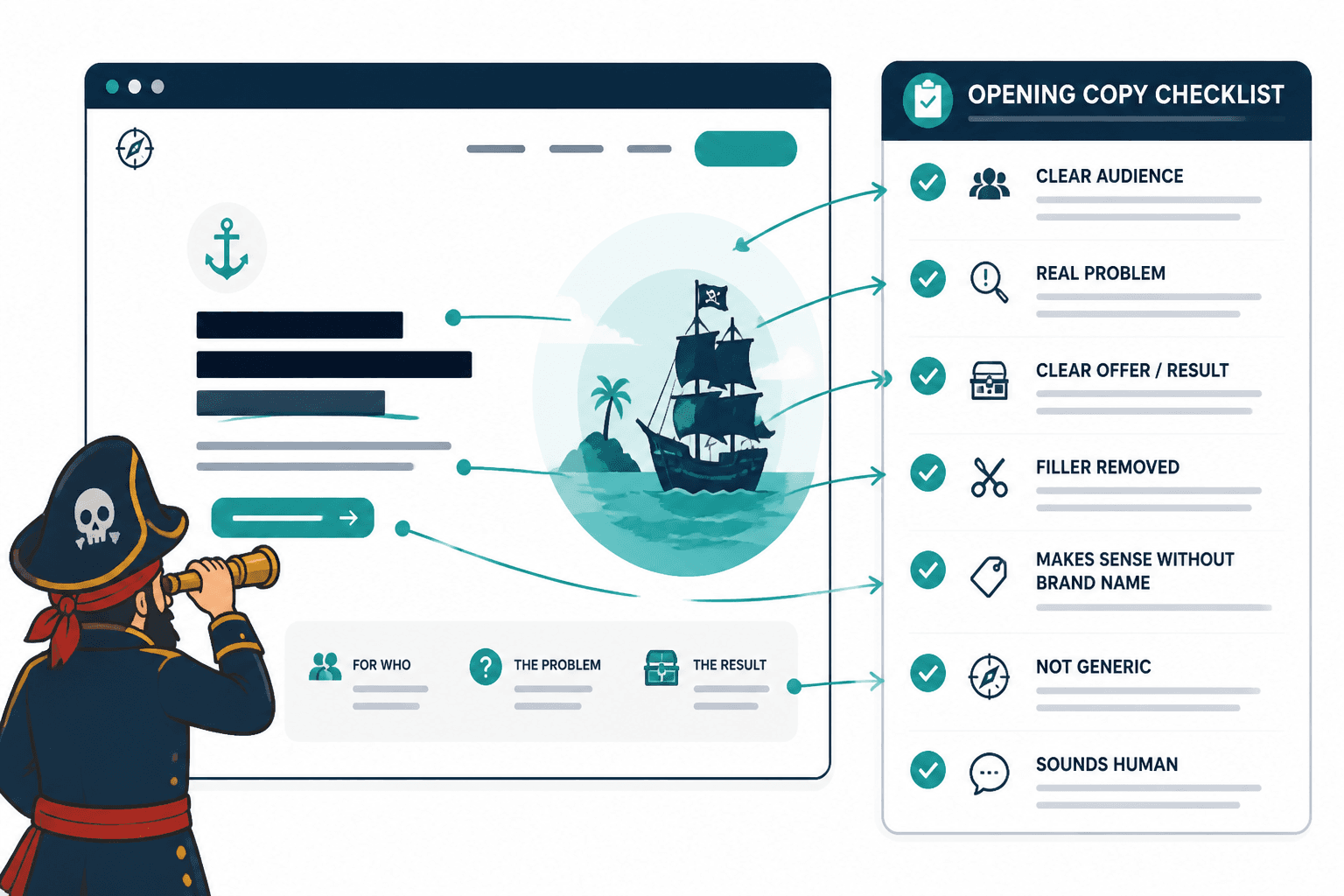
A quick editing checklist for stronger openings
- Can a stranger tell who this is for within a few seconds?
- Does the opening name a real problem, not a vague ambition?
- Is the offer or result clear early?
- Did you remove filler like “welcome,” “passionate,” and “innovative”?
- Would this still make sense if your brand name were removed?
- Could the line belong to 50 competitors? If yes, sharpen it.
- Does it sound like a person talking clearly, not a committee polishing a mission statement?
That last one matters more than people think. Readers are not grading your professionalism. They are scanning for relevance. Clear beats ceremonial every time.
FAQ
How long should an offer messaging opening be?
Usually one to three short lines. Enough to create clarity, not enough to become a miniature essay before the page even starts.
Should I mention the audience in the first line?
If it helps sharpen relevance fast, yes. But sometimes naming the problem first works better. Use whichever creates faster recognition.
Can I start with a bold statement or question?
Yes, if it leads to clarity. No, if it is just dramatic throat-clearing in nicer shoes.
The bigger point is simple: clearer structure and clearer writing make the piece more useful. That is usually what makes the ending land better too.