
Most positioning lines are not bad because they are unclear. They are bad because they are painfully familiar.
They use polished words, broad promises, and vague authority signals that sound respectable right up until they sound exactly like everyone else in the category. “I help ambitious founders grow with strategic messaging.” Fine. Also forgettable. Also suspiciously similar to 400 other bios, headers, and homepage hero sections.
If you want to know how to improve positioning lines without sounding generic, the fix is not making them fancier. It is making them sharper. More specific. More grounded in a real audience, a real problem, and a real result people can picture without needing a decoder ring.
This is where a lot of creators, consultants, and service businesses get stuck. They know what they do. They may even be very good at it. But when it is time to compress that into one clean line, they either become too vague, too clever, or too allergic to sounding simple. So the positioning line turns into soft beige paste.
Here’s how to fix that without sounding robotic, salesy, or like your website was raised by LinkedIn templates.
If you want the bigger picture, start with the parent guide.
What a positioning line is actually supposed to do
A positioning line is not your life story. It is not your mission statement. It is not a place to cram every service, credential, and personality trait into one sentence until it wheezes.
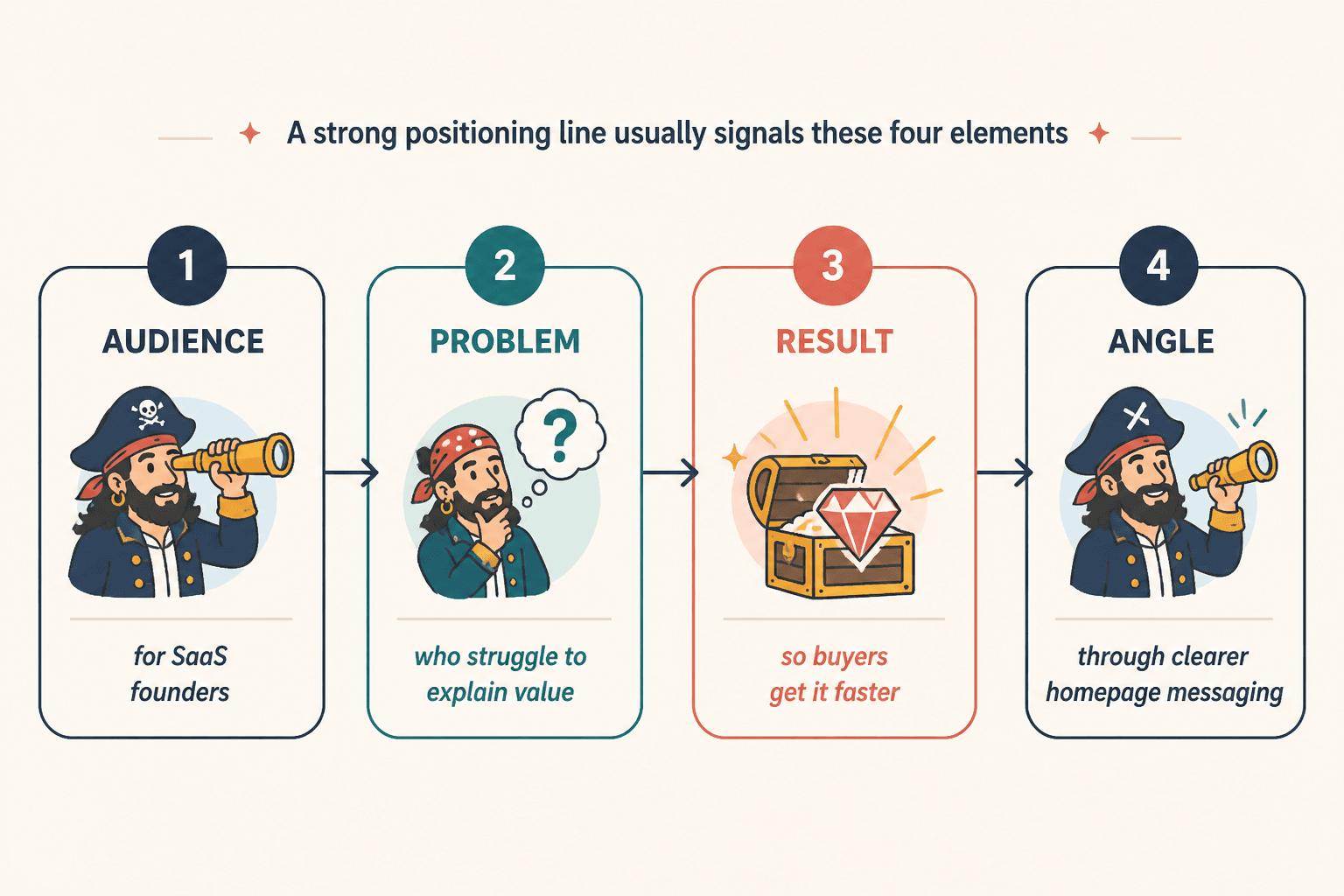
Its job is much simpler than people make it: help the right person quickly understand who you help, what you help them do, and why your angle is worth paying attention to.
That means a good positioning line usually does at least three things:
- Names or implies a specific audience
- Points to a valuable outcome or problem solved
- Hints at your angle, method, or difference
Not every line needs all three in equal measure. But if your line has none of them, you do not have positioning. You have brand-flavored wallpaper.
If you need help getting the broader foundation right first, start with offer messaging and positioning before obsessing over the one-liner.
Why generic positioning lines keep happening
Generic positioning usually comes from one of four habits.
1. You are trying to sound credible instead of useful
People reach for words like “strategic,” “transformational,” “innovative,” “impactful,” and “aligned” because they sound professional. They also say almost nothing on their own.
Credibility matters, obviously. But credibility comes from clarity, proof, and relevance. Not from stapling glossy words onto a sentence until it looks expensive.
2. You are describing the category, not your fit inside it
“I help businesses grow online.” Sure. That is technically a sentence. It is also so broad that nobody knows if you mean SEO, ads, copy, funnels, content, web design, or interpretive dance with a sales page attached.
Broad lines feel safer. They also make you easier to ignore.
3. You are hiding behind abstract outcomes
Words like “clarity,” “confidence,” “growth,” and “visibility” are not useless. But they get generic fast when they are not attached to a concrete context.
“I help consultants get clearer messaging” is fine but soft. “I help consultants explain what they do in a way that gets better-fit leads and fewer confused discovery calls” is immediately stronger because the result has shape.
4. You are trying to include everything
A positioning line is not improved by listing all your audiences, all your services, all your values, and three results. That is not clarity. That is overpacking.
If your line reads like it was negotiated by committee, it probably was. Even if the committee was just you in five different tabs, overthinking things.
How to improve positioning lines without sounding generic
Here is the practical part. If your current line feels bland, do not start by polishing it. Start by pressure-testing the thinking underneath it.
Step 1: Get brutally clear on who the line is for
You do not always need to literally name the audience, but you do need to know them clearly enough that the line sounds made for them.
Bad audience language is usually too broad:
- business owners
- entrepreneurs
- brands
- professionals
- creatives
Better audience language is usually more grounded:
- independent consultants
- service-based founders
- creators with digital offers
- coaches with messy messaging
- B2B experts trying to turn expertise into demand
You are not trying to narrow for the sake of looking niche. You are trying to make the right person feel accurately seen.
Step 2: Replace vague outcomes with visible ones
A good positioning line often gets stronger the moment the result becomes easier to picture.
Compare these:
- I help experts build authority online.
- I help experts turn their expertise into clear content, stronger positioning, and more qualified inbound leads.
The second one is not brilliant poetry. It is just more usable. The reader can imagine what changes.
When you are improving a line, ask: what does the result look like in real life? Better leads? Cleaner website copy? More sales calls with people who actually get the offer? Less confusion in DMs? Faster yeses? Pick outcomes with edges.
Step 3: Add your angle, not your resume
What makes your line less generic is often not more credentials. It is a more distinct point of view, method, audience fit, or problem framing.
Your angle might be:
- the type of people you serve
- the kind of problem you solve
- the way you solve it
- what you refuse to do
- the specific result you focus on
- the context you understand better than most
For example:
- Generic: I help founders with messaging.
- Stronger: I help service-based founders fix fuzzy messaging so their website sounds clear, credible, and worth paying for.
Same category. Better angle. More shape.
Step 4: Stop trying to sound profound
Clever wording is not evil. But most positioning lines collapse when people start optimizing for impressive over understandable.
If someone has to reread your line to figure out what you do, that is usually not intrigue. It is friction.
Clear beats clever most of the time. Clever can come after clear, if there is room.
Step 5: Write more versions than you think you need
The first version is usually your default industry language. The second version is often slightly better but still cautious. Somewhere around versions five through fifteen, the real distinctions start showing up.
This is one reason positioning work takes people longer than expected. It is not because the line is hard to write. It is because the clarity underneath it takes a minute to earn.
If your current line still feels stiff, this is a good companion read: how to rewrite boring offer messaging and positioning.
A simple formula that does not sound like a template if you use it properly
Templates are useful until people worship them. Use this as structure, not as a personality replacement.
I help [specific audience] [solve problem / get result] through [angle, method, or context].
Examples:
- I help independent consultants clarify their messaging so prospects understand the value fast and stop ghosting after discovery calls.
- I help creators turn scattered expertise into sharper offers, clearer content, and a website that actually pulls its weight.
- I help coaches fix vague positioning so their offer sounds specific, credible, and easier to buy.
Notice what makes these work better than generic versions:
- The audience is identifiable
- The result is practical
- The language is plain
- The promise is meaningful without becoming ridiculous
That last one matters. If your line promises to revolutionize everything in twelve words, people will smell the internet on it.
Before-and-after positioning line rewrites
Sometimes the easiest way to see the difference is side by side.
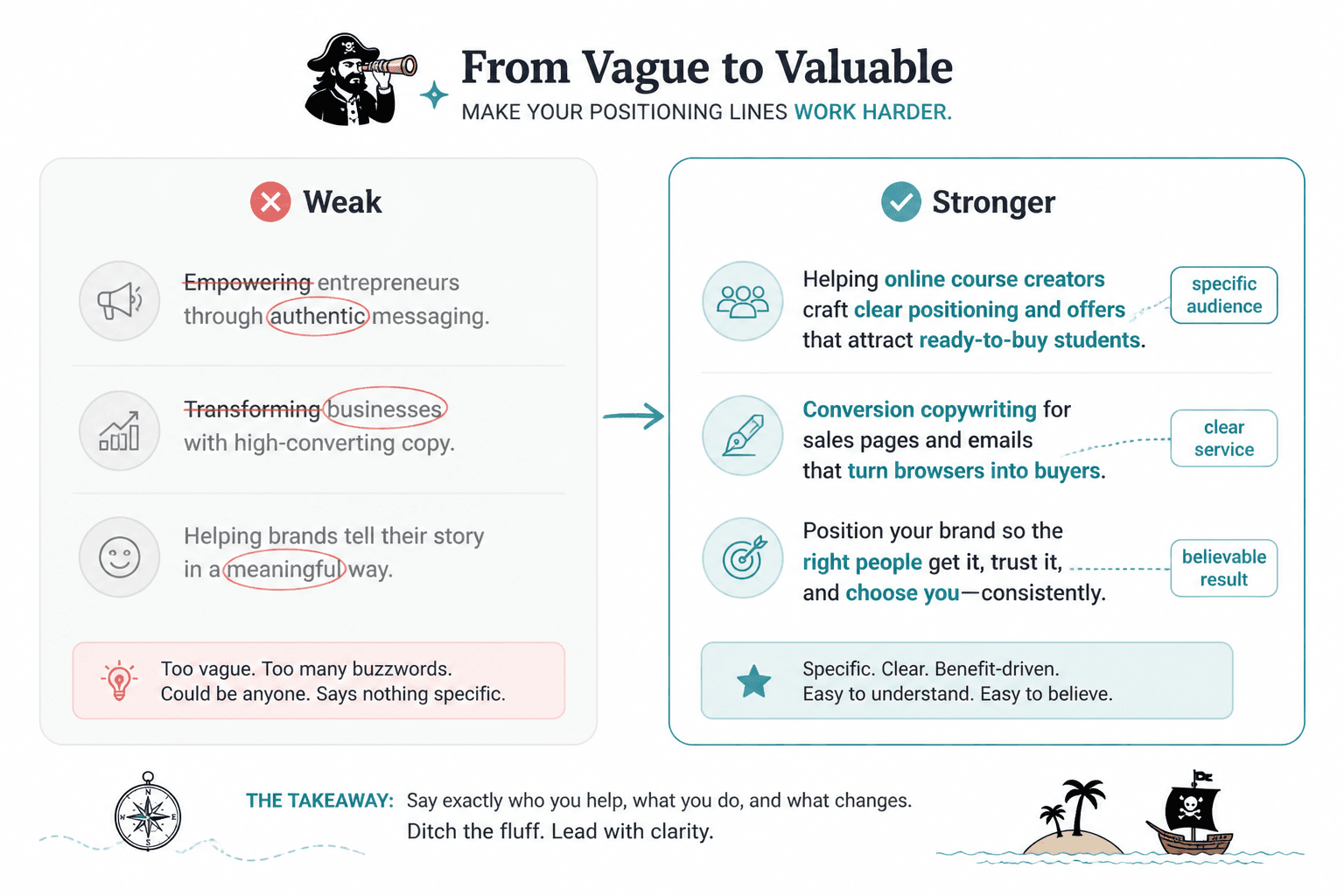
| Weak version | Stronger version | Why it works better |
|---|---|---|
| I help brands grow with strategic content. | I help personal brands turn their expertise into content that builds trust and brings in better-fit leads. | Specific audience, clearer outcome, less corporate fog. |
| Empowering entrepreneurs through authentic messaging. | I help online business owners explain what they do more clearly so the right people actually want the offer. | Drops fluff, adds practical result. |
| Transforming businesses with high-converting copy. | I write website copy for service businesses that need clearer positioning, stronger trust, and more qualified inquiries. | Names service, audience, and result without sounding inflated. |
| I help coaches scale with clarity and confidence. | I help coaches tighten their offer messaging so their sales page, bio, and content all say the same useful thing. | Makes the abstract result more concrete and believable. |
What to cut from a generic positioning line
If your line feels weak, these are usually the first things to remove or challenge.
- Empty adjectives: strategic, impactful, powerful, aligned, authentic, transformative
- Broad audience labels: entrepreneurs, leaders, businesses, visionaries
- Overpromised outcomes: scale effortlessly, unlock massive growth, transform your life and brand
- Soft filler: passionate about, dedicated to helping, on a mission to support
- Clever but unclear phrasing: if it sounds poetic but nobody knows what you do, it goes
This does not mean every adjective is banned. It means adjectives do not get to do the heavy lifting.
Questions that force a better positioning line
When the line is fuzzy, the issue is usually upstream. These questions help pull out stronger material.
- Who is this specifically for, and who is it not for?
- What problem are they tired of dealing with?
- What result do they actually care about, not just the polite version?
- What do I help them do that competitors also claim, but in a more specific way?
- What context do I understand unusually well?
- What happens after my work is done that makes the value obvious?
- What words would my best-fit client actually use to describe the problem?
That last one is often where the good stuff is. Positioning improves fast when it starts sounding more like the buyer’s brain and less like a branding workshop.
If your opening line also feels weak on the page, read how to start offer messaging and positioning without a weak opening. A decent positioning line can still fall flat if the surrounding copy drifts into throat-clearing.
How specific should your positioning line be?
Specific enough that the right people feel a click. Not so specific that the line becomes cramped, weirdly technical, or impossible to use across your website and profiles.
There is a balance here. If your line is too broad, it sounds generic. If it is too narrow, it can become awkward and fragile. You do not need to stuff in every qualifier just to prove you know your niche.
For example, this is probably too broad:
I help founders grow.
This is probably too cramped:
I help first-time female SaaS founders with pre-seed B2B workflow products improve investor-facing and customer-facing messaging for top-of-funnel acquisition.
And this is much more workable:
I help early-stage SaaS founders clarify their messaging so buyers understand the product faster.
You can always add nuance elsewhere on the page. Your positioning line does not need to carry the entire business on its back.
Where your positioning line should show up
Once you have a good one, use it where first impressions matter most.
- Homepage hero section
- About page intro
- LinkedIn headline or bio
- Social profile descriptions
- Lead magnet landing page header
- Pitch decks and speaker bios
- Email intro or signature line, if relevant
That does not mean copy-paste the exact same wording everywhere forever. But your core positioning should be recognizable across channels. If your website says one thing, your LinkedIn says another, and your offer page sounds like a third person took over halfway through, trust gets thin fast.
The bigger point is simple: clearer structure and clearer writing make the piece more useful. That is usually what makes the ending land better too.