
Most people do not ruin trust with CTA writing because they use the wrong button color or forget to say “click here.” They ruin it because the moment money enters the picture, their calls to action start sounding desperate, manipulative, or weirdly overproduced.
That is the real tension behind How to Monetize CTA Writing Without Wrecking Trust. You want content and copy to lead somewhere useful. You want leads, sales, bookings, subscribers, replies, maybe actual revenue. Reasonable goals. But if every CTA suddenly reads like a pushy funnel intern got hold of your brand voice, people feel it fast.
The fix is not “never sell.” That advice sounds noble and usually leads to creators building an audience full of people who clap politely and buy nothing. The fix is writing CTAs that match the relationship, the level of attention you have earned, and the actual value of the next step.
Here’s how to make your CTA writing pull in leads and sales without making your content feel like a bait-and-switch with better punctuation.
Want the broader roadmap? Start with the parent guide.
What goes wrong when people try to monetize CTA writing
CTA writing tends to get ugly when the call to action is doing emotional labor the content did not earn.
You see this everywhere. A decent post ends with a hard pivot into “DM me ‘GROWTH’ if you’re serious.” A useful article suddenly lunges at the reader with “Book your free strategy call today before spots vanish.” A thoughtful thread wraps up with a pitch so thirsty it practically leaves fingerprints on the screen.
The problem is not monetization. The problem is mismatch.
- The content gives light advice, but the CTA asks for a high-commitment sale.
- The tone is helpful, but the CTA shifts into webinar-bot language.
- The audience is still cold, but the CTA acts like trust is already there.
- The offer is vague, so the CTA compensates by getting louder.
- The writer wants conversions, so every post starts ending in the exact same sales move.
People do not mind being sold to nearly as much as internet discourse likes to pretend. They mind being rushed, cornered, or handled. There is a difference.
If you are trying to monetize your content, your CTA writing needs to feel like a logical next step, not a sudden grab for the wallet.
How to monetize CTA writing without wrecking trust: the core principle
The cleanest way to monetize CTA writing without wrecking trust is simple:
Your CTA should feel proportionate to the value, proof, and attention that came before it.
That one rule clears up a lot.
If someone just found you through a short post, the CTA probably should not be “book a call.” If they read a detailed article that solves a meaningful problem and shows clear expertise, then a stronger commercial CTA may fit. If they have seen several useful pieces from you over time, a direct offer can work very well because the relationship already has some weight behind it.
Trust-friendly monetization is really about sequencing. You are not trying to trick people into the next step. You are trying to make the next step make sense.
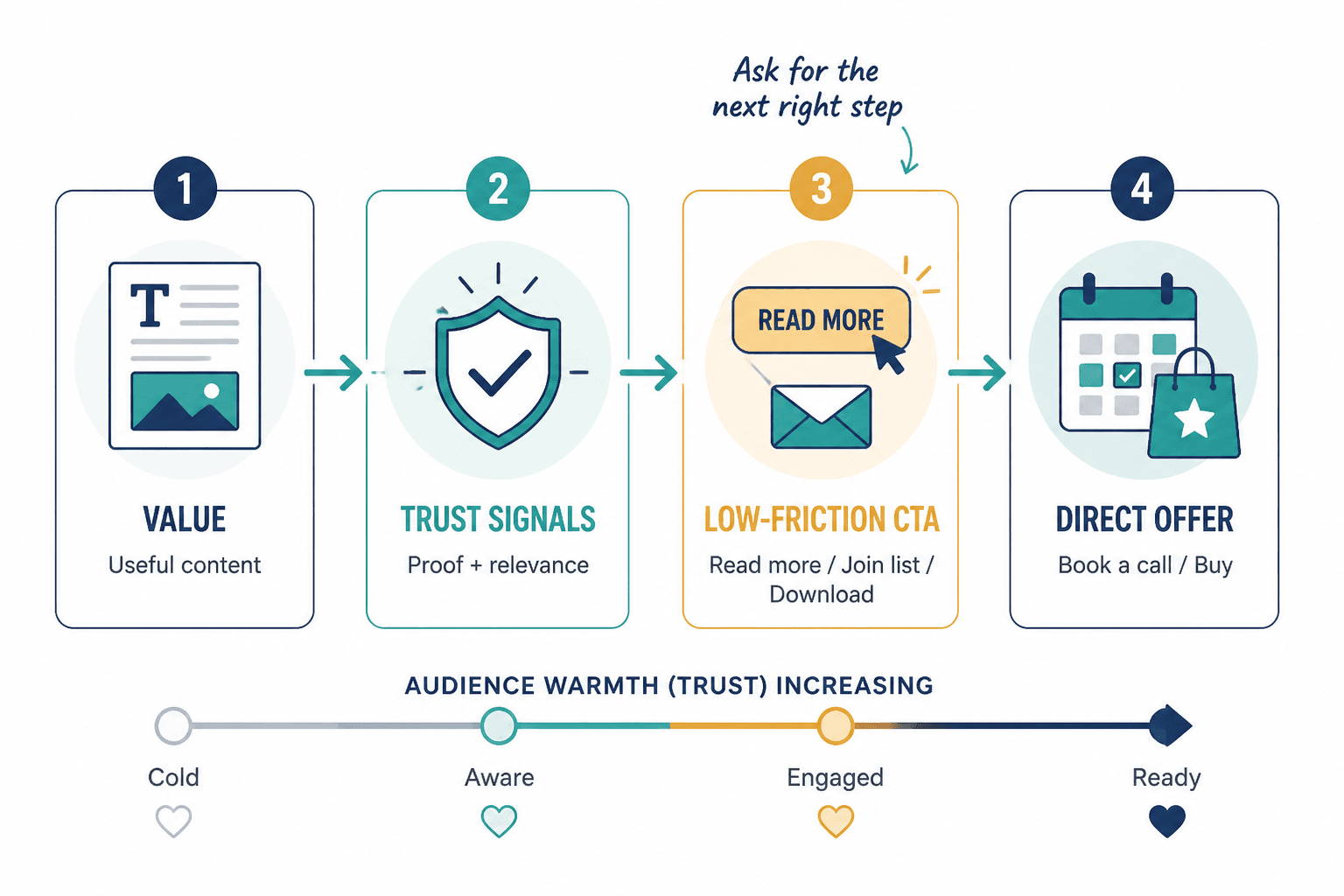
Ask for the next right step, not the biggest possible one
A lot of CTA writing gets wrecked by greed disguised as strategy.
You do not need every post to close a sale. You need your content ecosystem to move people forward. Sometimes that means the CTA is:
- Read a related article
- Reply with a question
- Join the email list
- Download a useful resource
- Check the service page
- Book a call
- Buy the offer
The right move depends on how warm the audience is and how much conviction the content created. This is one reason strong CTA writing sits inside broader CTA writing strategy, not just sentence-level persuasion tricks.
The 5 trust-preserving rules for monetized CTAs
1. Match the CTA to the reader’s stage of trust
Cold readers need lower-friction CTAs. Warm readers can handle stronger asks. Very warm readers often appreciate directness.
| Reader state | Better CTA type | Avoid |
|---|---|---|
| Cold | Read more, follow, subscribe, get resource | Immediate hard sell with no context |
| Warm | Case study, lead magnet, soft consult invite, product page | Vague “let’s work together” fluff |
| Hot | Book call, apply, buy now, reply for details | Overexplaining and adding friction |
This sounds obvious until you look at how many people use the same CTA everywhere. Same ending on posts. Same ending on emails. Same ending on articles. Same ending on threads. It saves time, sure. It also flattens nuance and makes you sound like a person with one move.
2. Sell the next step honestly
A trust-preserving CTA tells the reader what they are actually getting.
Bad monetized CTAs get foggy on purpose:
- “Let’s unlock what’s possible”
- “Take your business to the next level”
- “Transform your results today”
Those phrases are not persuasive. They are evasive.
Better CTA writing says what happens next in concrete terms:
- “If you want help tightening your CTAs, book a 30-minute messaging review.”
- “Want the full template? Grab it here and use it in your next launch email.”
- “If your website gets traffic but not inquiries, this conversion copy package is built for that.”
Clarity builds trust because it reduces the feeling that somebody is trying to steer you into a mystery box with Stripe attached.
3. Keep the tone consistent with the rest of the piece
If your article sounds like a thoughtful human and the CTA sounds like a copywriting contest entry from 2019, people feel the gear shift.
This is where a lot of creators lose credibility. They write plainly all the way through, then hit the reader with some Franken-CTA like:
Ready to stop leaving money on the table and finally scale with intention?
No one talks like that unless they are trying to corner you near a webinar registration page.
If the piece is direct and useful, let the CTA be direct and useful too. If the piece is casual, the CTA can be casual. If the piece is sharper and more opinionated, the CTA can carry some edge. What it should not do is change personality when money appears.
If this is something you struggle with, it helps to study how to write CTA writing without sounding salesy or robotic. Because robotic CTAs are not just ugly. They make people less willing to trust whatever comes next.
4. Make the offer feel earned by the content
A monetized CTA works best when the reader can see exactly why the offer belongs there.
If your post teaches people how to identify weak calls to action, then a relevant offer might be:
- A CTA audit
- A conversion copy service
- A workshop on rewriting offers and buttons
- A template pack for post CTAs or website CTAs
If your content and CTA are disconnected, trust drops. It feels transactional instead of useful. This is why content-to-offer alignment matters more than persuasion flourishes. The CTA should complete the idea, not interrupt it.
5. Do not ask the CTA to fix a weak offer
Sometimes the CTA is not the issue. The offer is muddy, generic, or unimpressive, and the writer keeps trying to rescue it with stronger wording.
That usually leads to pressure tactics, inflated claims, fake urgency, and enough “just imagine” language to trigger hives.
A good CTA can sharpen demand. It cannot manufacture trust around an offer that feels vague or low-value. If people keep ignoring the CTA, check the offer before rewriting the button for the 14th time.
Practical CTA models that monetize without feeling grubby
You do not need every CTA to be soft. You need it to be appropriate. Here are a few monetization-friendly CTA models that usually hold trust well.
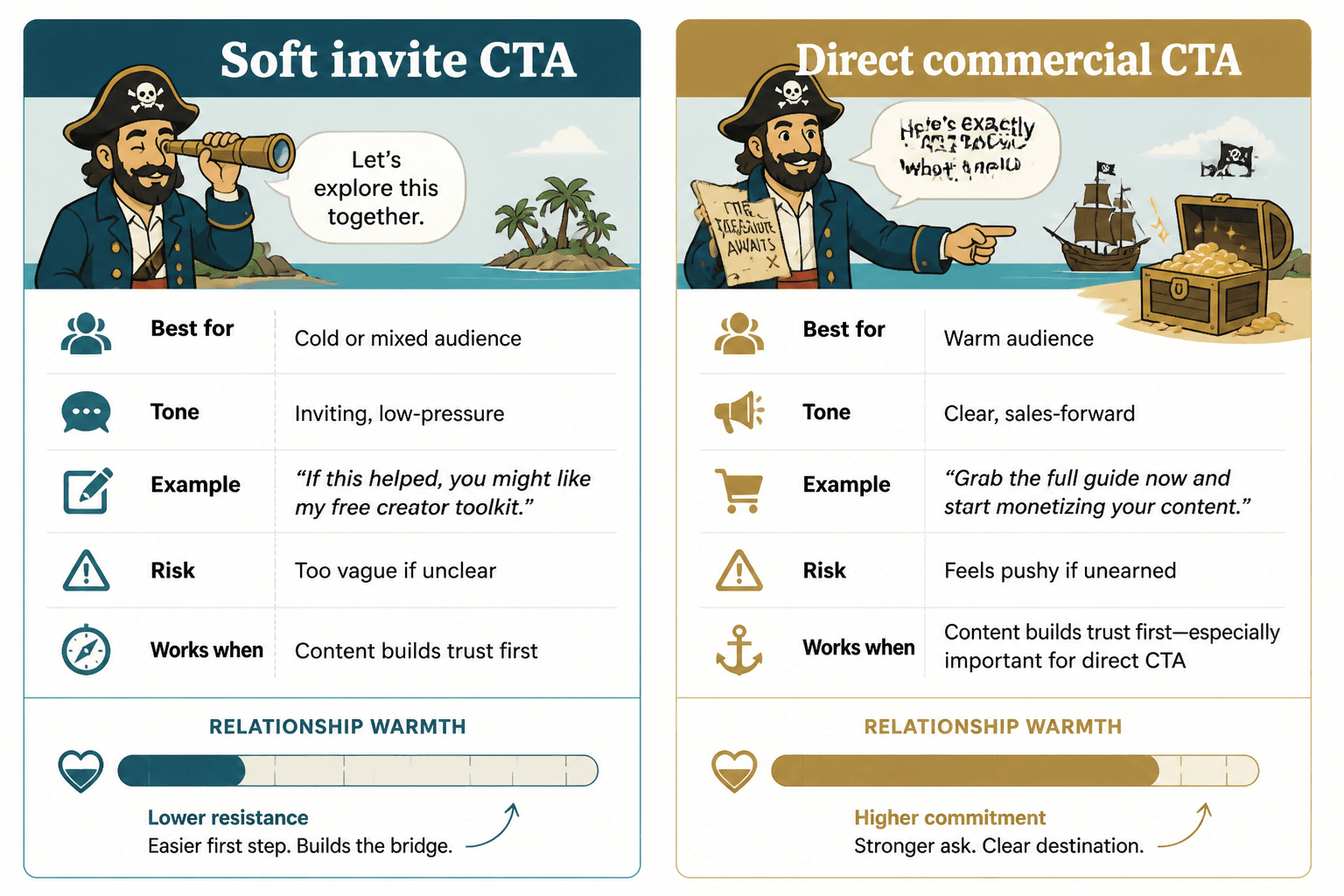
The soft transition CTA
Best when the audience is colder or the content is top-of-funnel.
- “If this helped, the full guide on CTA strategy goes deeper.”
- “If you want more examples, I break that down here.”
- “If your calls to action feel flat, start with this framework.”
This type works because it extends value before asking for commitment.
The problem-specific offer CTA
Best when the content has clearly identified a pain point the offer solves.
- “If your site gets visitors but weak inquiries, my conversion copy package is built to fix that gap.”
- “If your post CTAs get attention but not action, I offer CTA rewrites for personal brands.”
- “If you want someone to tighten your messaging instead of giving you vague advice, that’s what this service does.”
This feels clean because it connects the content problem to a specific commercial solution.
The invite CTA
Best when you want leads without pushing too hard.
- “Want me to take a look at your CTA? Send it over.”
- “If you are reworking your website messaging, reply and I can point you to the right resource.”
- “Need help tightening this on your site or sales page? You can book a review here.”
This model lowers resistance because it feels like an invitation, not a trap door.
The direct commercial CTA
Best when the audience is warm and the offer is already clear.
- “Need this done for you? Book the CTA rewrite service.”
- “If you want stronger conversions from your site, this is the package.”
- “Ready to fix your offer pages and calls to action? Start here.”
Direct CTAs are not inherently trust-breaking. They only feel aggressive when the content has not earned them.
Before-and-after CTA rewrites
Sometimes the easiest way to see the trust issue is in the wording. Here are a few common rewrites.
Example 1: Vague and pushy
- Before: “Ready to unlock more growth? DM me now to scale your business.”
- After: “If you want help tightening the CTAs on your website or posts, send me one and I’ll show you what I’d change.”
The second version is clearer, lower-pressure, and actually says what the interaction is for.
Example 2: Generic article ending
- Before: “If this resonated, let’s connect and explore how we can work together.”
- After: “If your CTA writing sounds fine but still does not move people, my CTA review is built for exactly that problem.”
“Resonated” has done enough damage online. The rewrite names the issue and makes the offer relevant.
Example 3: Too much funnel energy
- Before: “Spots are limited. Book your free strategy session before they’re gone.”
- After: “If you want a second set of eyes on your CTA strategy, you can book a messaging review here.”
The first one leans on pressure. The second one leans on fit.
Example 4: Soft CTA with monetization logic
- Before: “Follow for more tips.”
- After: “If you are working on website conversion copy, the related guides on CTA structure and post CTAs will help next.”
This is still a soft CTA, but it moves the reader deeper into a path that can eventually monetize. Not every CTA needs to cash out instantly.
Where monetized CTAs fit across your content funnel
If your only monetization tactic is “end every piece with buy now,” your CTA writing will start sounding stale and overworked very quickly.
A better approach is to use different CTA strengths across the funnel.
- Top of funnel: read another article, follow, subscribe, save, reply
- Middle of funnel: download a resource, review a case study, check a service page, answer a question
- Bottom of funnel: book a call, buy the product, apply, request a quote
This is how monetization happens without every piece feeling like a sales ambush. You let content do its actual job at each stage.
If you want a more direct angle on converting CTA writing into business outcomes, read how to turn CTA writing into more leads or sales. And if your issue starts much earlier in the sentence, how to start CTA writing without a weak opening is worth your time because weak openings often force CTAs to work too hard later.
How to know when your CTA is hurting trust
You do not need a dramatic public backlash to know something is off. Usually the warning signs are quieter.
- People engage with the content but ignore the offer
- You feel the need to overexplain or add urgency every time
- The CTA sounds noticeably more corporate than the rest of your writing
- Readers click through less when the sales language gets heavier
- You keep reusing the same CTA because nothing else feels safe
- Your content is useful, but inquiries come from poor-fit leads who misunderstood the offer
That last one matters. Trust is not just about getting more yeses. It is also about getting cleaner yeses from people who understand what you actually do.
A simple framework for writing monetized CTAs that still feel human
Use this 4-part structure when you want a CTA to sell without sounding like a hostage note from your funnel.
- Name the problem clearly. What issue is still bothering the reader?
- Bridge to the offer. Why is this next step relevant?
- Describe the next step plainly. What are they clicking, booking, or requesting?
- Keep the tone natural. Say it like the same human wrote the rest of the piece.
Example:
If your website is getting attention but your calls to action are too vague to convert, I offer CTA rewrites that tighten the message and make the next step clearer. You can book that here.
It is not flashy. Good. Flashy is overrated in CTA writing. Clear beats clever most days, especially when money is involved.
The bigger point is simple: clearer structure and clearer writing make the piece more useful. That is usually what makes the ending land better too.