
Most creators do not struggle because their offer is terrible. They struggle because they describe the problem like a sleep-deprived intern writing placeholder copy five minutes before launch.
The result is predictable. Your audience reads your page, post, or pitch and thinks, “Sure, I guess that is annoying,” instead of, “Oh. That is exactly the mess I am in.” And if they do not feel the problem clearly, they will not care about your solution no matter how polished your package looks.
Simple problem framing templates for busy creators fix that. Not by making your messaging sound smarter, but by making it easier for the right people to recognize themselves in what you are saying.
This is about getting clearer, faster. You do not need a 42-page brand strategy document. You need a few sharp ways to describe what is going wrong, why it matters, and what kind of help you actually offer.
If your current messaging says things like “helping creators grow with clarity and confidence,” we need to talk. Gently, but still.
For the full path around this topic, head to the parent guide.
Why problem framing matters more than clever copy
People buy help when they feel understood. Not vaguely encouraged. Understood.
Good problem framing does a few things at once:
- It shows you know what the audience is dealing with
- It makes the problem feel specific and real
- It creates tension around the cost of staying stuck
- It sets up your offer as a relevant next step
- It filters out people who are not actually a fit
Bad problem framing does the opposite. It turns your message into warm, vague mush. You sound nice. You sound professional. You also sound like 600 other people offering “clarity,” “alignment,” and “support.”
That is not positioning. That is wallpaper.
The real job of problem framing
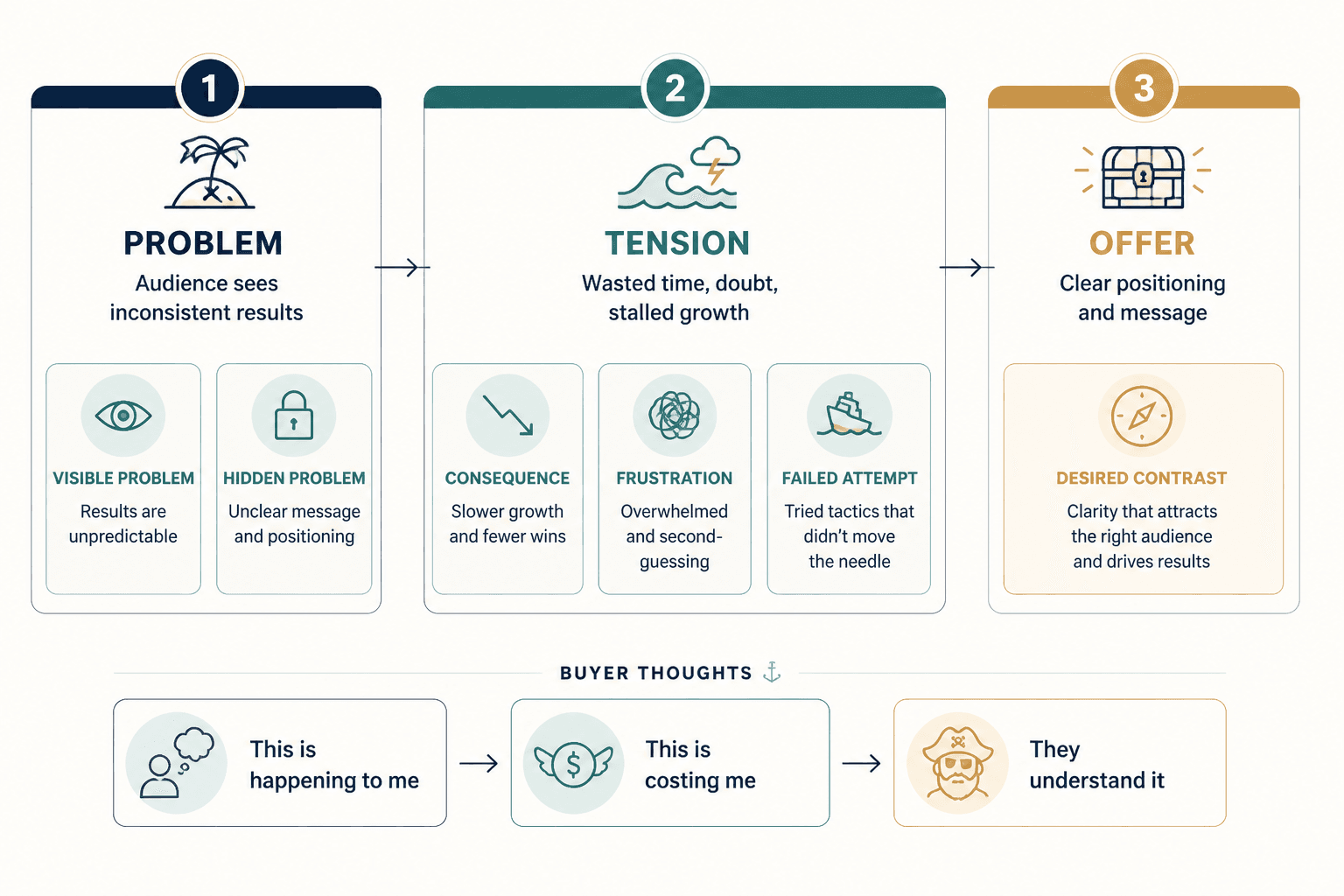
Your job is not to describe every possible pain point. It is to describe the right problem in a way that makes your ideal buyer think three things quickly:
- This is happening to me
- This is costing me more than I thought
- This person seems to understand the shape of it
That is what moves someone from mild interest to actual attention.
For a broader foundation, you can pair this with the offer messaging and positioning guide for creators who want better results. But if your immediate problem is, “I know what I do, but I cannot explain the problem cleanly,” the templates below are the part you probably need first.
What good problem framing includes
Before the templates, here is the quick filter. Strong problem framing usually includes some combination of these:
- The visible problem: what the person notices is not working
- The hidden problem: the deeper issue causing the visible mess
- The consequence: what this problem costs them
- The frustration: what makes it feel especially annoying or defeating
- The failed attempt: what they have already tried that did not solve it
- The contrast: what they want instead
You do not need all six every time. But if your messaging has none of them, it will probably feel thin.
7 simple problem framing templates for busy creators
These are made to be practical, not precious. Use them on sales pages, lead magnets, service pages, profile copy, landing pages, and content hooks. You can also combine them.
1. The “you are doing the work, but not getting the result” template
This one works well for creators, consultants, and service providers whose audience is already making an effort but not seeing traction.
You are [doing effort], but still [missing desired result] because [deeper issue].
Examples:
- You are posting consistently, but still not getting qualified leads because your content is useful without being positioned.
- You are showing up online every week, but still not converting attention because your offer message is too vague to create demand.
- You are writing thoughtful content, but still hearing crickets because the problem you solve is not landing fast enough.
Why it works: it respects the audience. It does not assume laziness. It identifies a frustrating gap between action and outcome.
2. The “it is not just X, it is Y” template
This is great when your audience is misdiagnosing the problem. Which, to be fair, happens a lot.
It is not just [surface problem]. It is [deeper or more useful diagnosis].
Examples:
- It is not just a content problem. It is a positioning problem.
- It is not just that your website copy sounds bland. It is that it never frames the problem sharply enough to create urgency.
- It is not just low engagement. It is weak message-market fit dressed up as an algorithm complaint.
This format is clean, fast, and nicely punchy. Use it in headlines, subheads, posts, and opening sections.
3. The “stuck between” template
Useful when your audience feels trapped between two bad options or conflicting pressures.
You are stuck between [frustrating option A] and [frustrating option B], which makes [desired result] harder than it should be.
Examples:
- You are stuck between trying to sound professional and trying to sound human, which makes your messaging feel stiff and forgettable.
- You are stuck between wanting more clients and not wanting to sound pushy, which leaves your content oddly allergic to selling.
- You are stuck between broad messaging that gets ignored and niche messaging that feels scary, so you keep publishing copy that pleases nobody.
This one works because tension is built in. It gives shape to the audience’s indecision instead of just naming a generic pain point.
4. The “looks like X, actually causes Y” template
This is useful when the obvious symptom is not the real business issue.
What looks like [surface symptom] is actually causing [bigger consequence].
Examples:
- What looks like a weak homepage headline is actually causing people to leave before they understand your value.
- What looks like inconsistent posting is actually causing trust gaps in your funnel.
- What looks like harmless vagueness in your offer statement is actually making your best-fit clients self-select out.
This is strong when you want to raise the stakes without turning theatrical. Important difference.
5. The “you do not need more X, you need Y” template
Very handy for creators selling strategy, messaging, copy, consulting, or simplification.
You do not need more [common thing]. You need [more relevant thing].
Examples:
- You do not need more content ideas. You need better angles for the expertise you already have.
- You do not need more website pages. You need clearer problem-solution messaging on the pages people already visit.
- You do not need another rebrand. You need a sharper explanation of what goes wrong before clients hire you.
This template works because it cuts through common overthinking. It helps you position your offer against noise without ranting about the entire industry like a man with a podcast mic and too much time.
6. The “the reason this feels hard is…” template
This one adds empathy without becoming soft or vague.
The reason this feels hard is not [self-blaming explanation]. It is [more accurate explanation].
Examples:
- The reason this feels hard is not that you are bad at marketing. It is that your offer is still described in expert language instead of buyer language.
- The reason this feels hard is not that you lack value. It is that your messaging makes people work too hard to understand the value.
- The reason this feels hard is not a lack of effort. It is a lack of clean positioning.
This is especially good for audiences who are competent but frustrated. It lowers resistance because it removes the subtle accusation that they are failing due to laziness or incompetence.
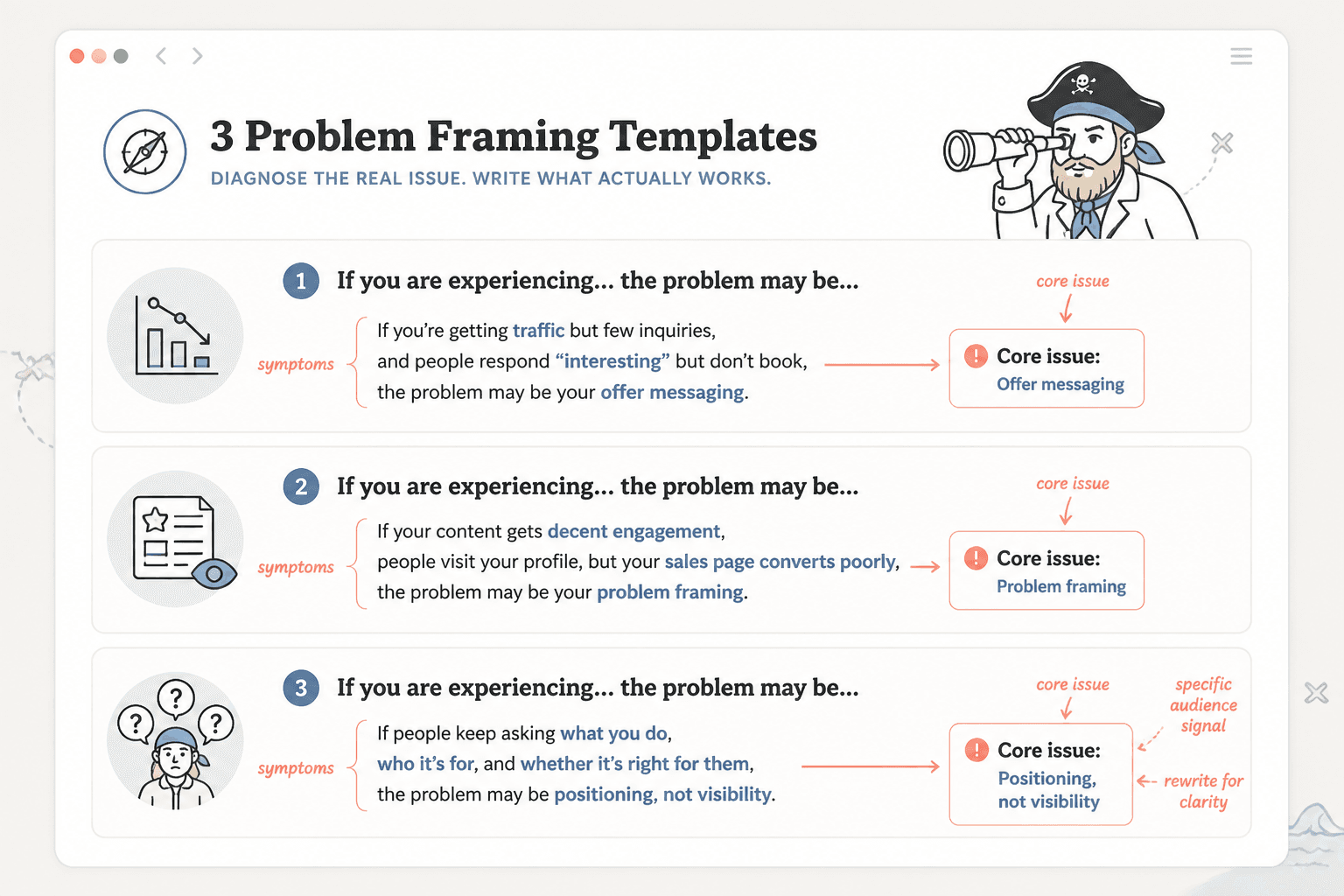
7. The “if you are experiencing A, B, and C…” template
When you need speed and clarity, this one is simple and effective.
If you are experiencing [symptom A], [symptom B], and [symptom C], the problem may be [core issue].
Examples:
- If you are getting traffic, weak inquiries, and lots of polite “interesting” responses, the problem may be your offer messaging.
- If your content performs decently, your bio gets profile visits, and your sales page still does not convert, the problem may be your problem framing.
- If people keep asking what exactly you do, who it is for, and whether it is right for them, the problem may be your positioning, not your visibility.
This format is less elegant than some of the others, but very usable. And usable beats elegant when you are trying to ship.
How to choose the right template
Do not pick the one that sounds smartest. Pick the one that matches what your audience already feels.
| Use this template | When your audience is dealing with |
|---|---|
| You are doing the work, but not getting the result | Effort without traction |
| It is not just X, it is Y | A misdiagnosed problem |
| Stuck between | Conflicting pressures or choices |
| Looks like X, actually causes Y | A hidden business consequence |
| You do not need more X, you need Y | Noise, overcomplication, tool addiction |
| The reason this feels hard is… | Self-blame, confusion, discouragement |
| If you are experiencing A, B, and C… | Multiple symptoms that point to one issue |
If you serve smaller or earlier-stage audiences, this matters even more. You often need simpler, clearer framing because your audience is not browsing for abstract strategy language. They are trying to solve a practical mess. This companion piece on offer messaging and positioning for creators with small audiences goes deeper on that.
How to turn a template into strong messaging
A template is not the final copy. It is the structure. To make it work, fill it with language your audience actually uses and details they can recognize.
Step 1: Start with the symptom they notice
What are they complaining about in practical terms?
- “I am posting but not getting leads”
- “People do not seem to get what I do”
- “My site sounds fine but it is not converting”
- “I know my work helps, but the message is not landing”
Step 2: Identify the deeper issue
What is likely causing the visible problem?
- Weak positioning
- Generic problem language
- No clear contrast between before and after
- Offer statements that describe services but not outcomes
- Messaging built from your perspective instead of the buyer’s
Step 3: Add consequence
Why does this matter?
- You attract the wrong leads
- People bounce without taking action
- You have to over-explain in every call or DM
- Your content gets attention but not trust
- Your offer feels optional instead of necessary
Step 4: Make it sound like a person said it
This part gets skipped a lot. A structurally good sentence can still sound robotic if the wording is too polished or abstract.
For example:
You are facing visibility constraints due to unclear market differentiation.
No human has ever felt that sentence in their soul.
Try this instead:
You are showing up, but people still cannot tell why your offer is different or why they should care right now.
Same idea. Much better.
Before and after: weak problem framing vs stronger problem framing
Example 1
Weak: I help creators gain clarity and grow their brand.
Stronger: I help creators whose content is decent but not converting because their message is too broad, too polite, or too forgettable.
Why it works: this version names the kind of creator, the problem, and the likely reason behind it.
Example 2
Weak: Your business deserves messaging that reflects your value.
Stronger: If your offer is good but your website still sounds like it is trying not to bother anyone, the problem is probably not your value. It is your framing.
The bigger point is simple: clearer structure and clearer writing make the piece more useful. That is usually what makes the ending land better too.