
Most weak CTAs have one of two problems:
- They sound like a pushy internet marketer trying to corner you near a checkout button.
- They sound like polished corporate mush written by a workflow automation tool with no pulse.
That is usually why they do not work.
If your call to action feels needy, vague, weirdly formal, or aggressively “conversion-focused,” people can feel it immediately. Not because readers hate being guided, but because bad CTA writing creates friction right at the moment where trust matters most.
So if you want to know how to write CTAs without sounding salesy or robotic, the answer is not to remove the ask. It is to make the ask feel natural, specific, and proportionate to the moment.
A good CTA does not shove. It directs. It helps the reader take the next sensible step. Sometimes that step is buying. Sometimes it is replying, reading something else, booking a call, downloading a resource, or just paying closer attention.
This is where a lot of people get clumsy. They spend time making the content useful, then slap on a CTA that sounds like it escaped from a funnel template written in 2018. The result is a strange tonal crash at the end.
Here is how to fix that.
For the broader learning path, visit our parent guide.
Why most CTAs sound bad in the first place
A CTA usually sounds salesy or robotic for one of three reasons:
- It asks for too much, too soon.
- It uses language nobody would naturally say.
- It is disconnected from what came before it.
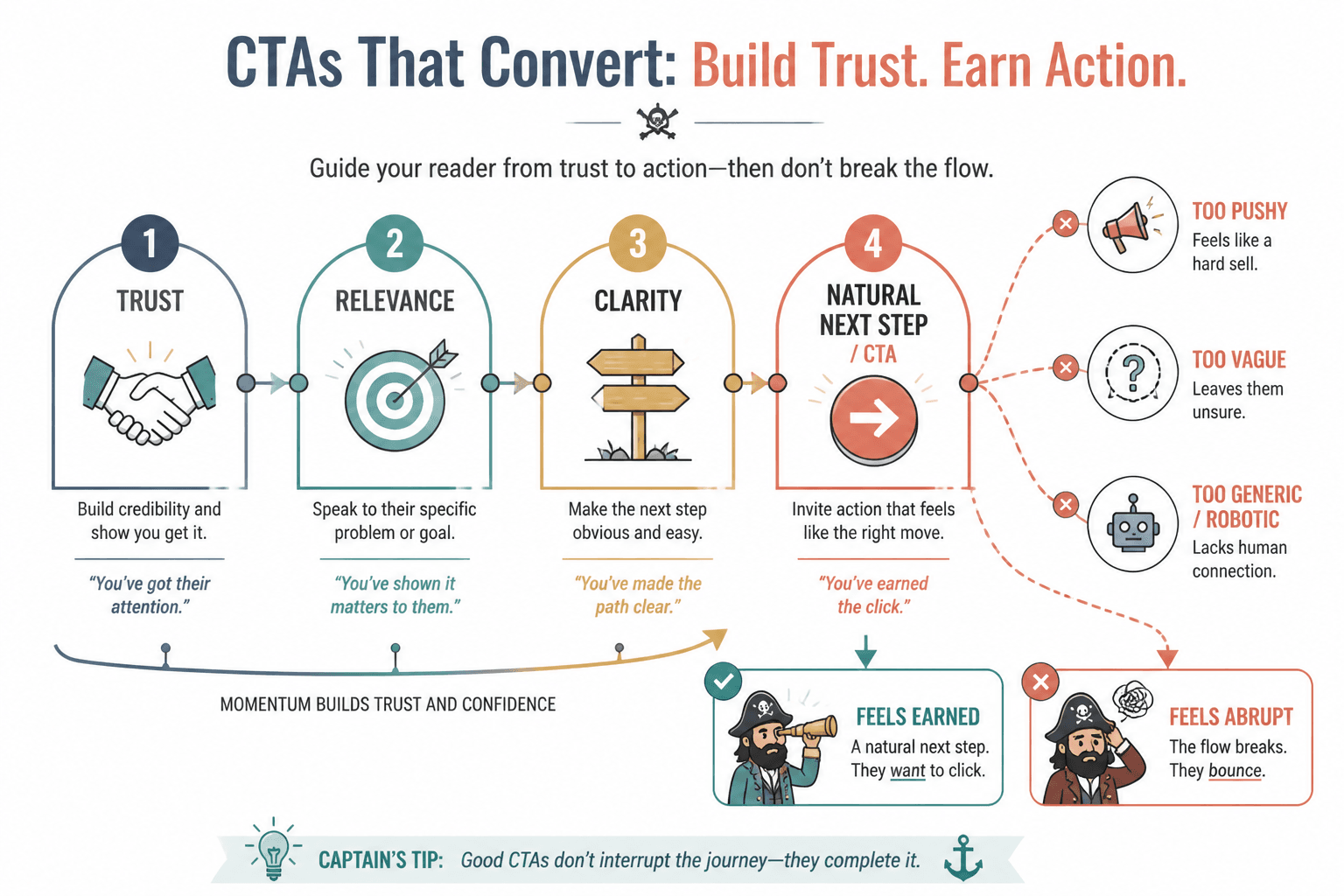
That last one gets ignored a lot. A CTA is not just a button label or closing line. It is the end of a sequence. If your content builds trust, shows relevance, and gives the reader a clear reason to continue, the CTA feels earned. If not, even a decent CTA can feel awkward.
Think of it this way: people are not reacting only to the final sentence. They are reacting to the whole lead-up. A weak CTA often reveals a weak path.
A CTA should feel like the natural next step, not the sudden arrival of a stranger with a clipboard.
If you want broader fundamentals first, this guide on CTA writing and this deeper piece on how to write better CTA writing are good companion reads.
What a good CTA actually does
A good CTA does four things well:
- It matches the reader’s level of readiness.
- It makes the next step clear.
- It sounds like a human wrote it.
- It gives the reader a reason to act now, or at least keep moving.
That does not mean every CTA must be clever. Usually the best ones are pretty plain. But plain is not the same as stale. “Book a free consultation today to transform your business” is plain in the worst possible way. “See if this fits” is plain in a much better way.
The job is not to impress people with your CTA. The job is to reduce friction and keep momentum.
Start by matching the CTA to the stage of trust
One of the fastest ways to sound salesy is asking for a high-commitment action before the reader has enough reason to care.
If someone just found you through a post, article, homepage, or landing page, “Schedule your strategy intensive now” may be doing a bit much. You have not earned that yet. Meanwhile, “Read the guide,” “See examples,” or “Check whether this is a fit” can feel much more natural.
Trust and commitment should move together.
A simple way to think about CTA intensity
| Reader stage | Better CTA types | Usually too much |
|---|---|---|
| Cold | Read this, see examples, learn how it works | Buy now, book now, apply now |
| Interested | Get the guide, compare options, explore the service | Hard-close sales language |
| Warm | Book a call, request details, start here | Vague “reach out sometime” language |
| Ready | Book now, get started, choose your plan | Overexplaining the obvious |
This is one reason soft CTAs can work so well. They respect where the reader actually is instead of acting like every visitor showed up with credit card in hand and perfect emotional readiness. If you want to get better at that style, read how to improve CTA writing with soft CTAs without sounding generic.
Use language a real person would actually say
This should not be revolutionary, and yet here we are.
A lot of CTAs fail because they sound borrowed from old sales pages, beige SaaS sites, or AI-generated copy that knows the theory of persuasion but not the texture of human speech.
Readers notice when your CTA suddenly shifts into stiff marketing dialect:
- Discover the solution
- Unlock access now
- Take the next step on your journey
- Leverage this opportunity
- Transform your business today
None of those sound like a person. They sound like a brochure trying to make eye contact.
Better CTA language tends to be simpler, more grounded, and more specific:
- See how it works
- Read the full guide
- Check the examples
- Book a call
- Tell me what you need
- Start here
- Get the template
Notice what changed. Less posture. More clarity.
Cut the phrases that instantly make CTAs feel fake
If your CTA includes any of the following, it may not be doomed, but it is flirting with doom:
- “Don’t miss out”
- “Act now”
- “For a limited time” when nothing meaningful is actually limited
- “Take your business to the next level”
- “Unlock your potential”
- “Start your transformation”
- “Click below” when there is no real reason to click below beyond your wish that they would
These phrases are not persuasive because they are common. They are weak because they are detached from anything specific. They ask the reader to supply all the urgency, belief, and context themselves.
And people usually do not volunteer for that kind of labor.
Make the CTA specific about what happens next
One reason robotic CTAs feel robotic is that they are too abstract.
“Learn more” is not terrible, but it is often lazy. Learn more about what? In what format? Why should I bother? What happens after I click?
Specificity makes CTAs feel more trustworthy because it removes ambiguity. It also helps the reader self-qualify.
Weak vs stronger CTA wording
- Weak: Learn more
Stronger: See how the process works - Weak: Get started today
Stronger: Book a 20-minute intro call - Weak: Download now
Stronger: Get the checklist - Weak: Contact us
Stronger: Tell me what you need - Weak: Explore solutions
Stronger: Compare the service options
Good CTA writing often answers an unspoken question: What exactly am I saying yes to?
Give the reader a reason, not just an instruction
A CTA gets stronger when the benefit is tied to the action instead of left floating somewhere else on the page.
Not every CTA needs a mini pitch attached to it, but many perform better when the reader understands the payoff immediately.
Examples
- Flat: Book a call
Better: Book a call to see if this is a fit - Flat: Download the guide
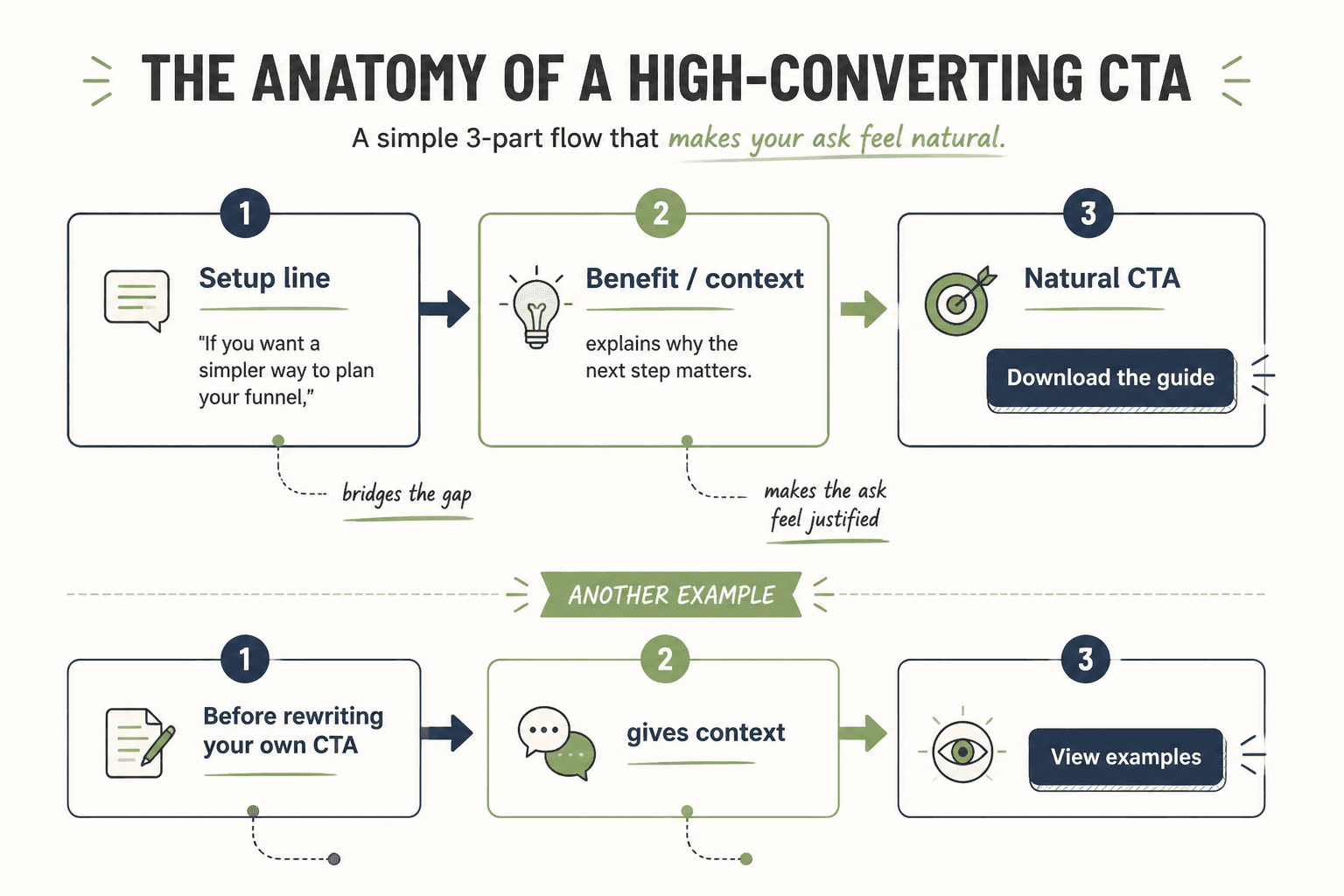
Better: Download the guide if you want a simpler way to plan your funnel - Flat: View examples
Better: View examples before rewriting your own CTA
This is especially useful when your offer needs context or when the reader is not yet fully sold on why the next step matters. The goal is not to cram a full value proposition into one line. It is to make the ask feel justified.
Sometimes one extra phrase does the job. Sometimes you need a short sentence before the CTA to bridge the gap. That little bit of setup can make the CTA feel far more natural because it creates continuity instead of tonal whiplash.
Write CTAs that match the tone of the page, post, or email
This is where a lot of otherwise smart writers trip over themselves.
If your article is thoughtful and grounded, and the CTA suddenly starts barking “Claim your spot now,” it feels off. If your homepage is clean and direct, and the CTA says “Embark on your transformation,” it feels even more off. Tone mismatch makes readers trust you less, even if they cannot explain why.
Your CTA should sound like it belongs in the same room as the rest of your copy.
That does not mean every CTA has to be super casual. It means it should be consistent. A coach, consultant, service provider, and personal brand can all sound professional without sounding embalmed.
Quick tone check
- If the rest of the page sounds human, keep the CTA human.
- If the rest of the page is concise, do not end with inflated hype.
- If the content is warm and conversational, do not close with legal-sounding stiffness.
- If the offer is premium, do not confuse “premium” with “cold and abstract.”
Use soft CTAs when the hard sell would be weird
Not every CTA should be trying to close the sale.
In fact, a lot of content performs better when the CTA simply moves the relationship forward one notch. This matters for articles, social posts, newsletters, and top-of-funnel landing pages where the reader may be interested but not quite ready.
Soft CTAs work because they lower pressure without removing direction.
Good soft CTA examples
- See if this approach makes sense for you
- Read the full breakdown
- Check the examples first
- If you want help with this, start here
- Take a look at the process
- Reply and tell me what you are stuck on
These still ask for action. They just do it without sounding like they are trying to pin the reader to the wall.
Before-and-after rewrites: turning stiff CTAs into better ones
Sometimes the easiest way to improve CTA writing is to see what changed.
Example 1: Homepage CTA
Before: Schedule your complimentary discovery session today and unlock your next level of growth.
After: Book a discovery call to see if we are a fit.
Why it works better: less inflated, more believable, clearer next step.
Example 2: Article CTA
Before: Want to transform your content strategy? Contact us now.
After: If you want help tightening your content and conversion path, start with the CTA examples here.
Why it works better: matches article intent, lowers pressure, gives a clearer next action.
Example 3: Email CTA
Before: Click here to leverage this opportunity.
After: See the full offer details here.
Why it works better: nobody talks about “leveraging this opportunity” unless they are trying to sound like a conference lanyard.
If you want more rewrites like that, see how to rewrite boring CTA writing and CTA writing examples for coaches, consultants, and personal brands.
A simple framework for writing better CTAs
If you tend to overcomplicate CTA writing, use this simple formula:
Verb + specific next step + optional reason
Examples
- Read the full guide
- Book a call to see if this fits
- Get the template and customize it for your offer
- Compare the options before you choose
- Reply with “CTA” and I will send it over
That is enough structure to keep you clear without forcing every CTA into fake urgency or inspirational goo.
Common CTA mistakes that make good content feel worse
The bigger point is simple: clearer structure and clearer writing make the piece more useful. That is usually what makes the ending land better too.
CTA writing works best when the next step feels specific, natural, and easy to trust. A clearer ask usually outperforms a louder one.