
Most offer messaging does not fail because the offer is terrible.
It fails because the person selling it cannot explain it without sounding vague, inflated, or weirdly impressed with their own sentence structure.
That is the real problem behind better offer messaging and positioning clarity fixes for personal brands. You do not usually need a dramatic reinvention. You need cleaner language, sharper positioning, and a better grip on what your audience actually cares about.
If people keep saying “this sounds interesting” but do not buy, book, reply, or ask questions, your messaging probably has a clarity problem. If your site, bio, and sales copy all describe you slightly differently, your positioning probably has a clarity problem too. And yes, those two things are connected.
Here’s how to fix both without turning your brand into a stiff little corporate mannequin.
For the full path around this topic, head to the parent guide.
Why personal brand offer messaging gets blurry so fast
Personal brands have a special talent for making simple things sound confusing.
Partly because you are close to your own work. Partly because you do more than one thing. Partly because the internet has trained smart people to write phrases like “I help purpose-driven founders align their voice with scalable visibility ecosystems,” which sounds expensive but says almost nothing.
Blurry messaging usually comes from one of five problems:
- You are describing your method instead of the result
- You are trying to speak to too many audiences at once
- You are using abstract identity language instead of practical buyer language
- You are afraid that being specific will make you sound small
- You are stacking too many promises into one sentence
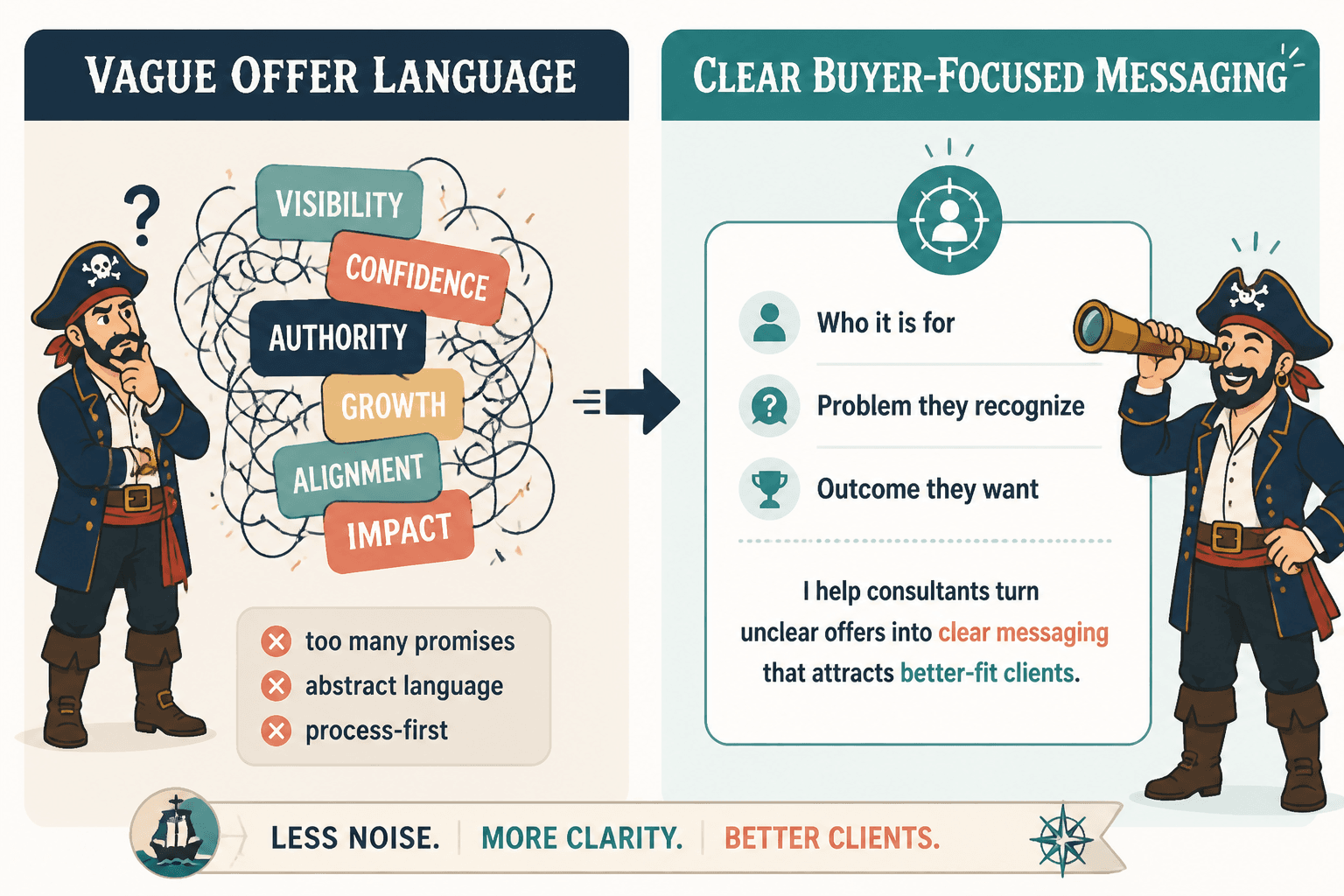
That last one gets people constantly. They try to say they help with visibility, confidence, messaging, authority, growth, alignment, audience building, sales, and impact in one breath. The result is not a powerful offer. It is verbal soup.
Good positioning feels simpler than the work behind it. That is the point.
Start with the buyer problem, not your process
People buy outcomes they can recognize. They do not buy your internal sophistication.
If your offer messaging starts with your framework, philosophy, or signature method before the reader even knows why they should care, you are making them do too much work. And they will not. Busy people do not sit around decoding your brand poetry.
Start with a problem they already know they have.
Weak version
I help personal brands step into aligned market leadership through strategic brand messaging.
Better version
I help personal brands explain what they do clearly enough that the right people actually want to buy.
The second version is not fancier. That is why it works better.
When you are trying to sharpen your offer, ask:
- What frustrating problem does my buyer already feel?
- What expensive or annoying consequence comes from not fixing it?
- What practical improvement will they get if this works?
- Can I say that in plain English without hiding behind jargon?
If not, keep going.
Fix your positioning by choosing the clearest angle
Positioning is not just “who I am.” It is the angle that helps the right person understand why your offer matters and why it is for them.
A lot of personal brands position themselves too broadly because they think broader means more opportunity. Usually it means weaker relevance. If everyone can sort of use your offer, no one feels pulled toward it.
Clear positioning often gets stronger when you anchor it around one or two of these:
- Audience: who it is for
- Problem: what it fixes
- Outcome: what improves
- Context: where or when it matters
- Approach: how it is different, but only if that difference is meaningful
You do not need to use all five every time. In fact, you probably should not.
Here is a simple positioning formula that works well for personal brands:
I help [specific audience] fix [specific problem] so they can get [specific outcome] without [common frustration or bad alternative].
Example:
I help coaches and consultants fix muddy offer messaging so their website and content attract better-fit leads without sounding generic or overpolished.
That is clearer than trying to sound important.
If you want more practical breakdowns, this guide to offer messaging and positioning for creators who want better results is a useful next read.
The quickest clarity fixes for weak offer messaging
You do not always need a total rewrite. Sometimes you need a cleanup job with standards.
1. Replace vague verbs with concrete ones
Words like elevate, empower, transform, amplify, unlock, align, and optimize often make copy sound bigger while saying less.
Use verbs people can picture.
| Vague | Clearer |
|---|---|
| amplify your brand | make your brand easier to understand and trust |
| elevate your messaging | tighten your messaging so more visitors become inquiries |
| unlock visibility | help more right-fit people notice your work |
| align your offer | make your offer easier to explain and buy |
2. Cut audience pileups
If your homepage says you help founders, creators, coaches, consultants, startups, small businesses, experts, and service providers, that is not inclusive. It is muddy.
Pick the audience that best matches your strongest results, clearest language, and most profitable work.
3. Stop leading with identity labels your buyer may not use
You might think of yourself as a messaging strategist, visibility mentor, thought leadership consultant, or brand clarity advisor. Fine. Your buyer is usually not searching for your preferred self-description. They are trying to solve a problem.
Lead with the problem and outcome first. Your role can come second.
4. Put one main promise above the rest
Every offer has side benefits. That does not mean all of them belong in the headline.
Choose the promise most likely to make the right person keep reading. Everything else can support it lower down the page.
5. Remove “sounds nice” filler
Look for phrases that feel polished but do no real work.
- purpose-driven
- heart-centered
- authentic authority
- aligned growth
- magnetic brand presence
- soulful visibility
Some of these can fit specific brands in the right context. But if your copy depends on them to create meaning, the copy is in trouble.
How to tell if your positioning is too generic
Here is a simple test.
Take your core positioning sentence and remove your name. Then ask: could ten other people in my niche say this and still sound accurate?
If yes, it is too generic.
That does not mean you need to become bizarre for attention. It means your copy needs sharper details.
Add specificity through one of these:
- The exact audience segment
- The exact situation they are in
- The specific blockage you solve
- The type of result you are known for
- The style or constraint that makes your approach different
For example, compare these:
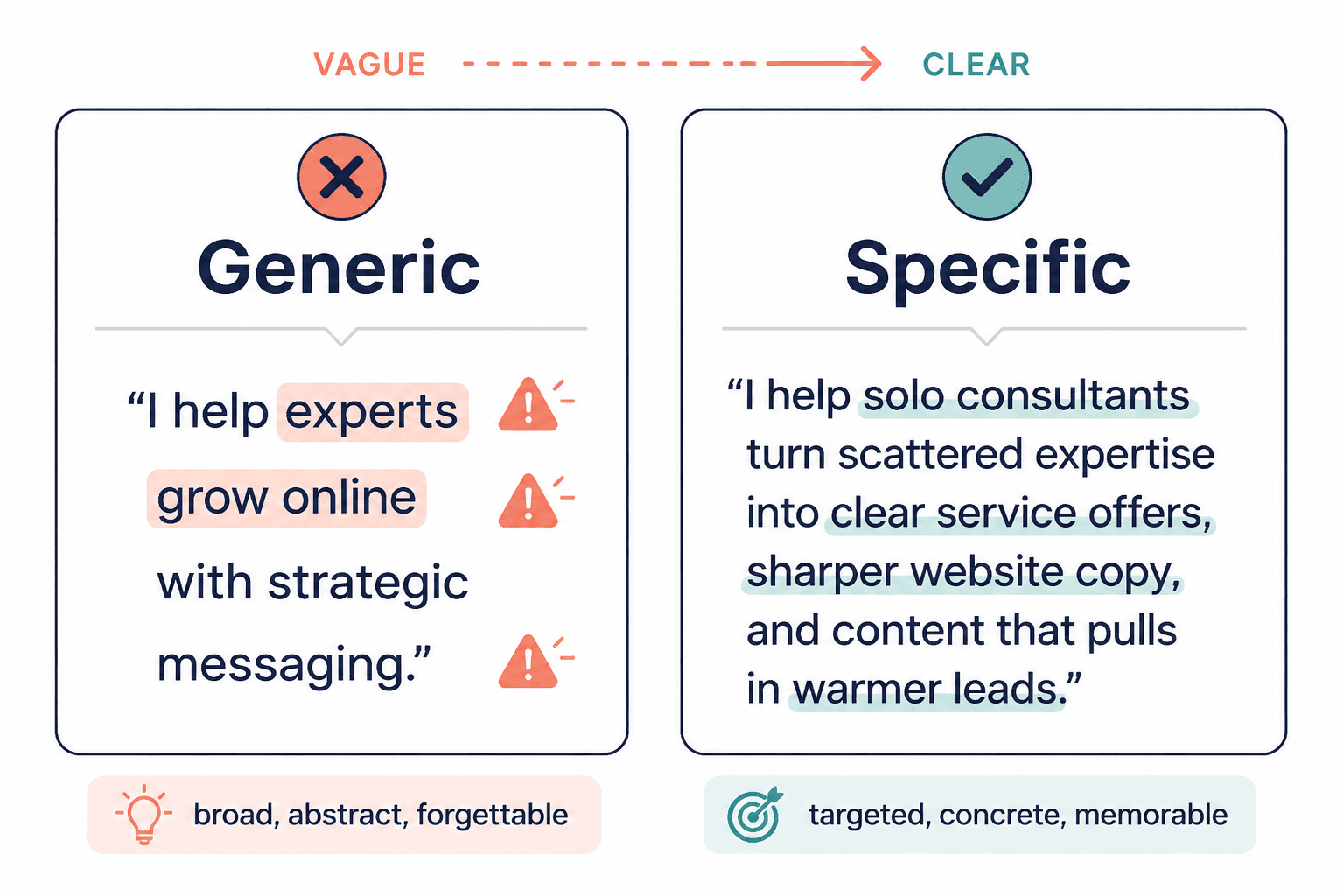
I help experts grow online with strategic messaging.
I help solo consultants turn scattered expertise into clear service offers, sharper website copy, and content that pulls in warmer leads.
The second one gives the reader something to hold onto. That matters.
If this is the part you keep wrestling with, these positioning line improvements without sounding generic should help.
Use a messaging stack instead of one overloaded sentence
One reason people write bad offer messaging is that they are trying to force every important detail into a single line. That is not clarity. That is compression gone wrong.
Instead, build a simple messaging stack.
- Headline: biggest relevant promise
- Subhead: who it is for and what it helps them fix
- Support points: proof, process, outcomes, constraints, differentiators
- CTA: clear next step
Example stack:
Headline
Clearer offer messaging that helps personal brands convert more of the right people.
Subhead
For coaches, consultants, and experts whose websites and content sound decent but still leave prospects unsure what they actually do or why it matters.
Support points
- Sharpen your positioning so the right audience recognizes themselves faster
- Clean up vague copy that sounds polished but does not sell
- Turn scattered ideas into a message your site, profile, and content can all support
CTA
See how your current messaging stacks up.
That structure gives your message room to breathe. It also lets different parts of the page do different jobs, which is how good conversion copy works.
Better offer messaging and positioning clarity fixes for personal brands usually come from subtraction
Here is the slightly annoying truth: many clarity fixes are edits, not additions.
You often improve messaging by removing things:
- Extra audiences
- Extra promises
- Extra adjectives
- Extra method language
- Extra throat-clearing
- Extra cleverness
Most personal brand copy gets worse when it tries too hard to sound premium. Premium does not mean abstract. It means clear, confident, and specific.
If your sentence needs a decoder ring, it is not high-level. It is just difficult.
A practical rewrite process you can use today
If you want a working process instead of vague advice, use this.
- Pull your current headline, bio, and offer description into one document. Put them next to each other and notice where they conflict.
- Underline the repeated themes. What problem, audience, and outcome keep showing up?
- Circle every vague word. If the reader cannot picture it, replace it.
- Reduce the offer to one core promise. What is the main thing this helps someone do better?
- Add one layer of specificity. Name the audience, context, or friction point.
- Rewrite for spoken clarity. If you would never say it out loud to a prospect, do not put it on the page.
- Check for consistency across touchpoints. Your site, profile, lead magnet, and content should sound like they belong to the same business.
That last point gets overlooked constantly. Positioning is not a homepage ornament. It shapes everything around the offer. If your LinkedIn headline says one thing, your website says another, and your call says a third, buyers feel the wobble even if they cannot explain it.
For a more complete walkthrough, this article on how to write better offer messaging and positioning is worth bookmarking.
Before and after: quick positioning rewrites
Example 1
Before: I help visionary entrepreneurs build aligned brands that create impact and growth.
After: I help service-based founders clarify their brand message so their website and content attract better-fit clients.
Example 2
Before: Strategic messaging support for experts ready to scale with authenticity.
After: Messaging strategy for experts whose offer makes sense in their head but still feels fuzzy on the page.
Example 3
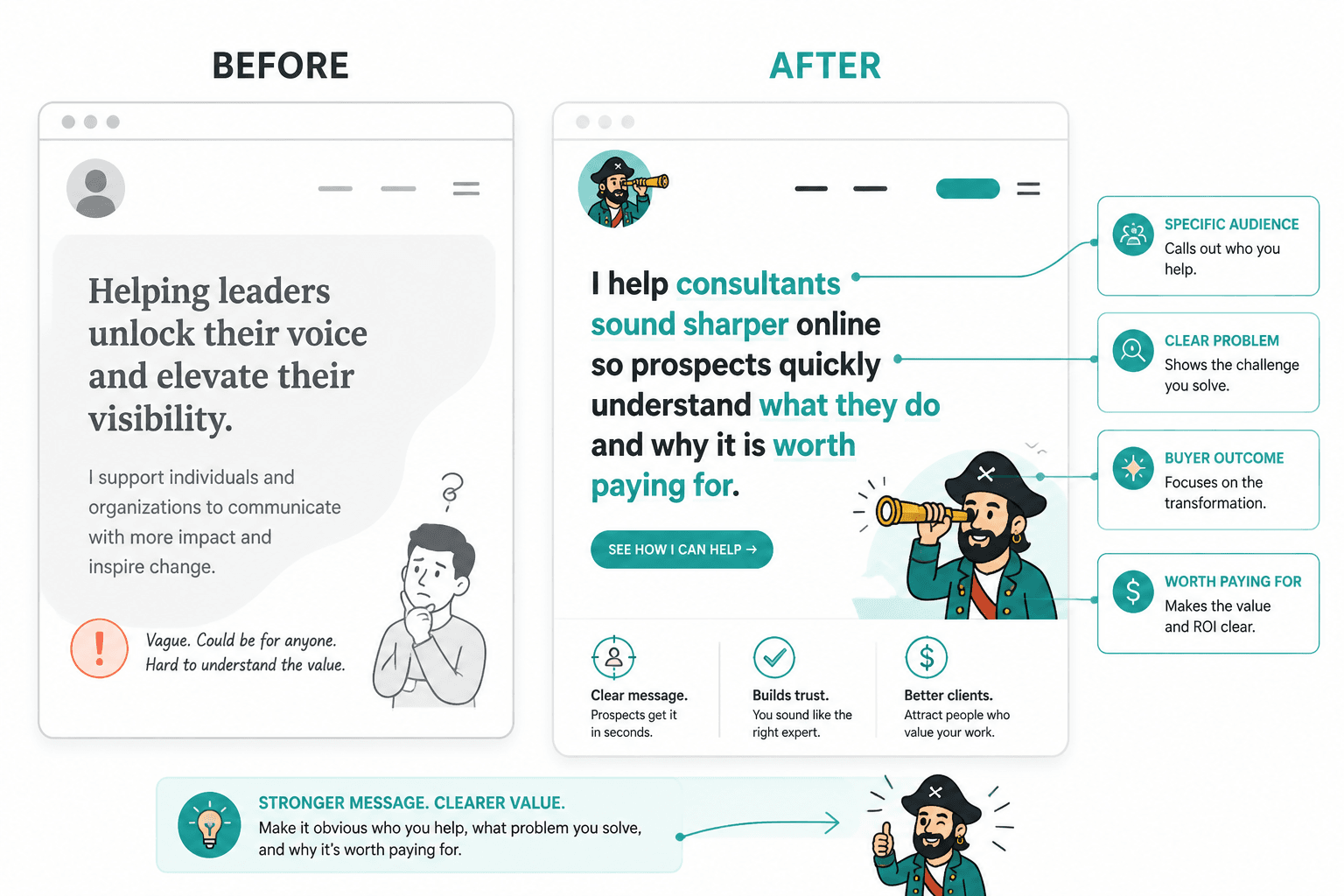
Before: Helping leaders unlock their voice and elevate their visibility.
After: I help consultants sound sharper online so prospects quickly understand what they do and why it is worth paying for.
Notice the pattern. Better copy does not merely sound stronger. It makes the buyer’s situation easier to recognize.
If you want more side-by-side examples, see these offer messaging and positioning examples for coaches, consultants, and personal brands.
Where your positioning should show up, not just your homepage
Once your messaging is clearer, do not leave it trapped on one page like a decorative houseplant.
Your positioning should shape:
- Your homepage headline and subhead
- Your services page
- Your social bio
- Your pinned post or featured section
- Your lead magnet description
- Your discovery call page
- Your email welcome sequence
- Your content topics and examples
This is where a lot of personal brands leak trust. Their copy sounds one way on social and another way on the website. Their content talks about one problem while their offer sells something else. Prospects should not have to solve a mystery before they buy.
If you are building out the bigger structure around your message, the resources in website conversion copy and offer messaging and positioning are the sensible next stop.
The bigger point is simple: clearer structure and clearer writing make the piece more useful. That is usually what makes the ending land better too.