
Most offer messaging is not bad because the person is untalented. It is bad because it is trying so hard to sound credible that it stops saying anything clear.
You see it everywhere: “I help ambitious experts unlock aligned growth through authentic visibility.” That sounds polished. It also sounds like it was assembled from a bucket of expensive nonsense.
If your audience has to decode what you do, who it is for, and why it matters, your positioning is making the sale harder than it needs to be. And for coaches, consultants, and personal brands, that problem spreads fast. It shows up on your homepage, your bio, your sales page, your discovery calls, your content, and the weird little intro you give when someone asks, “So what do you do?”
This is where Offer Messaging & Positioning Examples for Coaches, Consultants, and Personal Brands actually becomes useful. Not as a pile of vague formulas, but as a practical way to sharpen how you describe your work so the right people get it faster, trust it more, and can actually tell if it is for them.
You will get examples, rewrites, simple frameworks, and a way to fix positioning without turning your brand voice into beige consultant soup.
To see how this fits into the wider strategy, open the parent guide.
What offer messaging and positioning are really doing
Offer messaging is how you describe the value of what you sell. Positioning is the context that makes that offer feel relevant, distinct, and worth paying attention to.
Put less politely: messaging is what you say, positioning is why people believe this is for them instead of the other 47 people saying vaguely similar things on LinkedIn.
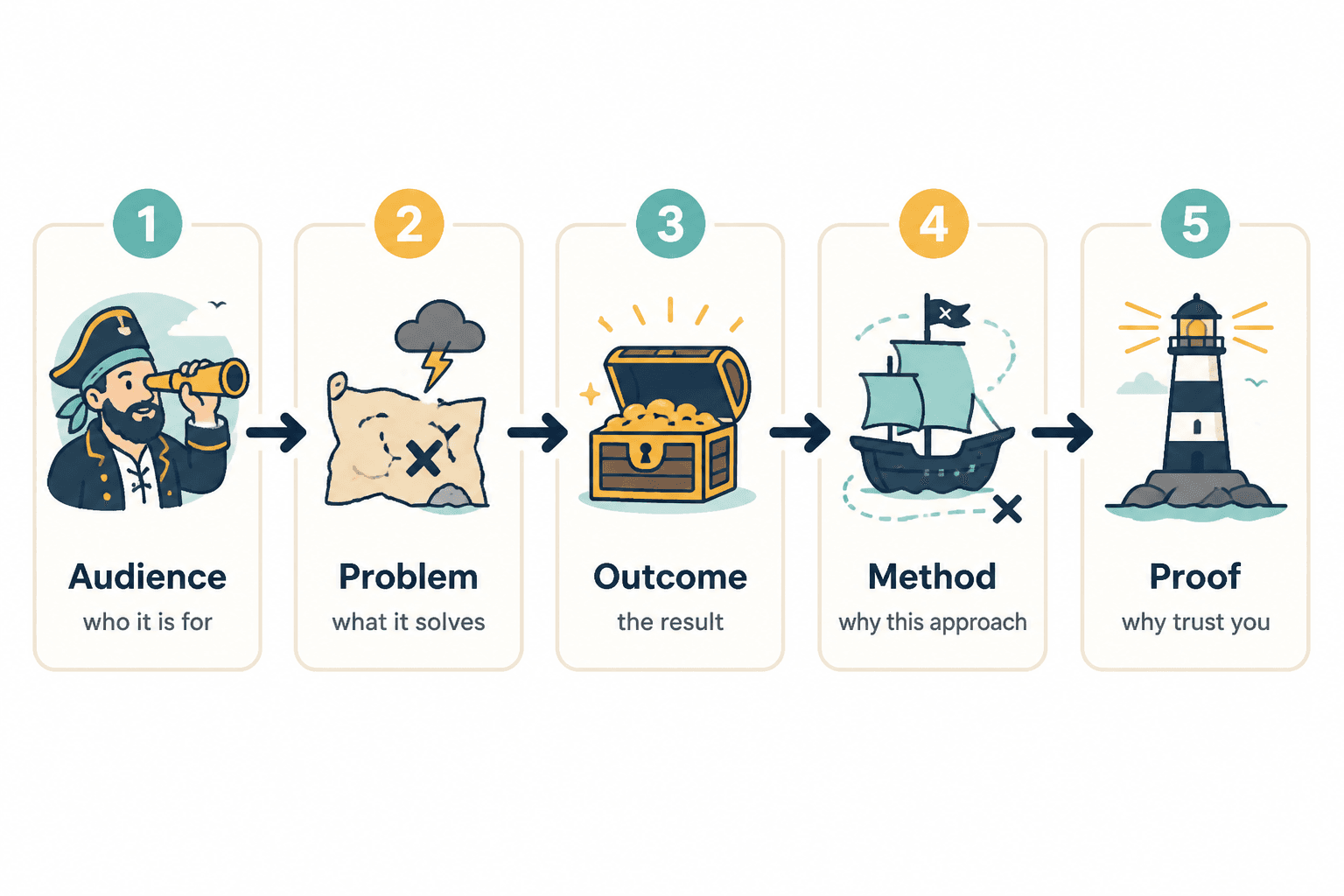
Good positioning answers a few questions fast:
- Who is this for?
- What problem does it solve?
- What kind of result does it help create?
- Why this approach instead of the usual one?
- Why should I trust you?
If those answers are fuzzy, the offer feels fuzzy. And fuzzy offers do not convert well, no matter how many times you rewrite the button text.
For a broader foundation, this piece works well alongside offer messaging and positioning and the more strategic walkthrough in offer messaging and positioning guide for creators who want better results.
The most common positioning mistake: sounding broad to avoid losing people
A lot of smart people keep their messaging broad because they are afraid clarity will make them seem smaller.
So instead of saying, “I help solo consultants tighten their offer and homepage copy so more visitors turn into leads,” they say, “I help purpose-driven entrepreneurs elevate their brand presence.”
The first one may attract fewer random compliments. It will attract more qualified buyers.
Broad messaging feels safer. But in practice, it often makes you look less established, not more. Specificity signals confidence. Vagueness signals either uncertainty or an attempt to be all things to all people. Neither is especially persuasive.
What better positioning usually sounds like
- More concrete
- More audience-specific
- More tied to a business outcome
- More honest about the process
- Less stuffed with identity-flattering fluff
If your copy sounds impressive but your ideal client still would not know whether to click, reply, or move on, it is not working hard enough.
A simple positioning structure that does not sound robotic
You do not need a sacred five-part formula carved into a mountain. But you do need structure. A useful one is:
- Audience: who you help
- Problem: what is frustrating, costly, slow, messy, or unclear for them
- Outcome: what improves
- Method or angle: how your approach is different or more useful
- Proof: why someone should trust you
That does not mean every sentence has to include all five. It means your overall messaging should make those pieces visible somewhere on the page, profile, or pitch.
Good positioning does not try to say everything. It makes the right person feel correctly understood fast.
Offer messaging & positioning examples for coaches, consultants, and personal brands
Now for the part people actually came for: examples that do not read like they were generated by an overcaffeinated funnel template.
Example 1: Business coach
Weak: I help entrepreneurs scale with confidence, clarity, and alignment.
Better: I help service-based business owners simplify their offers, pricing, and sales process so they can grow without building a full-time chaos machine.
Why it works: it names the audience, the friction, and the kind of result. It also hints at a point of view: growth should not require unnecessary complexity.
Example 2: LinkedIn consultant
Weak: I help founders build magnetic personal brands on LinkedIn.
Better: I help B2B founders turn their expertise into clear LinkedIn content that attracts the right leads without posting cringe every day.
Why it works: “magnetic personal brands” means almost nothing. The stronger version says what they are creating, where it happens, what it helps do, and what pain it removes.
Example 3: Copywriter for coaches
Weak: I write authentic copy that connects and converts.
Better: I help coaches turn vague expertise into homepage and sales page copy that sounds like them and makes the offer easier to buy.
Why it works: “authentic” and “connects” are classic filler words. The improved version says what gets fixed and where the work shows up.
Example 4: Career coach
Weak: I empower professionals to create meaningful careers.
Better: I help mid-career professionals reposition their experience, tell better stories in interviews, and move into work that pays better and fits better.
Why it works: this one gives the reader something to picture. Specific actions. Specific audience. Specific upside.
Example 5: Visibility coach for creators
Weak: I help creators show up powerfully online.
Better: I help small-audience creators sharpen their message, content angles, and profile copy so more of the right people actually remember them.
Why it works: “show up powerfully” is pure fog. The rewrite anchors the work in real assets and a believable result.
If your audience is still small, read offer messaging and positioning for creators with small audiences. It is a good reminder that specific trust beats inflated branding every time.
Before-and-after positioning rewrites
Sometimes the easiest way to fix your messaging is to stop editing individual words and rewrite the whole idea around what the buyer actually cares about.
| Before | After |
|---|---|
| I help experts elevate their online presence. | I help consultants clean up their website messaging so visitors understand the offer and book more calls. |
| I support visionary founders with strategic brand clarity. | I help early-stage founders explain what they do in plain English so investors, clients, and collaborators stop looking confused. |
| I guide women entrepreneurs into aligned visibility. | I help women-led service businesses create content and offer messaging that attracts better-fit clients without sounding like everyone else in their niche. |
| I help coaches stand out authentically. | I help coaches clarify their niche, message, and sales page language so their offer feels easier to trust and easier to buy. |
Notice what changed. The stronger versions are not necessarily longer. They are simply doing more useful work.
- They name a clearer audience.
- They describe a real friction point.
- They point to a business or decision-making result.
- They avoid inflated abstract words.
How to write a stronger offer statement
If you need one core line for your homepage hero, profile, or intro, use this structure:
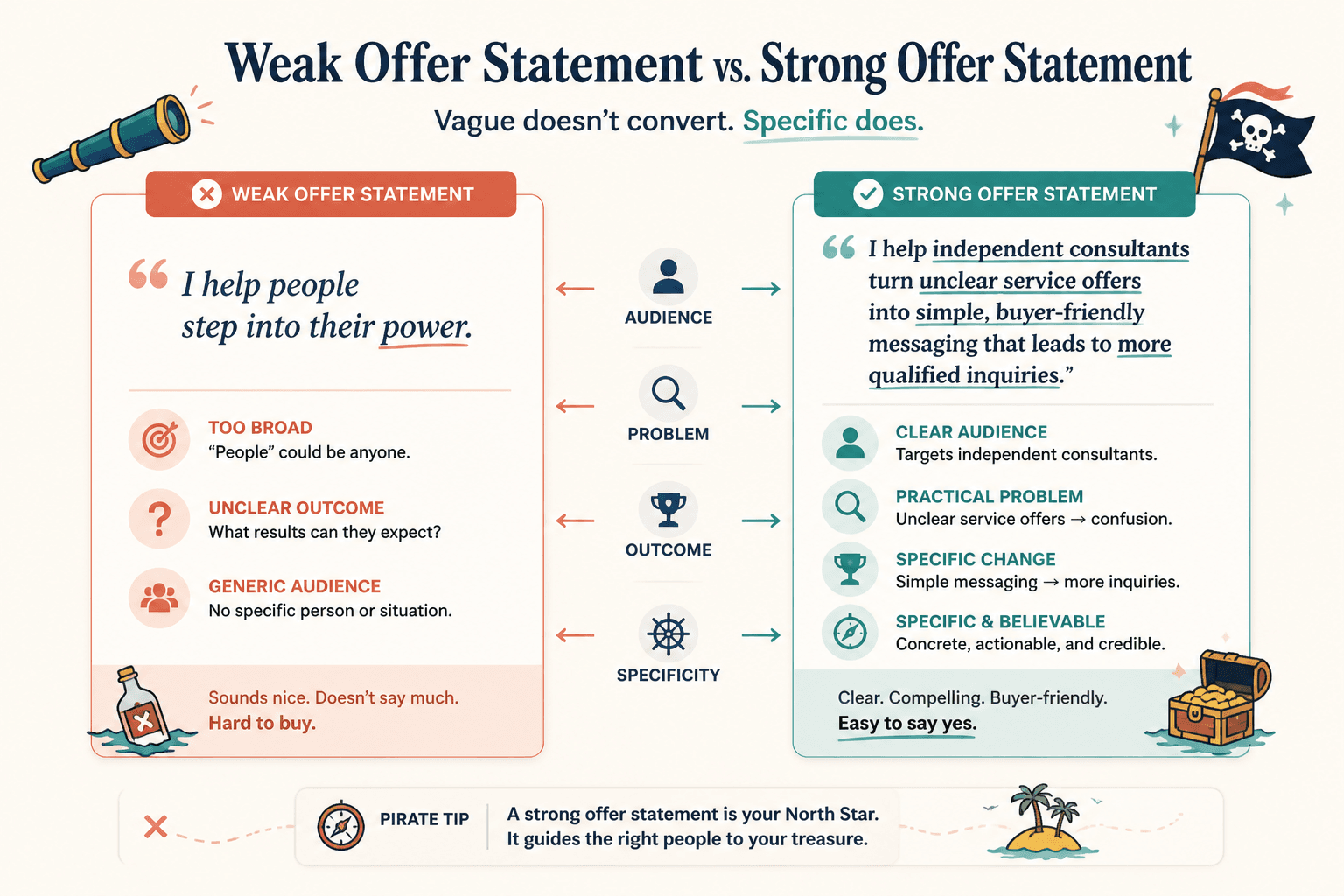
I help [specific audience] do [valuable result] by [specific method, asset, or angle].
That is not the only way to do it. But it is a solid starting point because it stops you wandering into poetic mist.
Filled-in examples
- I help independent consultants turn unclear service offers into simple, buyer-friendly messaging that leads to more qualified inquiries.
- I help creators package their expertise into sharper offers, cleaner landing pages, and stronger content hooks.
- I help executive coaches position premium offers for leadership clients who want substance, not self-help fluff.
- I help personal brands rewrite bios, homepages, and offer pages so the right people get the value in under 30 seconds.
For more fast-adapt examples, see offer statements examples creators can adapt fast.
What to emphasize if you are a coach
Coaches often lean too hard on transformation language and not hard enough on practical change. The result is messaging that sounds inspiring but slippery.
If you are a coach, your positioning usually gets better when you emphasize:
- The kind of client you work best with
- The stage they are in before working with you
- The shift your process helps create
- How your coaching differs from general advice, courses, or therapy
- What kind of proof or experience supports your approach
For example, a leadership coach does not need to say they “unlock human potential.” They can say they help newly promoted leaders manage teams, communicate clearly, and stop second-guessing every decision. Much stronger. Much less floaty.
What to emphasize if you are a consultant
Consultants usually have the opposite problem. They lean so hard on process and expertise that they forget to make the value legible to a non-expert buyer.
If you are a consultant, stronger positioning often means translating your work into visible outcomes. Not dumbing it down. Just making it easier to understand.
- What gets fixed, improved, reduced, or accelerated
- What the client can expect to be different after the engagement
- What your process includes in practical terms
- Why your angle works better than the usual approach
People do not buy “strategic advisory support” because the phrase sounds expensive. They buy because they believe your work will help them make better decisions, fix a costly bottleneck, or create a more valuable result.
What to emphasize if you are building a personal brand
Personal brands get especially vulnerable to vague messaging because the person is the brand, and that can make everything drift toward identity language.
Identity matters. Personality matters. But if your website and profile spend three paragraphs telling me you are multi-passionate, bold, heart-led, and deeply committed to impact, I still do not know what you sell.
For personal brands, useful positioning usually balances three things:
- Clarity: what you help with
- Distinctiveness: your voice, angle, or belief
- Credibility: why your guidance or service is worth trusting
Your voice can absolutely be present. It should be. Just do not let style replace signal.
A quick audit for weak messaging
If your current offer copy is underperforming, run it through this checklist.
- Does it name a specific audience, or just “entrepreneurs,” “humans,” or “leaders”?
- Does it describe a real problem, or only a positive aspiration?
- Can someone picture the outcome?
- Does it use plain English?
- Does it sound like you, or like every online business account from the last five years?
- Is there any proof, method, or angle that makes your offer feel distinct?
- Would a stranger know what to do next?
If you answered “not really” to more than two of those, the issue probably is not your font choice.
For practical cleanup, better offer messaging and positioning clarity fixes for personal brands is worth reading next.
How to make your positioning feel distinct without inventing fake uniqueness
A lot of people hear “differentiate” and immediately start trying to sound revolutionary. That usually creates awkward claims and dramatic wording that your actual service cannot support.
You do not need to invent a fake category or act like everyone else in your field is a clueless fraud. Distinct positioning often comes from smaller, more believable differences:
- The audience you specialize in
- The problem you focus on
- The point of view you bring
- The method you use
- The tone and personality of your brand
- The kinds of outcomes you prioritize
For example, “copywriter for coaches” is fine but crowded. “Copywriter for established coaches who need their offer to sound smarter, clearer, and more premium without sounding stiff” is already more specific and more memorable.
That is usually enough. You are not trying to become unrecognizable. You are trying to become easier to choose.
Where to use this messaging so it actually helps
Once you sharpen your positioning, do not leave it sitting in a notes app like a forgotten salad. Use it where buying decisions start.
- Homepage hero section
- About page opening
- Services page intro
- Offer page headline and subhead
- LinkedIn headline and about section
- Instagram bio
- Discovery call intro
- Lead magnet landing page
- Podcast guest bio
- Email signature if relevant
The bigger point is simple: clearer structure and clearer writing make the piece more useful. That is usually what makes the ending land better too.