
Some offers do not convert badly because the offer is weak. They convert badly because the explanation drags on so long that people lose the plot halfway through.
That is usually the real reason when short offer messaging & positioning beat long ones. It is not because short copy is automatically smarter, more modern, or more premium. It is because short copy often forces you to say the thing plainly. And plain tends to beat bloated.
If your audience has to dig through 14 lines of self-important brand fog to figure out what you do, who it is for, and why they should care, the problem is not that they have a short attention span. The problem is your message is making them work too hard.
Here is how to tell when shorter messaging gives you an edge, when longer messaging still earns its place, and how to tighten your positioning without sanding off the parts that actually persuade.
For the broader learning path, visit our parent guide.
Short beats long when the decision is simple
The more obvious the problem and outcome, the less explanation you usually need.
If you help consultants write sharper LinkedIn profiles, book more discovery calls, or clean up a confusing homepage, people can understand that quickly. They do not need a poetic manifesto about transformation architecture. They need the point.
Short messaging works best when:
- The audience already knows they have the problem
- The outcome is easy to picture
- The service category is familiar
- The price or commitment is relatively low
- The buyer is comparing a few options fast
- Your credibility is already visible elsewhere on the page or profile
In those cases, longer copy often creates friction instead of confidence. It starts explaining things no one asked about. It introduces abstract language. It makes a practical service sound suspiciously ceremonial.
Clear and compact usually beats “comprehensive” when the reader is trying to decide, not study.
What short offer messaging does well
Good short messaging does not merely remove words. It removes delay.
It gets to the audience, problem, outcome, and value faster. That matters on websites, landing pages, bios, service sections, and social profiles because people are not sitting there with a highlighter and a free afternoon. They are scanning for relevance.
It sharpens the promise
Short copy forces you to stop hiding behind broad language.
Compare these:
- Long and foggy: I help purpose-driven experts clarify their voice, refine their authority positioning, and build aligned messaging ecosystems that support visibility and sustainable business growth.
- Short and clear: I help coaches and consultants tighten their message so more of the right people ask about working with them.
The second version is not tiny, but it lands. You know who it is for. You know roughly what changes. You know why it matters.
It respects low-attention environments
On a homepage, services page, profile header, or lead magnet landing page, short messaging often wins because readers are making micro-decisions.
Do I stay?
Do I understand this?
Does this seem relevant?
Should I click?
Long-winded positioning can kill those tiny yeses before they stack up.
It makes you sound more confident
People often overwrite because they are trying to sound credible. Strange move, but common.
In practice, overexplaining can make you sound less sure of your point. Tight messaging feels more grounded because it names the thing directly. It sounds like someone who knows what they do, not someone nervously adding decorative adjectives around it.
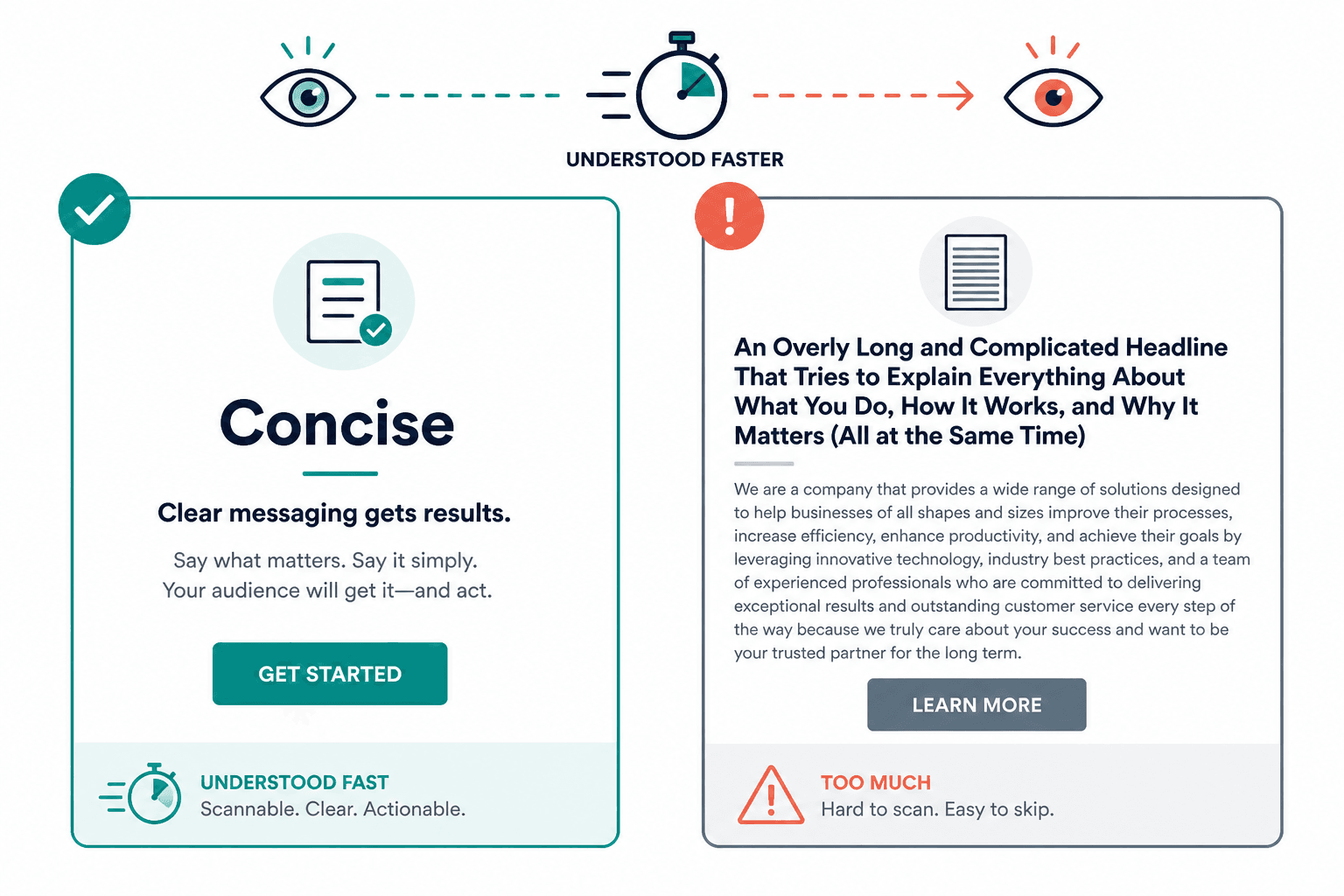
When short offer messaging & positioning beat long ones most clearly
There are a few situations where shorter messaging has a real advantage, not just a stylistic one.
1. Above the fold
Your headline, subhead, hero copy, and first CTA need speed. This is not where you dump your entire philosophy of service design.
A good rule: say enough to create clarity and interest, then let the rest of the page do the proving.
Better: Messaging strategy for experts who are tired of sounding smart but selling vaguely.
Worse: I partner with visionary founders, thought leaders, and transformational service providers to create resonant messaging experiences that align truth, strategy, and sustainable expansion.
2. In service menus and offer cards
People compare service options quickly. If every card needs a deep read, you have made choosing harder.
Short labels and sharp summaries help readers sort faster:
- Profile Rewrite: Tighten your bio, headline, and CTA so your profile actually converts interest.
- Homepage Messaging: Clarify your offer and positioning so visitors know what you do in seconds.
- Offer Audit: Find the confusion points killing conversions before you rewrite everything.
3. When your audience is already warm
If someone came from your content, referral network, newsletter, or podcast, they often need less explanation. They already trust your thinking. At that point, concise messaging can convert better because it gets them to the next step quickly.
This is especially true if you have built authority elsewhere through case studies, posts, or examples. Your short positioning does not have to carry the entire burden alone.
4. When the core value is practical, not conceptual
Some offers solve very tangible problems: improve conversion rates, clean up confusing messaging, write stronger CTAs, build a better profile, structure a funnel. Those offers usually benefit from concrete language, not layers of meaning.
If the value is practical, your wording should probably be too.
5. When your market is crowded
In busy markets, shorter positioning can help because it creates contrast through crispness. Most people in crowded service categories write like they were paid by the adjective. Tight language stands out.
Not because it is flashy. Because it is readable.
Short does not mean vague, clever, or stripped of proof
This is where people get it wrong.
They hear “shorter is better” and start shaving off the useful parts. Suddenly the copy is tiny, stylish, and completely unhelpful.
Bad short messaging often sounds like this:
- Clear offers for bold brands
- Messaging that moves
- Say less. Mean more.
- Build a business that fits
Lovely. Means nothing.
Strong short messaging still needs four things:
- Audience: who it is for
- Problem: what is not working
- Outcome: what improves
- Specificity: enough detail to feel real
If you cut any of those, the message may become shorter but not stronger.
When longer messaging still wins
Not everything should be reduced to one tidy line. Sometimes long copy is exactly what the sale needs.
Longer offer messaging tends to work better when the decision is expensive, emotionally loaded, unfamiliar, or high-trust.
For example:
- High-ticket consulting
- Complex transformation offers
- Done-with-you or strategic advisory services
- Offers aimed at skeptical or burned audiences
- New categories people do not instantly understand
In those cases, people may need more context, more proof, more objection handling, and more language that helps them understand the approach. Longer copy is not padding there. It is part of the sales process.
The trick is this: long copy should expand clarity, not repeat it in fancier clothes.
A better way to think about it
Do not ask, “Should my offer messaging be short or long?”
Ask, “How much does this reader need in order to believe, understand, and act?”
That is the right question. Everything else turns into copy folklore.
How to shorten your positioning without killing the persuasion
If your current message is too long, do not just trim random words. Rewrite from the core idea outward.
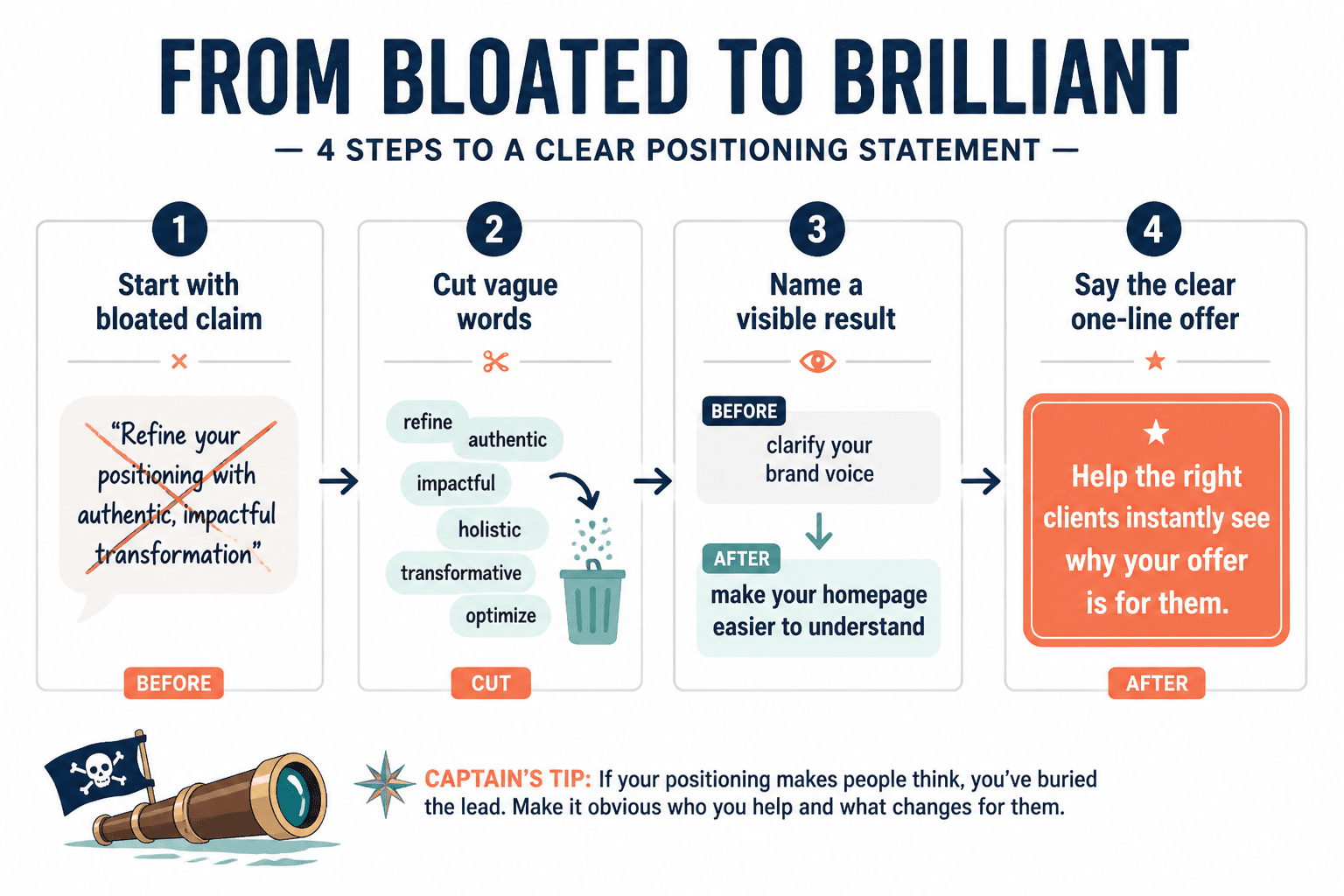
Step 1: Find the actual claim
Buried inside most long positioning statements is one usable sentence. Find it.
Ask:
- Who is this for?
- What problem am I solving?
- What changes after working with me?
- What part is distinctive enough to matter?
If you cannot answer those cleanly, the copy is not too long. The thinking is too muddy.
Step 2: Cut the prestige padding
Most bloated messaging is full of words that sound expensive but explain nothing.
Common offenders:
- aligned
- authentic
- impactful
- elevated
- sustainable growth
- powerful transformation
- purpose-driven
- high-level support
Those words are not banned forever. They are just guilty until proven useful.
Step 3: Replace abstraction with a result people can picture
“Clarify your brand voice” is weaker than “make your homepage easier to understand.”
“Refine your positioning” is weaker than “help the right clients instantly see why your offer is for them.”
Short messaging gets better fast when people can visualize the before and after.
Step 4: Keep proof near the short claim
A short statement often works best when it is followed by something that supports it:
- A quick example
- A case study snippet
- A credibility marker
- A “what this includes” line
- A concrete next step
This is why short copy can work beautifully on websites. The positioning line handles clarity. The rest of the section handles proof.
Step 5: Test the one-breath version
Can someone say your offer out loud in one breath without sounding ridiculous? Good. You are probably close.
If they need a comma, a semicolon, and spiritual endurance, it still needs tightening.
Before and after: tighter positioning that actually helps
Here are a few examples of how shorter messaging can beat the longer version.
Example 1: Messaging strategist
Before: I help visionary entrepreneurs and service-based thought leaders develop aligned messaging foundations that express their deepest truth, increase resonance, and create more ease in their marketing.
After: I help experts tighten their message so their marketing is easier to trust and easier to buy from.
The second one is shorter, but more importantly, it gives the reader something solid. Trust. Buying. Clearer mechanism.
Example 2: Business coach
Before: I support ambitious founders in creating sustainable, values-led businesses through strategic mentorship, energetic calibration, and customized growth pathways.
After: I help solo founders simplify their business model, tighten their offers, and stop guessing what to sell next.
Much less perfume. Much more point.
Example 3: Copywriter
Before: Conversion-focused copy solutions for heart-centered brands ready to scale with integrity, connection, and high-converting customer journeys.
After: Website copy for coaches and consultants who need clearer offers and more qualified inquiries.
Cleaner audience. Cleaner outcome. Cleaner reason to care.
A simple framework for deciding how much messaging you need
If you are trying to decide between short and long, use this quick filter.
| Situation | Usually better |
|---|---|
| Clear offer, familiar problem, warm audience | Shorter messaging |
| Homepage hero or service card | Shorter messaging |
| Complex, high-trust, high-ticket service | Longer messaging |
| Audience is skeptical or confused about the category | Longer messaging |
| Profile bio, headline, intro section | Shorter messaging |
| Sales page body, proposal, detailed service page | Longer messaging if it adds proof and clarity |
The goal is not to be brief for the sake of it. The goal is to use the shortest version that still creates understanding and enough trust to keep going.
Where to keep it short and where to expand
A smart website usually uses both.
- Keep it short in: headlines, subheads, bio lines, service cards, CTA buttons, intro blurbs, profile summaries
- Expand in: service detail sections, FAQs, case study breakdowns, sales pages, proposal pages, objection-handling sections
This layered approach works because readers do not all need the same amount of information at the same time. Some need a clear first hit. Others need more detail before they move.
The bigger point is simple: clearer structure and clearer writing make the piece more useful. That is usually what makes the ending land better too.