
Most creator AI summary prompts do not fail because the tool is bad. They fail because the prompt is lazy, vague, overloaded, or trying to get one paragraph to do the work of an actual strategy.
People paste in a transcript, ask for a summary, and then act surprised when the result sounds like a toothpaste brand wrote it after a compliance review. Flat language. Generic takeaways. No angle. No useful repurposing value. Then they blame AI.
If you are using AI to summarize podcasts, videos, newsletters, calls, interviews, workshops, or long-form content, the prompt matters more than most people want to admit. A weak summary prompt does not just give you mediocre output. It quietly wrecks your repurposing pipeline. Your posts get blander. Your hooks get softer. Your emails lose texture. And suddenly your “content system” is mass-producing forgettable oatmeal.
Here’s how to spot the creator AI summary prompt mistakes that hurt performance, fix them, and get outputs you can actually turn into sharper content, stronger assets, and better conversion paths.
For the main guide behind this topic, visit the parent guide.
What a good AI summary prompt is actually supposed to do
A lot of people treat summary prompts like compression tools. Just shrink this down. Make it shorter. Pull out the key points.
That is not enough.
For creators, a useful AI summary prompt should do at least one of these jobs:
- extract the strongest ideas from messy source material
- preserve the original angle, opinion, and voice
- identify what is actually reusable across formats
- separate strong points from filler
- surface hooks, examples, quotes, stories, and CTA-worthy lines
- prepare content for editing, repurposing, or distribution
If your prompt only says “summarize this,” do not expect strategic output. AI is not reading your mind. It is following the brief you barely gave it.
That matters even more if you are building a repeatable workflow. Summary prompts often sit near the top of the chain. If that first step is weak, every downstream asset gets weaker too. If you want a smarter process overall, this pairs well with creator AI editing and repurposing workflows and a cleaner approach to repurposing flows without sounding generic.
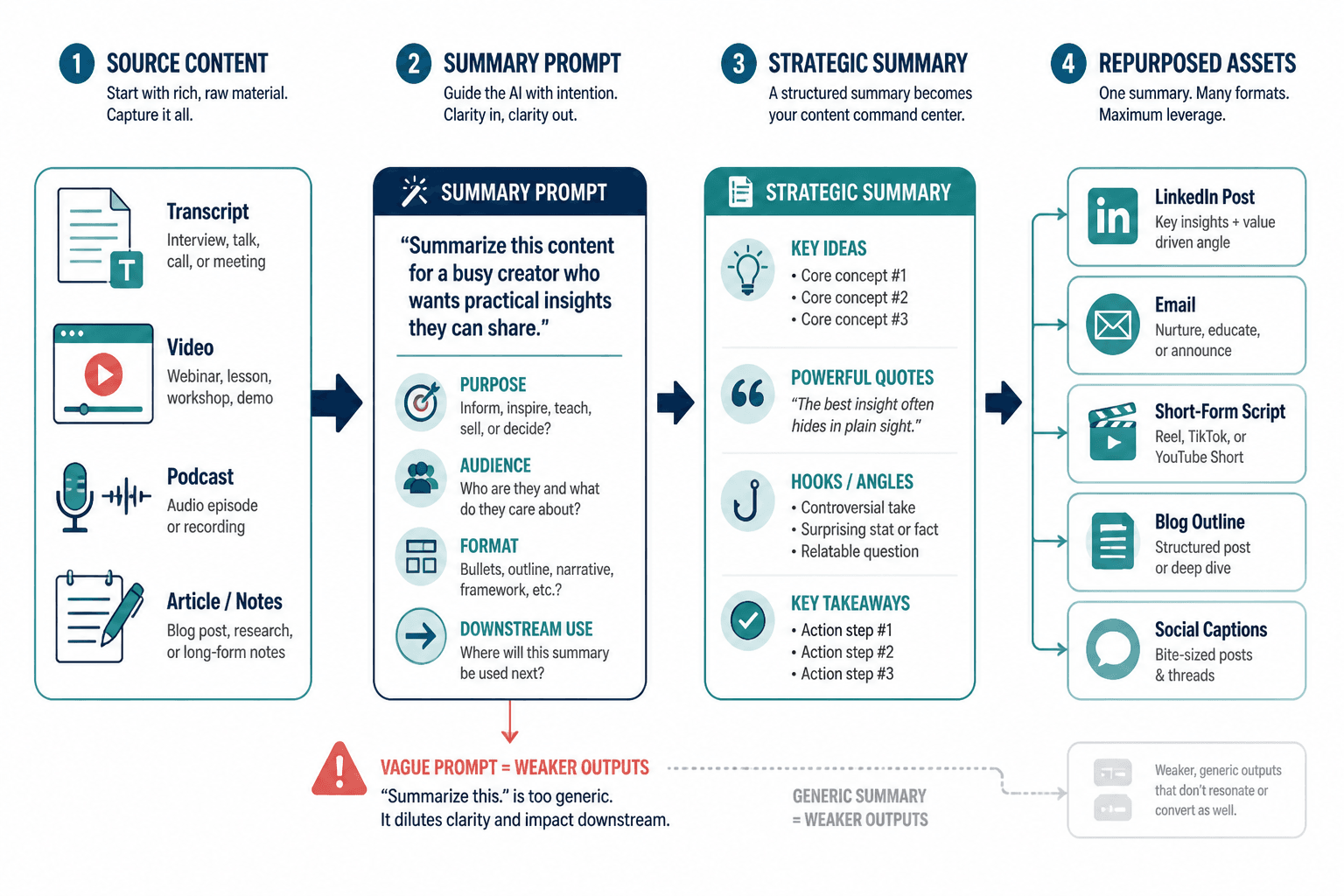
Creator AI summary prompt mistakes that hurt performance
1. Asking for a summary with no purpose
This is the big one.
If your prompt says something like “Summarize this transcript,” the model has to guess what kind of summary you want. Executive summary? Teaching summary? Social repurposing summary? Client-facing summary? Newsletter summary? Lead-gen summary? It will usually choose the safest and most boring version.
Better prompt direction looks like this:
Summarize this transcript for a creator who wants to turn it into LinkedIn posts, email content, and short-form educational clips. Pull out the strongest opinions, practical frameworks, memorable phrases, and examples worth repurposing. Ignore filler, greetings, repeated ideas, and weak transitions.
Now the AI has a job, not just a vague instruction.
2. Optimizing for shorter instead of sharper
People often ask AI to “make it concise” before they ask it to make it useful. That is backwards.
A summary that is short but mushy does not help you. You cannot build strong content from flattened ideas. You need compression with structure, not random trimming.
Instead of saying:
- make this shorter
- summarize in one paragraph
- give me a quick recap
Try saying:
- reduce this to the 5 most distinct ideas
- summarize each point in one clear sentence with no overlap
- pull only what would be useful to a coach, consultant, or creator repurposing this content
The difference sounds small. It is not. One gives you generic condensation. The other gives you editorial filtering.
3. Not telling the AI what to ignore
Good prompts are not just about what to include. They are also about what to leave out.
Most raw content contains junk:
- repetition
- throat-clearing
- setup lines
- audience greetings
- detours
- half-developed points
- examples that go nowhere
If you do not explicitly tell AI to remove that material, it will often preserve too much of it because it is trying to be faithful. Faithful is nice. Useful is better.
Add exclusion rules like:
- ignore repeated points
- remove scene-setting unless it adds meaning
- skip generic advice with no specific takeaway
- do not include filler intros or polite closing remarks
4. Forcing one summary to serve every platform
This is where a lot of repurposing goes stale. Someone wants one neat summary that can become a post, a thread, a newsletter section, an article outline, a lead magnet, and probably a children’s book if the quarter gets rough.
Different formats need different extraction logic. A LinkedIn post summary should surface tension, practical insight, and proof. An email summary may need narrative flow and one stronger central idea. A thread summary needs sequencing. A content database summary might need categorization and tags.
Do not ask one summary prompt to do all of it. Split the tasks.
A cleaner workflow is:
- Create a master extraction summary.
- Generate format-specific summaries from that master.
- Edit for voice and relevance before publishing.
That one change alone can improve quality fast.
5. Asking for “key takeaways” when the content needs angle
“Key takeaways” is one of those phrases that sounds useful and often produces dead writing.
Why? Because takeaways tend to become broad, safe, and polite. They smooth the edges off the original thinking. If your source content had a clear opinion, a strong contrarian point, a useful warning, or an unexpected insight, a basic takeaway prompt may sterilize it.
Try asking for these instead:
- most defendable opinions
- claims backed by examples
- surprising or non-obvious lessons
- ideas that challenge common creator advice
- lines with the strongest hook potential
That gets you closer to content people might actually remember.
6. Ignoring audience context
A summary for beginner creators should not sound like a summary for experienced consultants. A summary for personal brand content should not sound like one for in-house marketers. Yet people keep prompting as if audience context is optional.
It is not optional. It is the difference between “technically fine” and actually usable.
Add who the summary is for:
Summarize this for solo creators selling expertise online. Focus on the parts that help them create clearer content, build trust, and turn ideas into posts, emails, or lead magnets.
Now the model has a reader in mind. That usually sharpens what gets included and how it gets phrased.
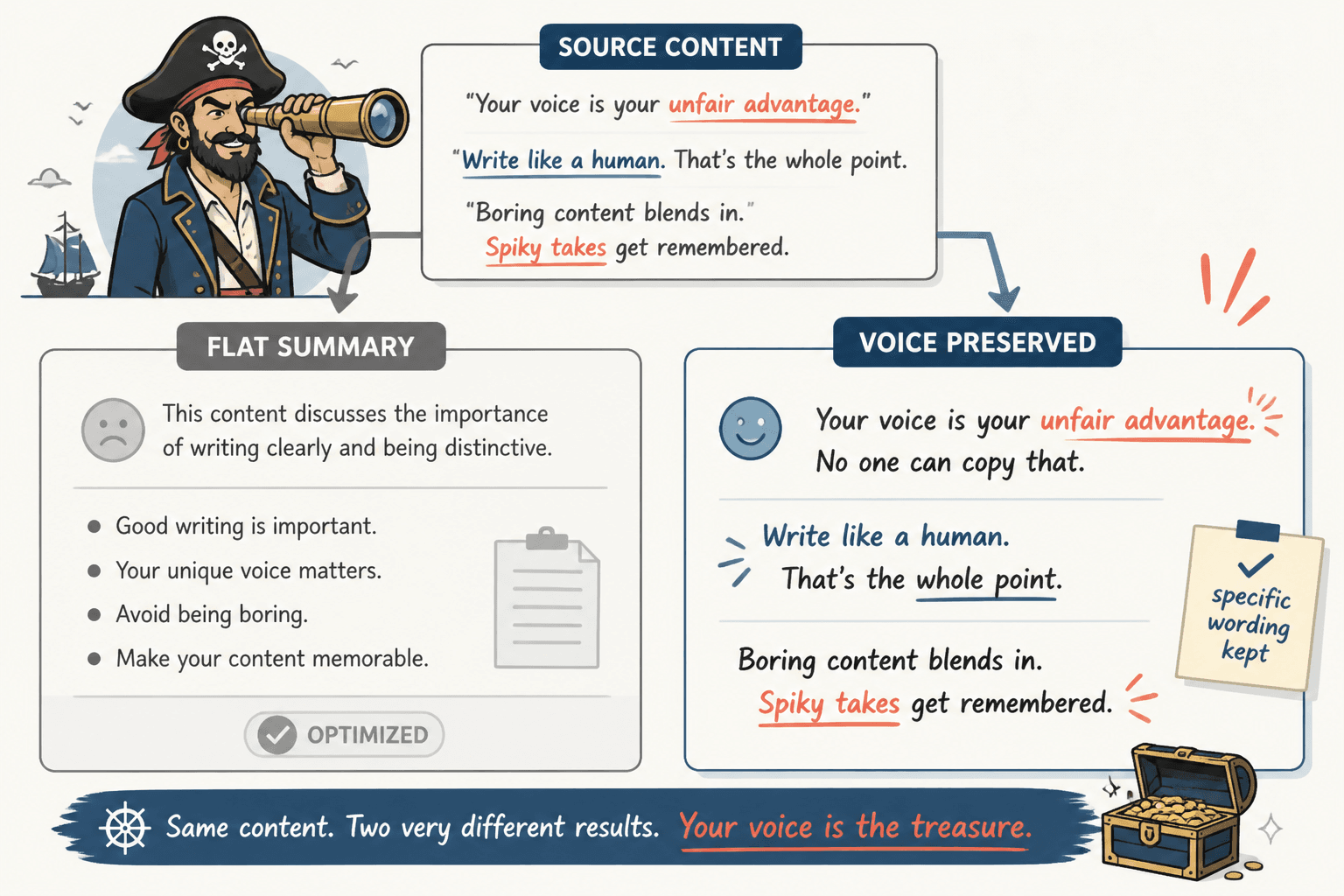
7. Using prompts that strip out the creator’s voice
Some prompts quietly bleach the personality out of the source material. You will see this when people ask for summaries that are “professional,” “clean,” “clear,” and “polished” without also protecting tone.
So the AI does what it thinks you want. It removes friction, edge, rhythm, and distinct phrasing. Congrats. You now sound like a tax software webinar.
If the original content has personality, tell the AI to preserve it:
- keep the original tone direct and conversational
- preserve dry humor or sharp phrasing when useful
- do not replace specific language with generic business wording
- retain strong opinions if they are supported by the source
This is especially important if you later plan to rewrite boring AI-assisted content. It is easier to preserve voice early than to rebuild it from beige dust later.
8. Asking for too much in one prompt
This is the classic kitchen-sink mistake.
People write prompts like this:
Summarize this transcript, identify the best quotes, make it SEO-friendly, turn it into 10 LinkedIn posts, a thread, a newsletter, and a lead magnet outline, keep my voice, improve the structure, and make it more engaging.
That is not a prompt. That is a workload dispute.
When too many goals sit in one instruction, the quality usually drops. The model starts blending tasks instead of doing any of them well. Separate extraction from transformation.
Think in stages:
- Stage 1: summarize and extract
- Stage 2: categorize usable ideas
- Stage 3: adapt into formats
- Stage 4: edit for voice and conversion
Not glamorous, but much better.
9. Forgetting to ask for structure
A wall of summary text is annoying to read and even worse to repurpose.
If you want output you can actually use, ask for a structured summary. For example:
- core theme
- top 5 ideas
- strongest quotes
- examples worth reusing
- points with lead magnet potential
- possible hooks
- claims that need proof or clarification
Structure reduces cleanup time. It also helps you spot what is missing. If the summary has no examples, no proof, and no interesting lines, that is useful information. It means the source might need editing before repurposing, or the prompt needs to guide extraction better.
10. Treating summary prompts like a replacement for judgment
This one is less technical and more operational.
Even a strong AI summary prompt does not remove the need for taste. It does not know which point aligns best with your positioning. It does not know which quote sounds most like you on a good day. It does not know which idea your audience is already tired of hearing unless you tell it.
AI can help you extract and organize. It cannot do your editorial thinking for you. Not well, anyway.
Use the summary as a draft asset, not as sacred text. Cut harder. Reorder points. Add missing specificity. Throw out anything that sounds technically competent and spiritually dead.
A better summary prompt framework for creators
If your current prompts keep producing bland summaries, use this framework instead.
| Prompt part | What to specify |
|---|---|
| Source type | Transcript, article, workshop notes, call recording, newsletter draft |
| Purpose | Repurposing, content planning, editing, asset extraction |
| Audience | Creators, coaches, consultants, founders, personal brands |
| Output format | Bullet summary, categorized sections, hook bank, quote list, content brief |
| Inclusion rules | Strong opinions, practical lessons, examples, quotes, frameworks |
| Exclusion rules | Filler, repeated points, weak transitions, generic claims |
| Tone guardrails | Keep direct voice, preserve personality, avoid corporate phrasing |
Here is a practical template:
Summarize the following [transcript/article/notes] for a creator repurposing content into posts, emails, and educational assets. Extract the strongest ideas, useful opinions, practical frameworks, memorable lines, and examples. Remove filler, repetition, intros, and generic statements. Organize the output into: core theme, top ideas, strongest quotes, examples worth reusing, and potential content hooks. Keep the tone direct and natural. Do not make it sound corporate or overly polished.
That is not magic. It is just specific enough to be useful.
Before and after: weak prompt vs stronger prompt
Weak prompt
Summarize this video transcript into key takeaways.
What usually happens
The bigger point is simple: clearer structure and clearer writing make the piece more useful. That is usually what makes the ending land better too.
The bigger point is simple: clearer structure and clearer writing make the piece more useful. That is usually what makes the ending land better too.