
Most creators do not have an AI problem. They have a format problem.
They feed one decent idea into a tool, ask it to “repurpose” the content, and get back a pile of lifeless copies wearing different platform costumes. Same point. Same rhythm. Same bland tone. Same suspiciously polished oatmeal.
That is why better creator AI format shifts for personal brands matter. Not because every platform needs a totally different personality, but because each format rewards different kinds of clarity, pacing, proof, and tension. If your AI workflow cannot adapt the shape of an idea, it will keep producing content that looks busy and performs like wallpaper.
Here’s how to use AI to shift formats properly so your ideas survive the move from post to thread to article to email to short-form commentary without sounding like they were copied, diluted, and shoved through a brand blender.
For the broader learning path, visit our parent guide.
What “format shifting” actually means
Format shifting is not just shortening or expanding content.
It means changing how an idea is delivered so it fits the platform, the reader’s attention, and the job the content needs to do. That might mean turning a sharp opinion into a LinkedIn post, a step-by-step breakdown into a thread, a practical lesson into an email, or a case-study angle into a longer article.
The core idea stays the same. The structure should not.
For personal brands, this matters even more because people are not just consuming information. They are deciding whether your thinking is clear, useful, trustworthy, and worth following. Bad repurposing makes you sound repetitive. Good format shifting makes you sound consistent.
Consistency is not posting the same thing everywhere. It is making the same core idea feel native wherever it lands.
Why most AI repurposing falls apart
Most tools are fine at generating versions. They are not naturally good at making editorial decisions.
So if your prompt is lazy, the result will be too. You will get:
- one message copied into five formats with barely any strategic change
- hooks that sound interchangeable
- threads with no momentum
- articles padded with generic filler
- emails that read like rejected LinkedIn posts
- caption-style writing forced into formats that need argument or proof
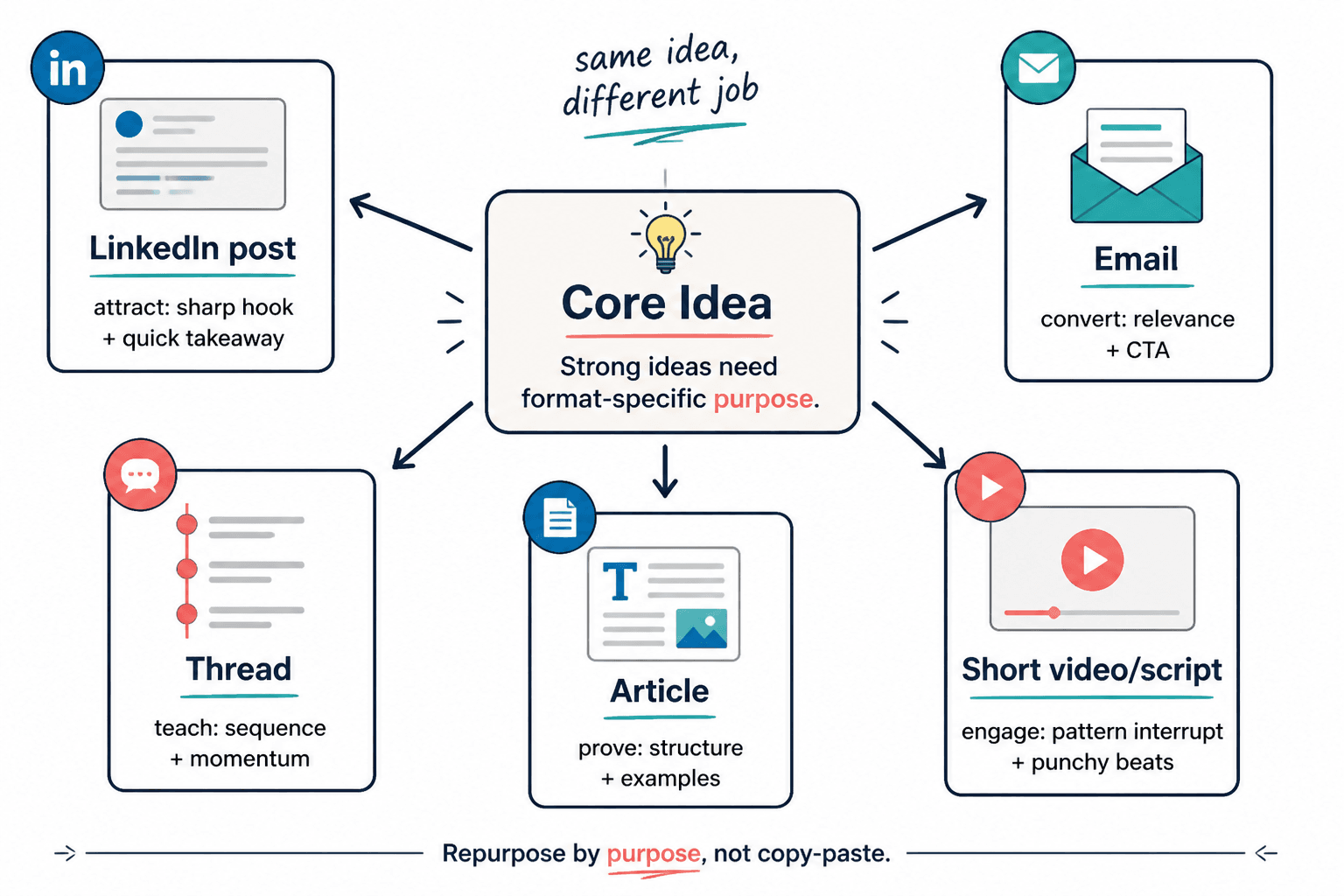
AI tends to flatten strong ideas unless you tell it what each format is supposed to do. That is the part creators skip. They ask for output before defining purpose.
And then they wonder why everything sounds “fine” in the most unhelpful sense of the word.
The smarter way to handle Better Creator AI Format Shifts for Personal Brands
Before you repurpose anything, define these four things:
- The core idea: What is the actual point?
- The audience angle: Why should this specific audience care?
- The format job: Is this format supposed to attract, teach, persuade, or convert?
- The tone shift: Should this version feel punchy, conversational, structured, or more authority-driven?
That one move makes AI much more useful. It stops being a content slot machine and starts acting more like a formatting assistant.
If you want a broader workflow for this, the creator AI editing and repurposing hub is the right place to build from. You can also pair this article with the more complete guide for creators who want better results if your process still feels messy.
Use this simple format-shift prompt frame
Instead of saying, “Repurpose this into a thread and a LinkedIn post,” give AI a better brief:
Take this core idea and adapt it for [format]. Keep the main point, but change the structure, pacing, and emphasis to fit the format. The goal is to [attention/trust/leads/authority]. Audience is [specific audience]. Tone should feel [clear, sharp, practical, conversational, credible]. Remove generic filler, avoid repeated phrasing, and make this version feel native to the platform rather than copied from another one.
Not glamorous. Very useful.
How one idea should change across common creator formats
Let’s take a simple source idea:
“Most personal brand content underperforms because creators publish ideas in the wrong format, not because they lack expertise.”
Now watch how that idea needs to shift.
LinkedIn post: make it useful and opinion-led
A LinkedIn post usually needs a strong first line, a clean angle, a bit of credibility, and a takeaway people can use fast.
Weak repurpose:
Many creators struggle with content performance because they are not using the right format for their message. It is important to understand platform differences and tailor your content accordingly.
Better shift:
Most underperforming personal brand content does not have an idea problem.
It has a format problem.
Good insight shoved into the wrong container usually dies quietly.
A sharp opinion becomes a bloated carousel.
A useful lesson becomes a thread with no tension.
A solid case study gets posted like a motivational caption.
Same expertise. Wrong packaging.
If your content feels smart but keeps getting polite silence, stop asking whether the idea is good.
Ask whether the format is doing the job.
That version has rhythm, contrast, and a clearer punch.
X thread: compress harder and create movement
A thread needs momentum. It cannot sound like an article chopped into little rectangles.
Better shift:
- Most creators do not have a content problem.
- They have a format problem.
- A strong idea in the wrong format usually underperforms, even if the advice is solid.
- Examples:
- Opinion posted like a tutorial
- Story posted like a tip list
- Case study posted like a vague “lesson learned”
- Different formats do different jobs:
- Posts = quick attention
- Threads = guided thinking
- Articles = depth + authority
- Email = relationship + conversion
- Do not just “repurpose.” Rebuild the idea for the format.
The thread version needs speed, cleaner sequencing, and less explanation per line. X does not reward throat-clearing. It rewards a point.
Article: expand the idea with proof and structure
An article has a different job. It needs enough depth to justify the reader staying with you. This is where AI often bloats instead of deepens.
A good article shift should add:
- clear framing of the problem
- real examples
- breakdowns by format or platform
- useful steps
- a practical next action
It should not add five paragraphs that say “content strategy matters” in different outfits.
Email: make it more direct and relational
Email can hold nuance, but it should still feel like it came from a person, not a committee of productivity ghosts.
Better shift:
If your content keeps getting ignored, the issue may not be your ideas.
It might be the format.
I keep seeing creators take one good insight and paste it everywhere with minor edits. Same point, same order, same tone. That usually weakens the idea instead of extending it.
A post should grab attention fast. An article should develop trust. An email should feel more direct and usable.
If you want more mileage from your content, do not just republish it. Rebuild it for the place it is going.
Notice the difference. Less performative. More personal. Better suited to inbox attention.
The 5 format shifts personal brands should train AI to make
1. From explanation to opinion
Many creator drafts explain too much and assert too little. AI often makes this worse by smoothing every edge off the idea.
Ask AI to identify the strongest claim in your draft and rebuild the piece around that claim. This works especially well for social posts where a clean opinion gets attention faster than a careful lecture.
2. From broad advice to situational specificity
“Be consistent” is not content. It is wallpaper.
Tell AI to rewrite broad advice into specific use cases:
- for coaches launching an offer
- for consultants building authority
- for solo founders posting on LinkedIn
- for creators turning articles into emails
Specificity makes repurposed content feel newly relevant instead of lazily recycled.
3. From polished summary to native platform rhythm
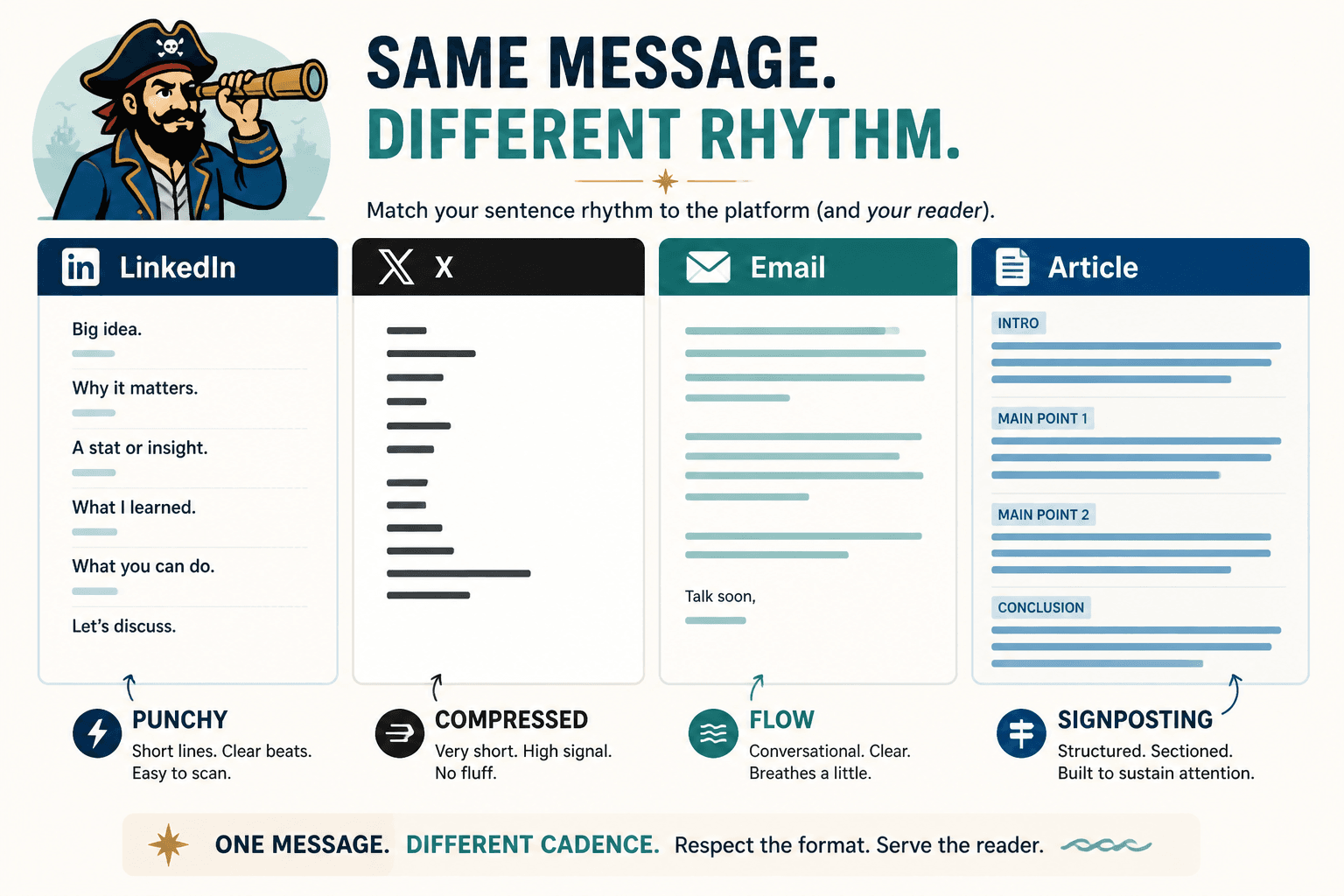
One of the biggest tells of bad AI repurposing is rhythm. Every sentence sounds evenly ironed.
But native platform rhythm varies. LinkedIn often wants punchy, broken-up progression. X wants compression. Email can hold a little more flow. Articles need stronger structural signposting.
So ask AI to adapt not just the wording, but the sentence pattern and pacing. That is where a lot of “this still sounds robotic” problems actually live.
4. From standalone post to funnel-aware asset
Some formats are for reach. Others are for trust or conversion. Your AI workflow should know the difference.
For example:
- a short social post might spark attention
- an article might deepen authority
- an email might move the reader toward a booking page or resource
That means the same idea may need different endings depending on where it lives. A post CTA might invite thought. An article CTA might point to a related resource. An email CTA might ask for a reply or click.
If you are trying to connect content to actual business outcomes, the material in how to write better creator AI editing and repurposing can help tighten that transition.
5. From one asset to a content set
The best use of AI is rarely “make this into one more post.” It is helping you build a smart content set from one solid source.
For example, from one article or voice note, you could create:
- 1 LinkedIn opinion post
- 1 X thread
- 2 short quote-style posts
- 1 email version
- 1 CTA-based post tied to your offer
- 1 article section expanded into a lead magnet teaser
That is a real repurposing workflow. Not just five weak remixes of the same paragraph.
A practical AI editing workflow for better format shifts
If you want this to work repeatedly, use a sequence instead of one giant prompt.
- Extract the core idea. Ask AI to state the main argument in one sentence.
- Identify the strongest angles. Ask for 3 to 5 possible framings for different audiences or formats.
- Choose the target format. Define the format’s job: attention, trust, depth, leads, or conversion.
- Generate a native draft. Instruct AI to rebuild, not just shorten or expand.
- Edit for voice. Remove generic transitions, repeated phrasing, and weirdly polished filler.
- Add proof or texture. Include examples, contrasts, mini-case points, or sharper specifics.
- Tune the CTA. Match the ending to the platform and intent.
This sequence is slower than one-click repurposing. It is also much less embarrassing.
If you want tool help, start with categories that support drafting, rewriting, and workflow management rather than looking for one mythical platform that does everything. The breakdown in best AI tools for creator AI editing and repurposing is useful for that.
Common mistakes that ruin AI format shifts
- Keeping the same hook everywhere: each format has different attention rules
- Using one tone for everything: what works in an article can feel stiff in a post
- Asking for quantity before strategy: more versions of a weak idea do not help
- Leaving the CTA unchanged: a social prompt is not the same as an email ask
- Not editing the AI draft: first-pass output is a starting point, not a finished asset
- Ignoring audience state: a cold reader and a warm subscriber do not need the same version
The bigger point is simple: clearer structure and clearer writing make the piece more useful. That is usually what makes the ending land better too.