
Most creators ask the wrong length question.
They ask how long their AI editing and repurposing workflow should be, as if there is one respectable number that proves they are being strategic instead of winging it. There is not. In 2026, the better question is this: how much editing and repurposing is enough to improve the asset, fit the platform, and move the reader, without turning your workflow into a full-time administrative hobby?
That is the real tension behind How Long Should Creator AI Editing and Repurposing Be in 2026? Not just output length. Process length. Content length after repurposing. Prompt length. Editing pass length. How many versions you should make from one idea. How much polish is useful before you are just sanding a spoon.
Here’s the practical answer: creator AI editing and repurposing should be as long as needed to sharpen the idea, adapt it to the channel, and preserve your voice. No longer. If your workflow keeps producing bland clones, overextended carousels, bloated threads, or polished nothingness, the problem is not that you need more AI. It is usually that you need less output and better judgment.
This article will help you figure out the right length for the work itself and the content that comes out of it, so you can repurpose faster without publishing a pile of robotic filler.
Want the broader roadmap? Start with the parent guide.
There is no magic length, but there are clear limits
AI editing and repurposing can save a creator a ridiculous amount of time. It can also quietly eat all of it.
A lot of people are now running every newsletter through five prompts, turning each section into a thread, stretching the thread into a LinkedIn post, shrinking the LinkedIn post into six tweets, then asking AI to rewrite all of it in three tones, two reading levels, and one “contrarian but warm” style. Technically productive. Spiritually exhausting.
The right length in 2026 depends on five things:
- The strength of the source idea
- The platform you are repurposing for
- Your goal — reach, trust, leads, authority, sales
- Your voice tolerance — how much AI smoothing you can use before it stops sounding like you
- Your workflow capacity — how much time you can realistically spend without breaking consistency
That means there is no single ideal output length. But there are good working ranges, and they are a lot more useful than random advice about posting “more content.”
Think in layers, not one giant repurposing chain
The cleanest way to decide how long creator AI editing and repurposing should be is to break it into layers.
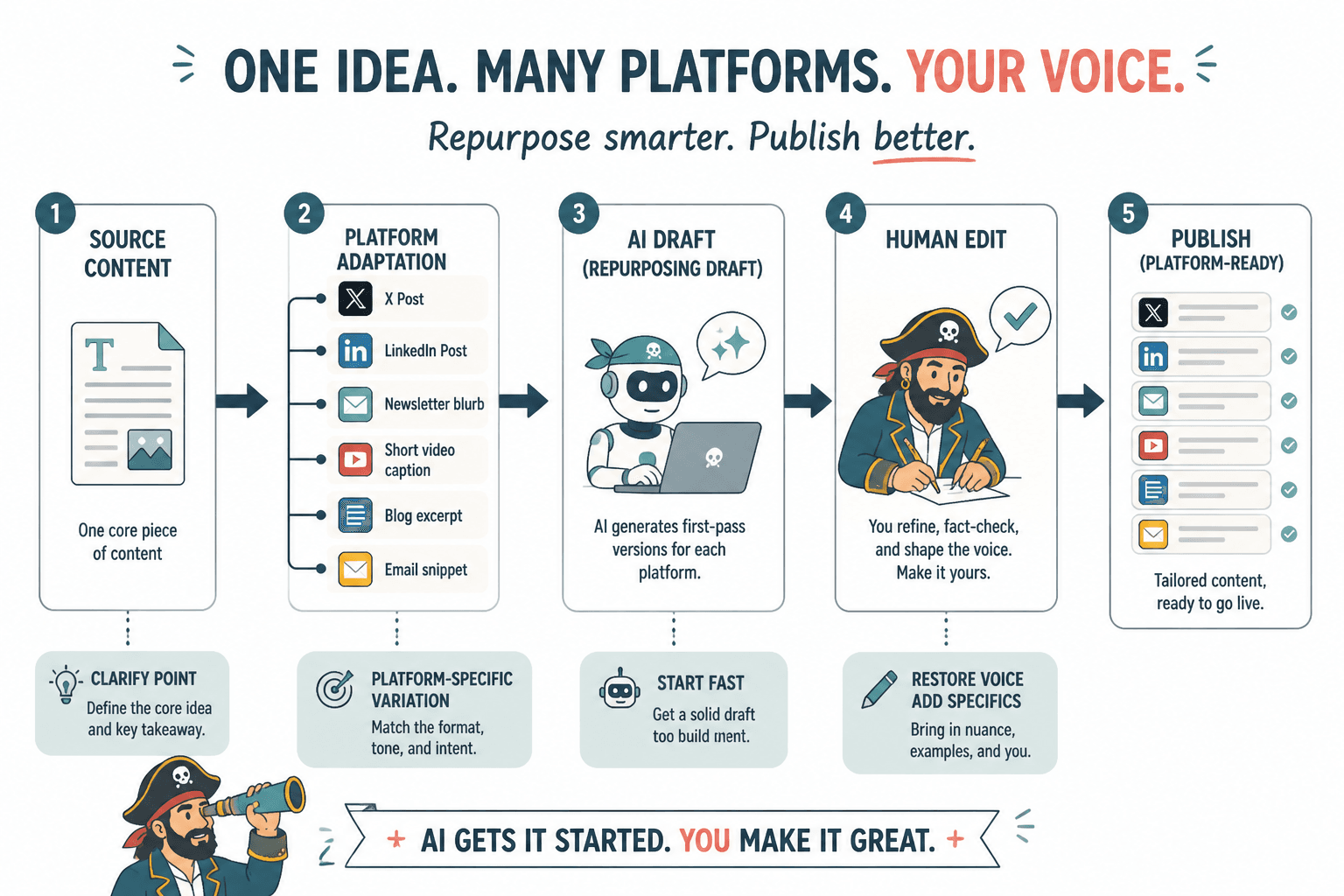
Most repurposing workflows go off the rails because creators treat one piece of content like a content piñata. They keep hitting it until a dozen mediocre assets fall out. Better approach: build in layers. One source asset. A short edit pass. A platform adaptation pass. A final human polish. Done.
For most creators, that means this:
| Layer | What it does | Ideal length in practice |
|---|---|---|
| Source cleanup | Fix structure, remove fluff, clarify point | 5–15 minutes |
| Repurposing draft | Turn source into platform-specific variations | 10–20 minutes |
| Human edit | Cut robotic phrasing, restore voice, add specifics | 5–15 minutes |
| Optional expansion | Add examples, proof, CTA, context | Only if the platform or goal needs it |
If you are spending 45 minutes repurposing one 500-word post into six channels and all six outputs sound like a confident intern guessing your personality, the process is too long for the result.
And if you are spending 90 seconds generating 14 assets from one half-baked note, the process is too short to produce anything worth posting. Cheap speed is still expensive when it burns trust.
How long should the actual content outputs be?
This is where people usually mean the title literally, so let’s get specific.
When AI helps you edit and repurpose content, the final asset should match the platform and the complexity of the point. Not the maximum amount of text the tool can generate before it starts repeating itself like a nervous keynote speaker.
Short-form social posts
Short posts should usually stay short after repurposing.
- X posts: one idea, one angle, one clean punch
- LinkedIn short posts: enough room for a hook, a point, and maybe a quick example
- Facebook casual posts: slightly looser, but still focused
If AI turns a sharp thought into a seven-paragraph sermon, it did not “add value.” It diluted the point. Short content works when the idea lands quickly. Repurposing should preserve that, not smother it in context nobody asked for.
Medium-length educational posts
This is where repurposing usually works best. A strong source asset can become:
- a LinkedIn advice post
- a Facebook story-plus-takeaway post
- a short email
- a mini thread
- a caption that leads to a full offer or article
For these, AI editing and repurposing should be long enough to do three things:
- adapt the opening to platform expectations
- change the structure to fit reading behavior
- add or remove detail based on what the audience needs to believe the point
That usually means moderate expansion, not endless expansion.
Long-form assets
Articles, newsletters, guides, pillar posts, and in-depth LinkedIn articles can justify longer AI editing and repurposing passes because they need more coherence. But longer does not mean padded.
If your source is a transcript, long-form editing may need a serious cleanup pass before repurposing. Spoken content is messy. It loops. It stalls. It says “basically” 19 times and somehow still skips the point. AI can help reshape it, but the useful length is whatever gets you from rambling source to readable structure.
In other words, long-form repurposing should earn its length through clarity and depth, not because your tool was feeling generous.
A practical rule for 2026: repurpose to fit the destination, not to honor the source
This is the part many creators miss.
They become weirdly loyal to the original piece. Every sentence must survive. Every nuance must travel. Every bullet must be represented in every adaptation. So a crisp podcast clip becomes a bloated LinkedIn post. A useful email becomes a dead-on-arrival thread. A decent article becomes 11 social posts that all say the same thing with slightly different shoes.
Repurposing is not preservation. It is translation.
That means the right length is determined by the destination format:
- If the platform rewards speed and punch, cut harder.
- If the platform rewards depth and authority, expand where needed.
- If the audience already knows the topic, remove basics.
- If the audience needs convincing, add proof, examples, or stakes.
This is also why short repurposed assets often outperform longer ones. A focused version that actually fits the platform beats a swollen adaptation that feels imported.
If you want the flip side of that argument, read when short creator AI editing and repurposing beat long ones.
How long should your AI editing pass be?
For most creators, the editing pass should be shorter than the drafting pass.
If AI gives you a usable draft, your job is not to hover over every sentence like a suspicious museum guard. Your job is to fix the parts that matter:
- the opening
- the positioning of the point
- the examples
- the proof
- the voice
- the CTA
That means a useful AI edit is often one or two passes, not seven. A good working model:
- Pass one: cut fluff, repetition, and generic transitions
- Pass two: add specificity, voice, and platform-fit formatting
If a third pass is needed, it should usually be for final polish, not wholesale rebuilding. If you keep needing total rewrites, the prompt, source material, or positioning is probably weak upstream.
That is worth saying more clearly: if every repurposed draft needs rescue, your workflow is not efficient. It is just making extra chores look automated.
Ideal repurposing length by creator goal
The best answer changes when your goal changes.
| Goal | Best repurposing length | Why |
|---|---|---|
| Reach | Short to medium | Fast to consume, easier to share, less friction |
| Trust | Medium | Enough room for nuance, proof, and personality |
| Authority | Medium to long | Depth helps when the insight is real |
| Leads | Medium | Needs value plus a clean next step |
| Sales | Short to medium, occasionally long | Depends on audience warmth and offer complexity |
Creators get in trouble when they use one repurposing length for every goal. Reach content gets too dense. Sales content gets too vague. Authority content gets cut so hard it becomes a slogan pretending to be insight.
The format has to match the job.
What most creators overdo in AI repurposing
If your workflow feels too long, one of these is probably the reason.
1. Too many versions of the same asset
You do not need four LinkedIn posts from one paragraph unless the paragraph contains actual layers worth separating. More often, one strong post beats four diluted cousins.
2. Expanding weak source material
AI is very willing to elaborate on mediocre ideas. That does not mean you should let it.
If the source is vague, fix the source first. A fuzzy idea made longer is still fuzzy. It is just now taking up more space.
3. Keeping every sentence too polished
Some creators keep editing until the draft sounds smooth in a way no human ever really sounds. Then they wonder why engagement drops. Because readers can smell furniture-polish content from across the room.
If you need help with that part, this will help: how to write creator AI editing and repurposing without sounding salesy or robotic.
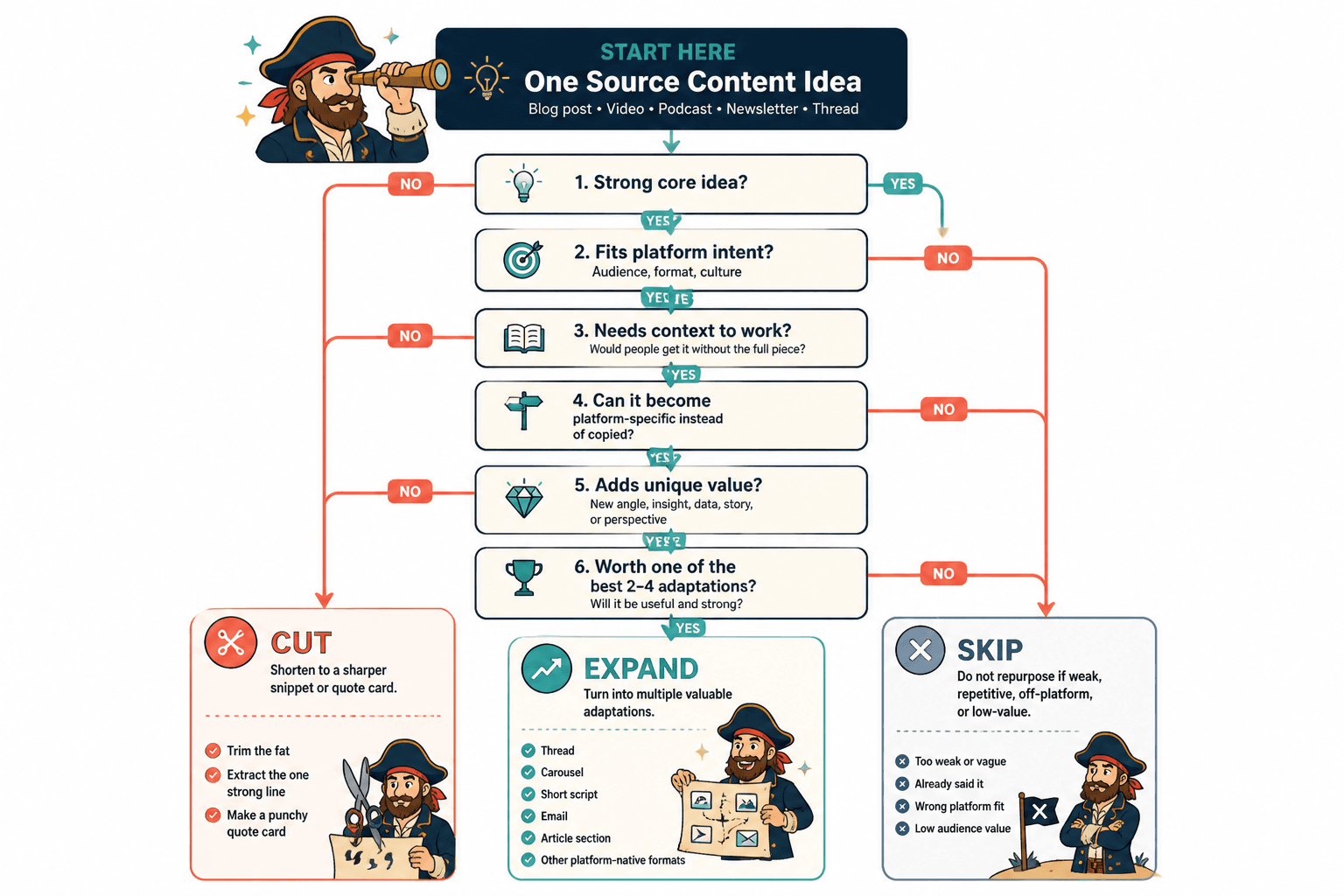
4. Treating repurposing like multiplication instead of selection
The goal is not to produce the maximum number of assets. The goal is to extract the most useful formats from the strongest idea.
That usually means choosing the best 2 to 4 adaptations, not demanding 12 because your tool can technically oblige.
A simple working range for most creators in 2026
If you want a practical benchmark, here it is.
- Editing one social post with AI: 5–10 minutes total
- Repurposing one source asset into 2–3 platform-specific posts: 15–30 minutes total
- Turning a long-form asset into a full repurposing batch: 30–60 minutes total, including human review
- Editing beyond 60 minutes for one content batch: usually only worth it for high-value launches, cornerstone assets, or sales pages
These are not laws. They are sanity-preserving ranges.
If your process is far longer, ask whether the asset deserves that much attention. If your process is far shorter, ask whether you are actually adapting the content or just photocopying it into new shapes.
How to tell when your AI editing and repurposing is too short
Too short does not just mean rushed. It means under-adapted.
Watch for these signs:
- the post still reads like the original platform
- the hook feels generic or misaligned
- the examples do not fit the audience
- the CTA feels pasted on
- the tone sounds like AI trying to be supportive in a hotel conference room
- the piece says the same thing three times in slightly different words
In that case, the answer is not necessarily to make it much longer. It is to make the edit more intentional. A sharper 8-minute pass beats a lazy 25-minute one.
How to tell when it is too long
This is even more common.
- you are preserving details the new audience does not need
- the post opens slowly because you kept the original setup
- every repurposed version starts sounding identical
- you are adding examples just to justify the word count
- the workflow feels heavy enough that you start avoiding it
- you are publishing less because the repurposing system became fussy
That last one matters a lot. A workflow that is theoretically excellent but practically annoying will lose to a simpler one you can repeat every week.
Best practice: start with one strong transformation, not five average ones
If you are building or cleaning up your workflow, do this first:
- Choose one strong source asset
- Create one repurposed version for one platform
- Edit it until it actually sounds like you
- Measure whether it saves time and still performs well
- Only then expand the workflow
This matters because creators often build a giant AI repurposing system before they have proved they can get one good adaptation out of it. That is backwards. Scale the thing that already works.
If your openings are falling flat after repurposing, read how to start creator AI editing and repurposing without a weak opening. And if the overall output still feels loose, how to write better creator AI editing and repurposing is the next logical stop.
A better way to judge length: usefulness per minute
This is probably the most honest metric available.
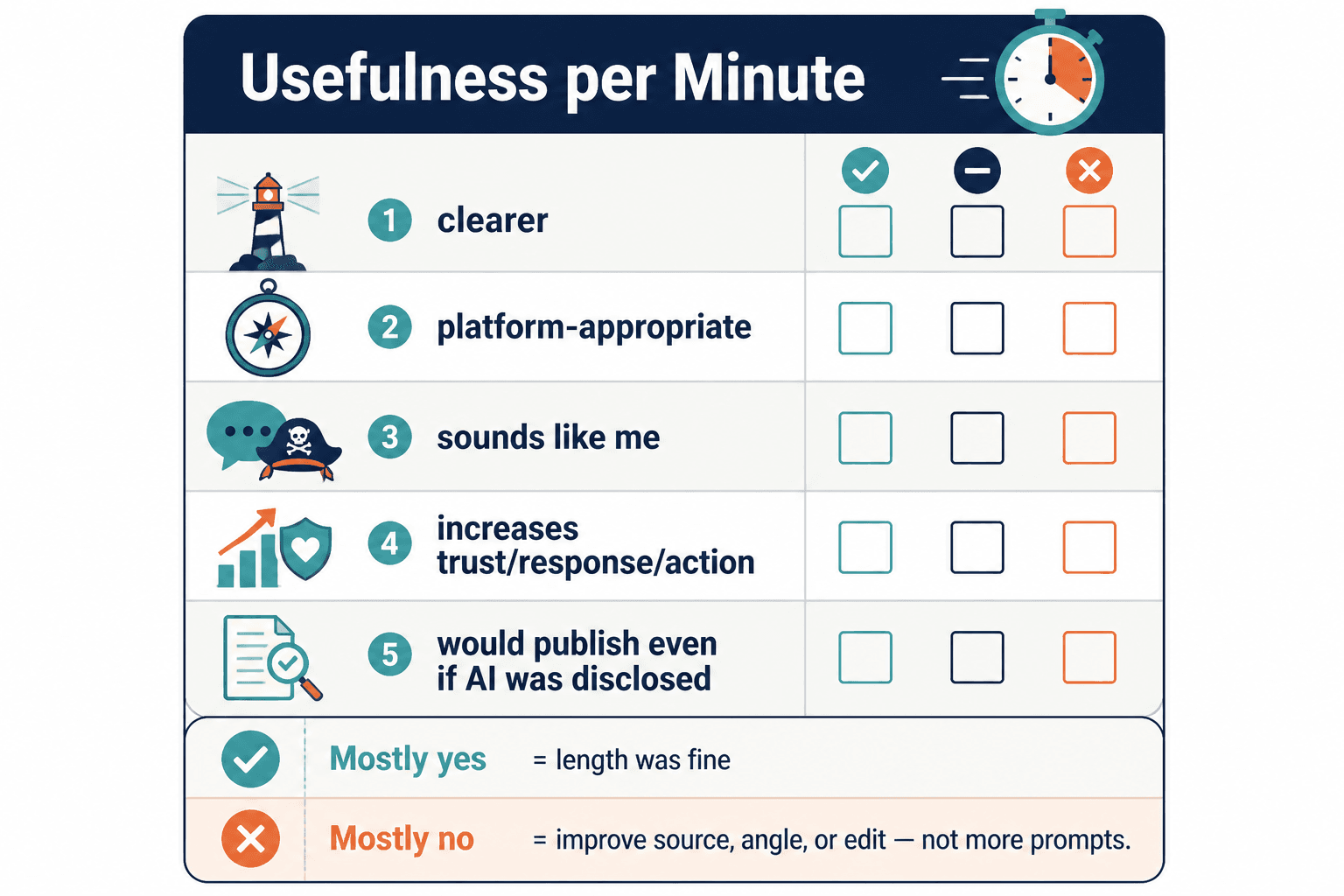
Do not judge your AI editing and repurposing workflow by how much content it produces. Judge it by usefulness per minute.
Ask:
- Did this version become clearer?
- Did it become more platform-appropriate?
- Did it sound more like me, not less?
- Did it increase the odds of trust, response, or action?
- Would I still publish this if nobody knew AI touched it?
If the answer is yes, the length was probably fine.
If not, adding more prompts will not rescue it. Better source material, a better angle, or a better edit might.
Where this fits in a broader creator workflow
AI editing and repurposing should sit inside a workflow, not become the workflow.
It works best when it supports strong source thinking, clear positioning, and channel awareness. It works badly when it becomes a machine for turning every rough thought into content confetti.
So if you are building a fuller system, it helps to think in this order:
- idea quality
- source asset quality
- editing quality
- repurposing fit
- distribution
- conversion path
You can explore the broader stack here: AI writing tools and workflows, creator AI workflows, and creator AI editing and repurposing.
FAQ
Should creator AI repurposing always make content shorter?
No. It should make content fit the destination better. Sometimes that means cutting. Sometimes it means adding context, examples, or proof.
How many repurposed assets should come from one source piece?
Usually 2 to 4 strong ones is plenty. More than that only works when the source contains genuinely distinct ideas.
How much human editing should happen after AI?
Enough to fix the hook, specificity, voice, and CTA. For most pieces, one or two human passes is enough.
What if AI output sounds polished but empty?
That usually means the source idea was weak, too generic, or over-expanded. Tighten the point before asking for more versions.
Is longer repurposing better for SEO?
Not automatically. Search-friendly content still needs focus, structure, and actual usefulness. Longer only helps when the topic needs depth.
The bigger point is simple: clearer structure and clearer writing make the piece more useful. That is usually what makes the ending land better too.