
Most lead magnets do not fail because the freebie is bad. They fail because the next step is lazy, vague, or weirdly aggressive.
Someone downloads your checklist, guide, template, or mini-course, and then what? They get a generic welcome email, a random sales pitch on day two, and a quiet sense that they have just walked into a funnel wearing a fake mustache.
That is the real problem. The lead magnet is only the hand-raise. The funnel decides whether that attention turns into trust, action, and revenue, or just another sleepy subscriber sitting in your email list like digital furniture.
This guide will show you the best funnel ideas to pair with lead magnets so the free thing actually leads somewhere useful. Not everywhere. Somewhere. That matters. You will see which funnel types work best for different offers, audiences, and buying temperatures, plus what people tend to mess up when they try to monetize too fast.
If you want the broader lead magnet context first, read this guide on lead magnets. If your bigger focus is building a cleaner revenue path from content, you may also want the related pieces in the monetization and money-content section.
To see how this fits into the wider strategy, open the parent guide.
What makes a good funnel match a lead magnet
The best funnel ideas to pair with lead magnets have one thing in common: they continue the same conversation the lead magnet started.
That sounds obvious. It should be obvious. Yet plenty of funnels ignore it completely.
If someone downloads a checklist about fixing weak LinkedIn hooks, the next step should probably help them apply that skill, deepen the result, or solve the next adjacent problem. It should not suddenly hard-pivot into a broad pitch for “business growth coaching” with three vague testimonials and a Calendly link.
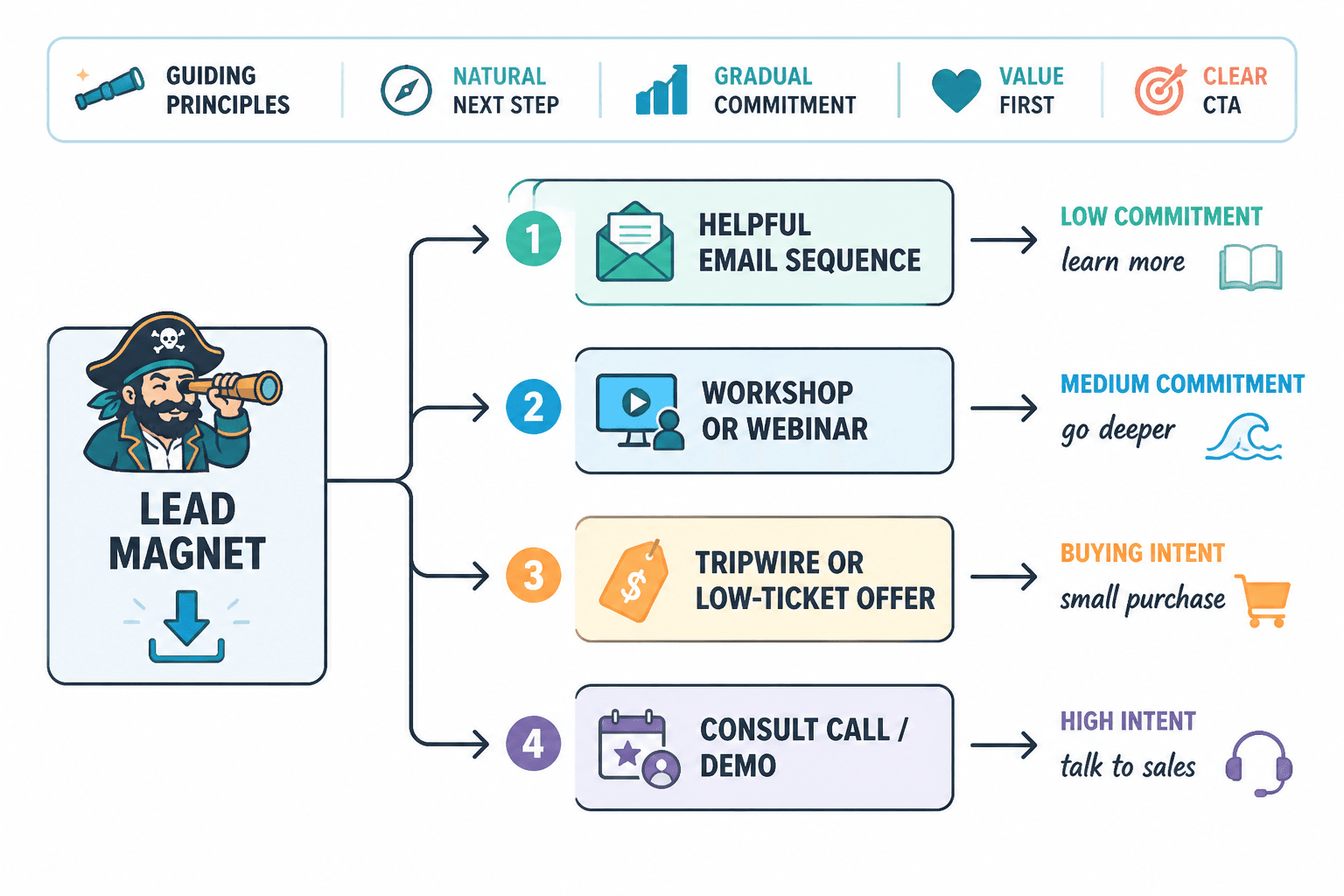
A solid funnel match usually has these traits:
- The offer fits the problem the lead magnet addresses
- The next step feels natural, not forced
- The level of commitment increases gradually
- The timing matches buyer intent
- The follow-up gives value before asking for money
- The CTA is clear enough that people know what to do next
You are not building a trapdoor. You are building momentum.
That means a good funnel asks: what is the most useful next move for someone who just said yes to this topic?
Not: how fast can I shove them toward my highest-ticket offer before they recover.
The 7 best funnel ideas to pair with lead magnets
There is no single perfect funnel. Different lead magnets need different follow-up paths depending on the audience, price point, and what people are actually ready to do next.
Here are the funnel types that tend to work best without wrecking trust.
1. Lead magnet to nurture email sequence to core offer
This is the classic option because it works. Not because it is exciting.
Someone downloads the free resource, then gets a short email sequence that helps them use it, understand the bigger problem, and see why your paid offer is the logical next step.
Best for:
- Coaches
- Consultants
- Service providers
- Creators with digital products
- Brands selling low- to mid-ticket offers
Simple structure:
- Deliver the lead magnet
- Help them get a quick win
- Show the common mistake or gap
- Offer a framework, case study, or example
- Present the paid next step
This works because it gives the lead magnet somewhere to go. The email sequence creates the bridge between “interesting free thing” and “paid help I now understand better.”
Where people mess it up: they either send too many filler emails or jump to the pitch before earning any trust. The fix is simple. Each email should do a job. If it does not, cut it.
2. Lead magnet to tripwire offer to higher-value product or service
A tripwire is a low-cost offer that helps a subscriber move from free to paid with very little friction. Think template pack, mini-workshop, swipe file, audit add-on, or short training priced low enough to feel easy but useful enough to feel real.
Best for:
- Digital product sellers
- Educators
- Audience-first creators
- Businesses that want to qualify buyers fast
Good flow:
- Free checklist: “10 mistakes killing your sales page”
- Tripwire: “Sales page teardown toolkit” for a small price
- Core offer: full course, consulting package, or done-for-you help
The tripwire does two useful things. It generates some revenue, sure, but more importantly, it identifies people willing to pay for a solution. That matters far more than vanity opt-in numbers.
Just do not make the tripwire feel like a downgraded random extra. It needs to solve a real problem, not exist purely because someone on the internet said every funnel needs a tiny paid product.
3. Lead magnet to consultation or strategy call
This one makes sense when the lead magnet attracts people with a clear business problem and your service is the next logical move.
For example, if someone downloads a messaging audit checklist, a consultation invite can work beautifully. The lead magnet helps them diagnose the issue. The call helps them solve it in context.
Best for:
- Consultants
- Coaches
- Agencies
- Service providers with custom work
- High-ticket offers
Strong version:
- Lead magnet teaches diagnosis
- Follow-up emails deepen the issue
- CTA invites qualified readers to book a call
Weak version:
- Lead magnet gets delivered
- Immediate email says “Book a discovery call now”
- No context, no trust, no reason
If your audience needs custom advice before buying, this can be a strong funnel. But the transition has to feel earned. A consult CTA works best after the person understands the cost of the problem and believes you can help with their version of it.
4. Lead magnet to webinar or workshop
This is useful when the topic needs demonstration, nuance, or stronger belief-shifting before a sale.
A lead magnet can warm people up around the problem. A webinar or workshop gives you more space to teach, show proof, handle objections, and present your offer without it feeling abrupt.
Best for:
- Offers that need education
- Higher-ticket coaching or programs
- Complex frameworks
- Audience segments that need more trust before buying
Example:
- Lead magnet: “5 content mistakes costing you warm leads”
- Workshop: “How to build a trust-first content funnel that brings in better buyers”
- Offer: program, service, or implementation package
The workshop should not just repeat the lead magnet with louder slides. It needs to advance the buyer’s understanding. Otherwise it feels like homework with a pitch attached.
5. Lead magnet to newsletter to soft conversion path
Not every lead needs to go straight into a short sales sequence. Some people are better served by entering your regular newsletter where trust builds over time.
This is especially good for creators, personal brands, and expertise-driven businesses where the sale often comes after repeated exposure rather than one tight promotional sequence.
Best for:
- Longer sales cycles
- Relationship-heavy businesses
- Writers and creators
- Consultants with trust-based buying decisions
Flow:
- Lead magnet solves one immediate issue
- Subscriber joins regular newsletter
- Newsletter builds authority, relevance, and familiarity
- Soft CTAs point to offers, calls, or products over time
This can look slower, but slower is not always worse. A subscriber who reads you for six weeks and then buys is often far stronger than one who panic-clicks into a call they were never ready for.
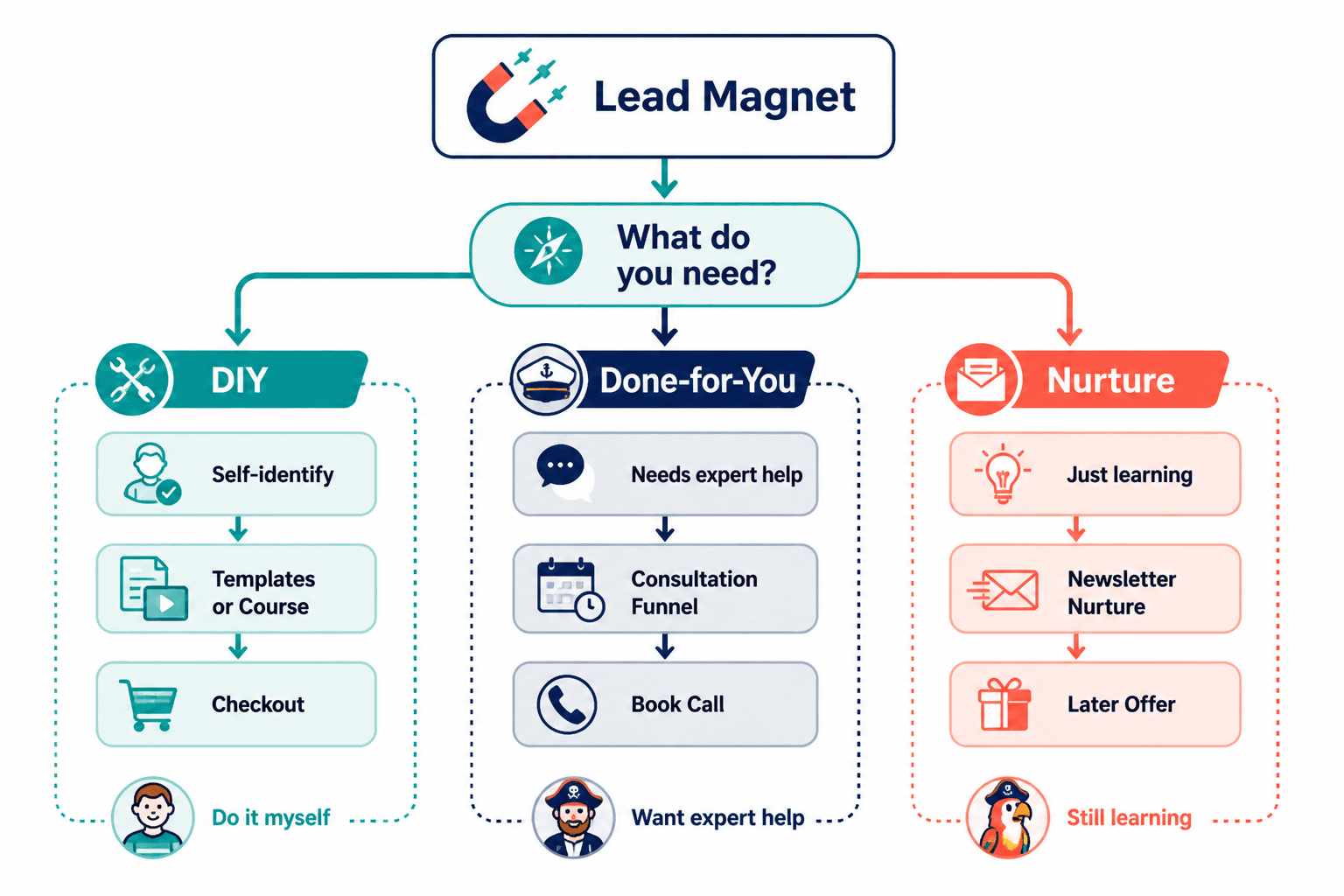
6. Lead magnet to segmented funnel based on interest or readiness
This is one of the smartest options if you attract mixed audiences.
Instead of pushing every lead into the same sequence, you segment them based on what they want, where they are, or what kind of help fits best. That can happen through the lead magnet itself, a follow-up email click, a short quiz, or a preference link.
Best for:
- Businesses with multiple offers
- Different audience types
- Brands serving beginners and advanced buyers
- People selling both DIY and done-for-you help
Example segments:
- “I want to do this myself” → templates or course
- “I want expert help” → consultation funnel
- “I am just learning” → newsletter nurture
This usually converts better because the path matches the person. Revolutionary stuff, apparently.
It also reduces one of the most common funnel problems: trying to sell the same thing to everyone just because they downloaded the same PDF.
7. Lead magnet to case study or proof sequence to offer
Some audiences do not need more information. They need more belief.
If your lead magnet already explains the basics well, the next step may be a proof-driven sequence showing how the method works in real situations. That could mean case studies, client examples, before-and-after breakdowns, or decision stories that remove skepticism.
Best for:
- Consultants
- Agencies
- Coaches with strong transformations
- Service businesses where trust and credibility matter heavily
Typical flow:
- Lead magnet teaches the framework
- Email sequence shows it working in practice
- Offer invites the subscriber to apply it with your help
This can outperform a pure educational sequence because it moves people from “interesting” to “I can actually see this working for me.”
How to choose the right funnel for your lead magnet
You do not need more funnel types. You need the right match.
Here is a practical way to choose.
Start with the intent behind the lead magnet
Ask what the lead magnet is actually doing for the reader.
- If it solves a quick tactical problem, a tripwire or product upsell may fit
- If it diagnoses a deeper issue, a consultation funnel may fit
- If it introduces a broad topic, a nurture sequence or newsletter may fit
- If it builds interest around a complex idea, a workshop funnel may fit
The lead magnet tells you a lot about the next step. Listen to it.
Look at the commitment jump
The bigger the jump from free to paid, the more trust and context you usually need in the middle.
Going from a free cheat sheet to a $19 template pack? Fine.
Going from a free checklist to a $5,000 consulting engagement? That usually needs more bridge steps, better qualification, and actual proof.
Match the funnel to your business model
Not every business should use the same post-download path.
| Business model | Best likely funnel match |
|---|---|
| Low-ticket digital products | Tripwire, short email sequence, product bundle path |
| Consulting or services | Nurture to consult call, case study sequence, segmented funnel |
| Courses or programs | Workshop funnel, nurture sequence, proof sequence |
| Creator newsletter business | Newsletter-first funnel with soft conversions |
| Multiple offers | Segmented funnel based on interest or readiness |
If you try to force a funnel style that does not fit how people buy from you, everything feels awkward. The emails get awkward. The CTA gets awkward. The conversion rate gets awkward. It is a whole awkward festival.
What to send after the lead magnet
A lot of people know they need a funnel but freeze on the actual follow-up. So here is a simple post-download sequence you can adapt.
A clean 5-email follow-up structure
- Email 1: Deliver the lead magnet and frame the result it should help create
- Email 2: Help them use it with one practical tip or quick-win instruction
- Email 3: Show the common mistake or deeper issue the lead magnet alone does not fix
- Email 4: Share proof, example, or case study that builds trust
- Email 5: Present the next step clearly: product, call, workshop, newsletter path, or offer
This works because it respects the pace of trust. It gives value first, context second, proof third, and promotion when the reader can actually make sense of it.
If you want a stronger system for moving opt-ins toward revenue, read how to turn lead magnets into more leads or sales.
Funnel ideas by lead magnet type
Sometimes the easiest way to choose a funnel is to start with the type of lead magnet you already have.
Checklist or cheat sheet
Usually best paired with:
- Short nurture sequence
- Tripwire
- Consult call if the checklist is diagnostic
These lead magnets are fast and tactical, so the next step should usually stay focused and practical.
Template or swipe file
Usually best paired with:
- Template bundle upsell
- Low-ticket toolkit
- Course or implementation offer
People who download templates often want speed and execution. They are closer to action than pure information seekers.
Mini-course or training
Usually best paired with:
- Workshop
- Program enrollment
- Proof-driven nurture sequence
These leads have already invested more attention, so they may be ready for a deeper next step.
Assessment, quiz, or audit-style lead magnet
Usually best paired with:
- Consultation
- Segmented funnel
- Case study sequence
Diagnostic lead magnets are excellent because they reveal intent. People who want to assess a problem are often much closer to solving it.
Common mistakes that ruin lead magnet funnels
You can have a good lead magnet and still tank the funnel with one of these classics.
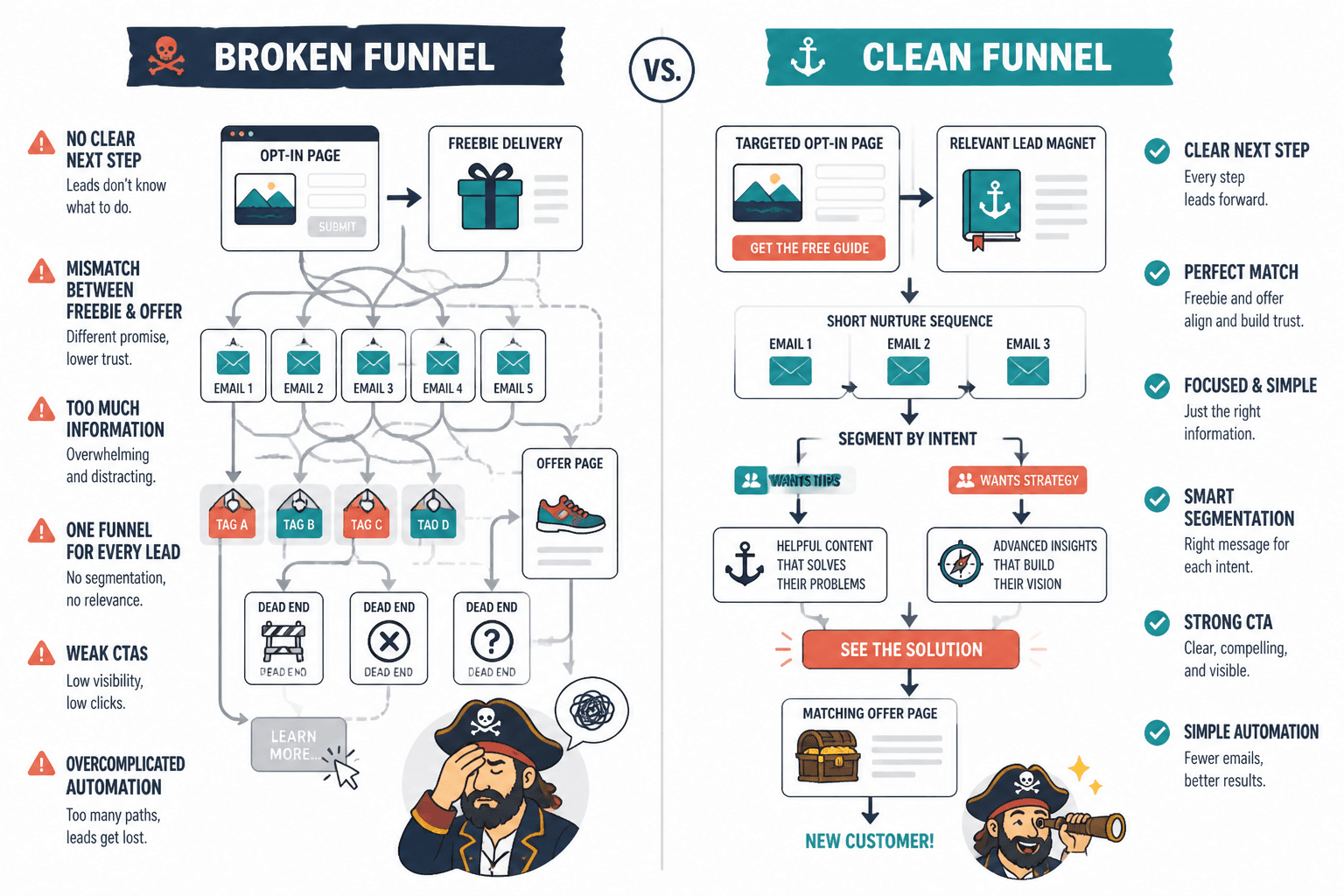
- Pitching too early: the subscriber barely knows you and you are already acting like step three of the relationship happened off-screen
- No clear next step: useful freebie, then nothing but vague “stay tuned” energy
- Mismatch between freebie and offer: the topic and product feel loosely related at best
- Too much information, no conversion path: endless nurture, zero direction
- One funnel for every lead: different intent levels shoved into the same sequence
- Weak CTAs: buried asks, soft language, no reason to act
- Overcomplicated automation: seven branches, twelve tags, and somehow still no coherent buyer journey
Simple beats clever here. A clean, believable path will often beat an overengineered funnel that looks impressive in a flowchart and confusing everywhere else.
Tools and templates that make these funnels easier to build
You do not need a giant stack of tools to make this work, but the right ones can save time and reduce chaos.
Useful categories include:
- Email platforms for delivery and nurture sequences
- Landing page tools for opt-ins and offer pages
- Automation tools for segmentation and follow-up
- Template systems for emails, CTAs, and lead magnet assets
- CRM or lightweight tracking if your funnel leads to calls or services
For practical options, read best email tools and funnel tools for lead magnets and best templates and tools for lead magnets.
Just remember: tools can help you send the right message faster. They cannot invent a sensible offer match or create trust out of thin air. Software is helpful. Software is not a personality transplant for your funnel.
How to monetize lead magnets without making people regret opting in
A healthy funnel monetizes by continuing to help, not by suddenly changing personality after the download.
That means:
- Being clear about what the free resource does and does not solve
- Making the paid offer a logical extension, not a bait-and-switch
- Using proof and specificity instead of pressure tactics
- Respecting buying readiness instead of forcing urgency where none exists
- Giving readers a graceful way to stay in your world even if they are not ready yet
If that balance is what you are trying to get right, read how to monetize lead magnets without wrecking trust.
Quick FAQ
What is the best funnel idea to pair with lead magnets?
Usually, a short nurture sequence followed by a relevant offer. But the real answer depends on the lead magnet, your offer, and how ready the subscriber is to buy.
Should every lead magnet lead directly to a sale?
No. Some should lead to a newsletter, workshop, or consult path first. For many businesses, trust has to be built before the sale makes sense.
How many emails should a lead magnet funnel have?
Often 3 to 7 is enough. More than that can work if each email has a clear purpose. Less can work if the offer is simple and the match is strong.
Are tripwire funnels still worth using?
Yes, if the low-ticket offer is genuinely useful and leads naturally to a bigger solution. No, if it is just a flimsy speed bump pretending to be strategy.
What if I have multiple offers?
Use segmentation. Different leads want different outcomes, and your funnel should reflect that instead of pretending everyone needs the same next step.
Pick the next step before you build the free thing
The best funnel ideas to pair with lead magnets are not the fanciest ones. They are the ones that make the next decision easy.
That is the whole job. Help the right person go from free value to the next useful action with as little confusion and resistance as possible.
So before you make another guide, checklist, template, or mini-course, ask one very practical question: what should happen right after this?
If you do not know, the lead magnet is not finished yet.