Most newsletter story sections do not underperform because the writer “isn’t a natural storyteller.” They underperform because the story is doing the wrong job.
It rambles. It takes too long to get to the point. It sounds suspiciously like a journal entry nobody asked for. Or worse, it exists purely to sneak a pitch into the reader’s ribs while pretending to be heartfelt.
If you’re writing a creator newsletter, a story section can be one of the most useful parts of the whole thing. It can build trust, add personality, make advice memorable, and keep your newsletter from reading like a sterile list of tips assembled by a productivity intern. But if the story is vague, indulgent, or disconnected from the reader, it hurts performance fast.
This is where most people get newsletter story sections wrong. They think the job is to be personal. The actual job is to make the personal relevant.
Here’s how to spot the newsletter story section mistakes that hurt performance, what to do instead, and how to make your story sections sharper, tighter, and much more worth reading.
For the full path around this topic, head to the parent guide.
What a good newsletter story section is actually supposed to do
A story section is not there to prove you have a life. It is there to create connection and momentum.
In practical terms, a strong story section usually does one or more of these things:
- Gives context for a lesson or opinion
- Makes a useful idea easier to remember
- Builds trust by showing how you think
- Adds voice and texture to an otherwise tactical newsletter
- Creates a more natural bridge into advice, a resource, or an offer
That last one matters. A good story section does not just entertain. It moves the reader cleanly into the next part of the email.
If your newsletter structure still feels messy overall, it helps to step back and look at the bigger picture of newsletter sections and formats before polishing individual parts in isolation.
Mistake #1: The story starts too early
A lot of writers spend the first five to eight lines warming up.
They explain the setting. They explain the mood. They explain what day it was, what they were thinking, and how oddly meaningful the whole thing felt. Meanwhile, the reader is already hovering over archive.
Your story section should begin where the tension begins, not where your memory begins.
Start at the interesting part. You are writing a newsletter, not a memoir with a publishing advance.
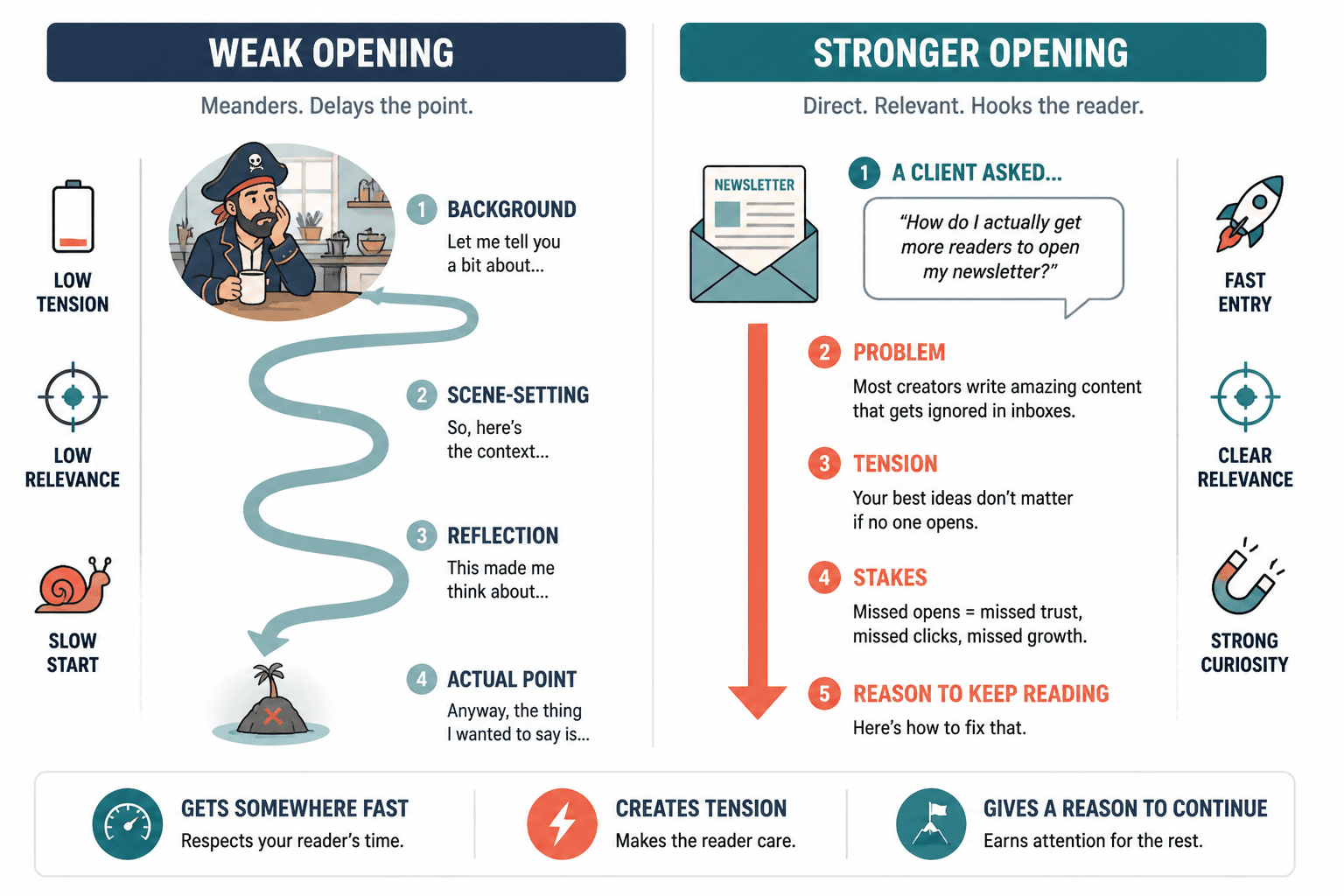
Weak opening
Last Tuesday morning, I was sitting at my kitchen table with a coffee, thinking about how busy the season had been, when I started reflecting on a conversation I had earlier that week…
Stronger opening
A client asked me why her newsletter was getting opens but no replies. The answer was uncomfortable: every email sounded polished, helpful, and completely unalive.
That second version gets somewhere fast. It gives us tension, relevance, and a reason to keep reading.
Mistake #2: The story is personal, but not useful
This is one of the biggest newsletter story section mistakes that hurt performance.
People confuse “authentic” with “unfiltered.” So they tell a story about a hard week, a random conversation, a business wobble, or something their kid said in the car, and then just sort of leave it there like it means something on its own.
Sometimes it does. Usually it doesn’t.
Your reader is not asking, “Was this honest?” They’re asking, “Why am I being told this?”
A useful story section needs a point. Not a vague takeaway. A real one.
A better test for your story section
- What is the actual idea underneath this story?
- Why does it matter to this audience?
- What should the reader understand, feel, or do differently after reading it?
- Could I summarize the point in one clean sentence?
If you cannot answer those quickly, the story probably is not ready yet.
This is also why rewriting matters. If your story section feels limp, bloated, or weirdly generic, rewriting boring newsletter sections and formats is usually less about adding sparkle and more about finally figuring out what the section is trying to say.
Mistake #3: The lesson is so obvious it dies on impact
You know the ending:
- Be present
- Consistency matters
- Don’t give up
- The little things matter
- Trust the process
Those are not insights. They are motivational wallpaper.
If the point of your story could be embroidered onto a tote bag, it probably needs more thought.
A good newsletter story section lands on something more specific. It names a tension the reader actually deals with. It offers a useful distinction. It challenges a lazy assumption. It shows the mechanism behind the lesson, not just the sentimental version.
Weak lesson
This reminded me that consistency really is everything.
Better lesson
The problem was not inconsistency. It was inconsistency in message. Showing up often does not help much when every email sounds like it was written by a different version of your business.
That has teeth. It gives the reader something they can actually use.
Mistake #4: The story takes too long to earn its place
Length is not the problem by itself. Plenty of longer story sections work beautifully.
The problem is drag.
Drag happens when a story keeps moving but the meaning does not. More scenes. More details. More explanation. No extra value. Readers feel that immediately.
If your story section is long, it needs to justify the space by doing at least one of these well:
- Building tension
- Delivering a strong emotional turn
- Adding meaningful specificity
- Setting up a sharp lesson or argument
- Making the reader feel seen in a concrete way
If it is not doing that, trim it. Ruthlessly.
A simple editing rule
For every paragraph in your story section, ask: does this increase tension, clarity, relevance, or payoff?
If not, it is decorative. Decorative writing is lovely in the right place. Most newsletters are not that place.
Mistake #5: The story and the rest of the newsletter feel glued together
One of the easiest ways to tank performance is to write a story section that feels like a completely separate species from the rest of the email.
You tell a story. Then you abruptly switch into three bullet points, a link, a resource block, and a CTA that sounds like it wandered in from another newsletter entirely.
That kind of transition creates friction. The reader feels the seams.
A better story section acts like a hinge. It should lead naturally into what comes next.
Example transition
That client conversation reminded me how often good newsletters fail because the structure is doing too much at once. So below, I want to show you the three sections I’d fix first if your emails are getting opened but not acted on.
Clean. Relevant. No clunky handoff.
If you’re pairing stories with curated links or recommendations, it also helps to tighten the surrounding blocks. This guide on improving newsletter resource blocks without sounding generic makes that easier.
Mistake #6: The story is really just a pitch in a fake mustache
Readers can smell this instantly.
You tell a story about a challenge. You build emotion. You hint at struggle. Then, surprise, the answer is your offer. Very touching. Very convenient. Very transparent.
This does not mean you can never sell after a story. You absolutely can. It just has to feel earned.
A good story-led pitch usually works because:
- The story reveals a real problem the offer genuinely helps solve
- The lesson stands on its own even if the reader does not buy
- The pitch is proportionate, not an ambush
- The CTA sounds like a next step, not a trap door
If the entire emotional setup only exists to push the sale, readers will start distrusting the story section itself. That is expensive. Trust once broken is annoying to rebuild.
Mistake #7: The voice gets weirdly dramatic
Some newsletter writers get near a story and immediately become 40 percent more theatrical.
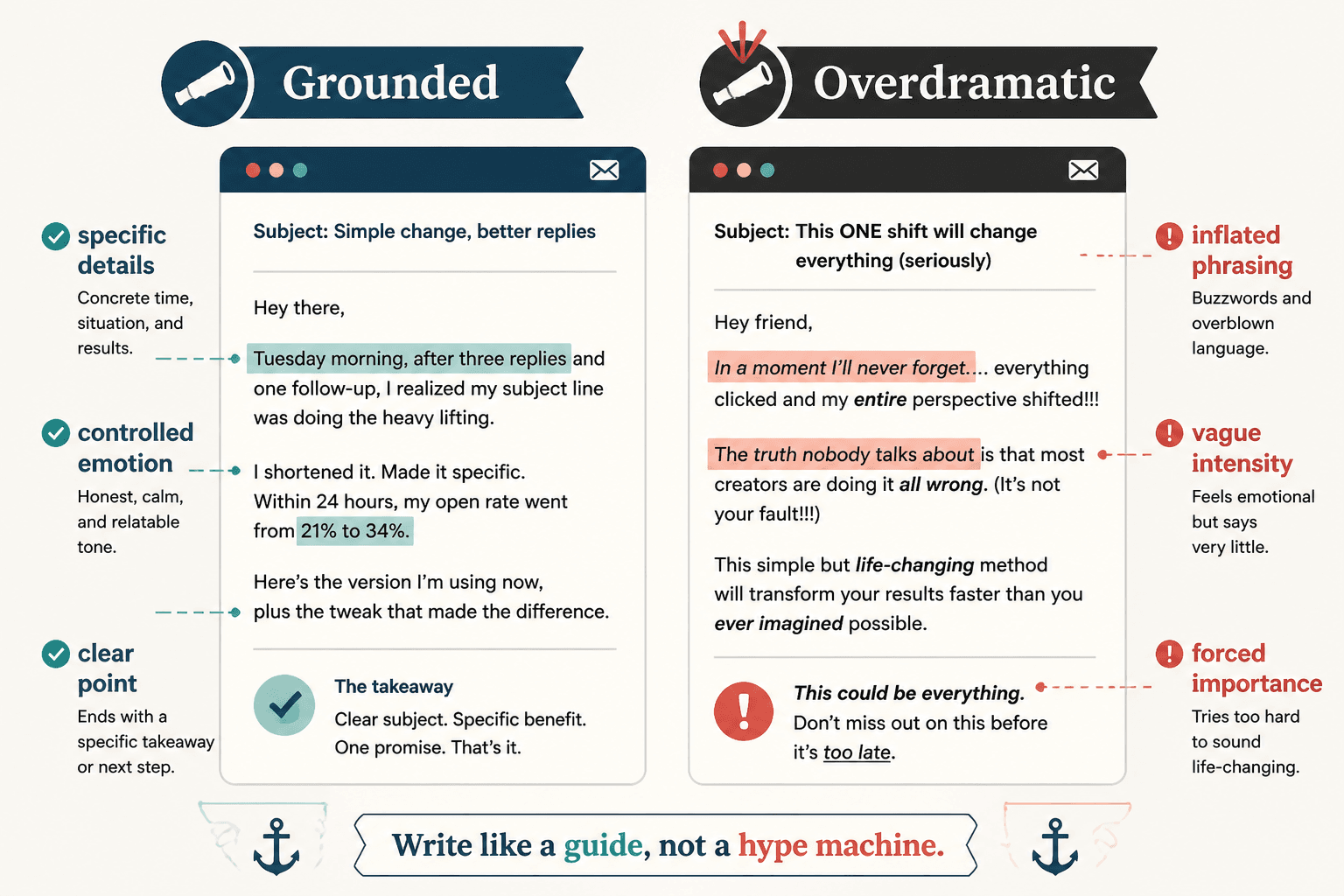
Suddenly everything is “a moment I’ll never forget” or “the truth nobody talks about” or “one of the hardest seasons of my life.” Sometimes that is true. Often it is just inflated writing trying to create importance by force.
You do not need to perform depth. You need to communicate clearly.
The strongest story sections usually sound a lot more grounded than people expect. Specific details. Clean observations. Controlled emotion. A point that does not need three layers of dramatic fog to feel meaningful.
Readers trust restraint. They get suspicious when every story arrives wearing stage makeup.
Mistake #8: The story is too generic to sound true
Ironically, a lot of “personal” story sections sound fake because they use no real texture.
They mention a challenge, a realization, and a lesson, but everything is abstract. No concrete moment. No sharp phrasing. No real tension. It feels like the story was sanded down until it could offend nobody and interest nobody.
Specificity is what makes stories believable.
Generic version
I recently had an experience that reminded me how important it is to simplify your message.
Specific version
A subscriber replied to say, “I like your stuff, but I still can’t tell what exactly you help people do.” That stung a little, mostly because she was right.
That second version sounds lived-in. It gives the lesson some bones.
If you need ideas for how to vary your format so every issue does not blur together, these newsletter section ideas and examples for creators are useful without getting gimmicky.
Mistake #9: There’s no payoff
A story section without payoff is just time theft in paragraph form.
The payoff does not have to be huge. It can be a useful line, a reframing, a concrete takeaway, a better question, or a smooth transition into the main point of the email. But there needs to be a reason the story existed.
One way to improve payoff is to write the lesson first.
Yes, first.
Before you draft the story, write one sentence that captures what the reader should walk away with. Then build or edit the story around that. This keeps the section from wandering off to admire its own emotional landscaping.
A simple structure for stronger newsletter story sections
If your story sections tend to sprawl, use this simple format:
- Start with the tension. What happened that made this worth telling?
- Add one or two specific details. Enough to make it real, not enough to become a short film.
- Name the shift. What changed, clicked, failed, or got clarified?
- Extract the point. What should the reader understand from this?
- Bridge forward. Lead naturally into the next section, advice, or CTA.
Newsletter structure works best when each section has one clear job and supports the main point of the issue. Simpler formats usually outperform busier ones when the writing stays sharp.