
Most personal brands do internal linking badly in one of two ways: they ignore it completely, or they stuff random “click here” links into old posts and call it strategy.
Neither helps much. One wastes authority you already have. The other creates a messy little trail of vague links that do not help readers, search engines, or your business.
Better Internal Linking Anchor Text for Personal Brands is not about gaming search. It is about making your site easier to navigate, easier to understand, and a lot more useful once someone lands on it. If you write articles, publish thought leadership, sell services, or build trust through content, your internal links should quietly move people to the next relevant step.
That means better anchor text, better page relationships, and a smarter habit of updating older content instead of constantly chasing new posts like a raccoon chasing shiny objects.
Here’s how to do it without making your site sound robotic or your articles feel like a keyword landfill.
To see how this fits into the wider strategy, open the parent guide.
Why internal linking matters more for personal brands than people think
If you are a personal brand, you usually do not have a giant site with hundreds of category pages doing the heavy lifting for structure. You’ve got articles, service pages, maybe a resource hub, maybe a newsletter page, and hopefully a few pieces that actually deserve more attention than they get.
Internal linking helps connect all of that into something coherent.
- It helps readers find the next useful piece of content.
- It gives search engines clearer context about which pages relate to which topics.
- It spreads attention to older posts that still matter.
- It supports conversions by moving readers toward service pages, guides, or lead magnets.
- It reduces the “one and done” problem where someone reads one article and disappears forever.
For creators, coaches, consultants, and solo founders, that matters a lot. You do not need more disconnected content. You need content that works together.
If your site already has a broader content system behind it, this gets even easier when your articles sit inside a clear structure like blog SEO writing and a more specific content cluster like blog article systems. Structure first, then links. Not random link confetti.
What anchor text actually is, minus the beige explanation
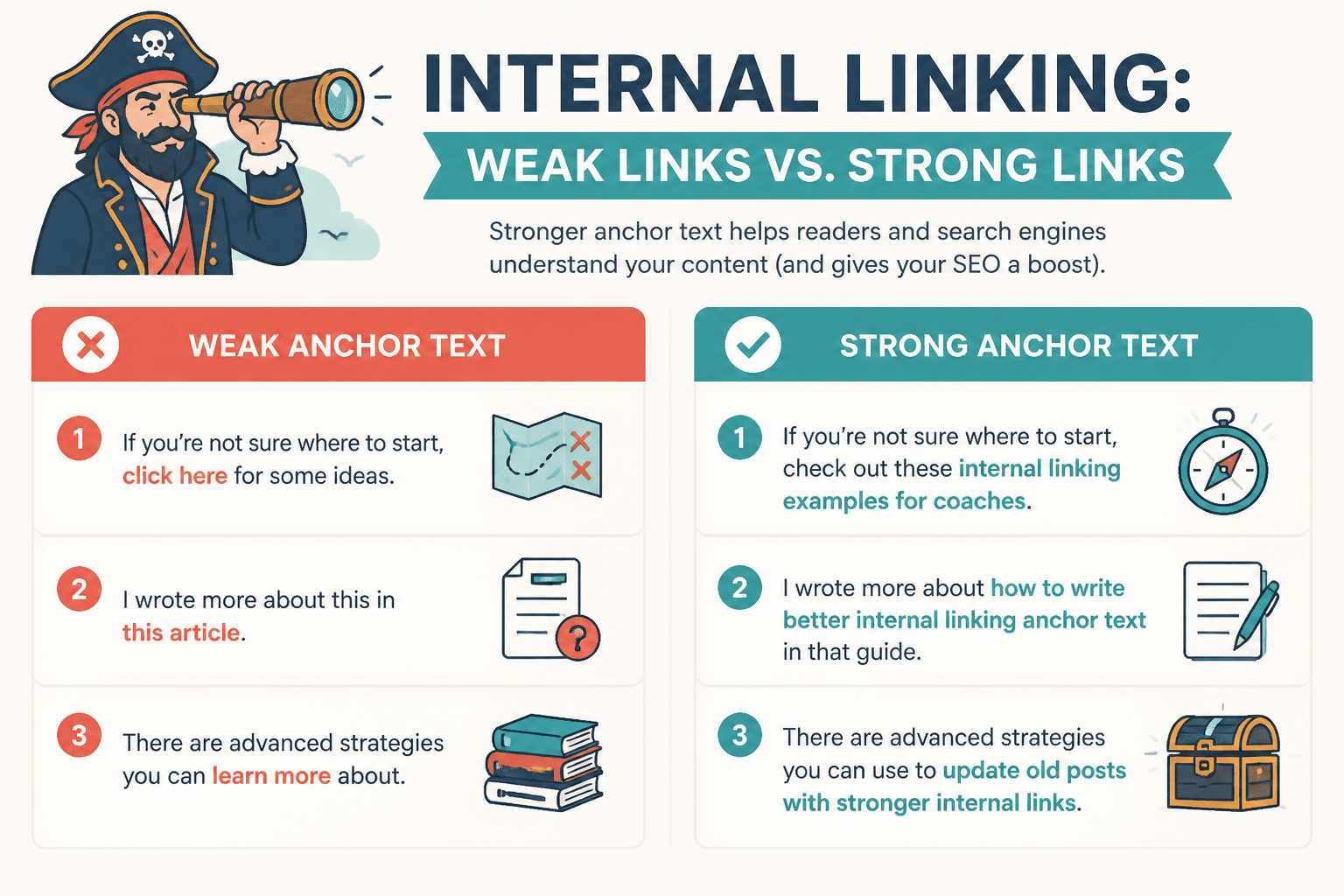
Anchor text is the clickable text in a link. That’s it. But the wording matters because it tells people and search engines what they should expect on the other side.
Bad anchor text is vague, generic, or weirdly stuffed. Good anchor text is clear, natural, and specific enough to set expectations.
| Weak anchor text | Better anchor text |
|---|---|
| click here | internal linking and updating guide |
| read more | examples for coaches, consultants, and personal brands |
| this article | how to write better internal linking and updating |
| learn more | turn old content into better internal linking and updating |
The goal is not to force an exact-match phrase every time. The goal is to make the link useful and readable.
That distinction matters because a lot of people hear “anchor text” and immediately turn into an overcaffeinated spreadsheet goblin. Suddenly every link has to match some precious keyword exactly. Then the article reads like it was assembled by a tense plugin.
Relax. Natural, descriptive language wins more often than awkward optimization theater.
The 5 anchor text mistakes personal brands keep making
1. Using generic filler text
“Click here” is not helpful. Neither is “read this” or “this post.” These give no context, waste an opportunity, and make your content feel sloppy.
If the linked page is about improving old posts, say that. If it is a guide, say guide. If it shows examples, say examples. Your reader should know what they’re getting before they click.
2. Forcing exact-match phrases every single time
Yes, relevance matters. No, you do not need to repeat the exact same phrase 14 times across your site like you are trying to hypnotize Google.
Variation is healthy. You can use close, natural versions of the same topic phrase depending on context. That makes the writing better and the link graph more believable because it is believable.
3. Linking with text that is too broad
If you write, “improve your content here,” that could lead to almost anything. Better to be more specific: “how to write better internal linking and updating” tells the reader exactly what kind of help they’re about to get.
4. Stuffing too many links into one paragraph
This is where useful structure turns into visual clutter. If every second sentence contains a link, readers stop trusting the guidance and start feeling herded.
Use internal links with intent. One relevant link in the right place usually beats four panicked ones jammed together.
5. Never updating old anchor text
This one is common. People publish a new article, maybe link to it once, and then move on forever. Meanwhile they have 30 older posts that could point readers toward it in much better ways.
Updating old content is where a lot of internal linking gains come from. Not glamorous. Still effective.
What good internal linking anchor text looks like in practice
A strong internal link usually does three things:
- It appears where the reader naturally wants the next step.
- It describes the destination clearly.
- It fits the sentence instead of interrupting it like a pushy pop-up in text form.
Here are a few simple before-and-after rewrites.
Example 1: vague to useful
Weak: If you want to learn more, click here.
Better: If you want a cleaner process, start with this internal linking and updating guide for creators who want better results.
Example 2: stuffed to natural
Weak: Our internal linking and updating examples for coaches consultants and personal brands page shows internal linking and updating examples for coaches consultants and personal brands.
Better: If you want to see how this looks in real content, these examples for coaches, consultants, and personal brands make the difference pretty obvious.
Example 3: flat to contextual
Weak: We also wrote about this topic in another article.
Better: If your bigger problem is the writing itself, this piece on how to write better internal linking and updating will help you fix the sentence-level stuff, not just the structure.
Notice what changed. The better versions do not just label the destination. They explain why someone might care enough to click. That is the part many people skip.
How to choose anchor text without sounding engineered in a lab
If you want better internal linking anchor text for personal brands, use this simple filter before you add a link:
- What is the linked page actually about? Be specific.
- Why would the reader want it here? Think next step, not random relatedness.
- What wording fits naturally in the sentence? Keep it readable.
- Can the anchor text signal the benefit or format? Guide, examples, process, checklist, rewrite, template.
- Does this sentence still sound human? Important. More important than some people want to admit.
That last point matters because good internal linking is part SEO, part UX, and part basic writing competence. If the sentence sounds ridiculous just so the anchor text can hit a phrase exactly, the sentence is bad. Fix the sentence.
A practical anchor text framework for personal brand sites
You do not need a giant taxonomy map to improve this. For most personal brand sites, anchor text can be planned around a few page types.
| Page type | Best anchor text style | Example |
|---|---|---|
| Pillar page | Broad, descriptive topic phrase | internal linking and updating |
| How-to article | Action-oriented phrase | how to write better internal linking and updating |
| Examples article | Format + audience + topic | examples for coaches, consultants, and personal brands |
| Guide article | Outcome-focused phrase | guide for creators who want better results |
| Refresh/update article | Improvement-focused phrase | turn old content into better internal linking and updating |
This gives you enough variety to avoid repetition while still keeping the topic relationships clear.
How to update anchor text in old content without creating a mess
This is where the real gains usually are. Not because updating old posts is magical, but because your older content is often underlinked, poorly linked, or still pointing people toward pages that are no longer your best next step.
Here is a clean process.
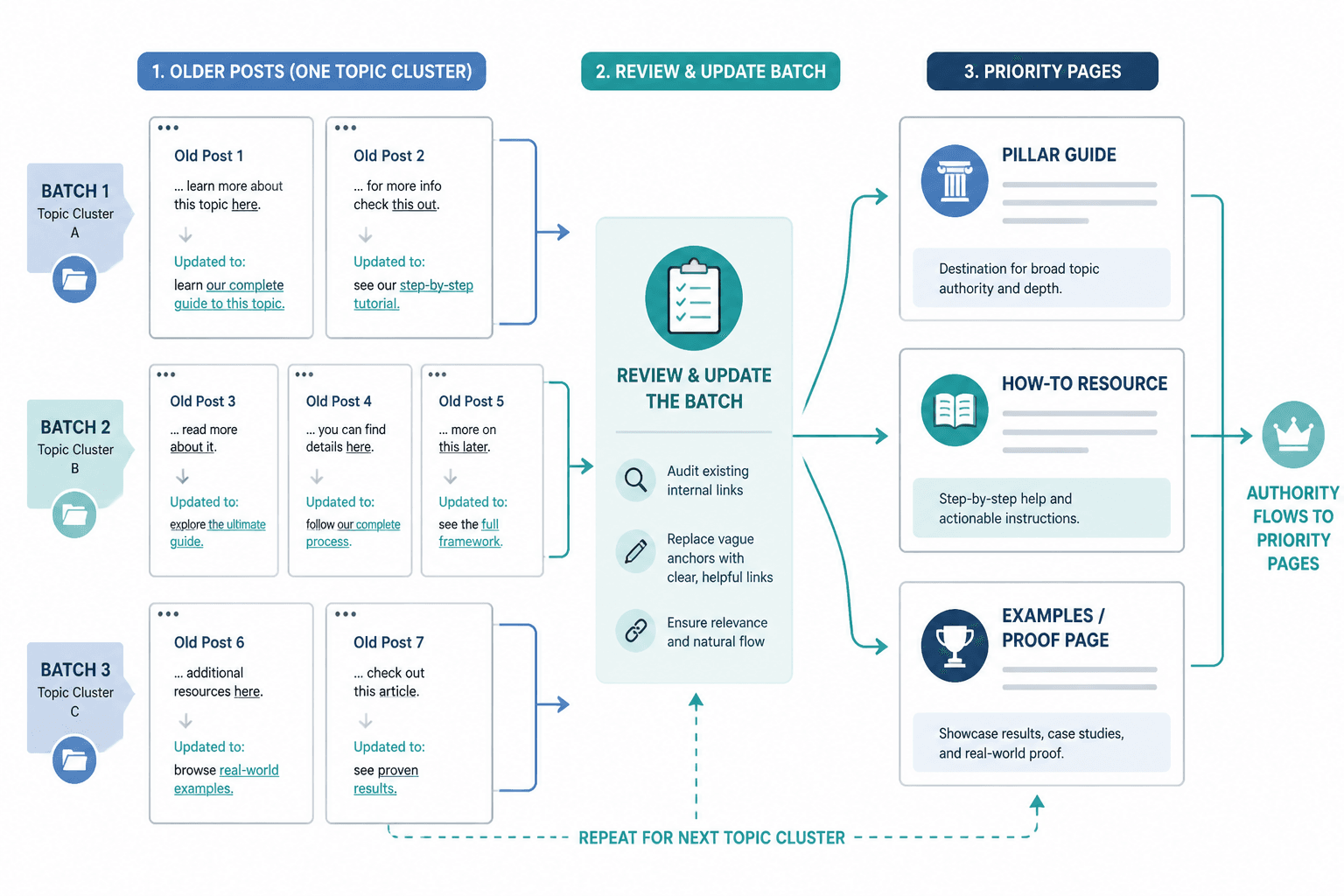
1. Start with your priority pages
Pick the pages that actually matter. Usually that means:
- pillar pages
- service pages
- high-value guides
- posts that convert readers into leads
- posts you want to rank better or keep fresher
If a page has business value or strategic relevance, it deserves better internal support.
2. Find older posts with natural linking opportunities
Look for articles that already mention the topic, problem, audience, or adjacent concept. You are not trying to shoehorn links into unrelated pages. You are trying to strengthen paths that already make sense.
For example, if you have older articles about content structure, SEO writing, blog systems, or updating old posts, they are obvious candidates to link back into your internal linking hub and related articles.
3. Replace weak anchors, do not just add more links
A lot of updates should be replacements, not additions. Change “read more here” into something useful. Turn “this guide” into a more descriptive phrase. Tighten vague references into purposeful links.
This improves clarity without bloating the article.
4. Match the anchor to the reader’s moment
Different sections of an article create different link opportunities.
- At the problem stage, link to a broad guide or pillar page.
- At the process stage, link to a how-to resource.
- At the proof stage, link to examples.
- At the refresh stage, link to updating old content.
That is what makes links feel helpful instead of promotional.
5. Update in batches
Do not try to “fix internal linking” across your whole site in one heroic weekend. That is how people create inconsistent anchors, forget what they changed, and resent their own website.
Do it in batches of 5 to 10 related posts. One topic cluster at a time is manageable, strategic, and much easier to review later.
How many internal links should a personal brand article have?
No magic number. Sorry. Annoying answer, but still the correct one.
The right number depends on the article length, topic complexity, and how many truly relevant next steps exist. A short article might only need 2 to 4 internal links. A deeper guide might reasonably include 5 to 10, sometimes more, as long as they are useful and not crammed into every available sentence.
A better question is this: does each link earn its place?
- Does it help the reader understand something better?
- Does it move them to a logical next piece?
- Does it support your site structure?
- Does the anchor text clearly describe the destination?
If yes, good. If not, you are decorating, not structuring.
How internal links should support your content hierarchy
Internal linking works best when it reflects the actual shape of your content.
That usually means broad pages linking to narrower pages, narrower pages linking back to broader pages, and related posts linking sideways where that helps the reader. If your content hierarchy is clear, your anchor text choices get easier because each link has a job.
For example, a topic like internal linking and updating might sit inside a larger content system. A broad category page introduces the area. A subcategory page narrows the focus. A pillar page holds the main topic. Supporting pages cover examples, how-to guidance, and content refresh strategies.
That lets you create natural pathways like this:
- category to subcategory
- subcategory to pillar
- pillar to supporting articles
- supporting articles back to pillar
- supporting articles to each other when the next step makes sense
Which is exactly why a reader exploring internal linking and updating might also want a practical piece on how to turn old content into better internal linking and updating or a more tactical article on how to write better internal linking and updating.
That is not “SEO juice sculpting.” That is just building a site that makes sense.
Anchor text formulas that actually work
If you freeze every time you have to choose anchor text, use these simple formulas.
Topic + format
- internal linking and updating guide
- internal linking and updating examples
- internal linking and updating checklist
Action + topic
- how to write better internal linking and updating
- how to turn old content into better internal linking and updating
Audience + outcome
- guide for creators who want better results
- examples for coaches, consultants, and personal brands
Problem + solution
- fix weak internal links in older posts
- improve anchor text without stuffing keywords
You can mix these naturally inside sentences without sounding repetitive. The point is to be descriptive, not theatrical.
What to audit if your internal linking still feels weak
If your content is published and linked, but still not doing much, check these things.
- Are your key pages buried? If only one article links to them, they are probably under-supported.
- Are your anchors vague? Generic text weakens context.
- Are links placed too late? Important links often belong earlier than people think.
- Are old posts outdated? Sometimes the problem is not just the link. The surrounding paragraph is stale too.
- Are you linking based on keywords instead of reader intent? Common mistake. Bad results.
- Are you over-linking from the same article to the same destination? Usually unnecessary and clunky.
Sometimes a link problem is actually a content clarity problem. If the article itself is muddled, no anchor text tweak will save it. A weak page can still be weak with better links. Slightly better dressed, sure. Still weak.
A simple internal linking workflow for ongoing content
If you publish regularly, this should become part of your content routine rather than a weird rescue mission every six months.
- Publish the new article.
- Add 3 to 5 internal links out to relevant existing pages.
- Identify 3 to 5 older articles that should link into the new one.
- Update those older posts with natural anchor text.
- Check whether the new article should link to a pillar page and whether the pillar page should link back.
- Review anchor text variety so everything does not sound cloned.
This is simple, but it is the sort of simple people skip because they are busy publishing the next thing. Then six months later they wonder why their content feels scattered.
Internal linking improves when each update makes the next useful step clearer. Cleaner structure usually does more work than a bigger pile of links ever will.