
Most people do not ruin trust with their lead magnets because they sell. They ruin it because the lead magnet was obviously just a trap with prettier typography.
You have probably seen the move. Someone offers a “free guide,” delivers three mildly useful pages, then hits you with five pitch emails, a fake deadline, and a booking link that sounds weirdly urgent for a relationship that started 14 minutes ago. That is not monetization. That is speed-running distrust.
If you want to figure out how to monetize lead magnets without wrecking trust, the answer is not “never sell.” It is to make the free thing genuinely helpful, make the paid next step make sense, and stop treating every new subscriber like a wallet with a pulse.
This article will show you how to turn lead magnets into revenue without getting slippery about it. We will cover what trust-safe monetization actually looks like, where people wreck it, what kinds of offers work best, and how to build a simple path from free resource to paid action that feels natural instead of vaguely manipulative.
If you want the bigger picture, start with the parent guide.
Why lead magnet monetization goes wrong so fast
The basic problem is not money. It is mismatch.
Someone signs up for one thing, then gets something else. They wanted a useful resource. You gave them a teaser brochure. They expected insight. You gave them recycled advice and a hard sell. They thought they were joining your world. You treated them like a conversion event.
Trust breaks when the value ladder is crooked.
- The lead magnet promises too much and delivers too little
- The free resource attracts the wrong people
- The paid offer has nothing to do with the free thing
- The follow-up sequence escalates too quickly
- The sales messaging feels generic, pushy, or fake-personal
- There is no real proof that the paid offer can help
People are not offended by being sold to nearly as often as marketers pretend. They are offended by being handled. There is a difference.
A good lead magnet says, “Here is something useful.” A bad one says, “Please tolerate this free PDF until I can corner you in your inbox.”
What trust-safe monetization actually looks like
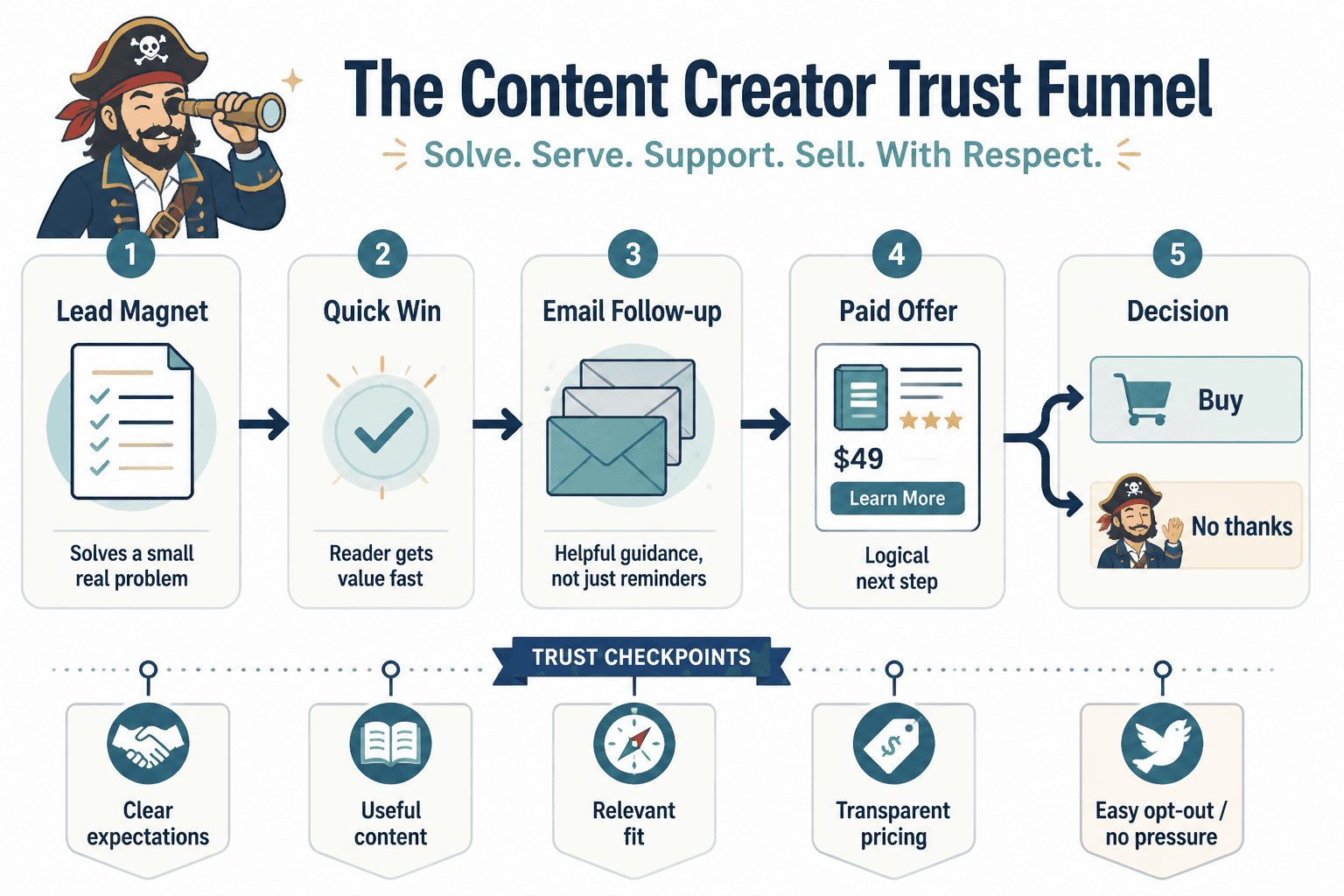
Monetizing a lead magnet without wrecking trust means the free thing creates real progress, the paid thing offers the next level of help, and the transition between them is honest.
That is it. No secret funnel sorcery. No ethically questionable “tripwire psychology.” Just relevance, timing, and actual usefulness.
In practice, trust-safe monetization usually looks like this:
- The lead magnet solves a small but real problem
- The reader gets a quick win or clearer diagnosis
- The follow-up emails help them use the thing, not just remember you exist
- The paid offer appears as a logical next step, not a jump scare
- The offer is framed clearly: who it is for, what it does, why it costs money
- The buyer can say no without getting shoved into a melodramatic scarcity tunnel
If you need a broader foundation for your lead magnet strategy, it helps to start with the main lead magnets hub and related monetization resources in monetization funnels and money content.
Start with a lead magnet that deserves to exist
You cannot monetize junk gracefully. The first trust problem is often the lead magnet itself.
If your free resource is thin, vague, overdesigned, or obviously withholding the useful part so you can sell it later, people feel that immediately. They may not complain. They just stop opening your emails, stop clicking your links, and mentally file you under “internet person with a funnel.” Not ideal.
A strong lead magnet should do at least one of these things:
- Help the reader make a decision
- Save them time
- Show them what is broken
- Give them a practical template or process
- Help them avoid an expensive or annoying mistake
- Create a small, visible win
Notice what is missing: “tease the premium offer so hard they feel incomplete without it.” That move is usually clumsy. Better to solve a smaller piece well, then offer help for the deeper or more involved work.
If your current free resource sounds polished but lands flat, read how to write lead magnets without sounding salesy or robotic. It is easier to monetize something when it sounds like a smart human made it, not a funnel template with a Canva addiction.
A simple test for lead magnet quality
Ask this before you publish:
- Would this still feel useful if I never pitched anything after it?
- Does it help the right person, or just attract anyone with a vague problem?
- Is the promise specific enough to attract intent, not just curiosity?
- Could someone implement part of it in under 30 minutes?
- Would I be comfortable if this was the first and only thing someone ever got from me?
If the answer is mostly no, do not build a monetization plan on top of it. Fix the lead magnet first.
Match the paid offer to the free promise
This is where a lot of funnels get weird.
If your lead magnet is about writing better LinkedIn hooks and your paid offer is a high-ticket mindset coaching package, people are right to feel whiplash. The paid offer does not need to be identical to the lead magnet, but it should feel connected in a way a sane person could explain in one sentence.
A clean match usually falls into one of these patterns:
- DIY to done-with-you: free checklist, paid workshop or group program
- Diagnosis to solution: free audit or scorecard, paid consulting or service
- Template to implementation: free template, paid system, course, or support
- Quick win to full process: free mini-guide, paid deeper framework or offer
- Education to execution: free training, paid setup, strategy, or coaching
The point is progression. The lead magnet should not trick people into the paid offer. It should prepare the right people for it.
Bad match vs good match
| Lead magnet | Bad paid next step | Better paid next step |
|---|---|---|
| 5-email welcome sequence template | General business coaching | Email funnel review or email strategy package |
| LinkedIn profile checklist | Random productivity membership | Profile rewrite service or personal brand positioning session |
| Audience messaging worksheet | Low-relevance course bundle | Messaging workshop, copy service, or consulting sprint |
| Lead magnet idea bank | Immediate high-ticket pitch with no bridge | Low-friction workshop on building and monetizing the magnet |
If you want help mapping those steps more deliberately, read best funnel ideas to pair with lead magnets. A lot of trust issues are really funnel design issues wearing a moral disguise.
Use monetization layers, not one aggressive leap
One reason people wreck trust is that they try to jump from “free PDF” to “book a call” like there is no middle ground. There is. Use it.
Not every lead is ready for your main offer. Some need a smaller paid step first. Some need more proof. Some just need time to see that you actually know what you are doing.
A layered monetization path gives people options without pressure. For example:
- Lead magnet solves a focused problem
- Welcome emails help them use it
- A low-friction paid offer appears, like a workshop, mini-product, template pack, or audit
- For buyers or engaged readers, the deeper offer comes later
This works well because it respects readiness. It also gives you a way to monetize without acting like every subscriber should immediately become a premium client.
Common trust-friendly monetization layers include:
- Paid template packs
- Mini-courses
- Workshops
- Audits or reviews
- Low-ticket strategy sessions
- Membership trials
- Implementation sprints
- Core service or coaching offer
That does not mean you need a whole value ladder made of 14 offers and a Notion diagram that looks like a conspiracy board. One or two logical next steps are enough.
Write follow-up emails that help first and sell second
Your email sequence is where trust usually survives or dies.
A good post-download sequence does not just say “here is your free thing” and then start circling the sale. It deepens the value of the lead magnet, answers friction points, and shows the reader what to do next. Selling becomes easier because the emails are useful on their own.
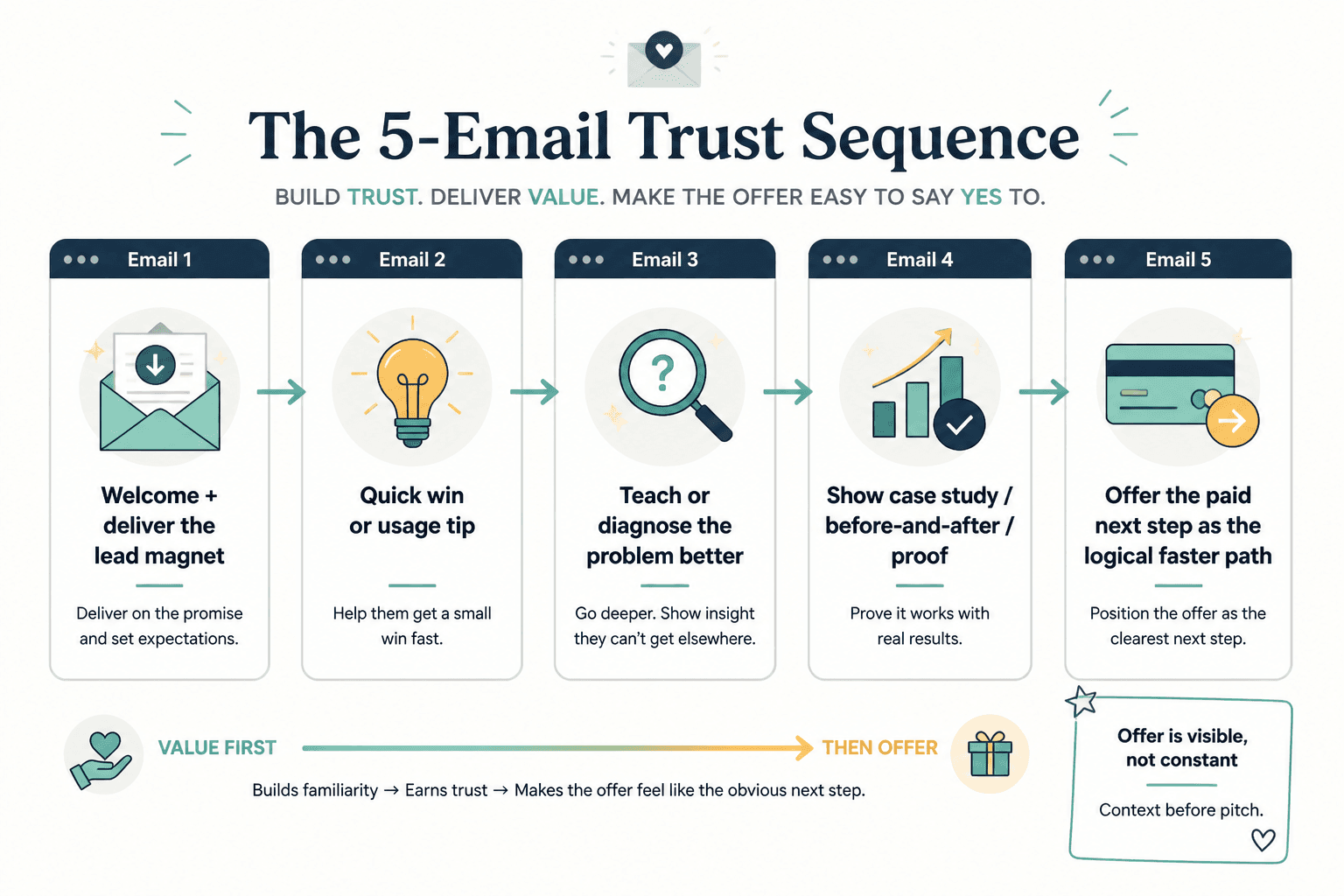
A simple 5-email sequence that does not feel gross
- Delivery email: give them the resource, tell them what to do with it, and set expectations
- Quick-win email: show one useful takeaway or action step from the lead magnet
- Obstacle email: address a common mistake, myth, or sticking point
- Proof email: show a case example, outcome pattern, or practical before-and-after
- Offer email: present the paid next step as the logical way to go further or do it faster
Notice the pacing. The offer is not hidden, but it is also not stapled to every sentence. You are building context.
This matters more than people admit. Readers are pretty good at sensing intent. If every email feels like it was written with one hand on the checkout button, trust slips. If the emails help them think better, diagnose the problem better, or apply the free resource better, the sale feels earned.
For more on turning that subscriber attention into revenue cleanly, read how to turn lead magnets into more leads or sales.
What to avoid in your sequence
- Overly dramatic subject lines with fake urgency
- Pretending the email is personal when it clearly is not
- Pitching before the subscriber has even used the free resource
- Talking only about your offer and not their problem
- Sending too many “just checking in” emails that say nothing
- Using countdown language for evergreen offers without context
Be honest about what the free thing can and cannot do
This is a trust move people skip because they think stronger promises convert better. Sometimes they do in the short term. They also attract the wrong expectations, which is a lovely way to grow a list full of disappointment.
A lead magnet should promise a useful step, not total transformation. If your checklist cannot realistically “double revenue” or “fix your content strategy,” do not write that. Tell the truth about the scope.
Clear scope actually helps monetization. Why? Because it makes the paid offer make sense. If the free thing helps them identify the issue, then the paid offer can help solve it more fully. If the free thing already promised the moon, your paid offer either feels redundant or like the withheld part of a bait-and-switch.
A cleaner framing sounds more like this:
- “Use this to spot the gaps in your welcome sequence before you rewrite it.”
- “This will help you choose the right lead magnet format for your audience and offer.”
- “These prompts will help you sharpen your profile positioning before you invest in a full rewrite.”
That kind of promise builds trust because it is specific, bounded, and believable. Boring? No. Credible. Which is better for sales anyway.
Use proof without turning the freebie into a sales deck
If you want people to buy after downloading your lead magnet, they need some reason to believe your paid offer works. That does not mean your PDF needs 19 screenshots, 4 testimonials, and a founder story that reads like a startup grant application.
Proof works best when it is placed around the lead magnet journey, not stuffed directly into every free asset page.
Useful places to include proof:
- On the thank-you page after signup
- In the second or third follow-up email
- On the sales page for the paid next step
- In a case-study email tied to the problem the lead magnet addresses
- In your profile, bio, or about page if people click through
And the proof itself should be relevant. A testimonial about how “amazing you are to work with” is nice. A proof point showing that your process helped someone improve conversion, save time, clarify messaging, or close leads is more persuasive.
Choose monetization methods that fit trust, not just conversion rates
Some monetization methods are not inherently bad. They are just easy to overdo.
Here is a practical way to think about it:
| Method | Trust risk | Works best when |
|---|---|---|
| Immediate tripwire offer | Medium | The paid item is closely related, low-friction, and genuinely useful |
| Email nurture to core offer | Low to medium | You need more context, proof, and education before the sale |
| Audit or strategy call upsell | Medium | The lead magnet exposes a problem that naturally leads to expert help |
| Workshop or mini-course | Low | The audience needs a guided next step before bigger offers |
| Discount-driven scarcity sequence | High | Rarely worth it unless there is a real deadline and a very warm audience |
If your brand depends on trust, credibility, and repeat attention, choose monetization paths you can sustain without sounding increasingly desperate. Short-term conversion spikes are cute until they train your audience to ignore you.
Make the next step obvious, not pushy
A lot of creators swing between two bad options: no CTA at all, or a CTA with the energy of someone trying to sell a timeshare in the comments section.
The fix is straightforward. Give the reader a clear next step that matches where they are.
Examples of trust-friendly CTAs after a lead magnet
- “If you want help applying this to your funnel, here is the next step.”
- “If you want the faster version, I offer a review where we fix this together.”
- “If this showed you the gap but you want the full system, start here.”
- “If you are not ready for the full offer, this workshop will help you implement the basics.”
These work because they do not pretend the free thing was the whole solution. They also do not insult the reader’s intelligence. The sale is visible. The pressure is low. The fit is clear.
Segment your leads so you do not oversell everyone equally
One of the cleanest ways to monetize lead magnets without wrecking trust is to stop sending the exact same sales pressure to every subscriber.
Some subscribers clicked because they are curious. Some are active buyers. Some want DIY help. Some want done-for-you support. If you ignore that and blast everyone with the same sequence, you create unnecessary friction and a lot of unsubscribes from people who may have become customers later under saner conditions.
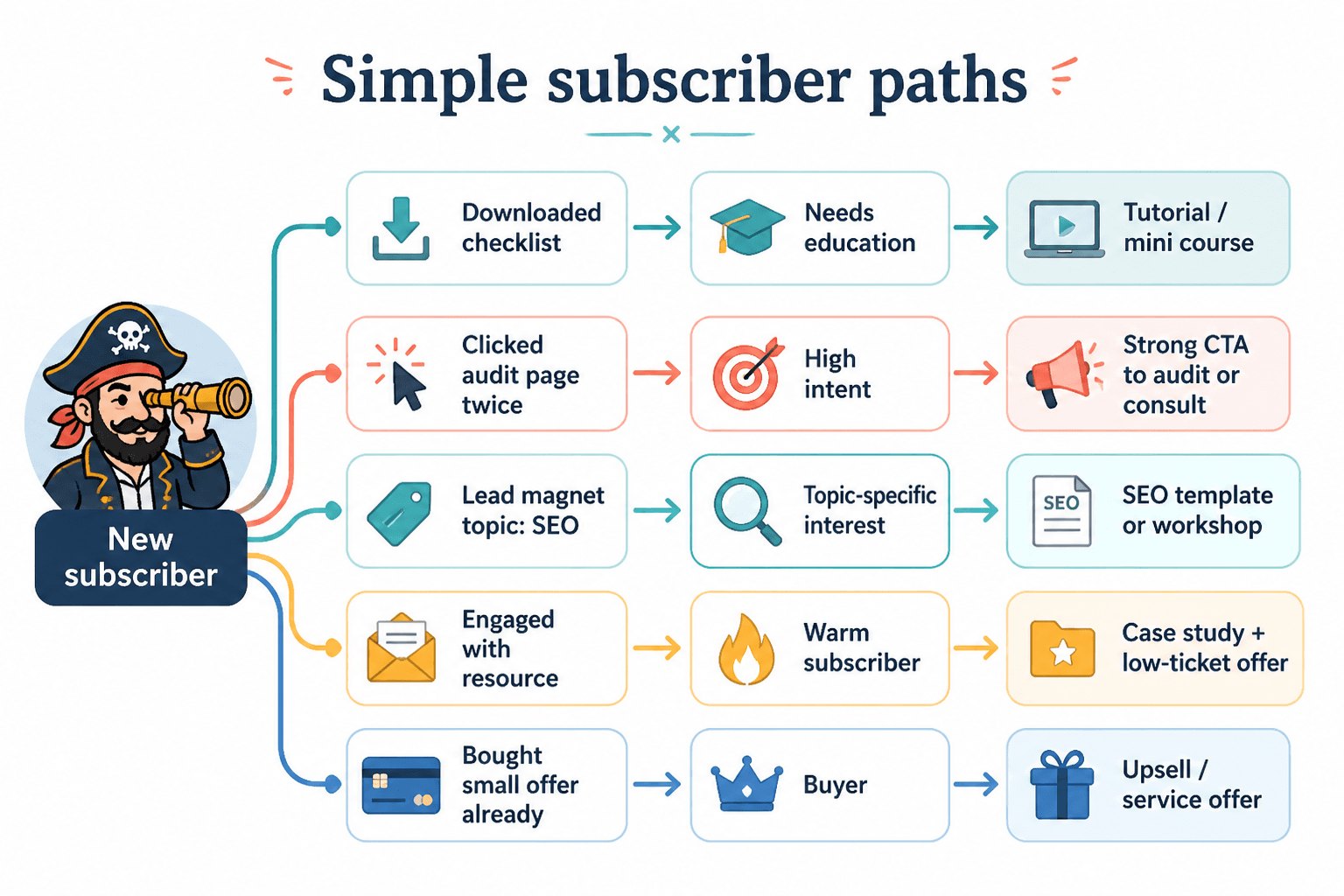
You do not need enterprise-level segmentation for this. Even simple splits help:
- By lead magnet topic
- By audience type
- By what links they click
- By whether they engaged with the resource
- By whether they bought a smaller offer already
This lets you tailor the next offer and tone. The person who downloaded your checklist may need more education. The person who clicked the audit page twice may be ready for a stronger CTA. Treating both people the same is lazy funnel design disguised as efficiency.
If you need systems to support that without losing your mind, check best email tools and funnel tools for lead magnets.
Common mistakes that quietly wreck trust
- Writing a lead magnet only to capture emails: if the value is fake, the list quality will be too
- Pitching too early: people need context, not a checkout link before breakfast
- Using a low-quality freebie to sell a high-trust offer: this is especially bad for consulting, coaching, or premium services
- Sending generic nurture emails: bland emails make paid offers feel less credible
- Creating offers that do not match the entry point: relevance does a lot of the conversion work
- Relying on urgency because the offer is weak: scarcity is not a substitute for fit
- Hiding the sale for too long: trust does not mean pretending you do not sell anything
That last one matters. Some people get so nervous about “being salesy” that they never make the next step clear. That is not trust-building. That is just vague. You can be direct and respectful at the same time.
A simple framework for how to monetize lead magnets without wrecking trust
If you want the short version, use this:
- Make the lead magnet genuinely useful. It should solve a real but limited problem.
- Attract the right person. Specific promises beat broad curiosity bait.
- Follow up with helpful emails. Teach, clarify, and remove friction before pushing the offer.
- Present a relevant paid next step. The offer should feel like the natural continuation.
- Use proof and segmentation. Show credibility and tailor the path where possible.
- Sell clearly, not aggressively. State the offer, explain the fit, and stop performing urgency theater.
That framework works for coaches, consultants, creators, freelancers, and solo founders because it is based on human trust, not platform tricks. And human trust is slower than hype but much more profitable once it compounds.
FAQ
Should a lead magnet include a pitch?
Yes, but lightly. A clear next step is fine. Turning the resource into a disguised sales page is where it starts to smell strange.
When should I sell after someone downloads a lead magnet?
Usually after delivering value and context first. That may be on the thank-you page, in email three, or after a quick-win email. The timing depends on offer complexity and buyer intent.
Are tripwire offers bad for trust?
Not automatically. They are bad when they feel disconnected, low-value, or too aggressive right after signup.
What is the best paid offer after a lead magnet?
The one that naturally extends the free resource. Workshops, audits, mini-products, and implementation offers often work well because they bridge free advice and deeper paid help.
How do I know if my lead magnet is hurting trust?
Look for low email engagement, weak click-throughs, high unsubscribes after the first pitch, and feedback that the free resource felt too basic or too salesy.
Monetize the next step, not the bait
The cleanest answer to how to monetize lead magnets without wrecking trust is this: stop using the lead magnet as bait and start using it as the first useful step in a real customer journey.
Give people something worth signing up for. Help them use it. Show them the next logical move. Then sell that next move clearly.
Trust usually does not break because you charged money. It breaks because the free-to-paid transition felt sneaky, mismatched, or thin. Fix that, and monetization gets a lot simpler.
If your current funnel feels off, start small: improve the lead magnet, tighten the follow-up sequence, and make sure your offer actually matches the problem that got the person onto your list in the first place. That alone will put you ahead of a depressing amount of the internet.