
Most lead magnets fail for a pretty boring reason: they offer more stuff instead of more clarity.
Creators make a checklist, template pack, mini guide, or ebook, then wonder why barely anyone signs up or why the people who do sign up never buy anything. The issue usually is not the format. It is that the lead magnet is too vague, too broad, too low-stakes, or too disconnected from the paid thing.
If you want the best lead magnet ideas and examples for creators, start here: stop asking, “What free thing can I give away?” and start asking, “What small result can I help the right person get fast?” That shift fixes a lot.
This article will help you choose lead magnet ideas that attract the right audience, fit your offer, and do more than collect random email addresses from people who enjoy free PDFs as a lifestyle. You’ll get practical formats, examples, what each one is good for, and how to avoid building a freebie that quietly dies in your footer.
For the main guide behind this topic, visit the parent guide.
What makes a lead magnet actually good
A good lead magnet is not just useful. It is useful to the right person, at the right stage, with the right next step.
That means it should do four things well:
- Attract the right audience: not everyone, your people
- Solve one specific problem: not their entire business by Thursday
- Build trust quickly: give them a real win, not fluff in a nicer font
- Lead naturally to your offer: the free thing should make the paid thing feel like the next obvious move
If your lead magnet gets a lot of downloads but attracts the wrong people, it is not working. If it is genuinely helpful but has no bridge to your service, course, membership, product, or consultation, it is still not working very well. Attention without alignment is just admin.
The best lead magnet is usually not the biggest. It is the one that creates the clearest “you understand my problem” moment.
Before you pick a format, match the lead magnet to the business
Creators often choose the format first. That is backwards.
A better order looks like this:
- What do you sell?
- Who is it for?
- What small problem shows up right before they are ready for your paid offer?
- What free resource would help them solve that one thing quickly?
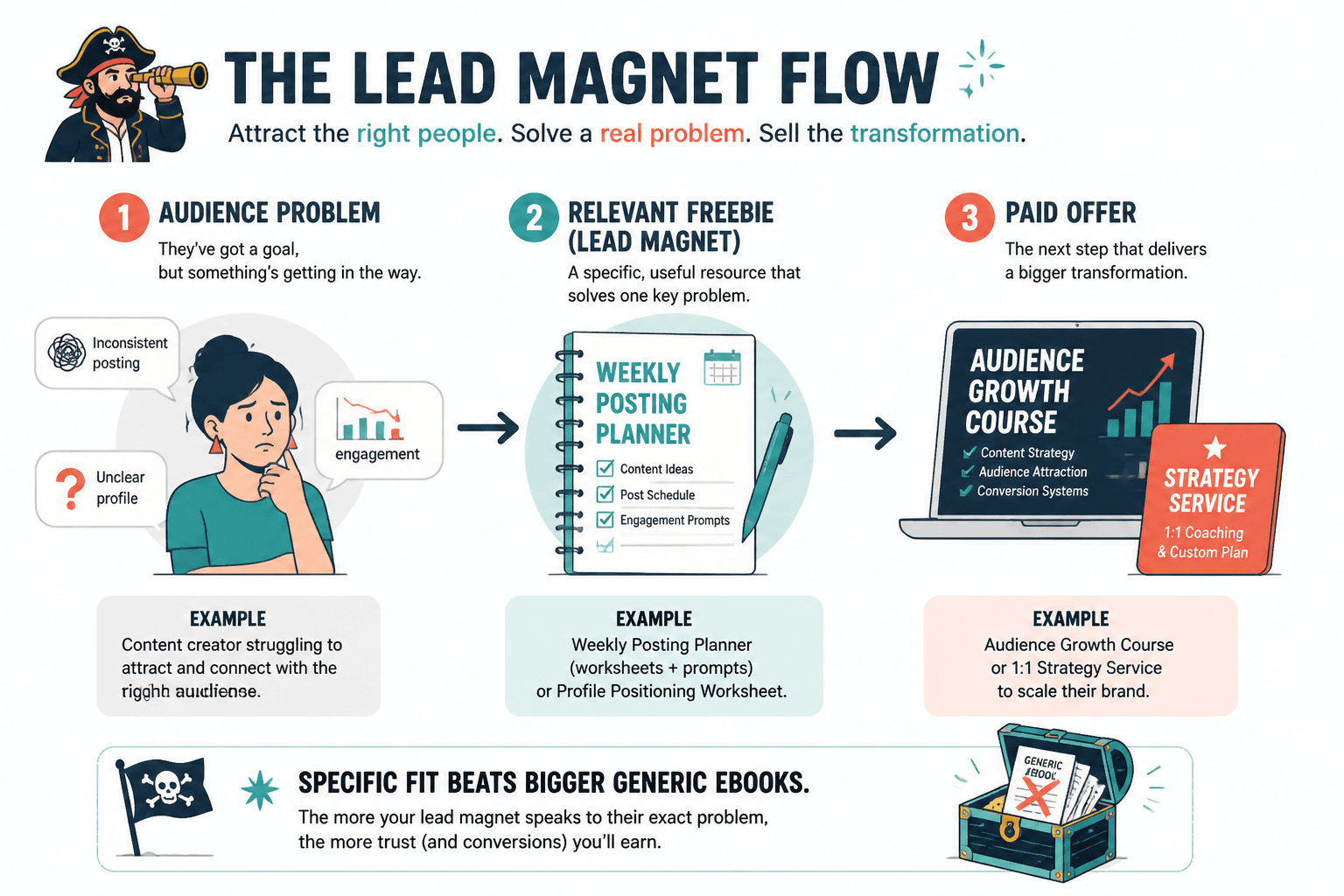
For example, if you sell content strategy consulting, a random “50 content ideas” PDF may get downloads, but a content audit checklist or hook rewrite template is far more likely to attract people who might actually hire you.
If you sell a course on audience growth, a weekly posting planner or profile positioning worksheet makes more sense than a giant ebook about “personal branding.” Bigger is not smarter. More relevant is smarter.
For a deeper breakdown of how these fit into your funnel, it’s worth reading this lead magnets hub and the broader monetization funnels section.
Best lead magnet ideas and examples for creators
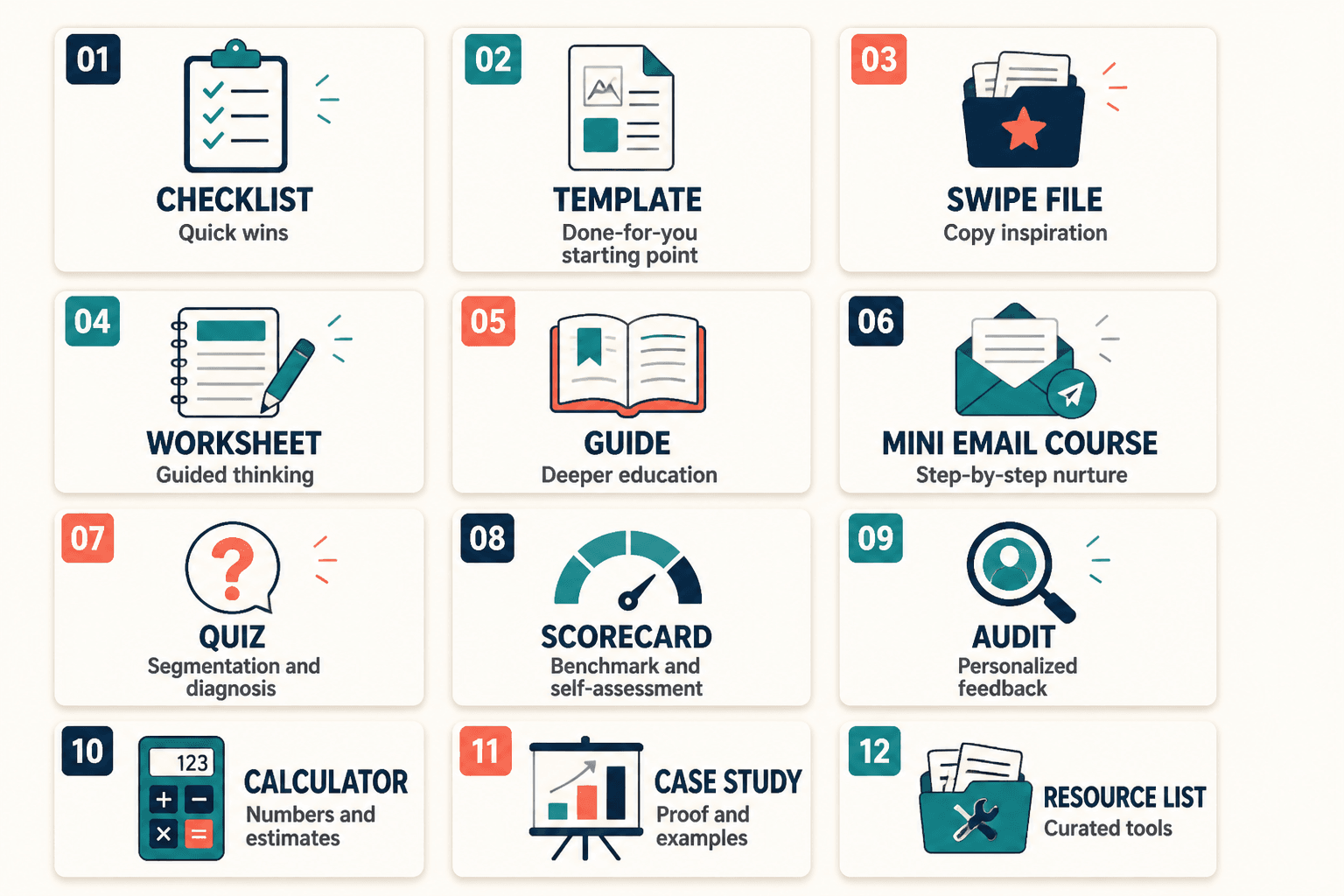
These are the lead magnet formats that tend to work best for creators, coaches, consultants, freelancers, solo founders, and personal brands. Not because they are trendy. Because they are practical, fast to consume, and easy to connect to a paid next step.
1. Checklists
Checklists work because they reduce uncertainty. People love knowing what to do next, especially when they are trying to avoid obvious mistakes.
Best for: audits, setup steps, publishing workflows, launch prep, profile reviews, funnel reviews
Examples:
- LinkedIn Profile Audit Checklist for Coaches
- Newsletter Launch Checklist for Personal Brands
- 12-Point Sales Page Review for Freelancers
- Creator Funnel Cleanup Checklist
Why it works: It gives people a clear, quick win without demanding much time. It also naturally exposes gaps they may need help fixing.
Good bridge to paid offers: audits, strategy calls, consulting, done-for-you services, templates, courses
2. Templates
Templates are one of the strongest lead magnets because people do not just want advice. They want a starting point that saves them time.
Best for: writing, outreach, content creation, client onboarding, funnels, launches
Examples:
- 10 Lead Magnet Landing Page Templates
- Creator Welcome Email Sequence Templates
- LinkedIn Post CTA Swipe File
- Consultant Discovery Call Follow-Up Templates
Why it works: The value is obvious in about three seconds. People understand templates immediately. They also imagine using them right away, which helps conversion.
The catch: bad templates become generic pretty fast. If your template reads like corporate wallpaper, it might collect signups but it will not build trust. Make them specific. Make them usable. Make them sound like a person wrote them.
3. Swipe files
Swipe files are templates with a bit more range. They are especially good for content creators who want examples, inspiration, and structures they can adapt.
Best for: hooks, CTAs, emails, bios, landing pages, sales posts, thread structures
Examples:
- 45 Hook Examples for Consultants Who Hate Clickbait
- 30 Soft-Sell CTAs for Creators
- 25 Welcome Email Openers That Do Not Sound Like a Funnel Goblin Wrote Them
- 20 Bio Formulas for Coaches and Personal Brands
Why it works: People like seeing what good looks like. Swipe files shorten the gap between “I understand this” and “I can use this.”
Good bridge to paid offers: copywriting services, content programs, memberships, messaging strategy, writing courses
4. Worksheets
Worksheets are good when the problem requires reflection, decisions, or customization. They ask for more effort than a checklist, but that effort can make them more valuable.
Best for: positioning, audience clarity, offer design, messaging, planning, pricing
Examples:
- Niche and Messaging Worksheet for New Creators
- Offer Positioning Workbook for Coaches
- Audience Pain Point Mapping Sheet for Consultants
- Creator Bio Rewrite Worksheet
Why it works: If your paid offer involves strategy or personalization, a worksheet can pre-qualify people beautifully. The ones who complete it are often far more serious.
5. Mini email courses
A short email course can be one of the best lead magnets for creators because it builds trust over several days instead of trying to impress someone with one PDF they never open.
Best for: education-heavy offers, trust building, warm-up sequences, more complex topics
Examples:
- 5 Days to a Sharper LinkedIn Content Strategy
- 7-Day Creator Funnel Mini Course
- 3 Lessons to Fix Your Offer Messaging
- 5 Emails to Build a Better Lead Magnet
Why it works: It trains the audience to expect value from your emails. That matters. If someone enjoys your free sequence, they are much more likely to read future emails and trust your paid offers.
Watch out for: turning it into a 14-email hostage situation. Keep it tight. Give actual lessons. Respect people’s inboxes.
6. Short guides or playbooks
Yes, guides still work. No, they should not be bloated little ebooks stuffed with obvious advice and Canva flourishes trying to distract from the emptiness.
Best for: teaching a simple process, framing a problem, introducing a method, showing strategic depth
Examples:
- A 7-Step Lead Magnet Planning Guide for Creators
- The Personal Brand Content Funnel Playbook
- A Practical Guide to Writing Better CTAs
- The No-Fluff Guide to Audience Positioning
Why it works: It lets you show thinking, not just tactics. This is helpful when your business relies on authority and strategic trust.
Rule of thumb: if it could have been a checklist, do not stretch it into a guide just because “ebook” sounds more serious.
7. Resource lists and tool stacks
People love curated shortcuts. A good resource list saves them research time and signals taste.
Best for: creators who recommend tools, workflows, software, prompts, references, reading lists, setup stacks
Examples:
- The Creator Tech Stack for Simple Content Operations
- My Favorite Research and Writing Tools for Solo Brands
- 25 Best Resources for Better Hooks and Headlines
- The Minimal Tool Stack for Newsletter Creators
Why it works: Curation is valuable when the internet is full of junk and ten thousand “best tools” lists written by people who clearly have not used half the apps.
Good bridge to paid offers: consulting, affiliate funnels, memberships, courses, systems setup services
8. Scorecards, quizzes, and self-assessments
These work when the audience wants diagnosis before advice. They are strong because they create self-awareness, which creates demand.
Best for: audits, readiness checks, maturity scoring, identifying bottlenecks
Examples:
- How Strong Is Your Creator Funnel? Self-Assessment
- Content Positioning Scorecard for Personal Brands
- Lead Magnet Effectiveness Quiz
- Audience Trust Audit for Coaches
Why it works: People are curious about themselves. Shocking development. If the assessment is thoughtful, it can segment leads well and point naturally to the next step.
9. Calculators and estimators
These are underrated. If your audience cares about time, money, conversion, pricing, output, or capacity, a calculator can be incredibly persuasive.
Best for: pricing, capacity planning, revenue forecasting, content ROI, funnel benchmarks
Examples:
- Freelancer Pricing Calculator
- Creator Revenue Goal Planner
- Newsletter Growth Projection Tool
- Lead Magnet Conversion Estimator
Why it works: It turns abstract advice into concrete numbers. That often makes your paid solution feel much more urgent and relevant.
10. Case study breakdowns
A case study lead magnet can work beautifully if your audience wants proof and specifics rather than generic theory.
Best for: consultants, strategists, service providers, agencies, educators selling expertise
Examples:
- How a Creator Turned One Lead Magnet Into Qualified Calls
- Behind the Funnel: From Content Post to Client Inquiry
- A Full Breakdown of a High-Converting Welcome Sequence
- How We Reworked a Coach’s Offer Positioning and Signup Rate
Why it works: It shows your thinking in action. It also helps serious buyers picture what working with you could look like.
11. Free audits or quick reviews
This is less scalable, but it can be excellent for high-ticket services. A free audit is basically a lead magnet disguised as personalized value.
Best for: consultants, agencies, strategists, conversion specialists, profile writers, content advisors
Examples:
- Free LinkedIn Profile Tear-Down
- 5-Minute Funnel Review
- Homepage Messaging Audit
- Email Welcome Sequence Review
Why it works: You are proving value before the sale. When done well, this can lead to much better inquiries than a general downloadable PDF.
Warning: put boundaries on it. Otherwise you’ve built yourself an unpaid part-time job and called it lead gen.
How to choose the right lead magnet format
If you are stuck between formats, use this simple filter:
| Question | Best-fit formats |
|---|---|
| Does the audience need a quick fix? | Checklist, template, swipe file |
| Do they need strategy or clarity? | Worksheet, guide, mini email course |
| Do they need diagnosis first? | Quiz, scorecard, audit |
| Do they care about numbers? | Calculator, estimator |
| Do they need proof before buying? | Case study, breakdown, audit |
| Do you want easy scalability? | Template, checklist, guide, email course |
The best choice is usually the one that creates the fastest meaningful result with the least confusion. Not the one that looks fanciest on a landing page.
Lead magnet examples by creator type
For writers and content creators
- 30 Hook Rewrites for Better Posts
- Weekly Content Planning Template
- Welcome Email Swipe File
- Audience Voice and Tone Worksheet
For coaches
- Client Attraction Funnel Checklist
- Consultation Call Prep Guide
- Offer Positioning Worksheet
- Coach Bio Rewrite Template
For consultants
- Lead Generation Audit Checklist
- Thought Leadership Post Templates
- Authority-Building Email Course
- Messaging Review Scorecard
For freelancers and service providers
- Pricing Calculator
- Proposal Email Templates
- Client Onboarding Checklist
- Portfolio Messaging Guide
For solo founders and personal brands
- Simple Funnel Map Template
- Lead Magnet Planning Workbook
- Audience Trust Scorecard
- Content-to-Offer Bridge Guide
If you want more fast-adapt ideas, this article on lead magnet ideas creators can adapt fast is a useful companion.
How to make your lead magnet more likely to convert
The format matters less than the packaging. A good template with a weak promise can still flop. A simple checklist with a strong angle can do very well.
Here’s what improves conversions most often:
- Be specific: “5-email welcome sequence template” is stronger than “email marketing guide”
- Focus on one outcome: one problem, one win, one next step
- Use plain language: no vague “transformation” fluff
- Make the value obvious fast: the reader should get it instantly
- Connect it to your offer: not aggressively, just logically
- Design for use, not decoration: pretty is nice, usable is better
One thing creators underestimate: a lead magnet does not need to be broad to feel valuable. Narrow often converts better because the reader can tell it is for them.
“The Creator Growth Toolkit” sounds impressive and says almost nothing.
“12 CTAs That Turn Helpful Posts Into Qualified Inquiries” is much clearer. Probably less glamorous. Definitely more useful.
Common lead magnet mistakes creators keep making
- Making it too broad: broad usually means forgettable
- Solving the wrong problem: useful does not matter if it attracts the wrong audience
- Giving information without application: people need action, not just reading material
- Using generic titles: “Ultimate Guide” is tired and often unsupported by the content
- No next step: the lead magnet helps, then nothing happens
- Overdesigning weak content: lipstick, meet pig
- Building for volume instead of fit: more leads is not always better leads
A lot of lead magnets are really content leftovers dressed up as assets. If it feels like a random pile of tips that did not earn a proper article, people can tell.
A simple lead magnet formula you can actually use
If you want a clean way to come up with stronger lead magnet ideas, use this:
- Audience: who is it for?
- Pain point: what specific problem are they dealing with?
- Quick win: what can you help them fix fast?
- Format: what is the easiest way to deliver that win?
- Bridge: what paid offer naturally comes next?
Example:
- Audience: coaches using LinkedIn
- Pain point: posts get views but no inquiries
- Quick win: improve CTAs and post structure
- Format: CTA swipe file + post template
- Bridge: content strategy consulting or messaging package
That is how you get a lead magnet that attracts people who might actually buy, instead of just people who collect freebies like digital squirrels.
If you have a small audience, this still works
You do not need a huge following for lead magnets to be useful. In fact, lead magnets can work especially well with small audiences when the audience is relevant and the resource is sharp.
With smaller audiences, specificity matters even more. Your goal is not to squeeze huge opt-in volume out of thin air. It is to attract the right few people, build trust, and move them toward a next step.
A creator with 800 followers and a tight lead magnet for the right niche can outperform someone with 40,000 followers and a fuzzy freebie aimed at “anyone building a brand.” The internet has enough vague ambition content already.
For that angle, read this guide to lead magnets for creators with small audiences.
How to connect the lead magnet to a real funnel
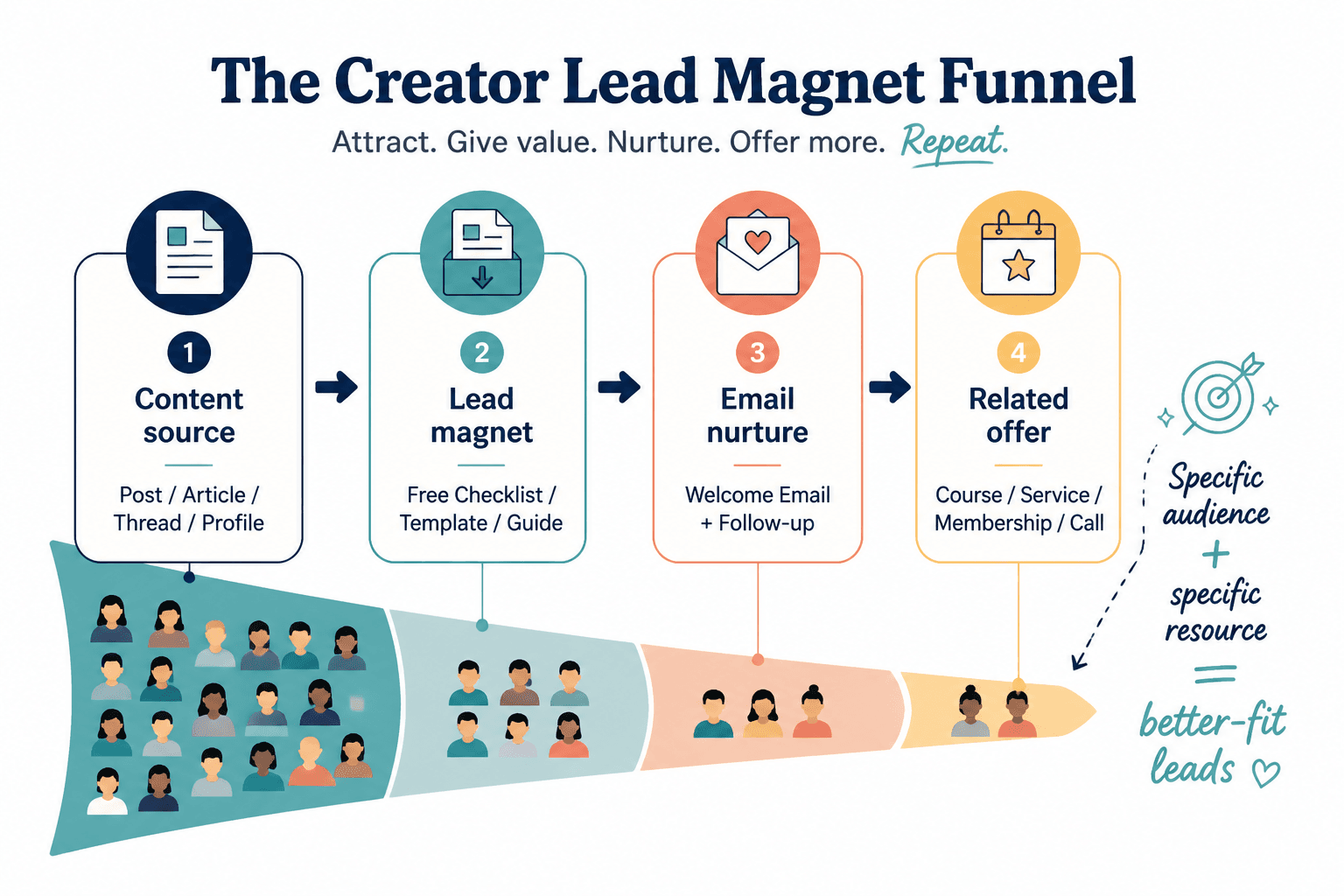
A lead magnet on its own is not a funnel. It is one step in a funnel.
A simple version looks like this:
- Post, article, thread, or profile sends people to the lead magnet
- Lead magnet solves one useful problem
- Welcome email or follow-up sequence builds trust
- Next step points to a related offer
That offer could be a paid newsletter, course, consulting package, service, membership, workshop, or call. The point is that there should be a visible path.
If you want a broader framework, this guide for creators who want better results pairs nicely with this article.
Quick before-and-after examples
Weak idea
Free Personal Branding Ebook
Better idea
7 Bio Templates for Creators Who Need Clearer Positioning
Why it is better: more specific audience, more obvious benefit, easier to imagine using.
Weak idea
Social Media Growth Guide
Better idea
30 Hook Formulas for LinkedIn Posts That Need Better First Lines
Why it is better: focused problem, practical output, stronger fit for people who write content.
Weak idea
Entrepreneur Toolkit
Better idea
Simple Lead Magnet Landing Page Checklist for Coaches and Consultants
Lead magnets work best when they solve one real problem cleanly and make the next step feel natural. The clearer the bridge from free value to real offer, the stronger the whole system gets.