
If your audience is small, your lead magnet cannot afford to be vague, bloated, or “helpful” in that fake general way that helps nobody enough to opt in.
That is the mistake a lot of creators make. They assume a small audience means they need a bigger freebie, a broader topic, or more stuff packed into a PDF like they are bribing people with page count. Usually the opposite works better.
Lead Magnets for Creators With Small Audiences work best when they are tight, specific, fast to use, and clearly connected to one real problem your audience already knows they have. Not a “complete guide to success.” Not a 47-page workbook nobody finishes. Something useful enough that the right person thinks, “Yep, I want that.”
Here’s how to create lead magnets that actually pull their weight when you do not have giant reach, a worshipful following, or endless traffic to waste on mediocre offers.
Want the broader roadmap? Start with the parent guide.
Small audiences need sharper lead magnets, not bigger ones
When your audience is small, every click matters more. You do not have the luxury of throwing a generic freebie into your bio and hoping volume saves you.
A creator with 500 relevant followers can absolutely build an email list, book calls, and make sales. But only if the lead magnet feels relevant to the exact people they want more of. That means specificity beats breadth. Relevance beats polish. Speed beats comprehensiveness.
Think of it this way: a small audience is usually a signal problem, not just a number problem. If your audience is small and your lead magnet is broad, you have stacked two weak signals on top of each other. That is how you end up with a free resource that gets polite silence.
The better approach is to make one strong promise for one type of person in one situation.
A small audience of the right people does not need more content confetti. It needs a reason to trust that your free thing will save time, reduce friction, or make a next step easier.
What makes a lead magnet work when you are still growing
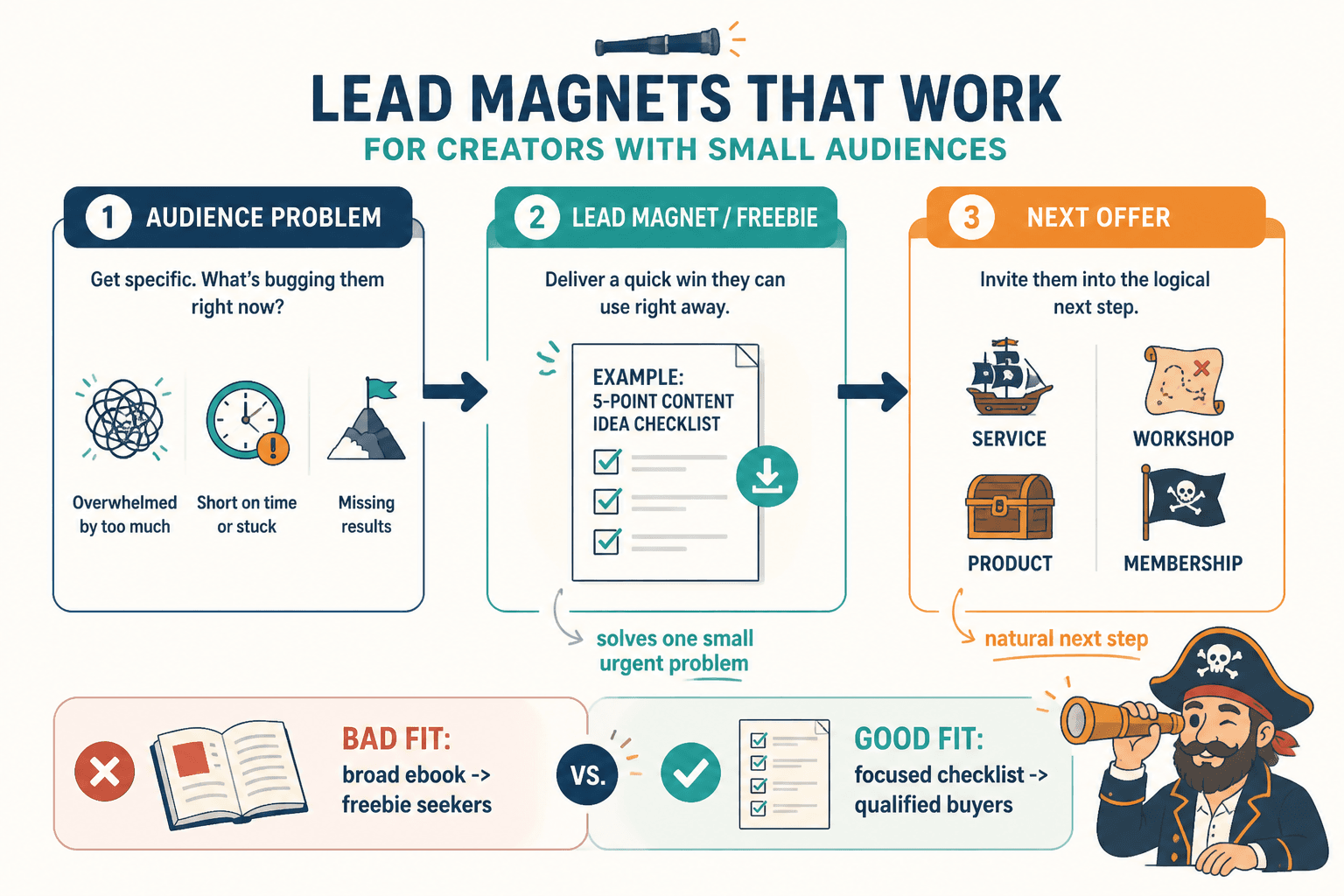
Good lead magnets for small creators usually do four things well:
- They solve a narrow problem
- They are quick to consume or use
- They naturally lead toward a paid offer, service, or next step
- They match the creator’s actual expertise instead of random audience bait
That last one matters more than people admit. A lot of creators make lead magnets based on what sounds popular rather than what connects to their real work. Then they attract subscribers who want freebies, not buyers who want outcomes.
If you are a coach, consultant, freelancer, writer, or solo founder, your lead magnet should not just “grow your list.” It should pre-qualify people. It should attract the kind of person who may later want your service, product, workshop, newsletter, membership, or recommendation.
That is why a simple checklist tied to your service often beats an impressive-looking ebook about a huge topic. One gets used. The other gets downloaded and forgotten in a digital drawer full of abandoned ambition.
The best types of lead magnets for creators with small audiences
You do not need a perfect format. You need the right format for the promise.
These are usually the strongest options for creators with small audiences because they are easier to make, easier to consume, and easier to tie to a business goal.
Checklists
Checklists work when your audience wants to avoid mistakes, review something before publishing, or make sure they did not forget a step.
Examples:
- LinkedIn post checklist before publishing
- Landing page review checklist for coaches
- Client onboarding checklist for freelancers
- Email welcome sequence checklist for creators
Good checklists are specific. Bad checklists are just obvious advice broken into bullets.
Templates
Templates are great when your audience wants speed. They want a starting point, not another lecture.
Examples:
- Discovery call follow-up email templates
- Content repurposing templates
- Short-form hook templates for consultants
- Bio rewrite templates for personal brands
Templates work especially well if your paid offer helps people customize, implement, or improve what the template starts.
Mini guides
A short guide can work well if it helps the reader make one decision, fix one bottleneck, or understand one process more clearly. Keep it tight. “Mini” should actually mean mini.
Think 5 to 10 useful pages, not a fake book with giant margins and motivational filler.
Swipe files
Swipe files are solid for writers, marketers, copywriters, and creators because they turn “I know I should post” into “I can use this right now.”
Examples:
- 20 CTA examples that do not sound needy
- 15 authority-building post structures
- 10 Facebook post openings that start conversations
- 12 consultation-offer email angles
Calculators, scorecards, and self-assessments
These can work beautifully because they create instant personal relevance. People love seeing where they stand. They love customized insight even more.
Just do not make the result so generic it feels machine-stamped. If someone takes your assessment and learns nothing beyond “you need consistency,” that is not insight. That is content wallpaper.
Short email courses
These work if your topic needs sequencing. They are useful when one PDF would be ignored, but a short 3-to-5-day email series can guide the person through a process.
This is often stronger than a downloadable document if your business already relies on email and trust-building over time.
If you want more format ideas, this guide to lead magnet ideas and examples for creators and these simple lead magnet delivery formats and templates are useful next reads.
How to choose the right lead magnet for your business
Do not start with format. Start with the paid thing you eventually want people to care about.
A strong lead magnet is not random free value. It is a small, fast win that creates trust and points naturally toward a deeper offer.
Use this simple filter:
- What does my audience struggle with right before they would need my paid help?
- What small resource would help them make progress on that problem quickly?
- What format would make that easiest to use?
- What next step should happen after they consume it?
That last question is where a lot of creators get lazy. They make the freebie, collect the email, and then… nothing. No welcome sequence. No relevant CTA. No path. Just vibes and a tagging system they swear they will organize later.
Your lead magnet should sit inside a simple funnel. It does not need to be fancy. It just needs to make sense.
- Post to lead magnet to welcome email to offer
- Article to lead magnet to nurture emails to consultation
- Bio link to free template to follow-up sequence to paid workshop
- Thread to checklist to case study to service page
If you want the broader category context, the site’s lead magnets hub and the wider monetization funnels section can help you map that next step more clearly.
Bad lead magnet ideas small creators should stop making
Some lead magnets sound useful but underperform constantly, especially for creators with smaller audiences.
The broad beginner guide
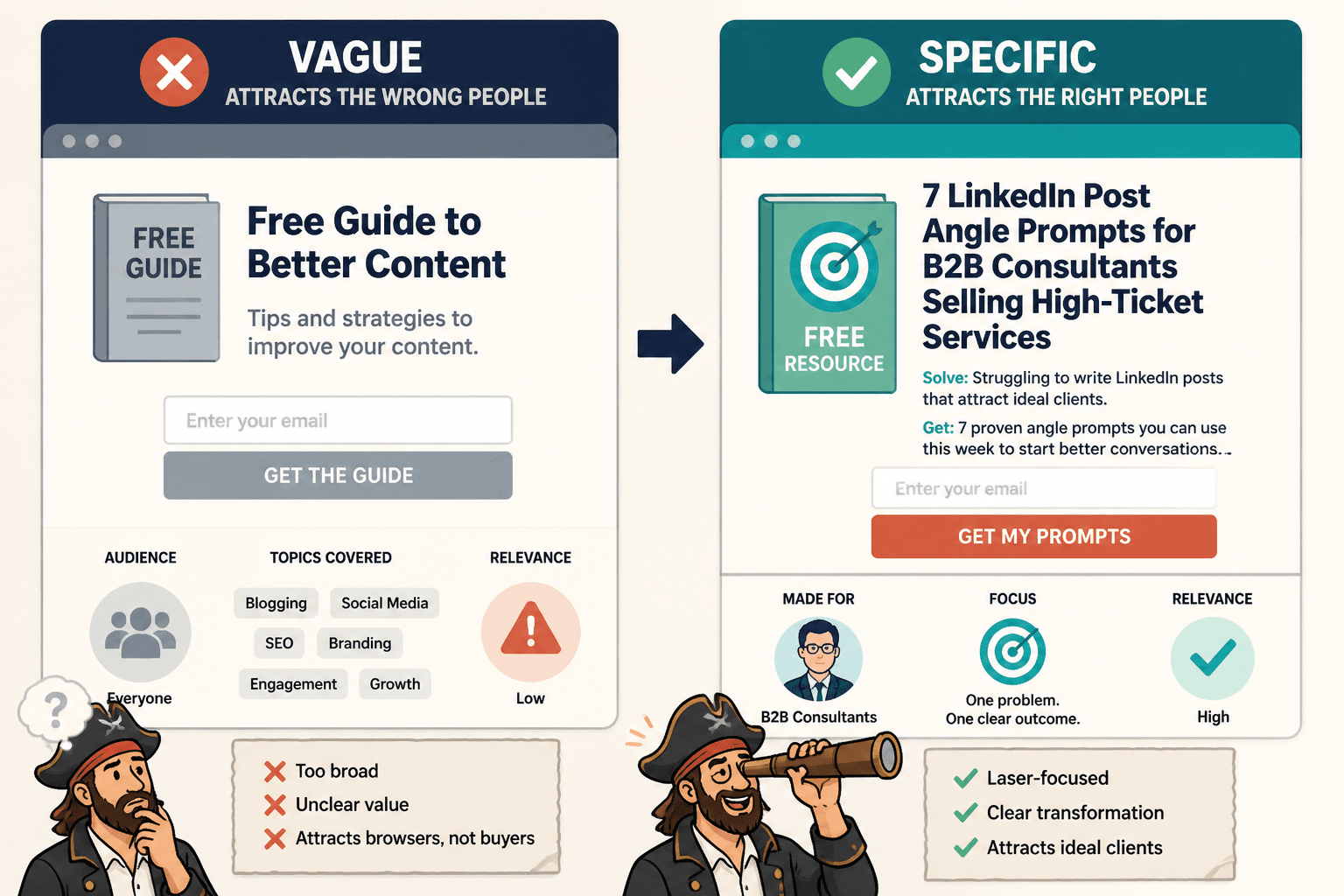
“The Ultimate Guide to Personal Branding” sounds impressive. It is also too broad, too common, and too easy to ignore.
Broader topic usually means weaker urgency. People do not opt in because a topic is big. They opt in because it feels immediately relevant.
The giant workbook
Most giant workbooks are homework disguised as value. Your audience does not want a second unpaid job.
If the resource takes an hour to understand before it becomes useful, conversion will usually suffer.
The generic resource everyone else has
If your freebie sounds interchangeable with 500 others in your niche, then a small audience is not your only problem. Your positioning is sleepy.
A decent test: if someone removed your name from the lead magnet headline, would it still sound obviously like your angle, audience, or expertise? If not, tighten it.
The freebie that attracts the wrong people
If you help consultants sell high-ticket services but your lead magnet is “100 Canva Templates for Instagram Quotes,” do not be shocked when your list fills with people who never buy what you actually sell.
List growth is not the goal. Relevant list growth is the goal. Big difference. Expensive difference, honestly.
A simple framework for making lead magnets for creators with small audiences
If you want a practical way to build one, use this:
1. Pick one narrow problem
Not “content strategy.” More like “coming up with better LinkedIn post angles when your expertise is solid but your posts feel flat.”
The narrower the problem, the easier it is for the right person to recognize themselves in it.
2. Promise one clear outcome
What will they be able to do, decide, write, fix, or avoid after using it?
Examples:
- Write stronger hooks in 10 minutes
- Audit your coaching sales page without hiring a copywriter yet
- Choose the right content pillar for your offer
- Fix the five mistakes hurting your bio conversion
3. Choose the fastest useful format
Do not choose an ebook when a checklist would do. Do not choose a course when a template would do. Fancy is often friction wearing a nice jacket.
4. Connect it to a next step
After they use it, what should they do?
- Reply to an email
- Read a related article
- Book a call
- Join a paid workshop
- Buy a starter product
The lead magnet should not feel like the end of the relationship. It should feel like the first useful proof that your paid work is worth attention.
5. Name it like a result, not a file type
“Free PDF” is not a hook. “5-Minute Offer Audit for Coaches” is better. “Client Onboarding Email Templates” is better. “The Tiny Funnel Fix Kit for Service Creators” is better if it is actually clear what that means.
A good title does a lot of the conversion work before anyone sees the opt-in page.
Examples of strong lead magnet angles for small creators
Here are a few stronger examples by creator type.
| Creator type | Weak lead magnet | Stronger lead magnet |
|---|---|---|
| LinkedIn ghostwriter | Ultimate Guide to LinkedIn Growth | 25 LinkedIn Hook Rewrites for B2B Experts Who Sound Too Safe |
| Business coach | Mindset Workbook | Service Offer Clarity Scorecard for New Coaches |
| Copywriter | Copywriting Tips PDF | Sales Page Fix Checklist for Low-Conversion Service Offers |
| Consultant | Free Marketing Guide | 90-Day Content Planning Template for Small B2B Consultants |
| Freelancer educator | Freelance Success Ebook | Client Onboarding Email Pack for Freelancers Who Want Fewer Messy Projects |
See the pattern? The stronger versions are narrower, more practical, and tied to a real pain point. They also hint at who they are for. That matters.
How to promote your lead magnet without sounding desperate
You do not need to scream about your freebie every day like it is the last lifeboat on the internet.
The best promotion usually happens when the lead magnet is attached to a problem you already talk about in your content.
That means:
- Mention it in posts about the problem it solves
- Link it from relevant articles
- Add it to your bio or profile CTA
- Use it in welcome messages or pinned posts where appropriate
- Reference it in emails when subscribers hit the related problem
For example, if your lead magnet is a checklist for improving content hooks, your posts should regularly talk about weak openings, vague ideas, bad formatting, and how stronger packaging improves response. Then the lead magnet feels like a natural next step, not a random interruption.
This is also why creators with small audiences should stop making disconnected freebies just because a marketing guru said every audience segment needs a different lead capture asset. Maybe later. Right now, one strong, relevant lead magnet is enough.
What to measure if your lead magnet is underperforming
If people are not opting in, do not immediately assume your audience is too small.
Check these first:
- Is the promise specific enough?
- Does the title sound useful or generic?
- Is the audience clear?
- Is the format easy to consume?
- Does the freebie match the content that promotes it?
- Does the opt-in page explain the outcome clearly?
- Is there obvious value fast, or does it sound like work?
If people opt in but do not engage after, look at delivery and follow-up.
- Did they get the resource immediately?
- Was it actually useful within minutes?
- Did your welcome emails continue the same topic?
- Was the next step clear and relevant?
A weak lead magnet often fails before the download. A mismatched funnel usually fails after it.
Lead magnets work best when they solve one real problem cleanly and make the next step feel natural. The clearer the bridge from free value to real offer, the stronger the whole system gets.