Most creators with small audiences make the same email mistake: they act like sequences only matter once they “have enough subscribers.”
That is backwards.
If your audience is small, your creator email sequences for creators with small audiences matter more, not less. You do not have the luxury of wasting attention. Every subscriber is more valuable. Every email has to pull its weight. And every awkward, vague, overlong sequence does a little trust damage you cannot really afford.
The good news is you do not need a giant list, a seven-figure funnel, or a 19-email automation that sounds like it escaped from a marketing course in 2018. You need a few sharp sequences that welcome people properly, build trust, and make a clean offer when the timing makes sense.
That is what this article will help you build: simple email sequences that work when your list is small, your time is limited, and your audience is made of actual humans instead of spreadsheet fantasy.
For the full path around this topic, head to the parent guide.
Why small creators need email sequences earlier than they think
A lot of creators treat email like a storage unit for future opportunities. They collect subscribers, send the occasional newsletter when inspiration strikes, and assume the real strategy can wait until they “grow.”
Not ideal.
When your audience is small, your email list is not just a list. It is your clearest line to people who already gave you more trust than a random follower ever will. A decent sequence helps you use that trust well. It introduces your work, gives people a reason to stay, and moves them toward the right next step without immediately trying to turn every new subscriber into a walking wallet.
Email sequences are especially useful for small creators because they help you do three things consistently:
- Make a strong first impression without manually writing the same intro over and over
- Build trust at scale, even if “scale” currently means 87 subscribers and a decent attitude
- Create momentum so people do not forget who you are five minutes after joining your list
You do not need complexity. You need coverage. New subscriber joins? They should know what you do, who it is for, why it matters, and what to do next. Buyer joins? They should get onboarding, not silence. Freebie subscriber joins? They should get context, not just a PDF thrown at them like stale conference swag.
What small-audience email sequences should actually do
Before you write anything, get clear on the job.
A good sequence is not there to prove how clever you are. It is not there to dump your life story into someone’s inbox. And it definitely is not there to fake intimacy with weird over-sharing and then swing into a sales pitch like a pickpocket in a mastermind.
For small creators, the best email sequences usually do some mix of the following:
- Welcome new people and set expectations
- Show what kind of creator, expert, or business owner you are
- Demonstrate useful thinking or practical results
- Guide subscribers toward your best content or offer
- Keep people warm between moments of active promotion
- Make small lists more profitable without making them feel exploited
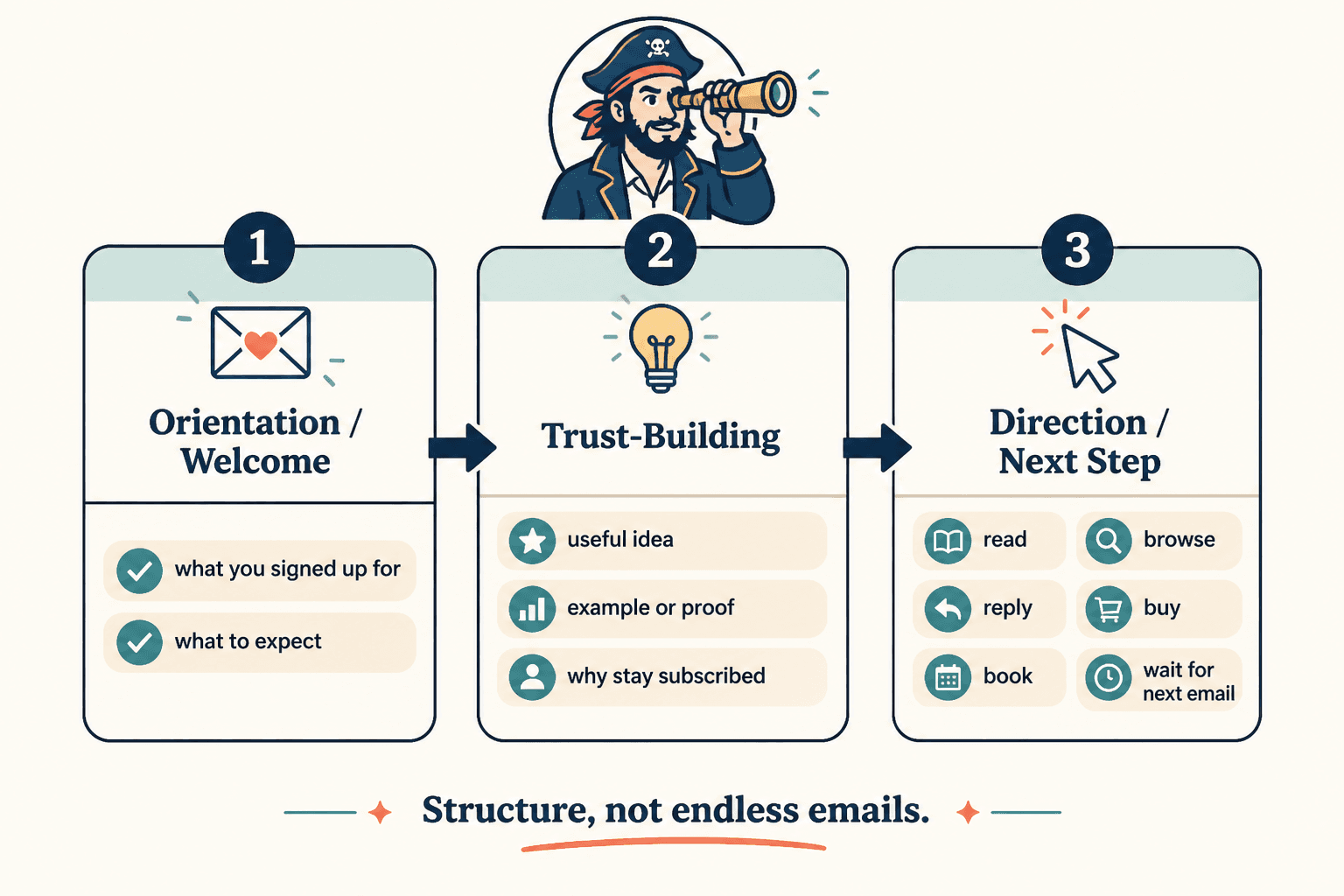
That means your sequence needs structure. Not endless emails. Structure.
The three jobs every useful sequence should cover
- Orientation: Tell people where they are, what they signed up for, and what they can expect.
- Trust-building: Give them useful ideas, proof, perspective, or examples that make staying subscribed feel smart.
- Direction: Point them toward one next step: read, reply, book, browse, buy, or wait for what is next.
If your sequence misses one of those, it usually underperforms. Plenty of creators welcome people nicely but never direct them anywhere. Others go straight for direction without earning trust. And some send long inspirational puddles that say a lot of words while accomplishing almost nothing.
The best creator email sequences for small audiences
You do not need every sequence under the sun. Start with the few that create the most leverage.
1. The welcome sequence
This is the first one to build. No debate.
Your welcome sequence is what new subscribers get after they join your list. It should make people feel like they arrived somewhere intentional, not like they fell into an abandoned newsletter with one PDF and a prayer.
A solid small-creator welcome sequence can be just 3 to 5 emails.
- Email 1: Deliver the thing, welcome them, set expectations
- Email 2: Share your core idea, approach, or philosophy
- Email 3: Give one genuinely useful lesson, framework, or example
- Email 4: Point them to your best resource, article, or offer
- Email 5: Invite a reply, consultation, waitlist, or low-friction next step
The point is not to cram your whole business into five emails. The point is to make subscribers quickly understand why your work matters and where they can go deeper.
2. The nurture sequence
If your list grows mainly from lead magnets, content upgrades, or social content, a nurture sequence helps stop subscribers from going cold immediately.
This sequence works well when someone has shown interest but is not ready to buy. You are keeping the relationship warm while proving your usefulness. Think practical ideas, common mistakes, mini case studies, short stories with an actual point, and occasional gentle offers.
Keep it tight. A nurture sequence does not need to become a lifestyle.
3. The soft sales sequence
Small creators often avoid selling because they do not want to annoy people. Fair. But avoiding sales entirely is not noble. It is usually just fear wearing tasteful clothes.
A soft sales sequence works well when you have a low-ticket offer, consultation, service package, workshop, or productized service. You are not hammering people with countdown timers. You are helping the right readers connect the dots between their problem and your paid solution.
A simple version might look like this:
- Email 1: Name the problem clearly
- Email 2: Show your approach or method
- Email 3: Share proof, a case example, or a realistic transformation
- Email 4: Present the offer plainly
- Email 5: Answer objections and restate who it is for
4. The launch or promo sequence
If you sell in campaigns, not all the time, you need a launch sequence. This one is less evergreen and more time-sensitive. It is designed to create attention and action around a release, open cart, workshop, cohort, or limited-time offer.
If you want more structure here, read creator launch sequences examples creators can adapt fast.
5. The onboarding sequence
This one gets ignored a lot, which is strange because it is one of the easiest ways to reduce buyer confusion and regret.
If someone buys from you, books you, joins your membership, or signs up for your program, they should not receive one payment confirmation and then radio silence. An onboarding sequence helps new clients feel smart for saying yes. It sets expectations, reduces friction, and improves the actual experience.
How to keep email sequences simple when your audience is small
Small creators get into trouble when they copy enterprise advice or big-name creator systems. Suddenly they think they need segmented trees, behavioral branching, 27 tags, and a Miro board that looks like a conspiracy wall.
You probably do not.
At this stage, simpler usually wins because it is easier to finish, easier to maintain, and easier to improve. A mediocre sequence you actually use will outperform the genius automation system you are still “mapping out” three months from now.
A good small-creator setup looks more like this
- One welcome sequence
- One nurture or trust-building sequence
- One sales or offer sequence for your main paid thing
- Optional onboarding if you sell a service or product
That is enough to start. You can build more later if the business actually needs it.
If you want a broader foundation first, start with email newsletter writing and then move into creator email sequences when you are ready to build out the moving parts.
What to put in each email so people do not immediately tune out
Most weak sequence emails are not terrible because they are too short or too long. They fail because they do not know their own job.
Each email should have one main point and one main action. That action can be tiny. Read this. Reply to this. Consider this. Book this. But it should exist.
A simple structure that works
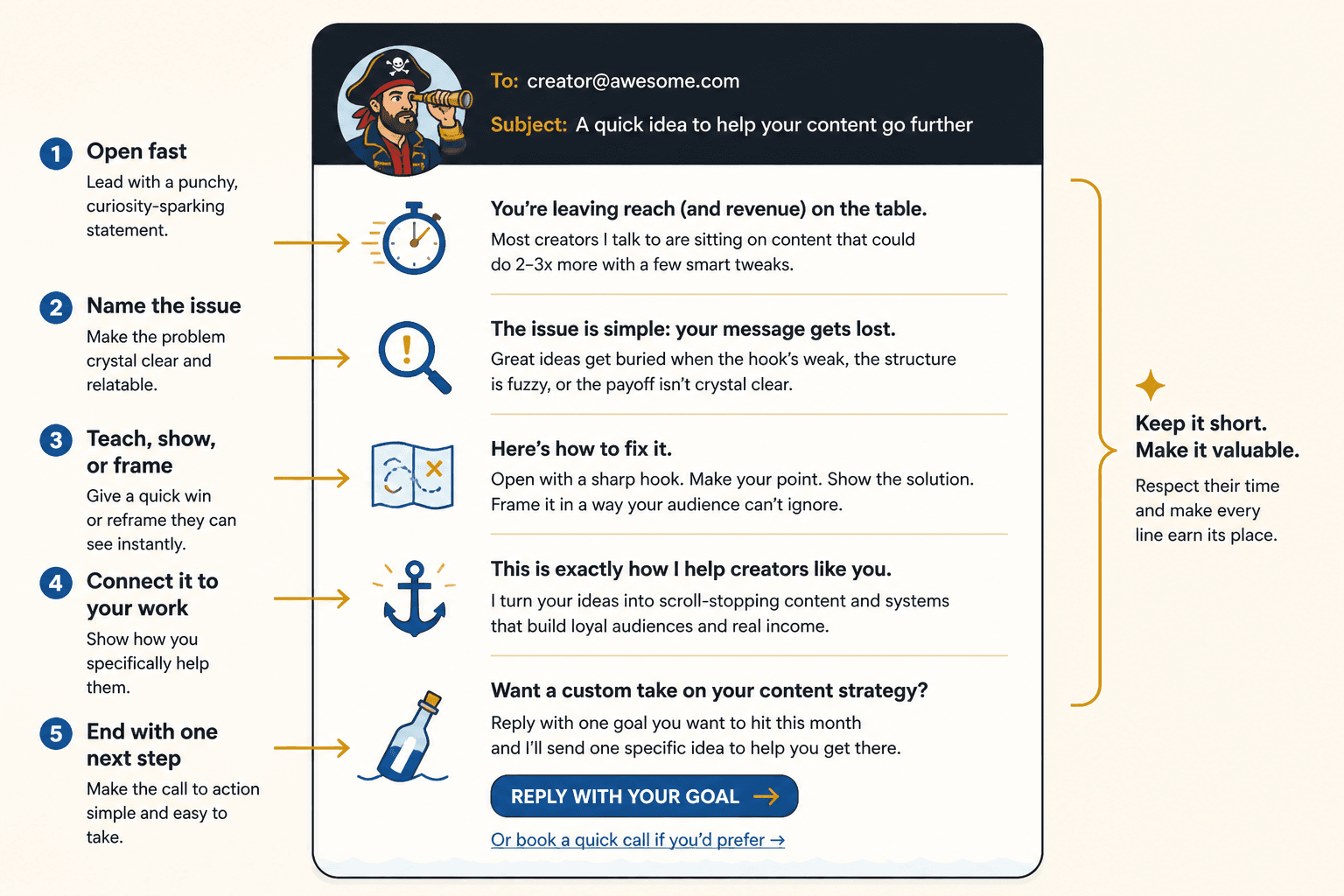
- Open fast. Get to the point quickly. No throat-clearing. No “I hope you are doing well.” Nobody is waiting breathlessly for that sentence.
- Name the issue. What problem, tension, mistake, or opportunity is this email about?
- Teach, show, or frame. Give one useful idea, example, insight, or shift in perspective.
- Connect it to your work. Why does this matter in the way you help people?
- End with one next step. Keep the CTA clean and specific.
That is enough structure for most creator emails. You do not need literary drama. You need movement.
Example: weak vs stronger sequence email opening
Weak:
Hi there, and welcome to my community. I am so excited to have you here. In this email, I want to share a bit about my story and how I got started helping people transform their brands.
Stronger:
Most creators do not have a content problem. They have a clarity problem. They know their topic, but their message lands like damp cardboard. That is the problem I help fix.
The second version starts with a point. It gives the reader a reason to care. It sounds like someone with an actual perspective, which helps.
How often should small creators send sequence emails?
There is no magic number, which is annoying but true.
For most small creators, a practical rhythm is every 1 to 3 days inside a short sequence. That is frequent enough to keep momentum without making people wonder why you suddenly moved into their inbox and started paying rent.
A few general guidelines:
- Welcome sequence: every 1 to 2 days works well
- Nurture sequence: every 2 to 4 days is usually fine
- Sales sequence: tighter spacing often works better, especially near the end of a promo
- Onboarding: send according to the user journey, not a random schedule
What matters more than exact timing is relevance. If each email feels purposeful, subscribers tolerate frequency surprisingly well. If each email feels padded, even one a week can feel like too much.
Common mistakes small creators make with email sequences
Here is where things usually go sideways.
- They write too much about themselves. Your story matters when it helps explain the reader’s problem or your method. It does not matter just because it happened to you.
- They over-educate and under-direct. Useful is good. But if every email teaches and none of them move the reader toward anything, the sequence just wanders around being informative.
- They pitch too early. If the first emotional beat is “buy my thing,” people will smell the funnel from miles away.
- They sound weirdly corporate. Nothing kills trust faster than a creator sounding like a compliance-approved brochure.
- They make every email too broad. One email, one point. Not six.
- They never update the sequence. Your sequence is not a sacred text. Improve it as you learn what people click, reply to, ignore, and buy from.
One more thing: do not confuse “small audience” with “low standards.” Small lists deserve sharp writing too. Probably sharper, because the relationship is closer.
A simple 5-email welcome sequence small creators can adapt
If you want a starting point, use this.
| Purpose | What to include | CTA | |
|---|---|---|---|
| 1 | Welcome + delivery | Deliver the freebie or confirm signup, set expectations, briefly say what you help with | Read, save, or reply |
| 2 | Core idea | Share your main belief or method, explain what people often get wrong | Read a related article or reply with a challenge |
| 3 | Proof + usefulness | Teach one practical framework, mini case, or before/after example | Try the idea or explore your best resource |
| 4 | Positioning + trust | Clarify who you help best, what you do not do, and why your approach works | Book, browse, or join a waitlist |
| 5 | Soft offer | Present your service, product, consultation, or next step clearly | Take the next step |
If you want more examples and variations, see best creator email sequences ideas and examples for creators.
How to make your sequences feel personal without manually writing everything
A lot of small creators worry that automation will make them sound cold. It can, if you write emails like an underfunded software company.
But automation itself is not the problem. Lifeless writing is the problem. Bland ideas are the problem. Pretending to be intimate with everyone in exactly the same robotic way is definitely a problem.
To keep automated sequences feeling human:
- Write like you actually talk to smart clients
- Use specifics instead of vague encouragement
- Reference the reason they joined when relevant
- Invite replies in a way that feels real, not compulsory
- Keep the tone consistent with your content and offer
- Do not fake urgency where none exists
You can also lightly personalize based on entry point. Someone who joined through a content writing checklist may need a different angle than someone who joined through a consulting offer. That said, do not build a complicated branching system just to feel advanced. Build what you can maintain.
The bigger point is simple: clearer structure and clearer writing make the piece more useful. That is usually what makes the ending land better too.