
Most creator bios fail at monetization for one of two reasons: they either say nothing useful, or they try to sell too hard in a space that should be building trust first.
That is the whole tension with How to Monetize Creator Bios & Profile Copy Without Wrecking Trust. Your profile needs to do business. It should help the right people understand what you do, why you matter, and what to do next. But the second your bio starts reading like a funnel sprayed directly into someone’s eyes, people back away.
A good creator bio is not a tiny ad. It is a positioning tool with a conversion job. It should attract, qualify, reassure, and gently direct. Not chest-bump. Not beg. Not perform motivational karaoke.
Here’s how to make your bios and profile copy earn leads, inquiries, and sales without sounding thirsty, robotic, or weirdly over-optimized.
For the broader learning path, visit our parent guide.
What monetizing a bio actually means
When people hear “monetize your bio,” they often think “jam an offer into every line and slap a booking link on the end.” That is not monetization. That is just impatience with punctuation.
Monetizing your bio really means making sure your profile helps move the right reader one step closer to a commercial outcome. That outcome might be a sale, a lead, a subscriber, an inquiry, a booked call, or a click to a useful resource that starts the relationship properly.
Your bio is doing monetization well when it answers four basic questions fast:
- Who are you for?
- What do you help them do?
- Why should they trust you?
- What should they do next?
If one of those is missing, your profile either feels vague or pushy. Usually both.
If you want a stronger foundation first, this guide on how to write better creator bios and profile copy is worth reading alongside this one.
Why most bios wreck trust before they ever sell anything
Trust drops when your profile copy feels like it was written to extract value before offering any.
That usually happens in a few predictable ways.
1. The bio is all promise, no proof
“Helping leaders scale impact and unlock visibility” sounds impressive until you realize it could belong to 40,000 people and none of them can explain what they actually do.
Vague claims do not create trust. They create suspicion with better fonts.
2. The CTA asks for too much too early
If someone lands on your profile cold and your first move is “Book a call now,” that may work if your positioning is very strong and the buyer is already warm. For most creators, though, that ask is too aggressive for the amount of trust established.
Cold profile visitors often need a softer next step first: read, subscribe, download, browse, learn, then maybe buy.
3. The tone feels synthetic
A bio can be polished without sounding like a thought-leadership mannequin. If your profile is stuffed with words like “empowering,” “passionate,” “transformational,” and “mission-driven,” it starts to feel less trustworthy, not more.
This matters because bios are tiny. Every vague or inflated word takes up space that could be used for clarity, proof, or direction.
4. The reader has to work too hard
People should not need to decode your business model from your profile. If your bio makes them guess your audience, service, offer type, or next step, a lot of them will simply leave.
Confusion is not subtle branding. It is friction.
For a cleaner non-salesy baseline, see how to write creator bios and profile copy without sounding salesy or robotic.
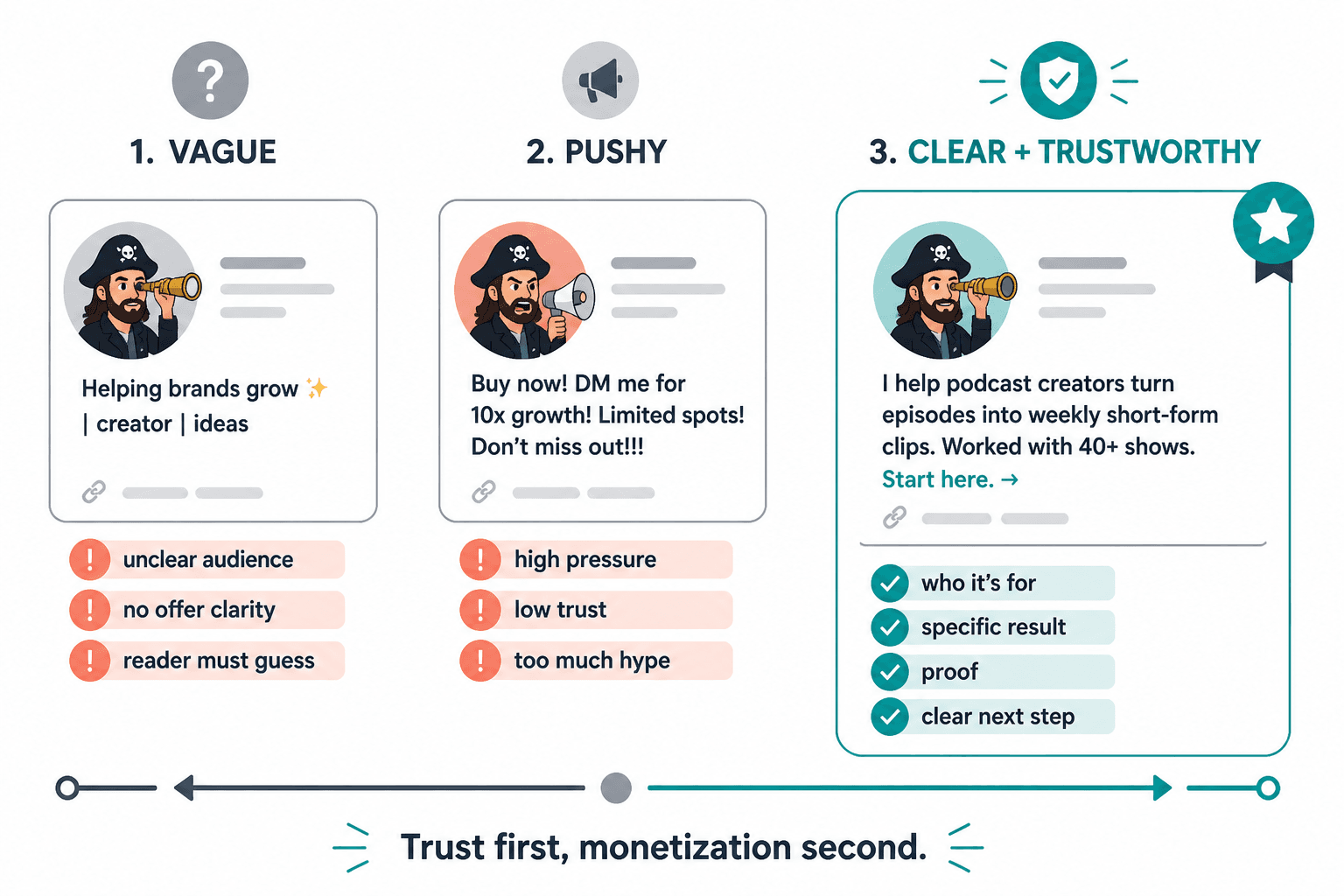
The better model: trust first, monetization second, both on purpose
The strongest bios do not choose between trust and monetization. They sequence them properly.
That means your profile copy should move in this order:
- Clarify who you help
- State the result or problem you work on
- Add proof, specificity, or credibility
- Offer a next step that matches the reader’s level of intent
Notice what is missing: hype. Bios convert better when they feel grounded. A clear sentence with actual relevance beats a grand statement trying to sound important.
Here is the simple truth a lot of people skip: your bio does not need to close the sale. It needs to make the next click feel sensible.
Your bio is not the whole funnel. It is the handoff.
What to include in a monetized creator bio
If you want your profile copy to support revenue without turning into a mini infomercial, include these building blocks.
A clear audience
Say who you help. Not everyone. Not “founders, creators, brands, visionaries, and leaders” unless you genuinely serve all of them with the same offer. Broad bios tend to attract weak-fit traffic and low trust.
Better:
- I help coaches turn scattered content into clear lead-generating posts
- Writing systems for consultants who want better authority content without posting every five minutes
- Helping solo founders sharpen their positioning, profile copy, and sales content
A practical outcome
What do people get? More clarity? Better leads? Sharper content? Easier conversion? Be concrete.
People trust what they can picture.
One piece of proof
This does not have to be a giant credential parade. One useful signal is often enough.
- Worked with 120+ service businesses
- Writer behind 10M+ views across founder content
- Former agency strategist
- Helped clients turn profiles into inbound lead channels
- Trusted by coaches, consultants, and B2B creators
Specific proof calms the reader down. It says, “This person probably knows what they are doing,” without screaming it from a rooftop.
A next step with appropriate friction
The CTA should match how ready the visitor is likely to be.
| Reader intent | Better CTA |
|---|---|
| Cold visitor | Read the guide, grab the free resource, see how I work |
| Interested follower | Join the newsletter, browse the case studies, watch the training |
| Warmer prospect | Apply to work together, book a call, message me about your project |
The mistake is not having a CTA. The mistake is using the same CTA for everyone.
How to Monetize Creator Bios & Profile Copy Without Wrecking Trust: the practical formula
Here is a practical structure you can use across LinkedIn, X, Instagram, Facebook, your site profile, or your creator landing page.
The 4-part bio formula
- Positioning: who you help
- Outcome: what you help them do
- Proof: why they should trust you
- Path: what they should do next
Template:
I help [specific audience] do [specific result] without [common frustration].
[Proof / credibility / approach].
[Clear next step].
Example for a content strategist:
I help consultants turn messy expertise into clear content that attracts better-fit leads.
Content strategist for service businesses. Trusted by founders, coaches, and lean teams that need sharper positioning.
Read the guide below or message me if you want help fixing your profile and content funnel.
Example for a writing coach:
I help experts write online like humans, not auto-generated beige wallpaper.
Writing coach for creators, consultants, and personal brands. Known for sharp messaging, stronger hooks, and cleaner profile copy.
Start with the free bio guide, then see the paid audit options.
That last line matters. “Start with the free guide” softens the ask while still supporting monetization. It gives people a low-risk way in.
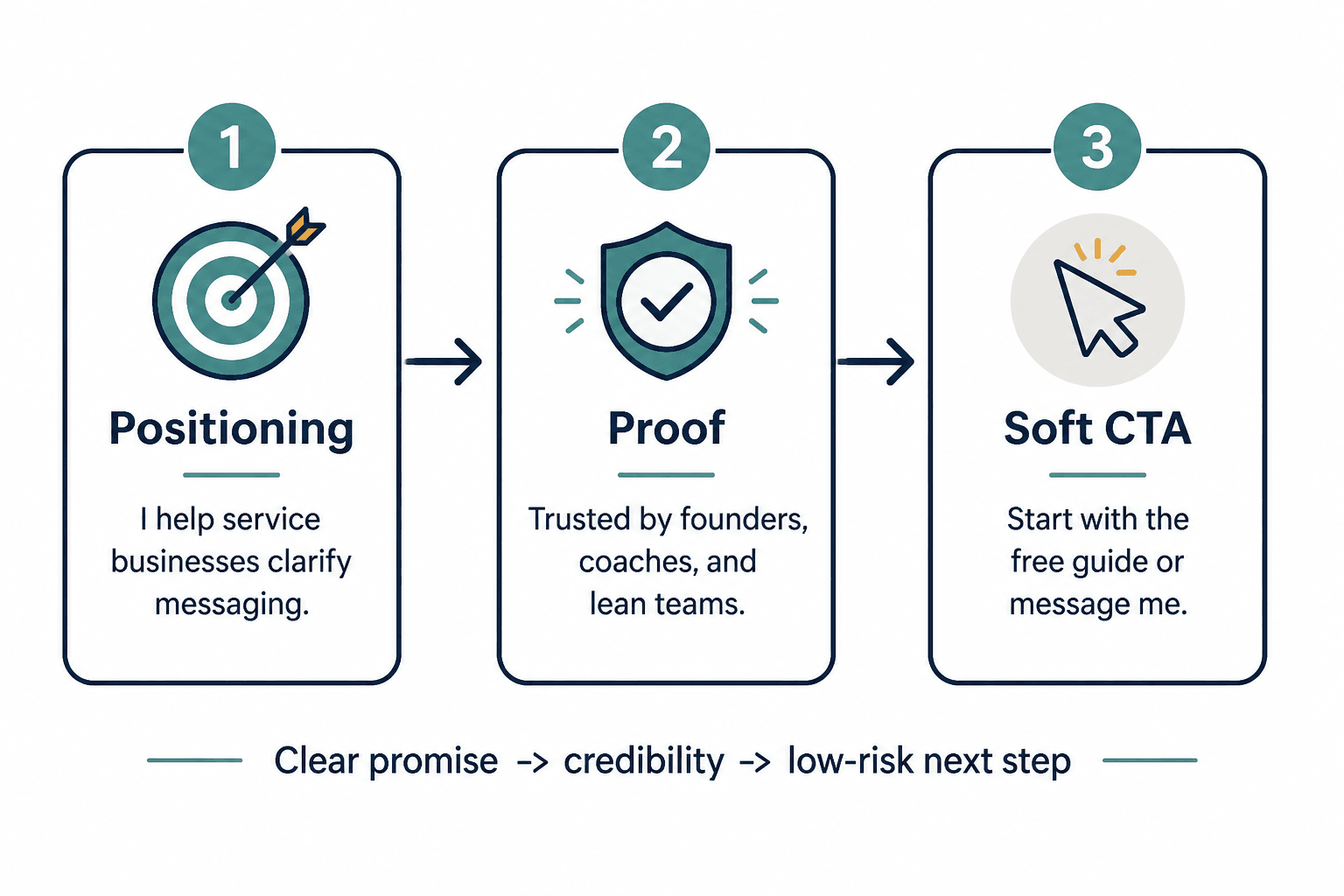
The best monetization paths for creator bios
You do not need your bio to sell one thing only. But you do need it to point toward a sensible path. Some paths work better than others depending on your audience, offer, and trust level.
1. Bio to lead magnet
This is one of the safest and strongest options for service-based creators. Your bio promises relevance, then points to a useful free resource.
Good for:
- Coaches
- Consultants
- Writers
- Freelancers
- Founders building email lists
Why it works: the bio earns trust by being clear, and the resource extends that trust with actual value.
Example CTA:
- Get the free profile rewrite guide
- Steal the 10-part content framework here
- Grab the checklist I use for client bios
2. Bio to newsletter
If your sales cycle is longer or your offers require trust, a newsletter is often a better move than sending cold traffic straight to a booking page.
This works especially well if your content teaches, diagnoses, or reframes problems your offer solves later.
3. Bio to service page or booking page
This can work very well when your audience is already problem-aware and your profile is strong enough to pre-qualify them.
But do not force it if the trust is not there. Sending cold people to “Book a strategy intensive” from a vague bio is basically asking them to buy dinner before you have introduced yourself.
4. Bio to case studies or proof page
If you sell higher-ticket work, this path can be excellent. Instead of pushing a hard CTA, point readers toward proof.
Example:
- See how clients use this approach
- Read the profile rewrites and results
- Examples and case studies below
Proof before pitch tends to age better than pitch before trust.
For broader strategy, this article on how to turn creator bios and profile copy into more leads or sales pairs nicely with what you are building here.
Before-and-after bio rewrites
Sometimes the fastest way to see the issue is to look at what people actually write.
Example 1: the vague expert
Before:
I help ambitious entrepreneurs unlock their next level through transformative content and authentic brand growth.
What is wrong with it:
It sounds polished, but says almost nothing. “Ambitious entrepreneurs” is too broad. “Next level” means nothing. “Transformative content” is fog wearing expensive glasses.
After:
I help coaches and consultants turn their expertise into clear content that earns trust and leads.
Messaging, profile copy, and content strategy for service businesses that want authority without sounding stiff.
Start with the free bio guide below.
Example 2: the aggressive closer
Before:
7 figures generated. 100+ clients served. DM me “GROWTH” to scale fast. Limited spots.
What is wrong with it:
It leads with pressure, not relevance. It sounds like a stranger trying to sell pre-workout in a parking lot.
After:
I help solo founders and consultants tighten their content and profile positioning so the right clients actually take action.
Worked with 100+ brands across content strategy and conversion messaging.
Want the breakdown? Read the guide or message me about an audit.
Example 3: the overstuffed bio
Before:
Writer | Coach | Founder | Speaker | Consultant | Podcast guest | Community builder | Personal brand mentor helping humans show up powerfully online
What is wrong with it:
Too many identities, no buyer clarity, no outcome, no next step. It reads like a tote bag covered in stickers.
After:
I help creators and experts sharpen their writing, positioning, and profile copy so their content pulls more weight.
Practical strategy, clean messaging, and less robot voice.
See examples and services below.
How to choose the right CTA without sounding like a sales funnel in a trench coat
Your CTA is where trust often gets wrecked, because people mistake “clear” for “hard sell.” You can be direct without sounding like you are trying to close someone in an airport lounge.
A strong bio CTA usually does one of three things:
- Invites a low-friction next step
- Offers a useful resource
- Signals how to work with you without pressure
Better CTA lines:
- Read the guide if you want a stronger profile
- See how I help clients fix this
- Start with the free checklist, then explore the audit options
- Want help with yours? Message me “bio”
- Browse examples, services, and next steps below
Weaker CTA lines:
The bigger point is simple: clearer structure and clearer writing make the piece more useful. That is usually what makes the ending land better too.