
Most creator launch emails are not bad because the writer lacks talent. They are bad because the sequence has no job beyond “mention the offer a few times and hope people suddenly care.”
That is how you end up with launches that feel rushed, repetitive, and weirdly desperate by day three. One email says the thing exists. Another says doors are open. Another says time is running out. Meanwhile, the reader is still sitting there thinking, “Fine, but why this, why now, and why should I trust this from you?”
If you want creator launch sequence examples creators can adapt fast, the goal is not to copy some bro-marketing countdown script and swap in your product name. The goal is to build a short sequence that creates clarity, trust, desire, and a clean next step without sounding like your inbox got possessed by a funnel template from 2019.
Here’s how to do that. You’ll get practical launch sequence structures, example emails, what each email is supposed to do, and how to adjust the sequence if you have a small audience, a service offer, or a digital product. If you need broader help with sequencing strategy first, start with this guide to better creator email sequences or the main creator email sequences hub.
If you want the bigger picture, start with the parent guide.
Why most launch sequences feel flimsy
A launch sequence is not just a pile of sales emails sent close together.
It is a guided argument. Each email should answer one part of the buyer’s decision:
- What is this?
- Who is it for?
- Why does it matter now?
- Why should I trust this?
- What happens if I wait?
- What should I do next?
When creators skip that structure, they usually do one of two things:
- They pitch too early, before the reader has enough context.
- They over-explain the offer and forget to create momentum.
Neither works especially well. One feels pushy. The other feels like reading a brochure somebody made in a panic.
A good launch sequence moves. It builds from relevance to proof to urgency. Not fake urgency. Actual urgency rooted in a deadline, a cohort start, a bonus expiring, limited bandwidth, or the simple fact that decisions do not make themselves.
The simple anatomy of a creator launch sequence
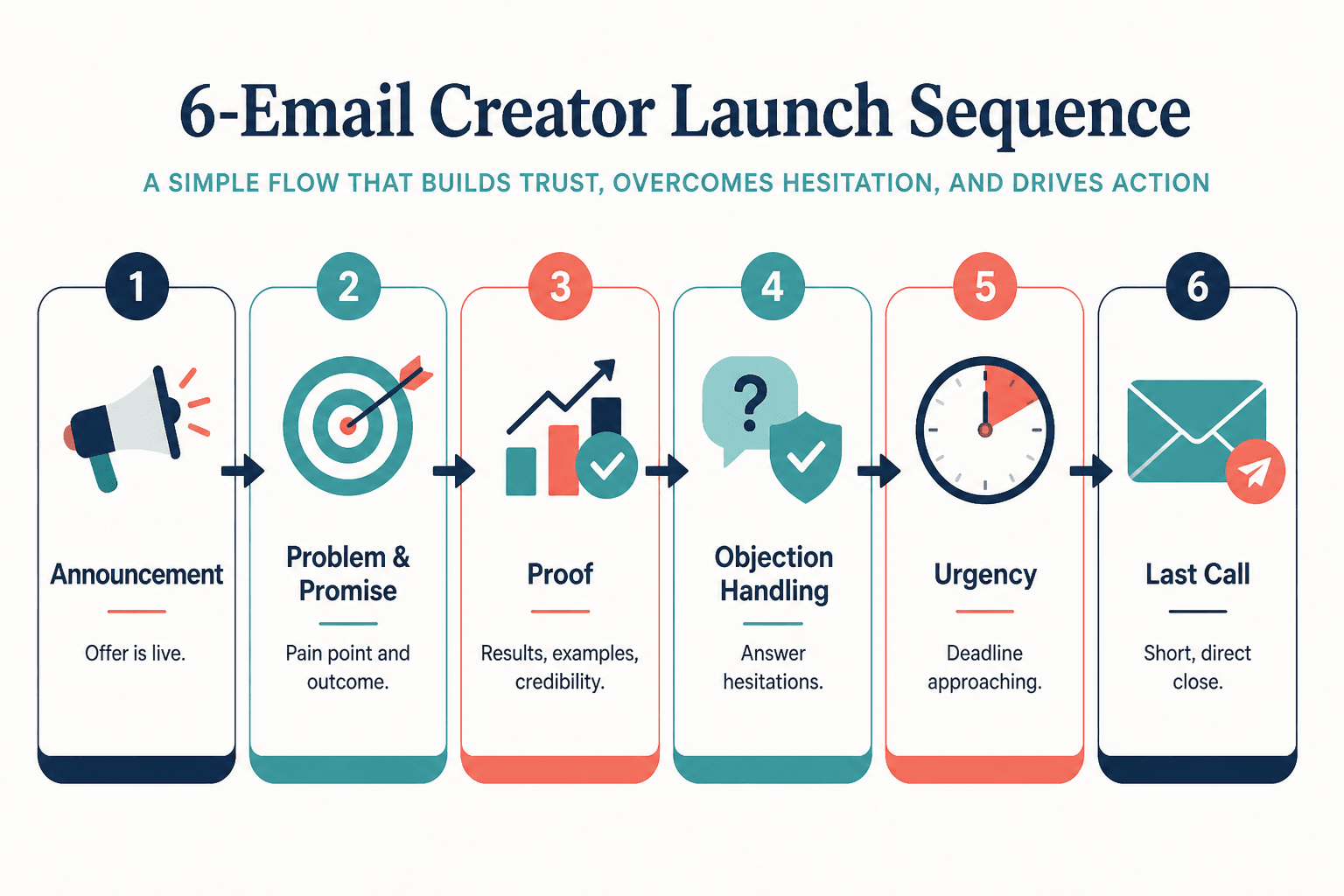
Before the examples, here is the basic structure most creators need. Not every launch needs all of these emails, but most good ones use these jobs in some form.
- Announcement: the offer is live and the right people should pay attention.
- Problem and promise: show the reader the pain point and how your offer helps.
- Proof: build trust with results, examples, process, or credibility.
- Objection handling: answer the hesitations that stop action.
- Urgency: remind people the window is closing and why it matters.
- Last call: short, clear, direct close.
That is the backbone. If you want more sequence ideas beyond launch campaigns, this roundup of best creator email sequences and examples is useful too.
Creator launch sequence examples creators can adapt fast
Let’s get into the practical part. These are not meant to be pasted blindly. They are meant to give you structure fast, so you can customize the angle, examples, and language to fit your audience and offer.
Example 1: 5-email digital product launch sequence
Best for:
- Templates
- Mini-courses
- Workbooks
- Guides
- Low to mid-ticket products
This works well when the offer is easy to understand and does not need a novel’s worth of explanation.
Email 1: Launch announcement
Goal: Tell the right people what is available, who it is for, and why it matters.
Subject: It’s live: the content planning system I wish I had sooner
Body:
I just opened access to [offer name].
It’s for creators who are tired of posting inconsistently, overthinking every idea, and rebuilding their content process from scratch every week.
[Offer name] gives you a simpler way to plan, draft, and ship content without turning your calendar into a full-time personality disorder.
Inside, you’ll get:
– [specific asset]
– [specific asset]
– [specific asset]
If your current system is “stare at cursor, feel bad, post late,” this will help.
See the details here.
Notice what this does not do. It does not spend four paragraphs thanking the audience, sharing a vague origin story, or announcing excitement like a corporate intern with a ring light. It gets to the point.
Email 2: Problem agitation and solution framing
Goal: Make the problem feel real, then show how the offer solves it.
Subject: The real reason your content keeps stalling
Body:
Most creators think they need more discipline.
Usually, they need less friction.
If your content process depends on motivation, perfect timing, and sudden sparks of genius, it will keep breaking. Not because you are lazy. Because the system is weak.
[Offer name] was built to fix that exact problem. It helps you:
– turn rough ideas into usable post angles
– stop reinventing your workflow every week
– create faster without sounding generic
That is the difference between “I should post more” and “I actually shipped five strong pieces this week.”
If that gap sounds familiar, you can check it out here: [link]
Email 3: Proof and specifics
Goal: Give the reader evidence. This can be testimonials, case studies, screenshots, a walkthrough, or your process.
Subject: What’s actually inside + who it helps most
Body:
A quick look at what’s inside [offer name]:
– Module/template/resource 1: [what it does]
– Module/template/resource 2: [what it does]
– Module/template/resource 3: [what it does]
This is especially useful if you are:
– a coach trying to post more consistently
– a consultant turning expertise into content
– a creator who has ideas but no repeatable system
One early buyer said: “[brief testimonial].”
Another used it to [specific result].
You do not need 400 testimonials here. You need believable proof, not a wall of suspicious praise that reads like your cousin wrote it at gunpoint.
Email 4: Objection handling
Goal: Remove the final bits of friction.
Subject: “Looks useful, but…”
Body:
A few common hesitations I’ve heard already:
“I already have a content system.”
Good. This is not meant to replace what works. It is meant to make it sharper and easier to use.
“I’m not posting daily.”
You do not need to. This works fine if you publish a few solid pieces a week.
“I’m worried it will feel too basic.”
It is practical, not fluffy. The point is usable systems, not motivational wallpaper.
If you were interested but stuck in maybe-land, this should help you decide.
See if it fits your kind of business.
Email 5: Final day close
Goal: Give a clear deadline and a clear action.
Subject: Closes tonight
Body:
Quick one.
[Offer name] closes tonight at [time].
If you want a simpler way to [main transformation], this is your window.
After tonight:
– the price changes / bonus disappears / access closes / cohort starts
If you have been meaning to join, do not leave yourself another “I’ll come back later” tab graveyard.
Here’s the link: [link]
Example 2: 6-email service or coaching launch sequence
Best for:
- Coaching offers
- Consulting packages
- Done-with-you services
- Small group programs
Higher-trust offers usually need a bit more context because the buyer is not just buying files. They are buying your thinking, process, and ability to help them get a result.
Email 1: Open the offer
Keep this one clear and calm. Service launches do not need circus energy. They need fit.
Subject: I’m opening 5 spots for [offer]
Body:
I’m opening [number] spots for [offer].
This is for [specific audience] who want help with [specific outcome].
Over [timeline], we’ll work on:
– [result area]
– [result area]
– [result area]
This is a good fit if you already have [baseline condition], but need help with [core friction].
Details and application here: [link]
Email 2: Name the expensive mistake
This is often stronger than listing features. Show the reader what is costing them time, leads, sales, or momentum now.
Subject: The content mistake that keeps good offers hidden
Body:
A lot of smart creators do not have an offer problem.
They have a communication problem.
Their positioning is fuzzy. Their content sounds competent but forgettable. Their audience kind of gets it, but not enough to act.
That is expensive.
Inside [offer], we fix that by tightening the message, sharpening the content angles, and turning your expertise into assets people can actually follow and buy from.
Email 3: Case study or walkthrough
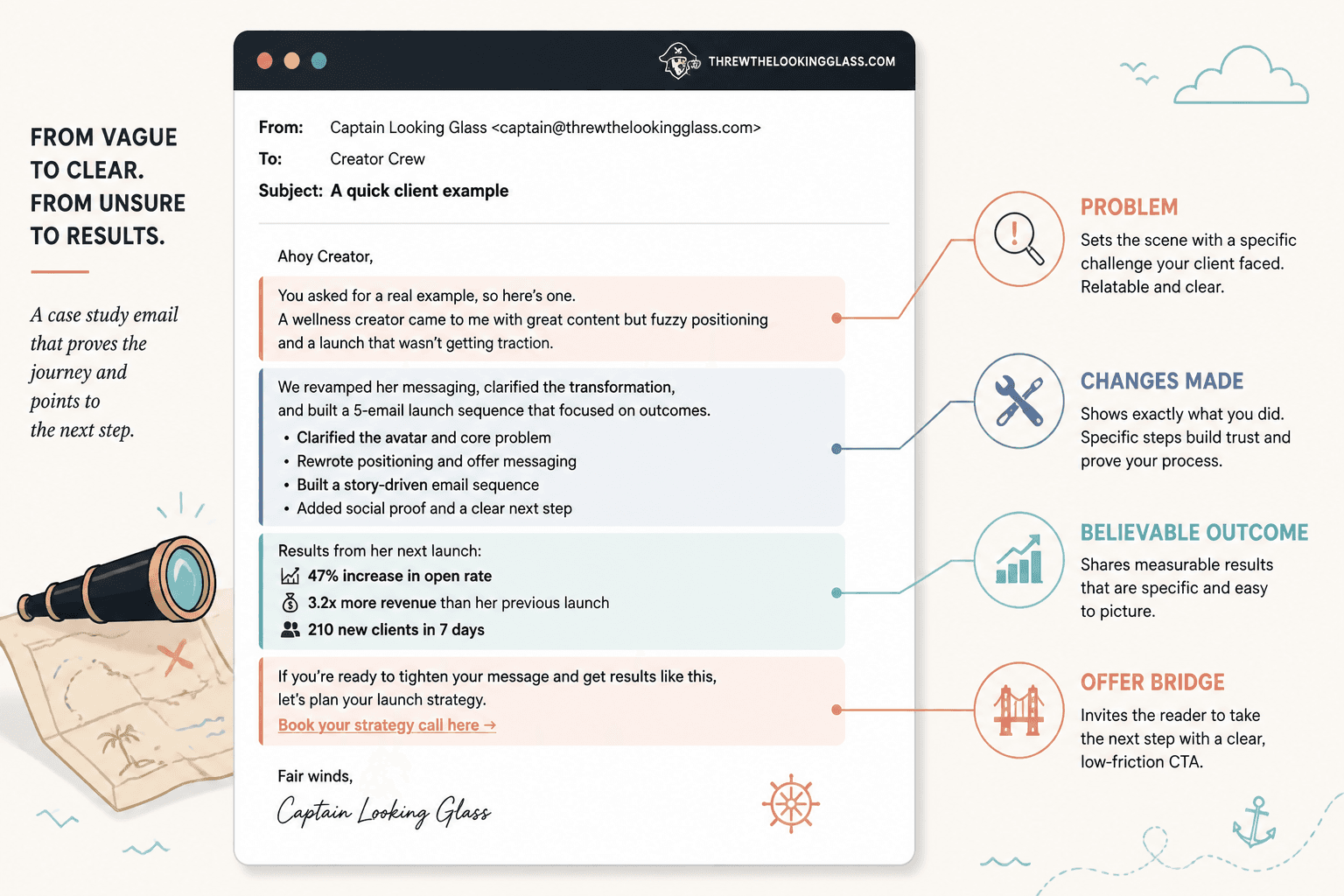
One real example often beats ten abstract claims. Show what changed, how, and why.
Subject: A quick client example
Body:
One client came in with strong expertise and weak packaging.
Her content was useful, but too broad. Her profile was vague. Her email CTA was timid. People read her work and moved on politely.
We tightened her positioning, rebuilt her content angles, and created a simpler lead path.
The result was not magic. It was clarity.
That clarity led to [specific believable outcome].
That is the kind of work we do inside [offer].
Email 4: Behind-the-scenes process email
For higher-ticket offers, people often want to know how you work, not just what you promise.
Subject: What working together actually looks like
Body:
If you are considering [offer], here is what the process actually looks like:
Step 1: We audit your current positioning, content, and conversion path.
Step 2: We identify the message gaps and friction points.
Step 3: We build a sharper content and offer system around what already works.
Step 4: We refine it in real time based on response and action.
No fluff. No endless brainstorm calls disguised as strategy. Just focused work that helps your message do its job.
Email 5: Objections and fit
This is where you answer questions like price, timing, readiness, and who should not buy.
Subject: Who this is for, and who should skip it
Body:
[Offer] is a strong fit if you already have something real to sell and want sharper messaging, content, and conversion.
It is probably not the right fit if you want instant results without changing anything, or if your offer is still pure fog.
That is not me being harsh. It is me trying to keep your money away from bad-fit decisions.
The bigger point is simple: clearer structure and clearer writing make the piece more useful. That is usually what makes the ending land better too.