
Most creator email sequences are not failing because email is dead. They are failing because the sequence sounds like a stiff funnel template wearing your brand colors.
You can usually spot the problem fast: vague welcome emails, awkward trust-building fluff, sudden sales pivots, and “just checking in” messages nobody asked for. The result is predictable. People join, skim one or two emails, and mentally file you under probably useful later. Later, of course, never arrives.
If you want better results, you need a sequence that actually matches how coaches, consultants, and personal brands build trust: with clarity, relevance, proof, and timing that does not feel like a hostage negotiation. This guide gives you practical creator email sequence examples for coaches, consultants, and personal brands, plus the structure behind them so you can adapt them without sounding like everybody else’s automation.
If you need the broader strategy first, start with email newsletter writing, then go deeper with creator email sequences and this more complete guide for creators who want better results.
If you want the bigger picture, start with the parent guide.
What a good creator email sequence actually needs to do
Before the examples, here is the part people skip: your sequence has a job. Usually more than one.
A strong sequence should help a new subscriber understand who you help, what you know, why your perspective matters, and what to do next. That next step might be reading more, replying, booking, buying, joining, or simply staying warm until the timing makes sense.
What it should not do is dump your life story into email one and then hard-pivot into “spots are filling fast” by email three. That move is older than most people’s abandoned lead magnets.
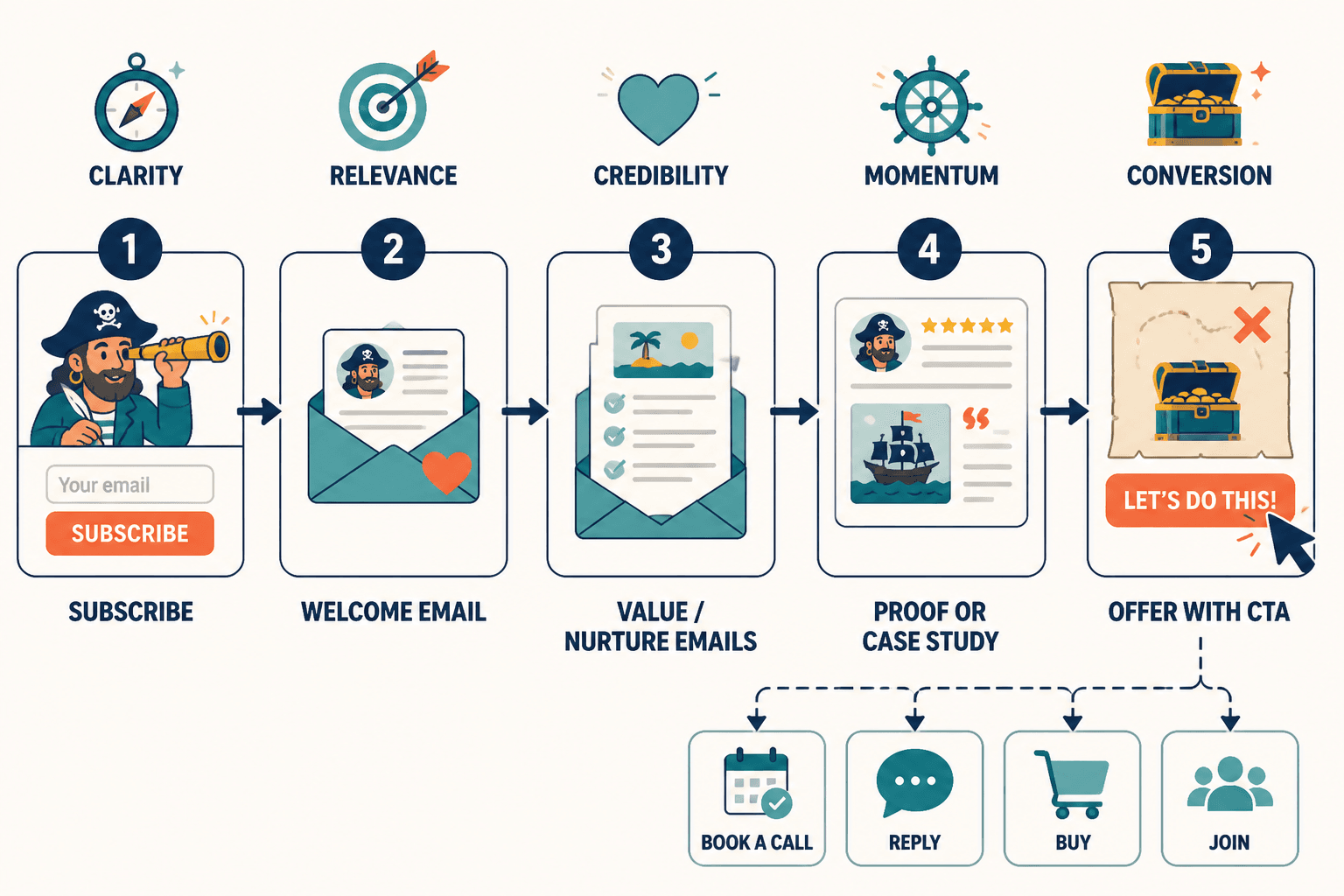
- Clarity: what you help with and who it is for
- Relevance: why this matters to the reader now
- Credibility: proof, insight, results, or a strong point of view
- Momentum: each email earns the next one
- Conversion: a next step that feels natural, not forced
That is the real game. Not “more emails.” Better sequencing.
The 5 sequence types most creators actually need
You do not need seventeen automations and a color-coded funnel mural. For most coaches, consultants, and personal brands, these are the sequence types that pull their weight.
- Welcome sequence: introduces your brand, ideas, and next step
- Nurture sequence: builds trust around a problem, method, or belief
- Offer sequence: sells a service, product, or program without sounding feral
- Re-engagement sequence: wakes up quiet subscribers or cleans the list
- Launch sequence: supports a time-sensitive promotion or opening
If you want more ideas beyond the examples here, this piece on creator email sequences ideas and examples is worth bookmarking. And if list engagement is already slipping, pair this with re-engagement flows for personal brands.
Example 1: Welcome sequence for a coach selling a high-ticket service
This is the sequence many people mess up first. They either make it too bland or too autobiographical. A welcome sequence is not your memoir. It is a trust-building runway.
Who this is for
A business, mindset, health, career, or leadership coach with a 1:1 offer, group program, or premium package.
Goal
Turn a new subscriber into an informed, interested lead who understands your approach and is open to a consult, application, or paid next step.
Simple 4-email structure
- Welcome and quick positioning
- Problem reframing
- Proof and method
- Soft conversion
Email-by-email example
Email 1: Welcome + what to expect
You joined because you want better client results without running your business like a chaos factory. Good. That is exactly what we talk about here.
Over the next few emails, I’ll show you the three patterns I see in coaches who are fully booked but still feel like their backend is held together by hope and browser tabs.
For now, start with this: being busy is not the same thing as being well-positioned.
Email 2: Reframe the problem
Most coaches think they have a lead problem. A lot of them have a clarity problem.
If your offer sounds broad, your content attracts the wrong people, and your sales calls keep turning into free consulting, more visibility will not save you. It just gives confusion a larger audience.
Here are three signs your positioning is doing the damage…
Email 3: Show your method with proof
I do not help clients “grow with confidence.” That phrase should probably be retired.
I help them tighten three things: message, offer, and sales path. When those line up, content gets easier and sales conversations get cleaner.
For example, one client stopped posting daily, narrowed her promise, rewrote her inquiry path, and closed more qualified leads in six weeks with less effort, not more.
Email 4: Soft CTA
If you are seeing your business in these emails, there are two good next steps.
If you are still diagnosing the issue, reply with “stuck” and tell me what feels messy.
If you already know you need help fixing your positioning and sales path, you can apply to work with me here.
The important thing here is the shape. It starts with clarity, builds tension, introduces a method, and only then invites action. No chest-beating. No dramatic fake intimacy. Just useful trust.
Example 2: Consultant nurture sequence that builds authority without boring people to death
Consultants often overestimate how much readers want polished expertise and underestimate how much they want clear judgment. A good nurture sequence does not just prove you know things. It proves you can think.
Who this is for
Consultants in marketing, operations, branding, product, growth, systems, sales, or strategy.
Goal
Move subscribers from mild awareness to “this person clearly understands the problem better than most people I have spoken to.”
5-email nurture sequence example
- Welcome + strongest opinion
- Common mistake clients make
- Mini case study
- Framework or diagnostic
- Invitation to deeper step
Email 1: Start with a useful opinion
Most companies do not have a content volume problem. They have a message precision problem.
Publishing more weak content does not create momentum. It creates a larger archive of things nobody remembers.
Email 2: Expose a familiar mistake
A lot of teams think their content is underperforming because the algorithm changed. Sometimes. But more often, the content has no sharp point, no audience fit, and no clear path from attention to action.
That is not an algorithm issue. That is strategy wearing a technical excuse.
Email 3: Mini case study
One consulting client came in asking for more traffic. Fair enough. But traffic was not the real bottleneck.
Their offers were hard to compare, the lead path was fuzzy, and the blog was attracting broad interest with no commercial shape. We simplified the offer stack, fixed the article CTAs, and aligned topics with buyer intent. Lead quality improved before traffic meaningfully changed.
Email 4: Give them a framework
When I audit a content system, I look at four things first:
1. Audience clarity
2. Message sharpness
3. Conversion path
4. Proof density
If one is weak, results sag. If three are weak, no publishing calendar is going to rescue you.
Email 5: Invite the next move
If you want to pressure-test your current content system, reply with your biggest bottleneck. If it is a fit, I’ll point you to the right next step, even if that next step is not hiring me.
That last line matters more than people realize. Consultants often get better responses when the CTA feels like informed help rather than a trap door into a sales process.
Example 3: Personal brand email sequence for creators selling digital products
Personal brands need a little more voice and personality, but the structure still matters. Charm without direction is just inbox wallpaper.
Who this is for
Writers, educators, creators, and niche experts selling templates, guides, mini-courses, memberships, or low-ticket products.
Goal
Build liking, reinforce expertise, and create a clean path toward a digital product sale.
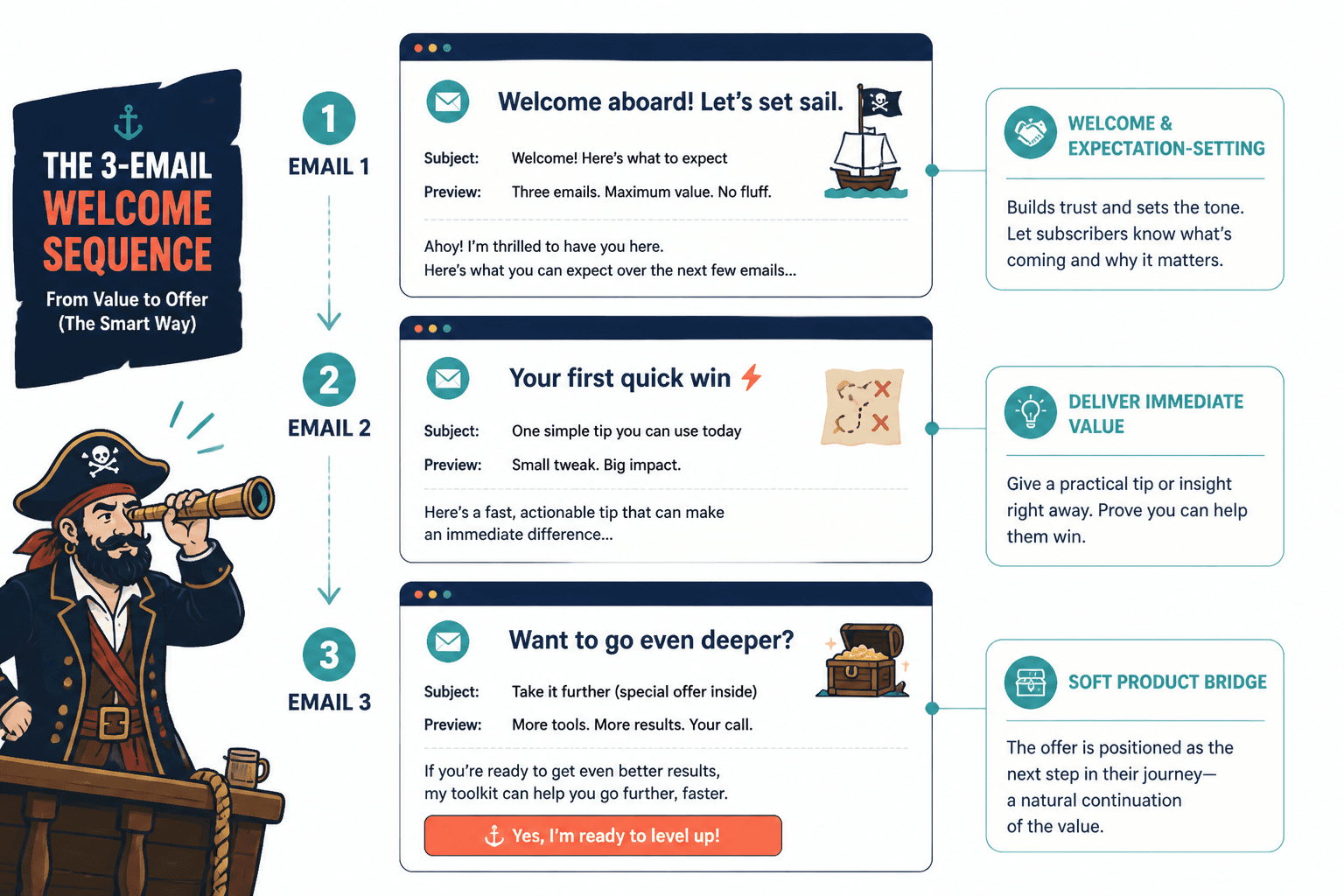
3-email sequence example
- Welcome + point of view
- Useful quick win
- Product bridge
Email 1: Welcome
You are here because you want content that sounds like a person, not a committee with a CRM.
I write about sharp positioning, useful content, and the kind of marketing that does not make you feel like you need a shower after publishing.
Email 2: Immediate value
Quick fix for today: if your content starts with three lines of setup before the point appears, cut them.
Most intros are throat-clearing. Your reader is not waiting with tea and patience. Put the live wire first.
Email 3: Product bridge
If that quick fix helped, my Content Hook Pack gives you 50 opening structures built for posts, newsletters, and sales emails that need to sound sharp without sounding synthetic.
It is practical, swipeable, and does not contain inspirational sludge. You can grab it here.
This kind of sequence works because the product appears as a continuation of value, not a random item shoved under the reader’s nose like a market stall sample.
Example 4: Discovery-call sequence for service providers
If your main goal is getting qualified calls, your sequence should pre-sell the call itself. Too many service providers treat the booking link like it is self-explanatory. It is not. People need a reason to take the meeting and a reason to believe it will be useful.
4-email booking sequence example
- Clarify the problem
- Show what is causing it
- Explain what happens on the call
- Handle hesitation + CTA
Email 1: You do not need more content ideas. You need a clearer content system that turns expertise into trust and trust into inquiries.
Email 2: The usual blockers are weak positioning, generic hooks, and no next step after attention. If your audience likes your posts but never moves, your content is probably educating without directing.
Email 3: If you book a strategy call, here is what happens: we look at your message, content path, offer fit, and friction points. You leave with a clearer diagnosis, not a vague “great conversation.” The bar should be higher than that.
Email 4: If you have been meaning to fix this but keep patching around it, book here. If now is not the time, stay subscribed. I would rather have an interested reader than a rushed lead.
That final line filters out poor-fit urgency and strengthens trust. Ironically, it often improves conversion because it removes the desperate energy.
Example 5: Re-engagement sequence that does not sound needy
When subscribers go quiet, creators tend to send one of two terrible emails: the guilt trip or the fake breakup note. Both are tired. A better re-engagement sequence is clear, respectful, and useful.
For a deeper version, read better creator email sequences re-engagement flows for personal brands.
3-email re-engagement example
- Acknowledge the gap and offer relevance
- Share strongest recent resource
- Give a clean stay-or-go choice
Email 1: It has been a while since you engaged with these emails, so here is the useful version instead of the dramatic version: if this topic is still relevant, I want to make sure what you get is worth opening.
Email 2: If you only read one thing from me this month, read this. It breaks down the three content mistakes that quietly kill trust before your offer even gets a chance.
Email 3: If you want to keep getting these emails, click here or reply with “keep me on.” If not, no problem. A smaller list that actually wants the work beats a bigger list of ghosts every time.
That is cleaner than pleading for attention and more effective than passive-aggressive list hygiene theater.
How to write your own sequence without copying someone else’s voice
The examples help, but templates go bad fast when they get copied too literally. Your best move is to build from a few fixed ingredients and then write them in your actual voice.
The simple build-your-sequence framework
- Pick one main goal. Book calls, sell a product, warm new leads, re-engage cold readers.
- Name the reader’s actual problem. Not your category. Their friction.
- Choose the proof. Results, examples, process, perspective, or a strong diagnostic.
- Map the bridge. What should each email make the reader ready for next?
- Write the CTA to fit the relationship. A cold subscriber should not get the same ask as a warm buyer.
And yes, tone matters. A lot. Coaches can usually be warmer. Consultants can usually be sharper. Personal brands can usually be more conversational. But all three still need specificity. “I help you become your best self” is not a positioning statement. It is vapor.
Common mistakes that make creator email sequences feel weak
The bigger point is simple: clearer structure and clearer writing make the piece more useful. That is usually what makes the ending land better too.
Email sequences work better when each message has one clear role and the progression feels natural. Better sequencing usually beats more aggressive copy.