Most creator email sequences do not fail because the writer is bad at email.
They fail because the sequence has no job.
It is just a pile of emails doing vague “nurture” things. One email tells a personal story. Another drops a tip. Then there is a soft pitch that feels oddly early, followed by silence, then a random newsletter three weeks later. That is not a sequence. That is inbox drift.
If you want better results from your email list, you need a sequence that moves people somewhere on purpose. More trust. More replies. More calls booked. More product sales. More qualified readers who actually remember who you are.
This Creator Email Sequences Guide for Creators will help you build that kind of sequence: one that has a clear goal, the right emails in the right order, and enough personality to sound like a person instead of a funnel template with a pulse.
If you are still patching together welcome emails from three different creators and one haunted swipe file, this should clean that up.
For the full path around this topic, head to the parent guide.
What a creator email sequence is actually supposed to do
A creator email sequence is a set of emails sent in a planned order to help a subscriber take a next step.
That next step might be:
- understanding what you do
- trusting your point of view
- replying to start a conversation
- consuming your best content
- buying a product
- booking a call
- sticking around long enough to become an actual fan, client, or buyer
The key point is simple: a sequence should reduce confusion and increase momentum.
That means every email does not need to do everything. In fact, when every email tries to teach, inspire, bond, sell, and perform personality all at once, the result is usually a bloated mess. One clear job per email works better.
If you want broader context on creator email systems, this sits nicely alongside the main email newsletter writing section and the broader creator email systems hub. For sequence-specific strategy, the core creator email sequences page is the logical parent.
Start with the goal, not the software
A lot of creators start by asking which email platform to use, how many emails to send, or what the perfect subject line formula is.
Wrong first question.
Start here instead: what result should this sequence produce?
Good sequence goals sound like this:
- Turn new subscribers into regular readers
- Warm up leads before a consultation offer
- Sell a low-ticket digital product
- Move people from freebie sign-up to paid membership
- Re-engage quiet subscribers
- Onboard new clients or customers
Weak sequence goals sound like this:
- Provide value
- Nurture my audience
- Build connection
- Stay top of mind
Those are not goals. Those are vibes.
Useful vibes, maybe. Still not goals.
Once you know the outcome, the sequence gets easier to build. You can decide what people need to believe, understand, and do before they get there.
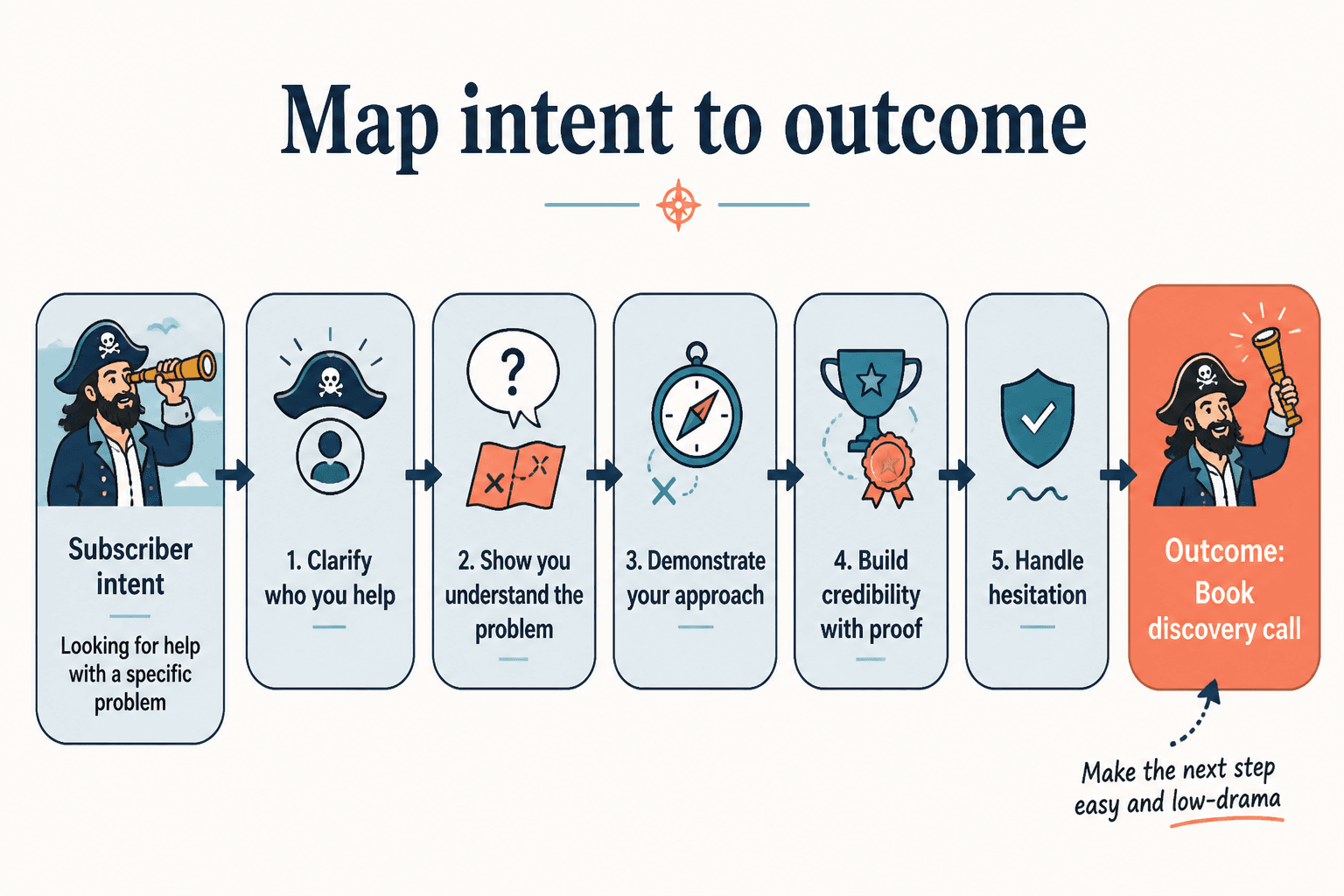
For example, if the goal is to book discovery calls for a consulting offer, your sequence probably needs to:
- clarify who you help
- show that you understand the reader’s problem
- demonstrate your approach
- build credibility with proof or examples
- handle common hesitation
- make the next step feel easy and low-drama
That is already much more useful than “send five welcome emails.”
The 5 creator email sequences most creators actually need
You do not need seventeen automated journeys because some newsletter guy on X likes drawing spaghetti diagrams.
Most creators can get very far with five sequence types.
1. Welcome sequence
This is the sequence most creators should build first.
Its job is to introduce your voice, set expectations, point people to your best stuff, and start building trust while the subscriber still remembers signing up.
A good welcome sequence can:
- increase opens on future emails
- get more replies
- move people toward your paid offer
- stop your list from feeling cold and random
2. Lead nurture sequence
This sequence helps warm up subscribers who may be interested in a service, offer, or higher-trust sale but are not ready yet.
Think of it as the bridge between attention and action.
3. Sales sequence
This one exists to sell something specific within a defined window.
It can be direct without turning into a used-car-email situation. The point is not to become weirdly aggressive. The point is to make a good offer clearly and repeatedly enough that interested people can act.
4. Re-engagement sequence
Some subscribers go quiet. That is normal. A re-engagement sequence tries to wake up the right people and let the wrong people drift off without pretending every email address is sacred.
5. Onboarding or post-purchase sequence
This is underrated. If someone buys, books, or joins, the next emails shape their experience, retention, and likelihood of recommending you. Many creators obsess over getting customers and then greet them with administrative soup.
Not ideal.
A simple structure for a welcome sequence that works
If you are building from scratch, start here. A lean 5-email welcome sequence is enough for most creators.
Email 1: Deliver the thing and set the tone
If someone signed up for a guide, template, checklist, or workshop replay, give it to them immediately. Do not make them tunnel through your life story first.
This email should do three things:
- deliver the promised resource
- briefly explain what you help with
- set expectation for what kind of emails they will get next
Simple example:
Here is the guide you asked for.
Over the next few days, I’ll send a few short emails on how creators can write emails people actually open, read, and act on.
If you are here to get better results from a small list without sounding like a funnel goblin, you are in the right place.
Email 2: Clarify the problem
This email should help the reader feel understood. Name the problem they are dealing with, but do it in a way that sounds observant, not melodramatic.
You are not trying to perform empathy like a wellness bot. You are showing that you know the pattern.
For example, if you help creators with email marketing, you might call out that most people do not need a bigger list first. They need stronger emails, better sequencing, and a clearer offer path.
Email 3: Teach one useful thing
This is where a lot of creators start dumping three frameworks, six tips, and a manifesto.
Do less.
Teach one sharp idea that creates an immediate win. That might be:
- a better email opener
- a cleaner CTA
- a quick fix for weak subject lines
- a way to structure story emails without rambling
Useful email sequences earn trust by being applicable, not by being long.
Email 4: Show proof or process
Now show that your approach works in real life. This could be a case study, a before-and-after rewrite, a client pattern, a mini teardown, or your simple method.
Proof matters because readers are tired. They have seen too many creators make broad claims with the confidence of a man selling sea moss from a rented Lamborghini.
Specifics help. Results help. Even a small, believable example helps.
Email 5: Invite the next step
Once trust and clarity are in place, make a simple invitation.
That next step might be:
- read another article
- join your newsletter properly
- reply with a question
- book a call
- check out a paid product
The CTA should match the warmth of the audience. New subscriber? Ask for a reply or a click. Warmer lead? Offer the consult or product.
How to write email sequences that do not sound like funnel wallpaper
Plenty of creators understand sequence structure and still produce flat emails. The problem is usually voice, specificity, and pacing.
Here is what improves that fast.
Write like you know who the email is for
“Creators” is already broad. “Business owners” is almost useless. If your email could be sent to coaches, consultants, YouTubers, authors, and SaaS teams without changing a line, it is probably too generic.
Tighten the reader in your head. For example:
- a consultant building authority with email
- a coach selling via newsletter
- a solo creator with a small but relevant list
- a service provider trying to get replies, not just opens
Specific audience assumptions make better emails.
Use one main point per email
If the email is about welcome sequences, do not bolt on list growth, AI tools, mindset issues, and “consistency” because you got nervous about not being comprehensive.
Comprehensive is often just another word for tiring.
Say specific things
Compare these two lines:
Your emails should provide value and build trust.
If your welcome emails only hand over the freebie and vanish, subscribers will forget you by Thursday.
The second one is stronger because it says something. You can picture it. You can react to it. It has a point of view.
Stop over-explaining the setup
Many emails waste the first four sentences warming up. Your reader is not settling into a Victorian novel.
Get to the point faster.
Weak opening:
I wanted to take a moment today to talk about something I think is really important when it comes to email marketing for creators.
Better opening:
Most creator welcome sequences lose people in the first email by trying to be warm, clever, and strategic all at once.
Let the CTA feel normal
You do not need to end every email with “If this resonated…” followed by a four-line emotional funnel whisper.
Plain CTAs often work better:
- Reply and tell me what you are selling this quarter.
- If you want help building this, book a call here.
- Read this next if your list is still small.
- I wrote a deeper guide on this here.
If you want help sharpening the writing itself, this companion guide on how to write better creator email sequences is a useful next read.
The sequence logic that gets better results
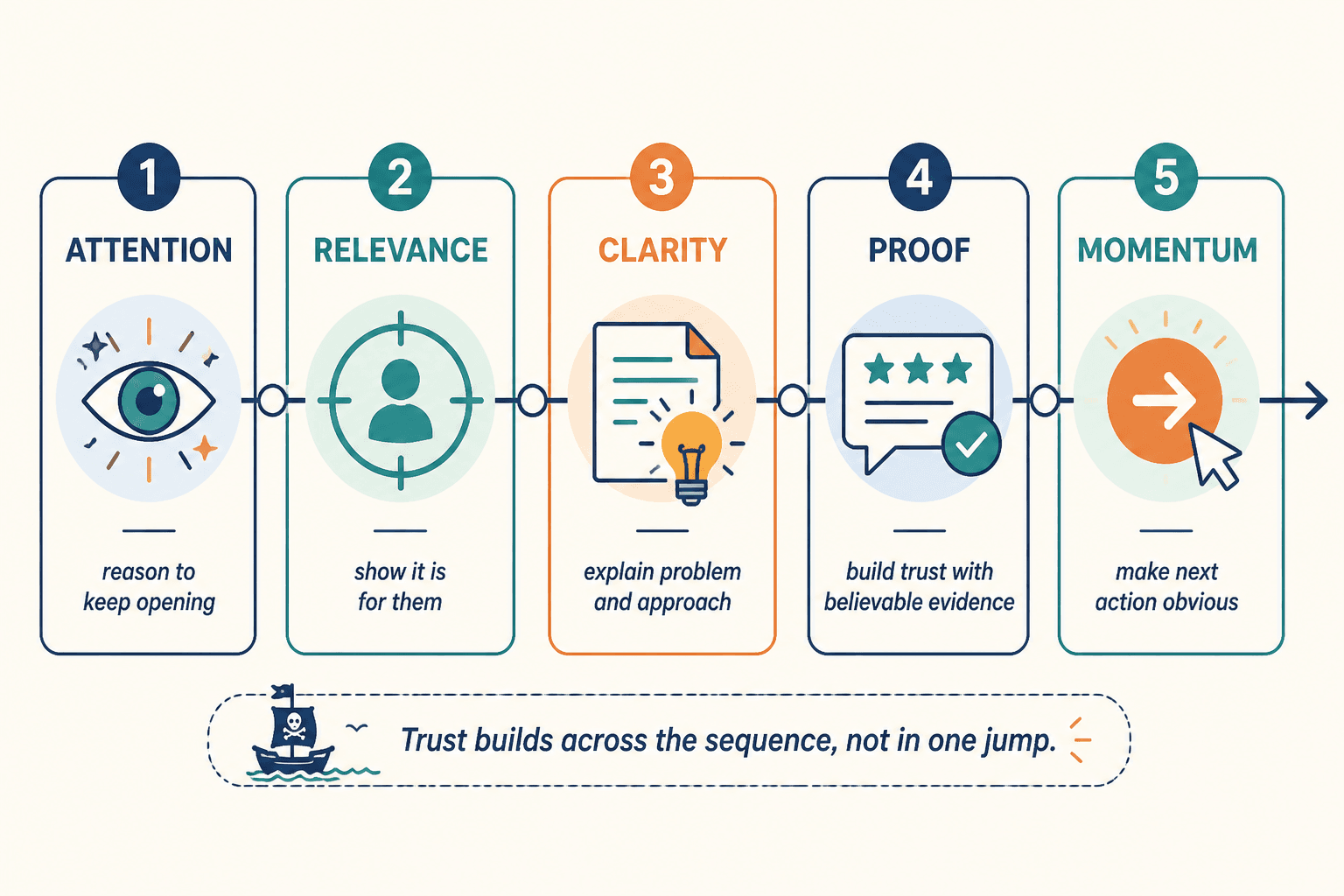
Here is the underlying logic behind strong creator email sequences:
- Attention: Give them a reason to keep opening
- Relevance: Show that the emails are for them
- Clarity: Explain the problem and your approach well
- Proof: Show why your advice or offer deserves trust
- Momentum: Make the next action obvious and low-friction
That order matters. Many creators try to jump straight from attention to sale. It can work if the offer is cheap, obvious, or the audience is already warm. But in most creator businesses, trust still has to do some lifting.
And trust is not built by sounding polished. It is built by being clear, useful, consistent, and believable over time.
How many emails should be in a creator sequence?
There is no magic number, which is annoying but true.
The right length depends on:
- how expensive the offer is
- how much trust the sale needs
- how aware the subscriber is of the problem
- whether the sequence is educational, sales-focused, or onboarding-focused
- how often you send regular emails outside the sequence
Still, practical guidelines help.
| Sequence type | Typical range | Main goal |
|---|---|---|
| Welcome | 3–7 emails | Introduce, build trust, guide next step |
| Lead nurture | 4–8 emails | Warm up interest and handle hesitation |
| Sales | 3–7 emails | Make the offer and convert interest |
| Re-engagement | 2–4 emails | Wake up quiet subscribers or clean the list |
| Onboarding | 3–6 emails | Improve customer experience and activation |
If you need more examples of what these can look like in practice, see best creator email sequences ideas and examples for creators.
Common mistakes creators keep making with email sequences
Writing a sequence with no offer path
Not every sequence has to sell. But if your business depends on revenue, the reader should eventually be able to see what working with you or buying from you looks like.
If your emails are all charm and no direction, people may like you and still never take action.
Pitching before the reader trusts you
This is the opposite problem. Some creators start selling in email two, before they have shown any insight, proof, or understanding. That works badly unless the subscriber came in hot and ready.
Confusing storytelling with progress
Stories can work beautifully in email. But a story is not automatically good because it happened to you. It has to earn its place.
If the anecdote does not clarify the problem, deepen trust, or support the offer, it may just be decorative autobiography.
No segmentation at all
Not every creator needs advanced automation. But if all subscribers get the same sequence regardless of what they signed up for, what they clicked, or what they want, relevance drops fast.
Simple segmentation is often enough:
- lead magnet topic
- service interest
- buyer vs non-buyer
- new subscriber vs long-time reader
Trying to sound “professional”
Professional is fine. Corporate oatmeal is not.
If your sequence sounds like it was approved by legal and emotionally edited by a webinar platform, people will stop caring. You can be clear, credible, and human at the same time.
What to send if you have a small audience
Creators with small lists often assume email sequences matter later, once the audience gets bigger.
Honestly, the opposite is often true.
When your list is smaller, every subscriber matters more. A decent sequence helps you get more value from the attention you already earned. It can also tell you what resonates before you scale.
If your audience is still small, focus on:
- clear positioning
- one strong welcome sequence
- reply-friendly emails
- simple offers or next steps
- learning from clicks and replies instead of obsessing over vanity metrics
This matters enough that we broke it out separately here: creator email sequences for creators with small audiences.
Tools can help, but they cannot rescue a boring sequence
Email tools are useful for automation, tagging, testing, drafting, templates, and sequence management. Great. Use them.
But no platform can fix these problems:
- unclear audience
- weak offer
- generic messaging
- bad sequencing logic
- emails with no actual point
Tools speed up execution. They do not provide taste, positioning, or trust.
So pick tools based on workflow, not fantasy. You want something that helps you draft, automate, organize, and track without turning your business into a dashboard hobby.
For that side of the process, this roundup on best templates and tools for creator email sequences should help.
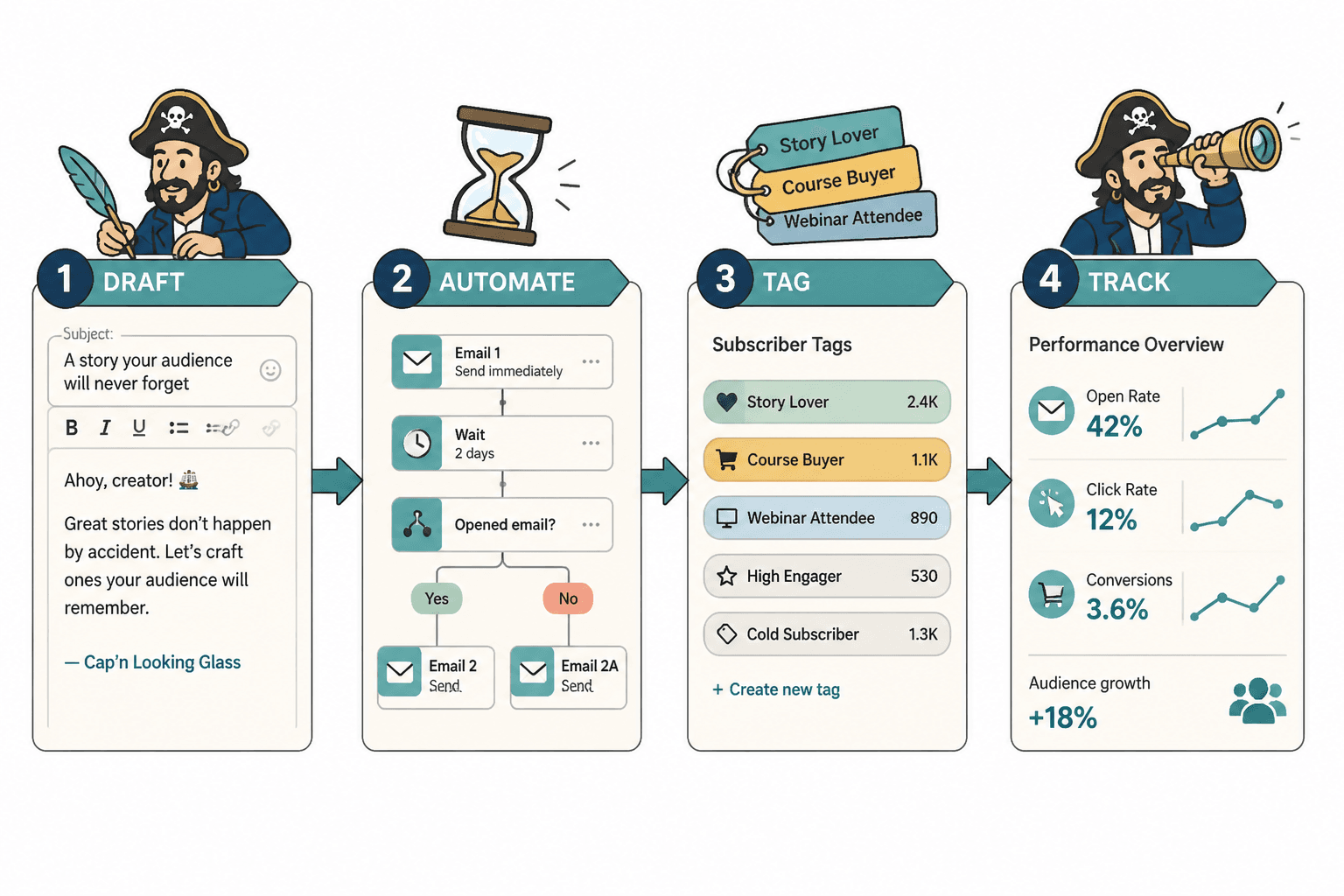
A practical sequence planning template
The bigger point is simple: clearer structure and clearer writing make the piece more useful. That is usually what makes the ending land better too.
Email sequences work better when each message has one clear role and the progression feels natural. Better sequencing usually beats more aggressive copy.