
A draft sits open in one tab, subject lines are scattered across a notes app, and the “welcome sequence” folder contains four versions of the same email with slightly different levels of optimism. The content is technically there. The structure is the part sulking in the corner.
That is where examples earn their keep. They turn “write a sequence” from a vague assignment into something you can shape, test, and actually publish. A good example shows what the emails are doing, how they move, and where the next step lives. Not glamorous, but extremely useful.
If you want the broader system behind these sequences, start with the creator email sequences guide. If you want to improve the writing itself, see how to write better creator email sequences. For tools that speed up drafting, there is also best AI tools for creator email sequences.
For creators, the point is not “send a few emails.” The point is to move someone from signup to trust to action without making every message sound like it was assembled by a motivational speaker with a CRM license.
What a creator email sequence actually needs to do
A useful sequence usually does four jobs:
- Orient the reader. Tell them why they are hearing from you and what happens next.
- Build trust. Give a quick win, a useful frame, or proof that you know the territory.
- Create momentum. Move from interest to action without awkward panic.
- Bridge to an offer. Make the next step feel like the natural next step, not a surprise invoice.
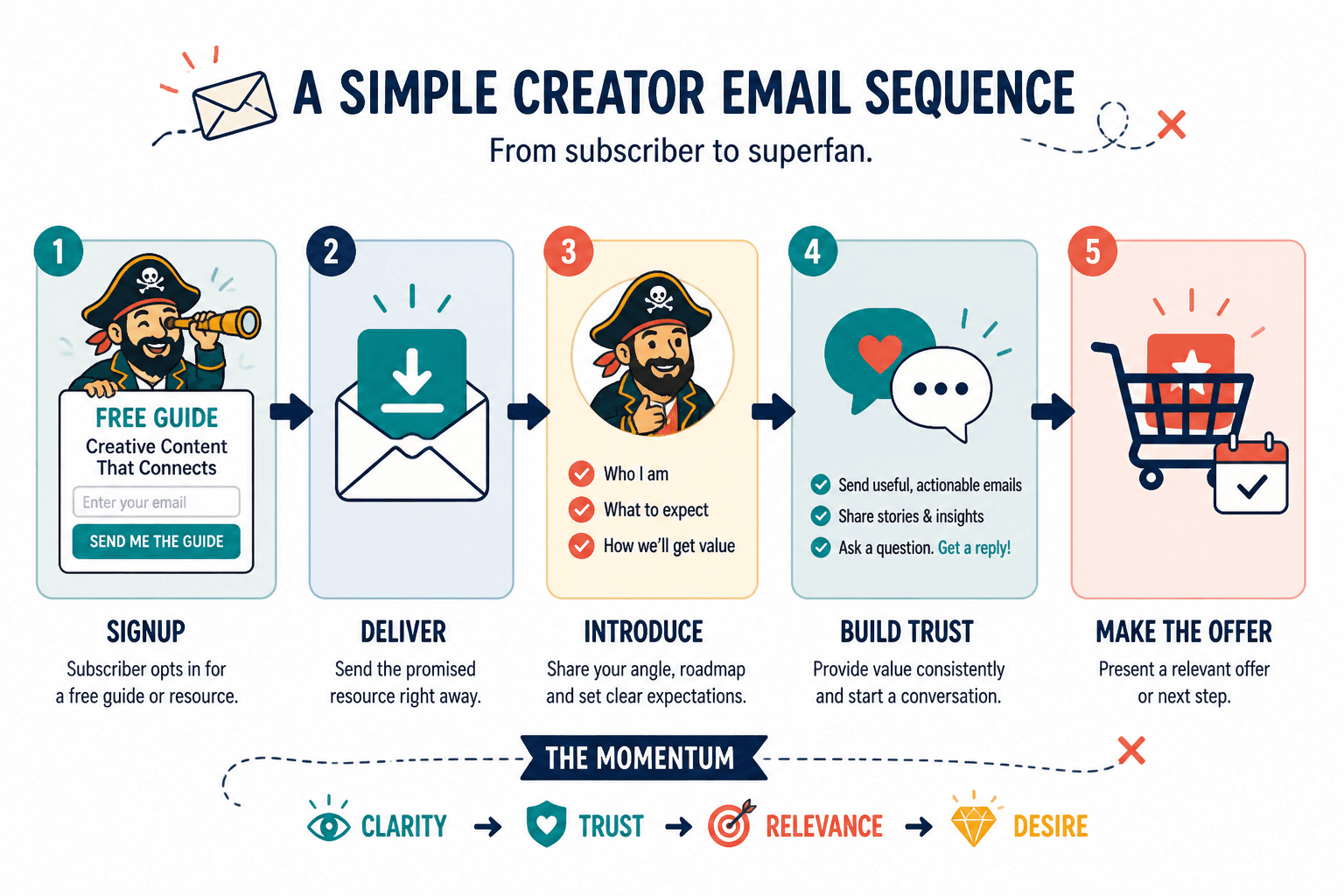
That simple flow matters because sequence types are not interchangeable. A welcome sequence should not read like a launch blast. A launch sequence should not behave like a long-form nurture essay. And a sales sequence should not hide the offer like it is embarrassed to be there.
The main creator email sequence types
These are the sequence types most creators actually use:
- Welcome sequence: Greets new subscribers, sets expectations, and gives a first win.
- Nurture sequence: Builds authority and familiarity over time.
- Launch sequence: Introduces a product, service, or offer and moves readers toward a decision.
- Sales sequence: Focuses on the offer, objections, proof, and close.
- Post-signup bridge: Connects a lead magnet or freebie to the next logical offer.
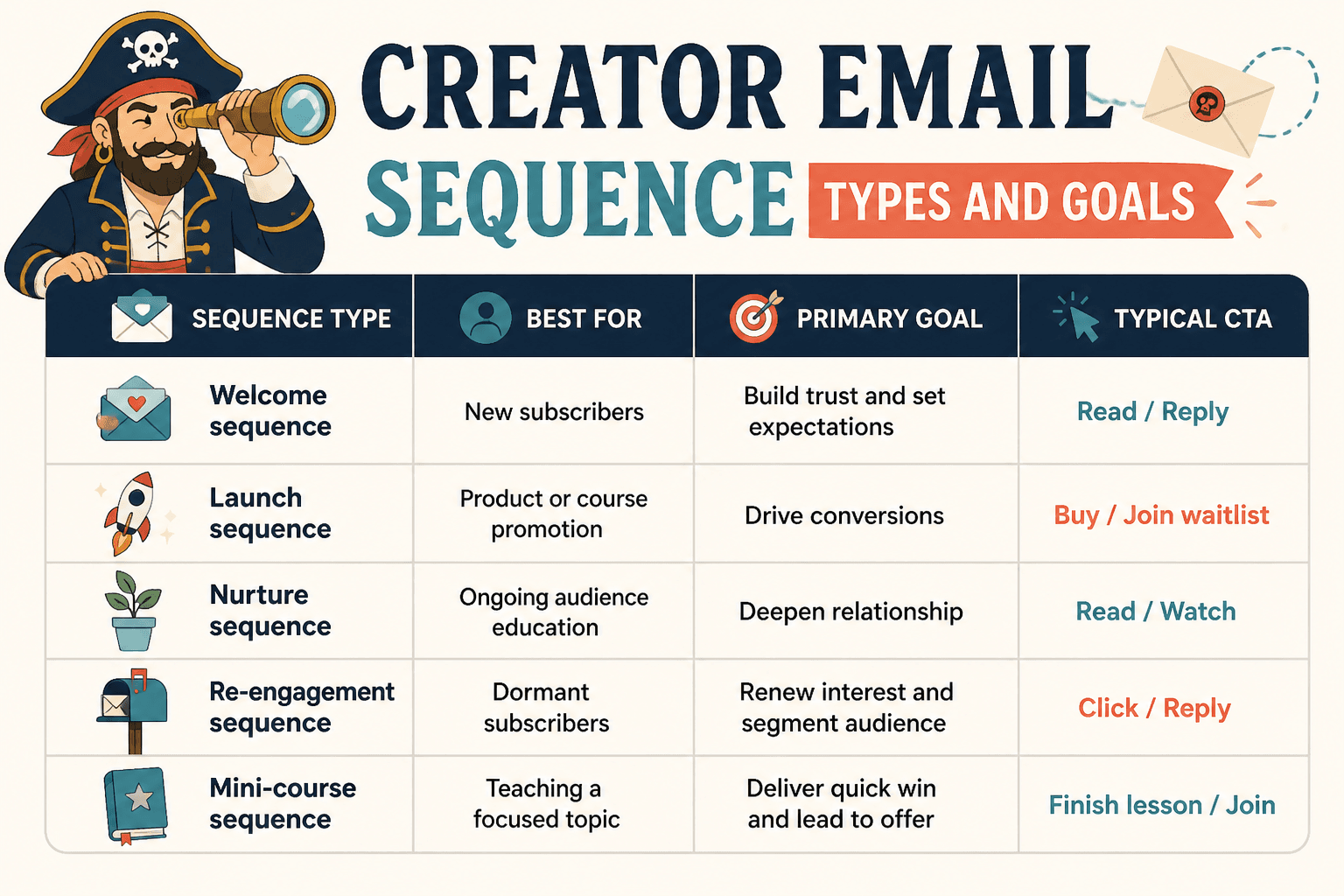
If you are sorting through which sequence to build first, the practical answer is usually: welcome first, then launch or sales arc if you have an offer, then nurture once the basics are working. The system gets less chaotic when each sequence has one job instead of trying to be the whole brand at once.
Example 1: Simple welcome sequence for new subscribers
Best for: creators who want to turn new signups into engaged readers, buyers, or future buyers.
Goal: make the subscriber feel oriented, valued, and clear on what to do next.
Typical length: 3 to 5 emails
Email 1: Welcome and expectation setting
Say hello. Confirm what they signed up for. Tell them what kind of emails to expect and how often. Keep it plain, human, and useful.
Email 2: Quick win or useful shortcut
Give them something they can use immediately. This can be a framework, a checklist, or a small fix related to the problem they came to solve.
Email 3: Your story or perspective
Explain what you care about and why your approach exists. Not a memoir. Just enough context to help the reader understand your point of view.
Email 4: Bridge to your best content or offer
Send them to your most useful post, your product page, or your main resource hub. The point is to show the next step before they drift off into the internet’s softer edges.
A simple welcome sequence works because it answers the silent subscriber question: “Why am I here, and should I keep reading?”
For a fuller structure breakdown, link this section to how to write better creator email sequences.
Example 2: Creator launch sequence for a new offer
Best for: digital products, memberships, services, mini-courses, and live launches.
Goal: move attention from “interesting” to “I should probably act now.”
Most launch emails are not bad because the creator lacks talent. They are bad because the sequence has no job beyond “mention the offer a few times and hope people suddenly care.” A better launch sequence has a clean arc.
The simple anatomy of a launch sequence
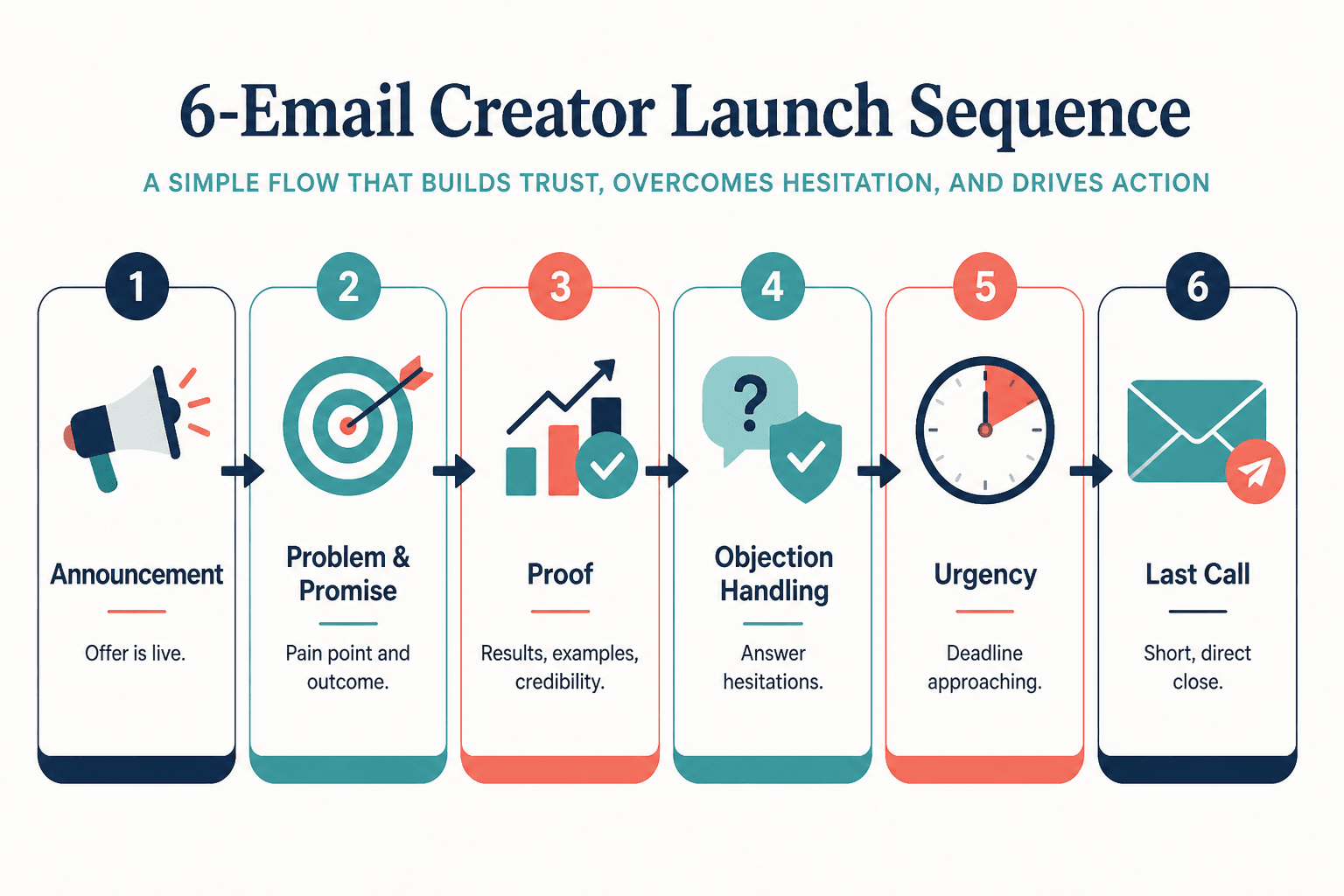
- Announcement: introduce the offer and who it is for
- Problem or opportunity: frame why the offer matters now
- Proof: show results, examples, or evidence
- Objection handling: answer the hesitations people actually have
- Close: give a clear deadline or decision point
Example launch sequence outline
- Email 1: Launch announcement – what the offer is, who it helps, and why you made it.
- Email 2: Problem agitation and solution framing – describe the pain point or opportunity in concrete terms.
- Email 3: Proof and specifics – show outcomes, examples, or what is inside.
- Email 4: Objection handling – time, cost, fit, confidence, or “I’ll do it later.”
- Email 5: Last call – brief reminder, deadline, and direct link.
For a more detailed version of this format, use the related guide on creator launch sequence examples creators can adapt fast.
Practical launch note
The best launch sequences do not over-explain the offer. They reduce uncertainty. People rarely need a 900-word manifesto about a course. They need enough clarity to decide whether it is for them, whether it solves the thing they care about, and whether waiting would be a bad idea.
Example 3: Simple sales email arc for busy creators
Best for: creators selling a service, course, template, membership, or product with a clear purchase path.
Goal: create a short, direct arc that leads to a sale without sounding like a tax notice in brand colors.
A sales arc is usually the leanest version of a creator sequence. It is not trying to teach everything. It is trying to get the reader from interest to decision.
The 5-part sales email arc
- Announcement – what the offer is and why it exists
- Problem or opportunity – why this matters right now
- Proof – screenshots, examples, testimonials, or outcomes
- Objection handling – answer the common hesitations
- Close – tell them what to do next
This arc works well because it respects the reader’s attention. It does not make them wander through eight emotional detours before getting to the part where the offer is actually offered.
If you want a tighter framework for this, the companion article simple sales email arc templates for busy creators is the natural next stop.
When to use this arc
- Launching a low-ticket product
- Promoting a service package
- Opening a membership window
- Driving signups for a limited-time offer
Example 4: Nurture sequence that builds authority without drifting
Best for: creators who need to stay visible between launches or offers.
Goal: keep subscribers engaged, reinforce your point of view, and create future buying confidence.
Nurture sequences go wrong when they become a pile of “thought leadership” with no point. Good nurture content is not random wisdom. It is a path.
Simple nurture structure
- Email 1: useful idea or quick insight
- Email 2: example or mini case study
- Email 3: common mistake and correction
- Email 4: deeper framework or behind-the-scenes explanation
- Email 5: soft bridge to an offer, resource, or relevant next step
The trick is not volume. It is progression. Each message should leave the reader a little more confident that you know what you are talking about and that your offer is not an accident.
How to adapt examples without sounding copy-pasted
Examples are useful because they give you structure. They become useless the moment you imitate their surface language too closely.
- Keep the job, change the angle. If the example is a proof email, your proof can be a screenshot, a short story, a breakdown, or a before/after.
- Write to one reader. The more generic the address, the less any line feels real.
- Use your actual vocabulary. Do not dress like a corporate case study if your brand is plainspoken.
- Trim every email to one main action. Multiple goals usually mean no clear goal.
A sequence should feel like you, but tighter. Not a clone, not a costume, not a machine wearing a clever shirt.
Common mistakes creators make with email sequence examples
- Using examples as scripts. Structure helps. Replacing judgment does not.
- Starting with the offer too early. Some readers need context before commitment.
- Adding too many emails. More emails are not always better. More clarity is better.
- Skipping the bridge. If the sequence has no obvious next step, it becomes content with a mailing schedule.
- Sounding like a template. Readers can smell generic automation from several scrolls away.
Quick way to choose the right sequence example
Use this short rule of thumb:
- If someone just joined your list, start with a welcome sequence.
- If you are introducing a new offer, use a launch sequence.
- If you want a fast path to conversion, use a sales arc.
- If you need to stay top of mind between promotions, build a nurture sequence.
If your sequence needs to turn attention into revenue, the next practical read is how to turn creator email sequences into more leads or sales. That is where the structure starts paying rent.
Wrap-up
The best creator email sequence examples are not fancy. They are legible. They show the reader where they are, why the sequence exists, and what happens next. That is enough to make a draft less wobbly and a launch less improvised.
Start with one sequence, give it one job, and use examples to keep the path clear. The rest is mostly editing, which is not a thrilling sentence, but it is often the true one.
For the broader system behind all of this, revisit the creator email sequences guide.