
If you have a small audience, weak CTAs cost more.
Not because the algorithm is punishing you. Not because you need some mystical funnel architecture. Mostly because when only a modest number of people are seeing your content, every ask has to pull its weight. A vague “let me know your thoughts” or a sudden “book a call” is not harmless. It is wasted space.
CTA writing for creators with small audiences is less about squeezing harder and more about asking better. Better timing. Better fit. Better level of commitment. Better next step.
If your audience is still growing, your CTA should help people move one inch closer, not demand they marry you in the parking lot. That means clearer asks, lower friction, more relevance, and a little less desperation dressed up as strategy.
This is how to write CTAs that make sense for small audiences: the kind that build trust, start conversations, collect leads, and create actual momentum instead of polite silence.
For the full path around this topic, head to the parent guide.
Why CTAs hit differently when your audience is small
Big creators can get away with sloppy asks because volume covers a lot of sins. If 50,000 people see the post, even a mediocre CTA can pull a few clicks, comments, or sales.
Small creators do not have that luxury.
When your audience is smaller, people notice tone more. They notice when the ask feels too aggressive. They notice when every post somehow ends in a pitch. They notice when your CTA has nothing to do with what you just said.
That is the upside too. Smaller audiences are often warmer, more specific, and more reachable. You do not need a CTA that screams. You need one that fits.
- More trust-sensitive: people are deciding if you are worth following, not just reacting to a post
- Less room for friction: confusing asks lose a higher percentage of people
- More relationship-driven: replies, comments, profile visits, and soft conversions matter more
- More audience-specific: generic CTA language feels especially hollow
So no, the answer is not “just be more direct” in every situation. Sometimes the best CTA is a comment prompt. Sometimes it is a profile action. Sometimes it is a free resource. Sometimes it is no CTA at all because the post itself is doing trust-building work.
What a good CTA for small creators actually does
A good CTA gives the reader a next step that feels natural after the content they just consumed.
That sounds obvious. Yet loads of creators still post a useful insight about messaging, then end with “DM me if you want to scale to 10k months.” Slight problem: the post earned curiosity, not buying intent.
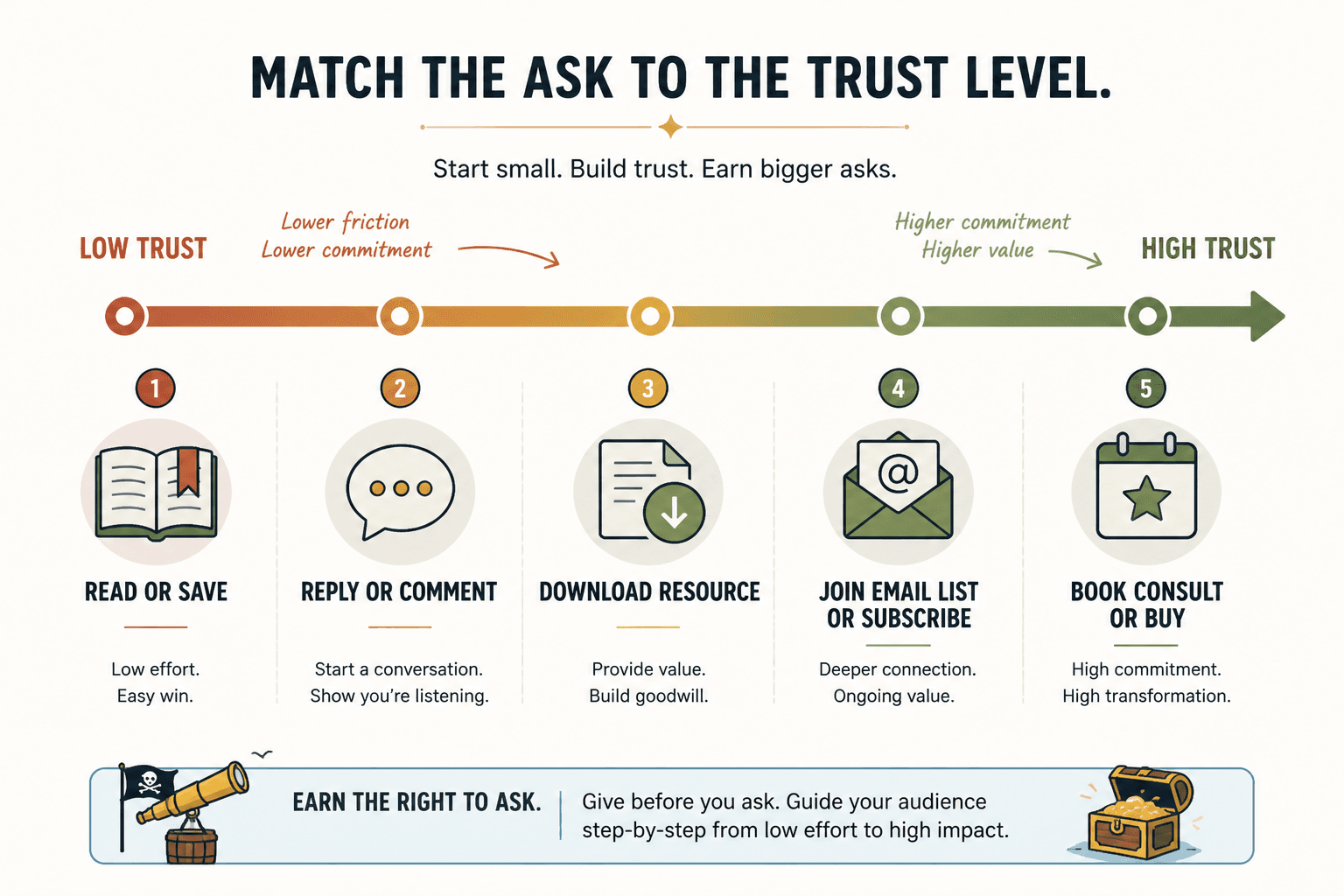
Your CTA should match the stage of attention you have earned.
- If the post built awareness, ask for a light response or profile click
- If the post built trust, offer a useful resource or invite a conversation
- If the post showed proof, suggest a consultation, inquiry, or deeper step
- If the audience is still cold, keep the ask small and clear
The best CTA is usually the next believable step, not the biggest possible one.
That one rule would clean up a shocking amount of creator marketing.
For a broader foundation, it helps to understand how CTA writing works across different stages of trust and conversion. Small-audience creators just need to apply those principles with less ego and better calibration.
Start with the four CTA jobs that matter most
Not every CTA needs to sell. In fact, if your audience is small, trying to make every CTA sell is one of the fastest ways to flatten your momentum.
Most of your CTAs will fall into one of four jobs.
1. Conversation CTAs
These are designed to get replies, comments, and signals from the right people.
- “What part of this are you still figuring out?”
- “Which of these mistakes do you see most in your niche?”
- “If you want, tell me what you are selling and I will tell you which line is too vague.”
These work well when your goal is feedback, visibility, and audience learning. They are especially useful when you want to turn content into actual conversations with potential clients or customers.
2. Traffic CTAs
These push people toward a profile, article, lead magnet, guide, or landing page.
- “I put the full checklist in my profile.”
- “If you want the longer version, read the guide here.”
- “I wrote up the full process in this CTA writing guide for creators who want better results.”
This works when the content creates curiosity but the full payoff lives elsewhere.
3. Lead CTAs
These invite people into something useful that continues the relationship: a free resource, email list, template, audit request, or low-pressure inquiry.
- “If you want the swipe file, message me ‘CTA’ and I will send it over.”
- “I made a simple version you can steal: simple CTA writing templates for busy creators.”
- “If you want me to look at your current CTA, send it over.”
This is where small audiences can do surprisingly well, because the ask feels useful rather than thirsty.
4. Sales CTAs
Yes, you can ask for the sale. Just earn it first.
- “If this is the part you want help fixing, you can work with me here.”
- “If your site is getting traffic but your CTA is dead on arrival, I help creators fix that.”
- “If you want a sharper version of this built for your business, get in touch.”
Sales CTAs work best after proof, specificity, and relevance. Not after a generic tip carousel with no evidence you understand the reader’s situation.
How to choose the right CTA when your audience is small
Before you write the CTA, ask three things:
- How warm is this audience?
- What did this piece of content actually earn?
- What is the easiest useful next step?
If you are posting to people who barely know you, your CTA should usually aim for engagement, learning, or low-friction lead capture.
If the post includes a strong opinion, a good example, a case study, or a clear proof point, you can ask for more. Maybe not “buy now,” but certainly “read this,” “reply with your situation,” or “request the template.”
And if the content is directly tied to a pain your offer solves, then yes, a sales CTA can make sense. But it still needs to sound like a sane human wrote it.
| What the content did | Best CTA type | Example |
|---|---|---|
| Shared a useful tip | Conversation or traffic | “Want the full version? I linked it in my profile.” |
| Taught a process | Lead CTA | “If you want the template, message me ‘template.’” |
| Showed proof or case study | Sales or inquiry CTA | “If you want help applying this, that is what I do.” |
| Started a strong opinion | Comment CTA | “Agree or disagree, what part are people getting wrong?” |
What small creators keep getting wrong with CTAs
They ask for too much, too early
If the reader just met you, a hard pitch often feels absurd. Especially if your post did not include proof, personality, or anything memorable beyond “consistency matters.”
Small audiences grow through trust compounding. CTAs should support that, not interrupt it with a blunt-force conversion fantasy.
They use dead phrases
“Let me know your thoughts.”
“Reach out if this resonates.”
“DM me for more info.”
These are not CTAs so much as vague shrugs. They create work for the reader and say very little about what happens next.
They make the CTA generic when the post was specific
If your post is about rewriting weak homepage CTAs, then the CTA should continue that conversation.
Not “follow for more content tips.” That is lazy. And readers can smell lazy from orbit.
They confuse visibility with movement
A comment CTA can be valuable. A link CTA can be valuable. A sales CTA can be valuable. But not if you use the same one every time without knowing what it is meant to do.
A lot of creators think they have a CTA problem when they really have a strategy problem. The ask is not wrong in isolation. It is wrong for that audience, that post, and that stage of trust.
Simple CTA formulas that work better for small audiences
You do not need 71 “high-converting CTA secrets.” You need a few structures you can adapt without sounding like a funnel intern.
The useful next step CTA
Formula: If you want [specific outcome], [simple relevant next step].
- “If you want better replies from your audience, ask narrower questions.”
- “If you want examples you can steal, read these CTA writing ideas and examples for creators.”
- “If you want help choosing the right CTA for your homepage, send me the current version.”
The low-friction invite CTA
Formula: If this is relevant, reply with [word/topic] and I will send [resource/help].
- “If you want the checklist, reply with ‘checklist’ and I will send it.”
- “If you want me to tell you which CTA on your site is too vague, send me the page.”
This works especially well for creators, consultants, and service businesses because it opens the door without forcing a full sales conversation.
The profile-path CTA
Formula: I put [resource/next step] in my profile if you want the full version.
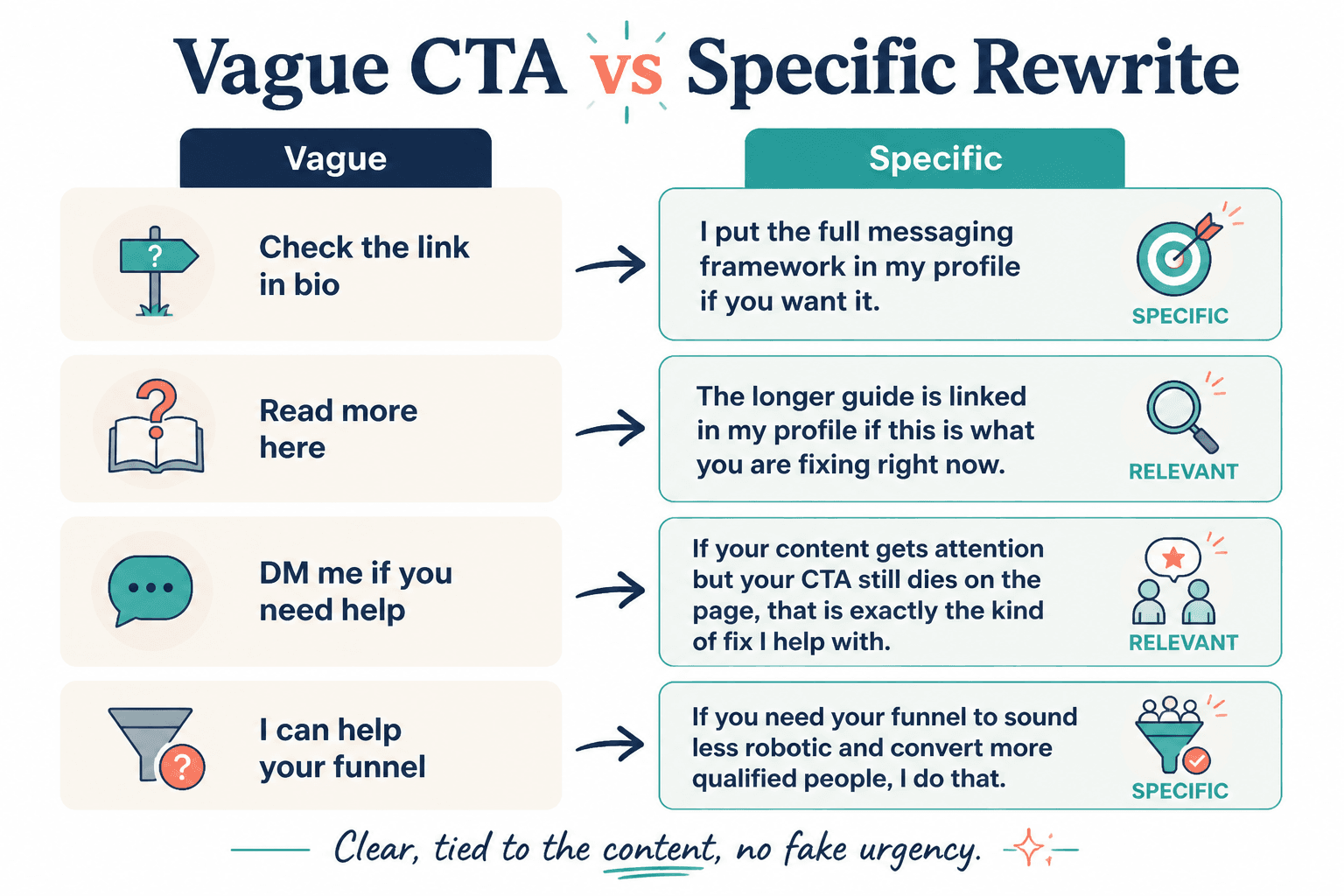
- “I put the full messaging framework in my profile if you want it.”
- “The longer guide is linked in my profile if this is what you are fixing right now.”
The soft sales CTA
Formula: If you want help with [specific problem], that is what I help people do.
- “If your content gets attention but your CTA still dies on the page, that is exactly the kind of fix I help with.”
- “If you need your funnel to sound less robotic and convert more qualified people, I do that.”
Notice what these have in common: they are clear, tied to the content, and not trying to cosplay urgency.
Before-and-after CTA rewrites
Sometimes the easiest way to improve CTA writing for creators with small audiences is to see what not to do.
Example 1: The empty engagement ask
Weak: “What do you think?”
Better: “Which of these CTA mistakes is hurting your site most: vagueness, weak placement, or asking too much too soon?”
The second one gives people something to respond to. It also teaches you something about your audience.
Example 2: The too-early sales push
Weak: “Book a call if you want to grow your business.”
Better: “If your homepage is getting traffic but nobody is taking the next step, send me the CTA and I will tell you what is weakening it.”
The better version is specific, useful, and much less annoying.
Example 3: The vague DM invitation
The bigger point is simple: clearer structure and clearer writing make the piece more useful. That is usually what makes the ending land better too.
CTA writing works best when the next step feels specific, natural, and easy to trust. A clearer ask usually outperforms a louder one.