
Most CTA advice is either painfully obvious or weirdly dramatic.
You get told to “create urgency,” “drive action,” and “optimize conversion pathways,” which is a lovely way of saying: ask people to do something without sounding desperate, vague, or like you swallowed a funnel course.
If you are a busy creator, you do not need 47 psychological triggers and a laminated persuasion framework. You need simple hard CTA templates for busy creators that are clear, direct, and easy to adapt across posts, pages, emails, and offers.
That is the real job of a hard CTA. Not to manipulate. Not to perform intensity. Just to make the next step obvious for people who are already interested.
Here’s how to write hard CTAs that feel clean, confident, and useful, plus templates you can steal without making your content sound like a dusty webinar landing page.
If you want the bigger picture, start with the parent guide.
What a hard CTA actually is
A hard CTA is a direct ask tied to a business outcome.
You are not just inviting engagement. You are asking the reader to click, book, buy, apply, subscribe, download, reply, or message you.
That is different from a soft CTA like:
- What do you think?
- Have you tried this?
- Follow for more
- Let me know if this helped
Soft CTAs are fine when your goal is conversation or reach. Hard CTAs are for action.
And no, “hard” does not mean aggressive. It means specific. Clear. Hard to misunderstand.
A weak CTA leaves people interested but idle. A strong CTA gives interested people somewhere to go.
Why most creators make hard CTAs worse than they need to be
Most bad CTAs do not fail because they are too short. They fail because they ask for too much trust too fast, or because they are so vague they barely qualify as language.
The usual problems look like this:
- They are generic: “Work with me” says almost nothing.
- They are needy: “Please support my journey” is not a business strategy.
- They are overstuffed: five links, three asks, zero clarity.
- They are premature: pitching cold readers like they already trust you.
- They sound like borrowed marketing sludge: “Take the first step toward transformation” needs a long nap.
Busy creators often overcomplicate CTA writing because they think every ask has to sound polished or original. It does not. It has to make sense in context.
If your content is practical and your offer is relevant, a straightforward ask usually works better than a dramatic one. People are not waiting to be seduced by your button copy. They are trying to decide, quickly, whether this next step is worth their time.
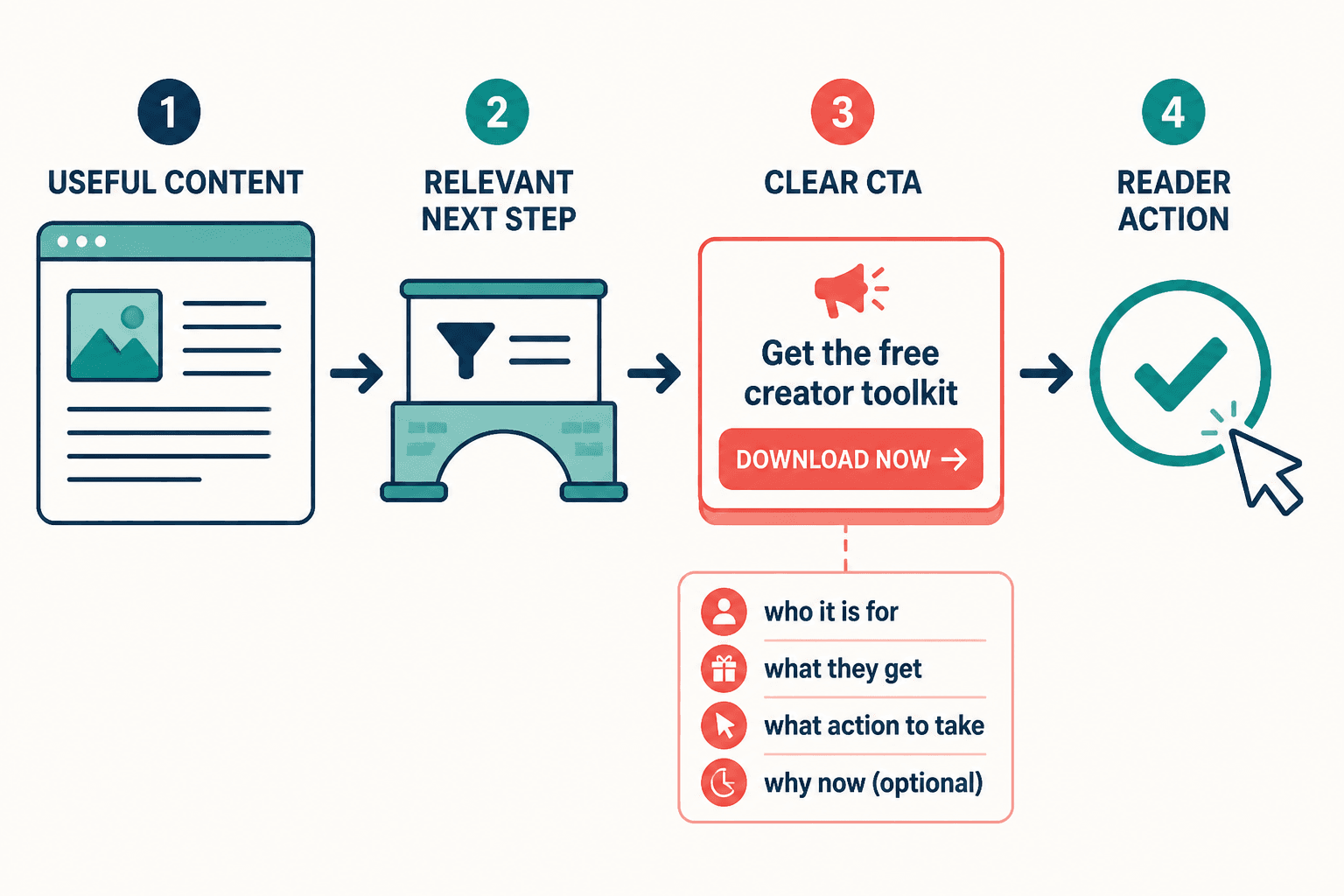
The 4-part formula behind simple hard CTA writing
If you want simple CTA writing hard CTAs templates for busy creators can actually use, start here. Most effective hard CTAs have four parts:
- Who it is for
- What they get
- What action to take
- Why now if needed
Not every CTA needs all four written out, but this is the skeleton.
1. Who it is for
This filters the right people in. It also makes the CTA feel more personal and less like a megaphone blast.
Examples:
- For coaches who need better sales pages
- If you are a consultant with a messy homepage
- For creators who want cleaner CTAs without sounding salesy
2. What they get
Spell out the outcome, asset, or next step. Not in abstract language. In plain English.
- Get the template pack
- Book a strategy call
- Read the full guide
- See how I’d rewrite your CTA
3. What action to take
Use one main verb. Click. Book. Download. Apply. Reply. Message. Join.
Not “connect with me to explore opportunities for aligned growth.” That sentence has suffered enough.
4. Why now
This is optional, but useful when there is real urgency, limited capacity, or a logical reason to act now.
- I am opening 3 client spots this month
- The workshop starts Friday
- Use this before you rewrite your homepage
The key word there is real. Fake urgency is one of the fastest ways to make a decent offer smell cheap.
How to choose the right hard CTA for the moment
Not every piece of content should ask for the sale. This is where creators get clumsy. They write one useful post, then tack on a CTA that feels like it wandered in from another conversation.
Match the CTA to the reader’s level of trust.
| Reader state | Better CTA | Avoid |
|---|---|---|
| Cold | Read this guide, grab the free template, follow for more useful content | Book now, buy now, apply now |
| Warm | Join the list, watch the demo, reply for details, check the offer page | Overexplaining basic next steps |
| Hot | Book the call, start the project, buy the product, apply for the program | Ending with a timid “let me know if you want more info” |
A hard CTA works best when the content has already done some of the trust-building work. If your post teaches something useful, shows proof, or frames the problem sharply, then the CTA can be direct without feeling harsh.
If you need help thinking through where CTA writing fits in the bigger picture, this CTA writing guide is a solid next read.
Simple hard CTA templates for busy creators
Now the useful bit. These are simple templates you can adapt quickly. Keep them plain. Add specificity where it helps. Remove fluff where it does not.
1. The direct service CTA
Template:
Need help with [specific problem]? [Action] to [get specific result].
Example:
Need sharper website copy? Book a consult and I’ll show you where your pages are losing action.
This works because it names the problem and the outcome in one breath. No fog. No posturing.
2. The limited-capacity CTA
Template:
I’m opening [number] spots for [offer] this [time frame]. [Action] if you want one.
Example:
I’m opening 2 homepage rewrite spots this month. Message me if you want one before they go.
Use this only when capacity is actually limited. Invented scarcity is embarrassing, and people can smell it.
3. The lead magnet CTA
Template:
If you want the [resource], [action]. It will help you [practical outcome].
Example:
If you want the CTA swipe file, download it here. It will help you stop ending good content with weak asks.
4. The article-to-offer CTA
Template:
If this sounds familiar, [action] for help with [specific thing].
Example:
If this sounds like your sales page, book a review and I’ll help you tighten the messaging and CTA flow.
5. The low-friction DM CTA
Template:
[Action] me “[keyword]” and I’ll send you the [resource/next step].
Example:
Message me “CTA” and I’ll send you the worksheet I use to tighten calls to action.
This is useful on social when links are awkward or when you want to turn content into conversations. But be normal about it. Do not make every post a ritual of “comment MAGIC below.”
6. The diagnostic CTA
Template:
Want to know what is hurting your [asset/result]? [Action] and I’ll [specific review or analysis].
Example:
Want to know what is hurting your landing page conversions? Book a teardown and I’ll show you the friction points.
7. The product CTA
Template:
If you need [outcome], get [product]. It is built to help you [specific job].
Example:
If you need stronger CTA ideas fast, get the template pack. It is built to help you write faster without defaulting to mush.
8. The newsletter CTA
Template:
For more [type of insight], join the newsletter. I send [specific value] every [cadence].
Example:
For more practical conversion copy tips, join the newsletter. I send one useful breakdown each week.
9. The application CTA
Template:
If you want help with [result], apply for [offer]. It is for [specific audience].
Example:
If you want help fixing your website messaging, apply for copy coaching. It is for service businesses that already have traffic but weak conversion.
10. The “start here” CTA
Template:
Not ready for [bigger ask]? Start with [smaller next step].
Example:
Not ready to hire yet? Start with the free CTA examples so you can tighten your copy first.
This one is underrated. A lot of readers are interested, but not ready. Giving them a smaller step keeps momentum without forcing commitment too early.
If you want more swipeable options, these CTA writing ideas and examples for creators and button copy examples creators can adapt fast make good companion resources.
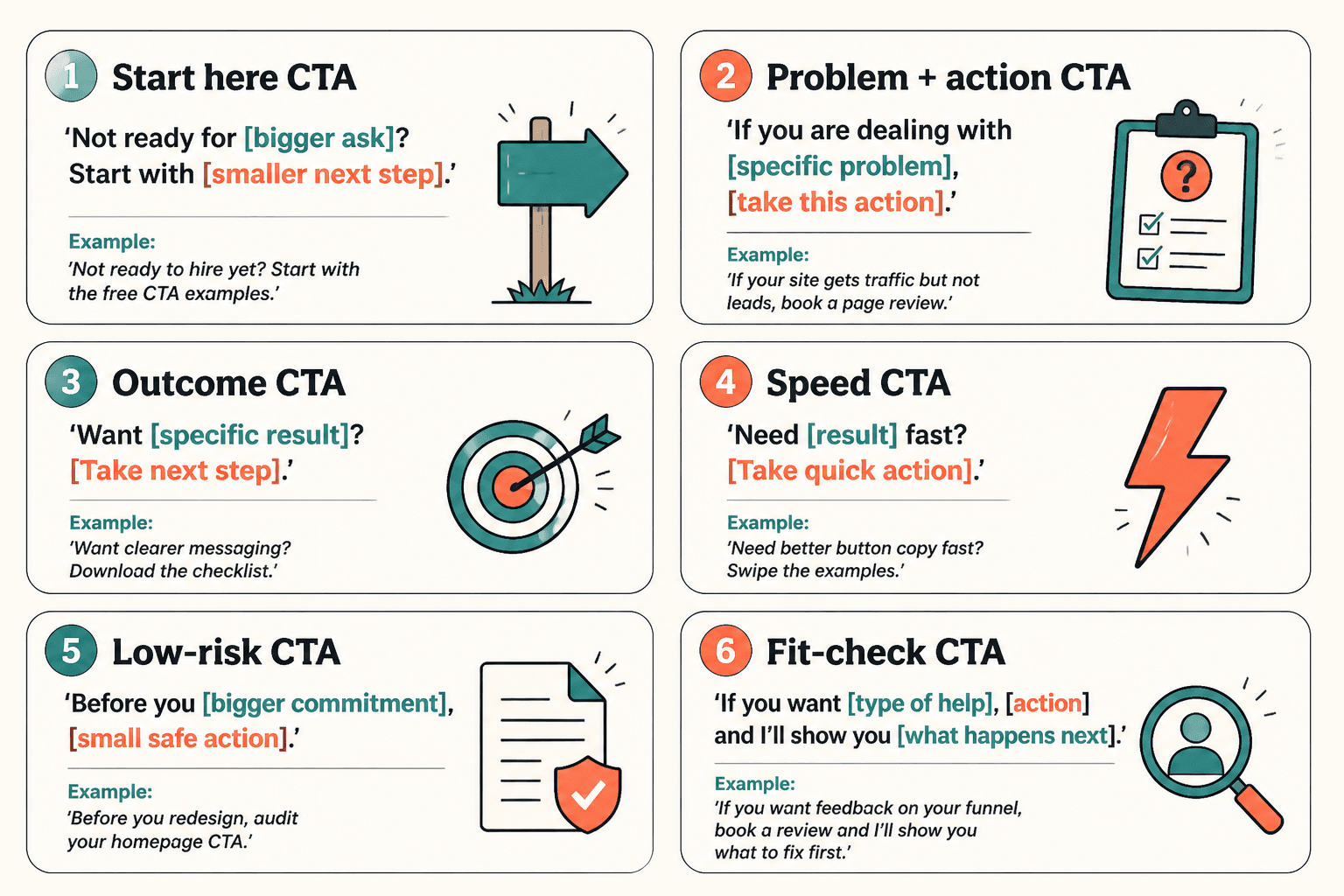
Before-and-after hard CTA rewrites
Sometimes the easiest way to improve CTA writing is to see what changed.
Example 1
Weak: If this resonated, feel free to reach out sometime.
Better: If your website is getting traffic but not leads, book a page review and I’ll show you what to fix first.
Why it works: clearer audience, clearer problem, clearer action.
Example 2
Weak: Check out my offer if you want to transform your business.
Better: Need help tightening your homepage messaging? See the copy package here.
Why it works: specific result beats grand vague promises every time.
Example 3
Weak: DM me for details.
Better: DM me “audit” and I’ll send you the details for my website CTA teardown.
Why it works: less friction, more clarity, better expectation-setting.
Example 4
Weak: Learn more.
Better: Read the full guide to fix the CTAs on your sales page.
Why it works: “learn more” is button wallpaper. It says nothing useful.
Where to use hard CTAs without making everything feel like a pitch
Hard CTAs belong in more places than most creators realize. The trick is to use them where intent already exists.
- Sales pages: obvious, yes, but many are still weirdly timid
- Service pages: especially after proof, process, and outcomes
- Blog posts: when the article aligns with a relevant next step
- LinkedIn posts: after useful advice or a concrete example
- Email newsletters: when you are moving readers toward an offer
- Lead magnets: the thank-you page and follow-up emails matter too
- Profiles and bios: people need a next move, not just a slogan
What you do not need is a hard CTA jammed into every single post. Some content should build trust, sharpen positioning, or start conversations. If every sentence is trying to march people toward checkout, you stop sounding clear and start sounding cornered.
For creators with smaller audiences, this matters even more. You do not need maximum pressure. You need relevance and clean next steps. This piece on CTA writing for creators with small audiences gets into that in more detail.
A fast checklist for writing better hard CTAs
Before you publish, run your CTA through this quick filter:
The bigger point is simple: clearer structure and clearer writing make the piece more useful. That is usually what makes the ending land better too.