
Most website bios do not start weak because the writer lacks credentials. They start weak because they open with fog.
“Hi, I’m Sarah, and I’m passionate about helping businesses grow.”
That is not an opening. That is polite wallpaper.
If you want your bio or profile copy to actually do its job, the first few lines need to tell people something useful, specific, and believable. Fast. Not your life story. Not a vague mission statement. Not a soft little paragraph that sounds like it was approved by a committee of beige blazers.
How to Start Website Bio and Profile Copy Without a Weak Opening comes down to one thing: lead with clarity people can use. The reader should quickly understand who you help, what you help with, and why you are worth listening to. Then your personality and proof can do their work.
Here’s how to write opening lines for website bio and profile copy that feel sharp, credible, and human instead of limp, generic, or weirdly overpolished.
For the full path around this topic, head to the parent guide.
Why most bio openings fall flat
The usual bad opening tries to sound nice instead of useful.
- It starts with your name, even though your name is already on the page
- It leads with passion, which is fine but not persuasive
- It talks about “empowering” people without saying what that means
- It lists broad roles with no clear throughline
- It sounds more interested in sounding impressive than helping the reader understand anything
This is especially common on About pages, home page profile sections, coach bios, consultant intros, and founder blurbs. People assume they should begin with an introduction because that feels formal. But on a website, formal is often just another word for forgettable.
Your opening is not there to clear its throat. It is there to orient the reader.
Good bio openings do at least one of these things right away:
- Name the audience clearly
- Name the problem or goal clearly
- Show your angle or positioning
- Hint at proof or credibility
- Set the tone of the brand without becoming a performance
If you miss all five, the opening usually collapses into mush.
What a strong opening actually needs to do
A good bio opening is not trying to say everything. It is trying to do a few jobs quickly and cleanly.
- Tell the reader who the bio is relevant for
- Make your work understandable in plain English
- Give a reason to keep reading
- Sound like a real person, not a stitched-together brand bot
That means your first lines should usually center the reader’s context more than your autobiography.
For example, compare these two openings:
Weak: I’m a passionate brand strategist dedicated to helping visionary entrepreneurs unlock growth and align with their authentic voice.
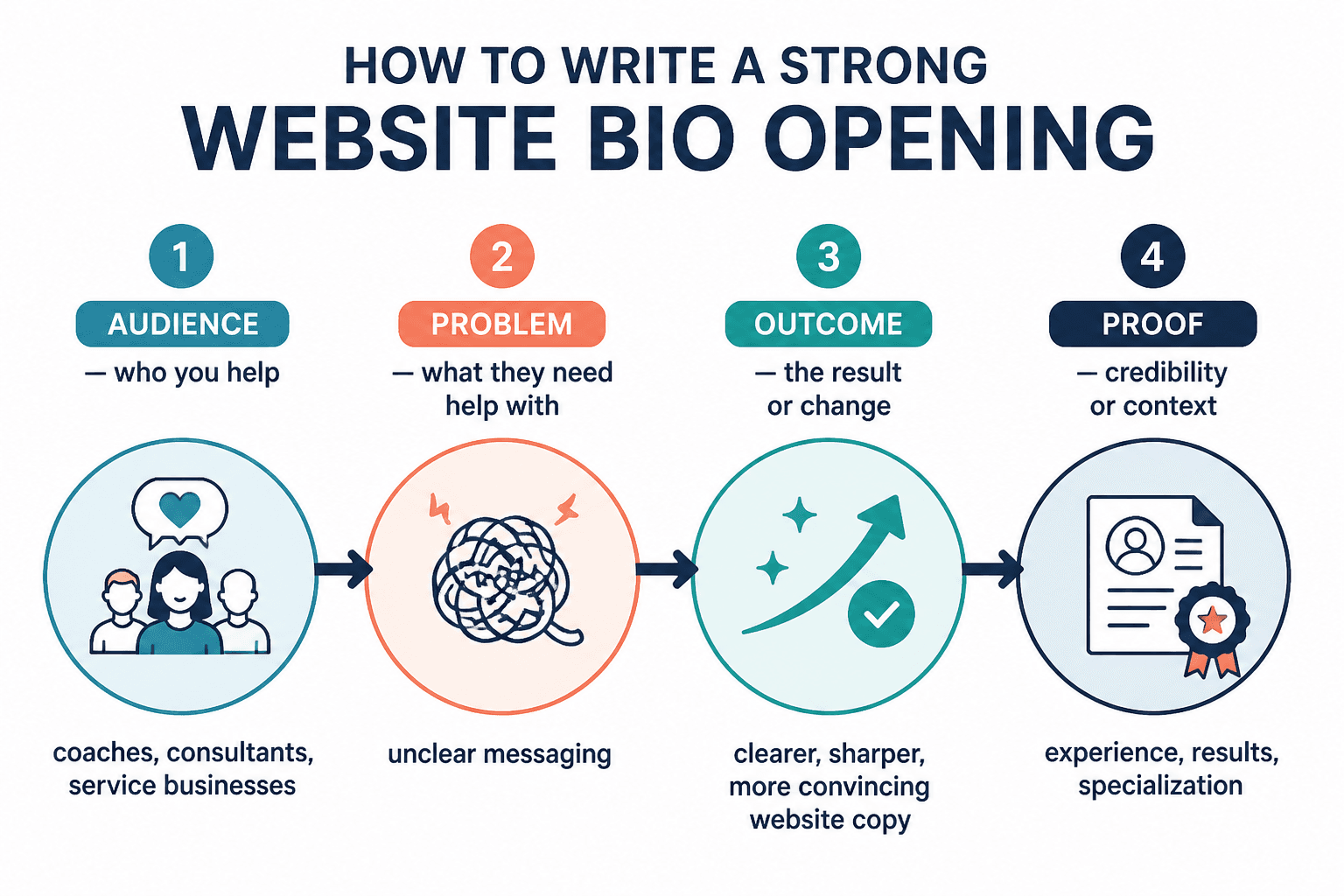
Stronger: I help coaches, consultants, and service businesses tighten their messaging so their websites sound clearer, sharper, and far more convincing.
The second one is not clever. That’s why it works. It tells the reader who it is for, what the person does, and what changes after working with them. No incense. No corporate incense either.
Once that foundation is in place, you can add personality, proof, style, and a bit more texture. But if the start is vague, the rest of the bio has to fight uphill.
How to Start Website Bio and Profile Copy Without a Weak Opening
If you want a practical way to build the opening, use this order:
- Start with who you help
- Add what you help them do
- Sharpen it with a specific outcome, angle, or contrast
- Follow with credibility or context
You do not always need all four in one sentence. In fact, cramming everything into one overstuffed line usually makes it worse. Two or three short sentences often work better.
1. Start with who you help
This is usually the cleanest move, especially for service businesses and personal brands.
Examples:
- I help B2B founders explain complex offers in plain English.
- I work with coaches who want their websites to sound more credible and less canned.
- I help small service businesses turn messy messaging into clear website copy that converts.
This works because it answers the reader’s first silent question: “Is this for me?”
2. Add what you help them do
Do not stop at the audience. Add the job.
Examples:
- I help consultants turn vague expertise into website copy clients actually trust.
- I help authors and personal brands shape bios that sound clear, distinct, and worth reading.
- I work with online service providers to improve the words on their websites so more visitors turn into inquiries.
The key is using language that normal people understand. If your opening needs a decoder ring, it is probably trying too hard.
3. Sharpen with an outcome, angle, or contrast
This is where the line stops being merely clear and starts becoming stronger.
You can sharpen by adding:
- An outcome: more inquiries, stronger trust, better-fit clients
- An angle: no hype, no jargon, no fake authority voice
- A contrast: clear instead of clever, persuasive instead of polished, specific instead of broad
Examples:
- I help coaches write website copy that sounds expert, human, and not like recycled funnel sludge.
- I work with consultants who need clearer messaging, stronger positioning, and fewer “interesting, but not for us” replies.
- I help founders explain what they do in a way that makes sense to buyers, not just other founders.
That last bit matters more than people think. A lot of bios accidentally perform expertise rather than communicate it.
4. Follow with credibility or context
Once the opening tells the reader what you do, your next lines can support it with proof.
- Years of experience
- Type of clients served
- Volume of projects
- Relevant background
- Notable results, if you can state them honestly
Examples:
- Over the past six years, I’ve helped service businesses clean up the messaging that was making good work look generic.
- I’ve written brand and website copy for coaches, consultants, and niche experts who needed trust before traffic.
- My background in strategy and conversion copy means I do not just make bios sound nicer. I make them pull their weight.
If you need help building those proof lines, this guide on better bio and profile copy credibility lines for personal brands is a useful next read.
Five opening formulas that work better than “Hi, I’m…”
You do not need one perfect formula. But you do need a structure stronger than “Hello, welcome to my corner of the internet.”
Formula 1: Audience + problem you solve
I help [audience] solve [specific problem] so they can [useful outcome].
Example:
I help consultants fix vague website messaging so more of the right clients actually get what they do.
Formula 2: What you do + how you’re different
I [do the work] with a focus on [angle or difference].
Example:
I write website copy for personal brands with a focus on clarity, trust, and zero inflated nonsense.
Formula 3: Reader problem first
If your [thing] is [common frustrating problem], I help fix that.
Example:
If your website bio sounds polished but says very little, I help turn it into something clearer, sharper, and more convincing.
Formula 4: Outcome first
I help [audience] get [outcome] through [what you do].
Example:
I help service businesses earn more trust from their websites through sharper messaging and stronger conversion copy.
Formula 5: Positioning statement with a little edge
I help [audience] do [thing] without [common frustration or bad approach].
Example:
I help coaches and consultants improve their website copy without sounding robotic, pushy, or suspiciously “premium.”
If your current version sounds stiff, vague, or too polished, read how to write bio and profile copy for websites without sounding salesy or robotic next.
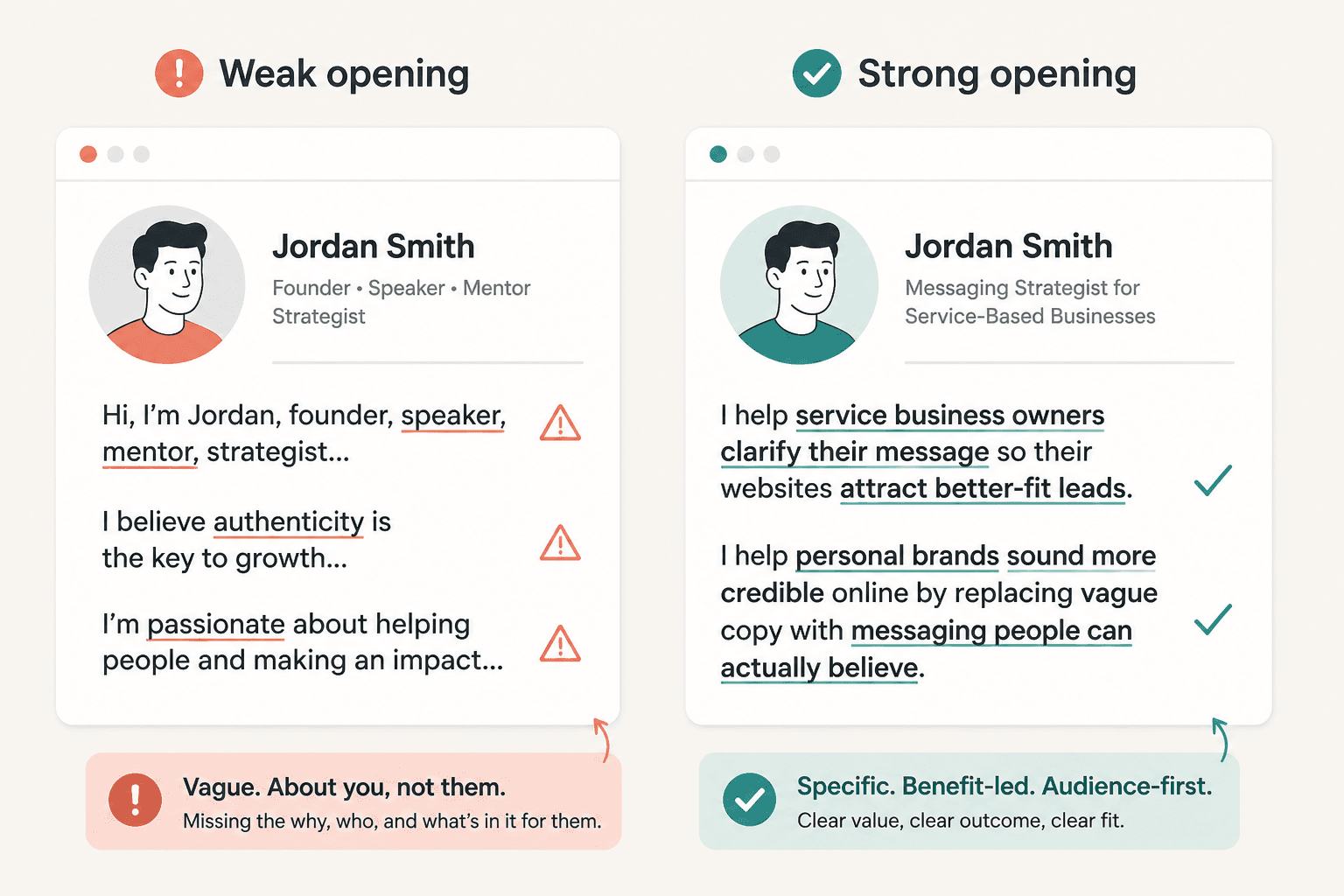
Weak opening vs strong opening examples
Sometimes the easiest way to improve your bio is to see what changed.
| Weak opening | Stronger rewrite |
|---|---|
| I am a passionate entrepreneur with a mission to help others succeed. | I help small business owners clarify their message so their websites attract better-fit leads. |
| Hi, I’m Jordan, founder, speaker, mentor, strategist, and creative visionary. | I work with founders who need clearer brand messaging, sharper website copy, and a stronger reason for people to trust them. |
| I believe authenticity is the key to growth in business and life. | I help personal brands sound more credible online by replacing vague, overpolished copy with messaging people can actually believe. |
| Welcome to my website. I’m so glad you’re here. | If your website sounds nice but does not clearly sell what you do, you are not alone. I help fix that. |
Notice the pattern. The stronger versions are not trying harder to sound impressive. They’re trying harder to be understood.
What to avoid in the first line
If you want to avoid a weak opening, there are a few traps worth cutting immediately.
- Your name as the opening: Your name is already visible on the page.
- “Passionate about…”: It is overused and usually says nothing specific.
- Too many roles: Writer, coach, speaker, mentor, founder, visionary, coffee enthusiast. Pick the roles that matter here.
- Abstract beliefs: Values matter, but they should support the message, not replace it.
- Soft welcome copy: Nice on social. Weak on a website bio that needs to earn attention.
- Instant life story: Context can come later. The opening needs direction first.
A useful test: if someone could swap your name into the opening and nothing important would change, the line is too generic.
A simple process to write your opening from scratch
If you are staring at a blank page and every sentence sounds fake, use this process.
- Write down who you help. Be specific enough to exclude people.
- Write down what they want or what frustrates them. Keep it practical.
- Write down what you help them do. Use plain language.
- Add one useful differentiator. Your angle, method, tone, or focus.
- Add proof in the next sentence. Not every claim belongs in line one.
Here’s what that might look like in rough notes:
- Audience: consultants and experts
- Problem: their websites sound vague or generic
- What I do: write and refine conversion copy
- Angle: clear, credible, not hypey
- Proof: years of client work across service brands
Then turn it into an opening:
I help consultants and niche experts turn vague website messaging into clear, credible copy that earns trust faster. My work focuses on sharp positioning, stronger conversion copy, and language that sounds human instead of inflated.
That is already miles better than “I’m a passionate strategist on a mission.” The bar is low, but still.
If your current copy needs a full overhaul, how to rewrite boring bio and profile copy for websites will help you clean up the rest.
How the opening changes based on page type
Not every website bio lives in the same place, so not every opening should behave the same way.
Homepage profile section
Keep it tighter. The opening should support the main value proposition, not compete with it.
Good fit:
I help service businesses sharpen their messaging so their websites do a better job earning trust and inquiries.
About page bio
You have a bit more room here. Start clear, then expand into story, philosophy, and proof.
Good fit:
I help founders and personal brands say what they actually do in a way that sounds sharp, credible, and easy to trust. Most of my work sits at the intersection of messaging, website copy, and positioning.
Team or founder profile card
The bigger point is simple: clearer structure and clearer writing make the piece more useful. That is usually what makes the ending land better too.
Bio and profile copy work best when they make the reader understand who you help and why it matters quickly. Clearer positioning usually beats extra polish.