
Most creator bios do not fail because they are too short.
They fail because they are trying very hard to sound impressive while saying almost nothing useful.
You have probably seen the usual mess: a stack of vague roles, a cloudy promise, a few polished buzzwords, and no clear next step. “Helping purpose-driven founders amplify impact.” Great. Doing what, exactly? For whom? Why should I trust you? And what am I supposed to do after reading that?
If you want to know how to turn creator bios & profile copy into more leads or sales, the answer is not making them fancier. It is making them clearer, more specific, and more useful at the exact moment someone is deciding whether you are worth their attention.
Your bio is not just a summary. It is a tiny conversion asset. It helps the right people understand what you do, decide if it is relevant, and take the next step without friction. Done well, it can quietly move people from profile view to subscriber, inquiry, booking, or sale. Done badly, it just sits there in a nice shirt.
Here’s how to fix that.
For the main guide behind this topic, visit the parent guide.
What a creator bio is actually supposed to do
A good bio is not a life story. It is not a personality collage. It is not your chance to list every identity you have collected since 2018.
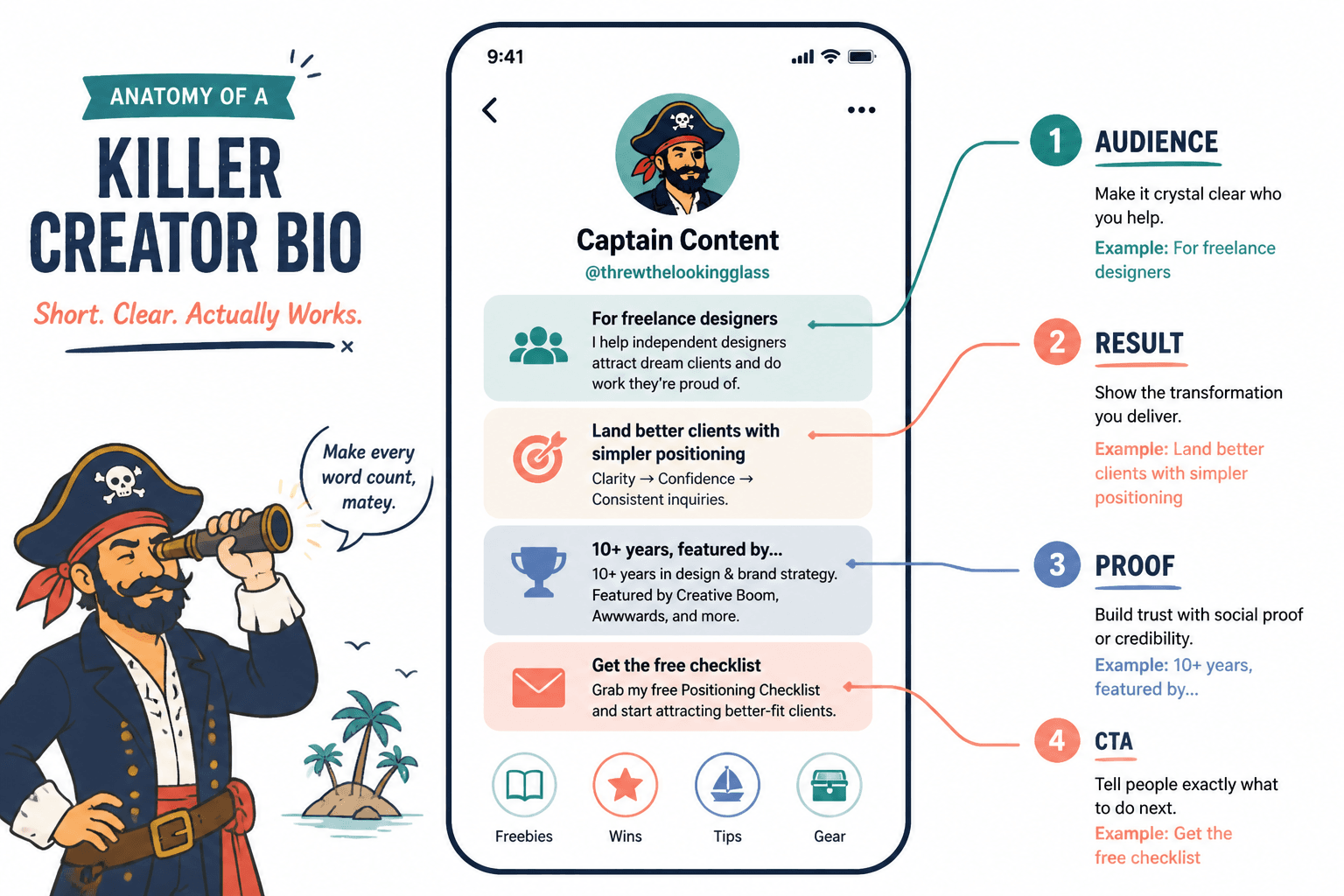
Its job is simple: help the right person understand who you help, what you help them do, why they should trust you, and what to do next.
That means your profile copy should answer four questions fast:
- Who is this for?
- What result do they help with?
- Why should I believe them?
- What action should I take now?
If your bio misses one of those, you create hesitation. If it misses two, you lose people. If it misses three, you have built a lovely little fog machine.
For a deeper foundation on profile structure, it helps to read how to write better creator bios and profile copy alongside this article. This piece is more about conversion. The other one helps you clean up the basics first.
Why most bios do not bring leads or sales
Most bios underperform for boring reasons. Not mysterious reasons. Not “the algorithm.” Just basic clarity problems.
1. They describe the creator, not the offer
People often write bios like résumés with better lighting. They list titles, credentials, interests, and identity markers, but they do not translate any of that into value for the reader.
Readers are not rude for scanning past that. They are busy.
2. They aim for broad appeal and end up vague
“I help people grow online” sounds inclusive. It also sounds disposable. The wider you make the claim, the less believable and memorable it becomes.
3. They have no proof
If your bio makes a promise with zero credibility markers, people have to do extra work to trust you. Most will not.
Proof does not need to be huge. It can be clients served, years in the field, outcomes achieved, audience built, notable work, or a specific method. It just needs to make your claim feel less like decorative optimism.
4. They do not direct the reader anywhere
You would be amazed how many bios end with absolutely no next step. No free resource. No newsletter. No booking link context. No invitation. Just vibes.
If you want more leads or sales, your bio has to move people somewhere useful.
How to turn creator bios & profile copy into more leads or sales
The simplest way to improve conversion is to stop treating your bio like branding wallpaper and start treating it like a short path.
The path usually looks like this:
- Grab attention with a clear positioning line
- Make the offer or outcome obvious
- Add proof that reduces skepticism
- Give one next step that matches the reader’s readiness
That is it. Not magic. Not hacks. Just lower friction and stronger relevance.
Step 1: Lead with who you help and what you help them do
Your first line matters because people make a snap decision from it. If the opening is weak, the rest of the profile has to work harder than it should.
Bad example:
Writer | Strategist | Speaker | Building meaningful brands through authentic storytelling
That sounds polished. It also sounds like 40,000 other bios.
Better:
I help coaches and consultants turn vague expertise into sharp content that brings in better leads.
Now we know the audience, the problem, and the result.
If your first line is weak, go fix that first. This guide on starting creator bios and profile copy without a weak opening can help if your current opener sounds like it was approved by a committee.
Step 2: Add proof, not puffery
Once you make a claim, back it up.
Proof can include:
- Number of clients served
- Years of experience
- Specific outcomes
- Notable publications or platforms
- A niche method or process
- Audience or newsletter size, if relevant and real
Weak:
I help experts grow their audience with powerful content strategies.
Stronger:
I help B2B consultants create LinkedIn content that attracts warmer leads. 120+ clients served.
The second version is not louder. It is just easier to believe.
Step 3: Match the CTA to the buyer’s temperature
Not everyone who reads your bio is ready to buy. Some are curious. Some are comparing. Some are lightly stalking before deciding if you seem normal.
Your CTA should match that reality.
| Reader state | Best next step |
|---|---|
| Just discovered you | Free guide, newsletter, starter resource |
| Interested but not ready | Case study, examples, pinned post, article |
| Warm and problem-aware | Book a call, apply, inquire, view service page |
| Already trust you | Buy now, join program, hire you |
This is where people get awkwardly aggressive. They write a bio for cold traffic and end with “DM me to scale to 7 figures.” Calm down.
For most creators, a softer but clear next step works better:
- Get the free guide
- Read the case study
- Join the newsletter
- See how I work
- Book a consult
If you want help balancing trust and monetization, read how to monetize creator bios and profile copy without wrecking trust. That is where a lot of people get a bit too eager.
Step 4: Remove everything that steals attention from the main conversion path
Bios are small. Space matters. If you pack in every role, hobby, mission, and side quest, you weaken the main message.
Cut or reduce:
- Too many job titles
- Vague values language
- Inspirational filler
- Random personal details that do not support positioning
- Old credibility markers that do not matter anymore
- Multiple CTAs fighting each other
A creator bio is not a storage unit. Keep what helps the reader decide.
A simple bio formula that actually converts
Here is a practical structure you can use on LinkedIn, X, Instagram, Facebook intros, about sections, and creator profile pages.
- Line 1: Who you help + result
- Line 2: How you help or what kind of work you do
- Line 3: Proof or credibility
- Line 4: Clear next step
Template:
I help [specific audience] get [specific result].
I do it through [service, content, method, or offer].
[Proof, credibility, or relevant outcome].
[CTA or next step].
Filled example for a content strategist:
I help consultants turn scattered ideas into content that brings in qualified leads.
Content strategy, profile messaging, and ghostwriting support.
Worked with 80+ experts across B2B, coaching, and service businesses.
Grab the free profile checklist below or book a strategy call.
Filled example for a coach:
I help new freelance coaches get their first consistent clients without sounding pushy online.
Messaging, offer clarity, and simple lead generation systems.
Former agency strategist. 50+ coaches supported.
Read the client-getting guide or apply to work together.
This structure works because it respects the reader’s time. They can understand your relevance in seconds.
Before and after bio rewrites
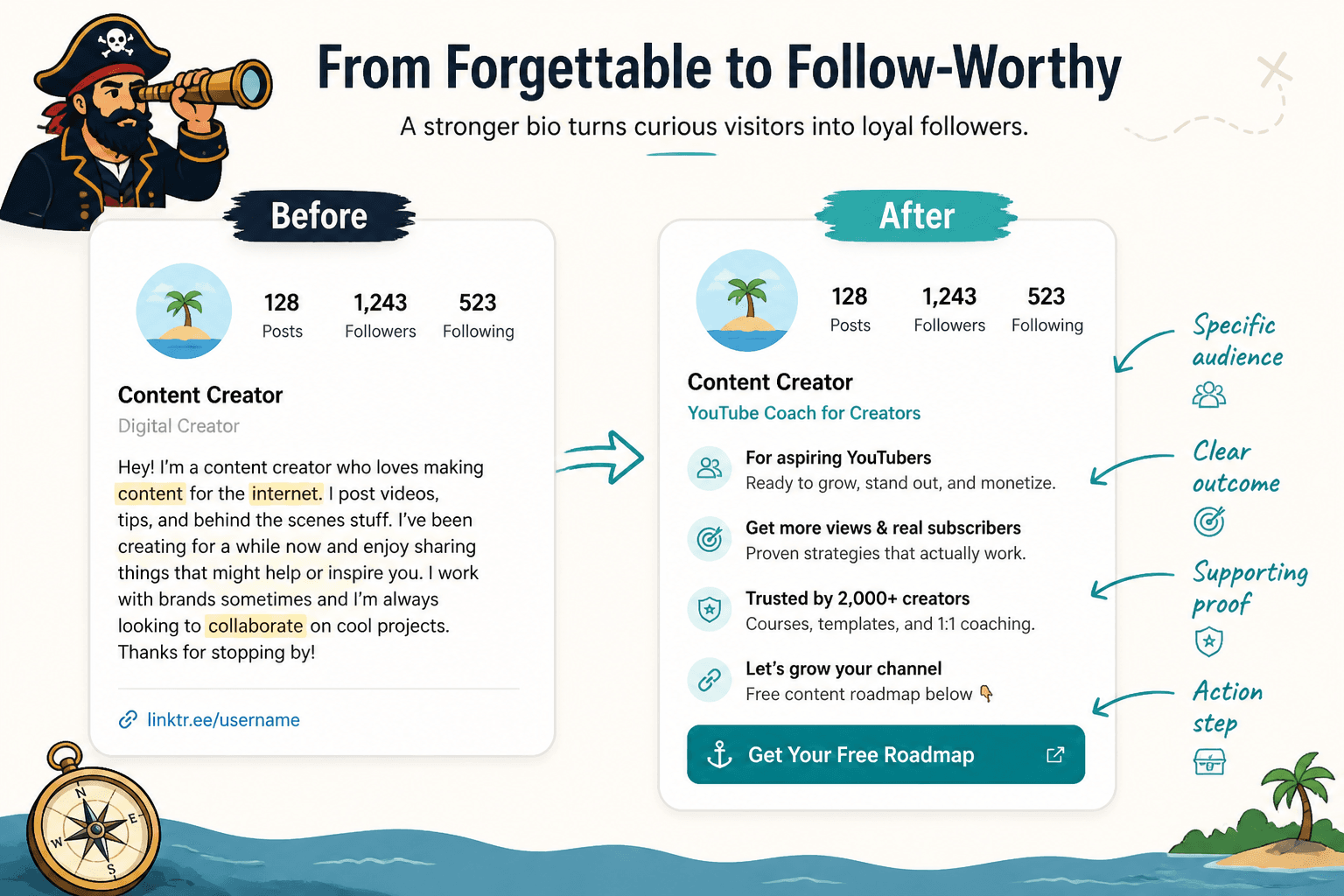
Sometimes the fastest way to see the problem is through rewrites.
Example 1: Too vague
Before
Helping entrepreneurs elevate their brand through authentic storytelling and strategic content.
After
I help solo founders turn their expertise into clear content that attracts leads and builds trust.
Brand messaging, LinkedIn content, and profile copy.
Want sharper positioning? Start with the free bio audit checklist.
What changed: clearer audience, clearer result, clearer services, clearer CTA.
Example 2: Too many roles
Before
Coach | Consultant | Speaker | Podcast Host | Course Creator | Helping leaders thrive with purpose and impact
After
I help first-time consultants position their expertise, package offers, and win better-fit clients.
Ex-agency consultant. Now coaching service providers to sell with more clarity and less flailing.
Book a consult or read the pinned client positioning guide.
What changed: one audience, one main outcome, stronger trust signal, less résumé cosplay.
Example 3: No conversion path
Before
I write about content, creativity, and business growth.
After
I help creators and small brands write sharper content that earns attention and trust.
Posts, bios, articles, and messaging systems that actually sound human.
Read the free guide or hire me for done-for-you strategy.
What changed: stronger promise, wider but still clear offer, and a direct next action.
How to choose the right CTA for your profile
A CTA should not be the loudest thing in your bio. It should be the most logical thing.
Good profile CTAs tend to do one of three things:
- Capture demand: Book a call, apply, inquire, hire me
- Nurture demand: Join the newsletter, get the free guide, read the article
- Qualify demand: See who I work with, view pricing, check examples
If your audience is cold, use a lower-friction CTA. If your audience already knows you and your offer is simple, a direct sales CTA can work. The key is matching intent.
Here are a few strong CTA examples:
- Get the free profile checklist
- Read the pinned case study
- Book a strategy call
- See how I help consultants
- Join 2,000+ readers getting weekly content fixes
- Apply for 1:1 coaching
And here are a few weak ones:
- Let’s connect
- DM me
- Check out my stuff
- Learn more
- Follow for value
Those are not CTAs. Those are shrugs.
Platform notes: your bio should fit the room
The core principles stay the same, but the shape should fit the platform.
LinkedIn bios and profile copy should lean professional, specific, and credibility-aware. This is a good place for niche clarity, outcomes, and trust markers. Your headline, about section, featured section, and CTA should all support the same positioning.
X
You have less room, so compression matters. Keep it punchy. Focus on audience, result, and one credibility marker if possible. Avoid trying to sound mysterious. That usually just looks unfinished.
The bigger point is simple: clearer structure and clearer writing make the piece more useful. That is usually what makes the ending land better too.
The bigger point is simple: clearer structure and clearer writing make the piece more useful. That is usually what makes the ending land better too.