
Most homepage copy sounds bad for one of two reasons.
It is either trying way too hard to sell, so every line feels like it was dragged out of a funnel template with a ring light and a trust issue. Or it swings the other way and becomes bland, polished, and weirdly lifeless. Professional, technically. Convincing, not really.
If you want to learn How to Write Homepage Copy Without Sounding Salesy or Robotic, the fix is not “be more conversational” and hope for the best. The fix is knowing what your homepage actually needs to do, what readers need to understand quickly, and how to sound like a real person with a clear offer instead of a corporate intern trapped in a branding workshop.
This is about writing homepage copy that feels human, sharp, and credible. Not overhyped. Not stiff. Not vague. Just clear enough to make the right people think, yes, this looks like it’s for me.
For the full path around this topic, head to the parent guide.
Why homepage copy goes wrong so often
Your homepage sits in an awkward spot. It has to explain what you do, who it is for, why you are worth trusting, and what someone should do next. That is a lot of pressure for one page.
So people panic and reach for junk language.
- “Helping visionary founders unlock scalable growth”
- “We provide innovative solutions tailored to your unique needs”
- “Transform your brand with strategic, results-driven support”
That kind of copy sounds polished until you notice it could belong to almost anyone. It does not create trust because it avoids saying anything concrete. It is trying to sound impressive instead of useful.
The other common mess is robotic clarity. It gives the facts, but in a dead-eyed way.
I am a business coach for entrepreneurs. I offer one-to-one coaching, group coaching, and digital products. Book a consultation to learn more.
Nothing is wrong with that grammatically. It is just flat. No tension. No point of view. No reason to care.
Good homepage copy lives in the middle. Clear, specific, and human. Strong enough to sell. Calm enough to trust.
What your homepage copy actually needs to do
Before you write better copy, you need a better job description for the page.
Your homepage is not there to say everything. It is there to orient people fast, build confidence, and move them toward the next step.
- Tell the reader who the site is for
- Explain what you help them do
- Show why your approach or offer is worth paying attention to
- Reduce uncertainty with proof, clarity, and structure
- Point them to the next action
That is the job. Not “sound premium.” Not “show personality at all costs.” Not “squeeze every offer onto one screen like the page is paying rent by the word.”
When your copy is trying to do too much, it usually gets noisier and more generic at the same time. A neat little disaster.
Start with a headline that says something real
Your headline does not need to be clever. It needs to do one brutal little thing well: make the right visitor instantly understand what you help with.
Salesy headlines usually overpromise. Robotic headlines usually under-say. The sweet spot is a headline that is clear, useful, and grounded in an actual outcome.
Weak headline patterns
- Helping you unlock your next level
- Strategic solutions for sustainable growth
- Copy that converts
- Elevate your brand with powerful messaging
These fail because they are too broad, too familiar, or too smug without earning it.
Stronger headline patterns
- Homepage copy that makes your business clearer in under 10 seconds
- Messaging strategy for coaches and consultants who are good at the work but bad at explaining it
- Web copy for service businesses that need more trust, fewer confused clicks, and better leads
See the difference? The stronger versions have an audience, a problem, and a believable result. They sound more human because they are saying something sharper.
If your opening keeps slipping into generic sludge, read How to start homepage copy without a weak opening and How to improve homepage copy home page hooks without sounding generic. The first screen matters more than people like to admit.
Use a subheadline to explain, not to decorate
A lot of homepages waste the subheadline on more fog. That is a missed chance.
Your subheadline should support the main promise with a bit more detail. This is where you can clarify who you help, what you offer, how you work, or what makes the offer easier to trust.
For example:
Headline: Website copy for experts who sound smarter in real life than they do on their homepage.
Subheadline: I help coaches, consultants, and service businesses turn vague messaging into clear, trust-building copy that gets the right people to stick around and take the next step.
That does not scream. It does not perform urgency like a maniac. It simply explains the value in normal language.
Stop writing to “everyone who might buy”
One reason homepage copy sounds robotic is that the writer is trying not to exclude anyone. So the copy gets broader and broader until it says almost nothing.
Specificity is not what makes copy feel narrow. It is what makes it feel believable.
You do not need to list every possible client type. You need enough audience clarity that the right person can recognise themselves quickly.
Too vague
I help businesses grow with strategic messaging and content solutions.
Better
I help coaches, consultants, and solo service brands tighten their messaging so their website sounds clearer, more credible, and much easier to trust.
The second version is not wildly niche, but it is grounded enough to feel intentional. That matters.
Write like a person who understands the problem
Human-sounding copy is not just about using contractions and throwing in a casual phrase. It comes from showing that you understand what the reader is dealing with in plain language.
That usually means describing the problem the way they would describe it, not the way a brand strategist would present it on slide 14.
Compare these:
Robotic: Many businesses struggle with inconsistent messaging across digital touchpoints.
Human: Your website says one thing, your social content says another, and your homepage still sounds like you borrowed it from a free template in a hurry.
The human version works because it has shape. It sounds like somebody paying attention. It creates trust by being recognisable, not by being formal.
This is also where a little personality helps. Not stand-up-comedian personality. Just enough voice that the copy does not sound like it was cleared by legal.
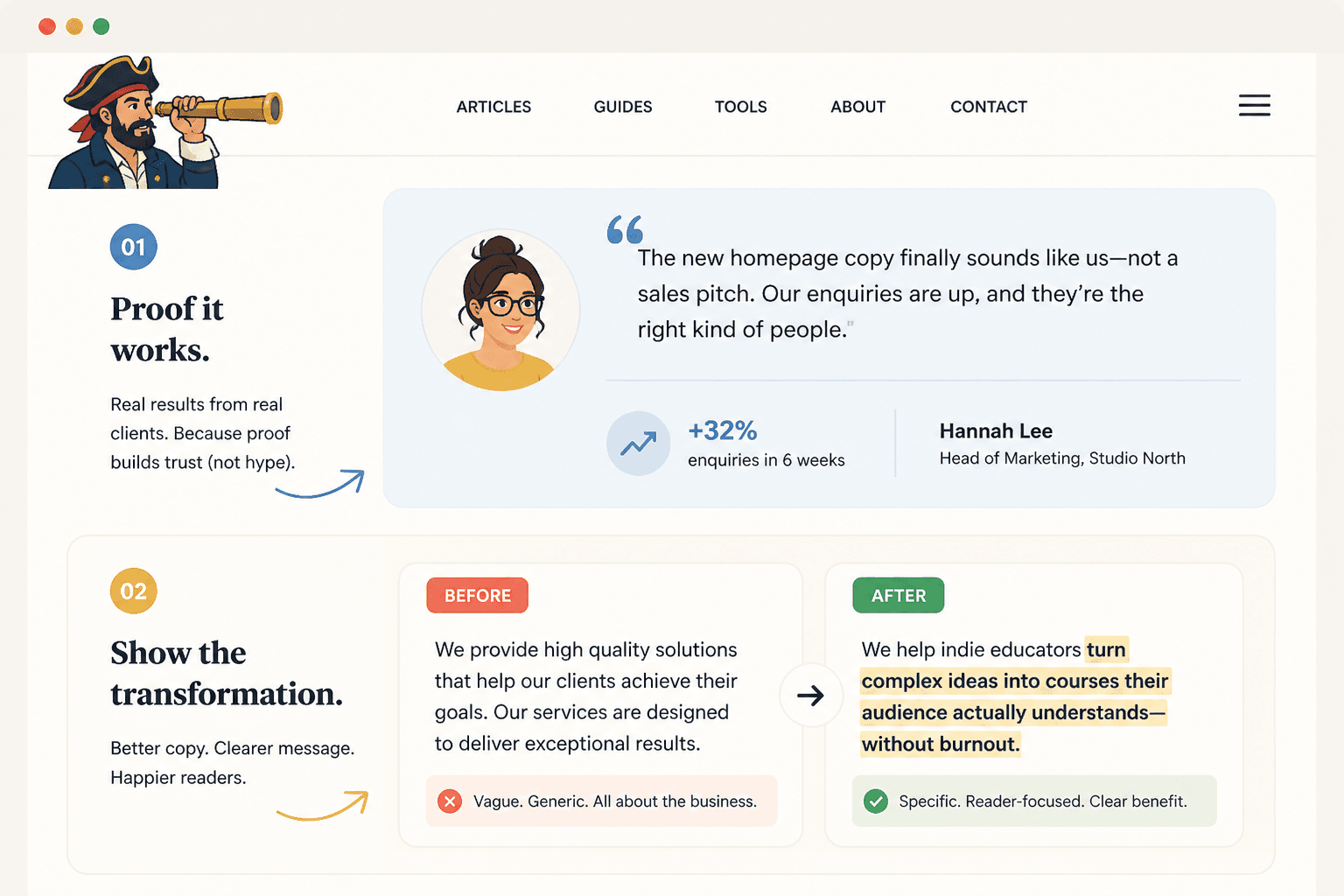
Use proof before you start making bigger claims
If your homepage sounds salesy, there is a good chance it is making claims that are not supported quickly enough.
Readers are not against persuasion. They are against unsupported persuasion. Big difference.
So if you want to say your work gets results, reduces confusion, improves conversion, sharpens positioning, or saves time, give people something to hold onto.
- A short client result
- A specific outcome
- A testimonial that sounds like a real person
- A notable credential or body of work
- A concise explanation of your process
- A sample before-and-after shift
For example, this:
I write high-converting homepage copy that gets results.
is much weaker than this:
I rewrite homepages for service businesses that are getting traffic but not enough enquiries, so visitors understand the offer faster and know what to do next.
The second version still sells. It just gives the claim a spine.
Keep each section focused on one job
Robotic homepages often feel robotic because they are overloaded. Every paragraph is trying to explain the offer, build trust, show authority, handle objections, and push the CTA all at once.
That is not persuasive. It is exhausting.
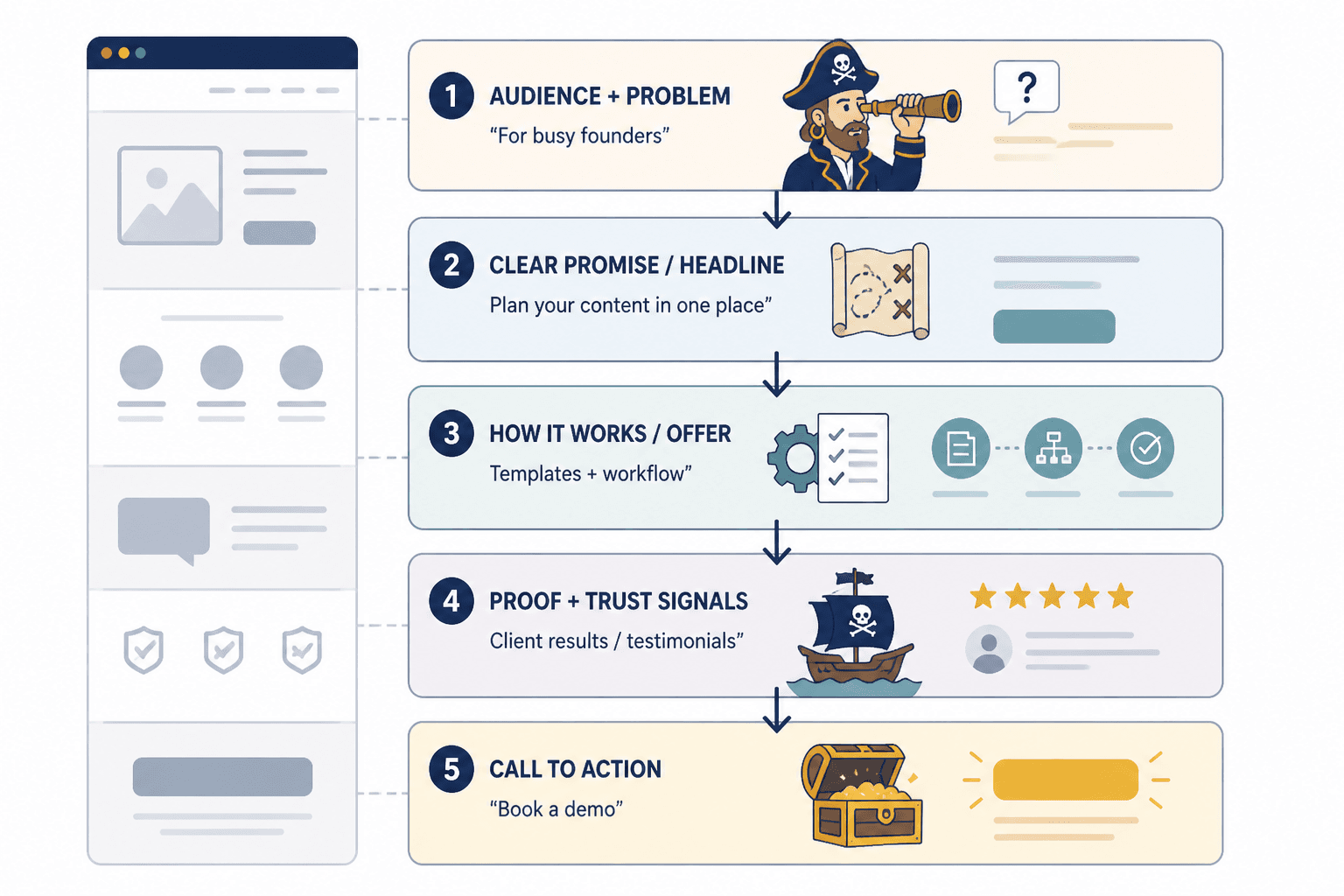
A better homepage has sections that each do one main thing well.
- Hero section: who it is for and what you help with
- Problem section: what is frustrating or broken right now
- Offer section: what you provide
- Proof section: why people should trust it
- Process section: how it works
- CTA section: what to do next
This structure does not make your copy boring. It makes it readable. Which is the more useful quality on a homepage, frankly.
If your current page feels messy, you might need a broader rewrite, not just better sentences. In that case, How to write better homepage copy and How to rewrite boring homepage copy will help you clean up the structure as well as the wording.
Cut the phrases that instantly make you sound like everyone else
Some homepage phrases are not evil. They are just overused to the point of meaninglessness.
- tailored solutions
- results-driven approach
- elevate your brand
- done-for-you support
- high-impact strategy
- authentic storytelling
- scale with confidence
- turn your vision into reality
You can sometimes keep one of these if the rest of the copy is strong. But if your page is stacked with them, it starts sounding like stock photography in sentence form.
Try replacing broad claims with specifics about what changes for the client.
Instead of this
I help brands craft authentic messaging that resonates.
Try this
I help service businesses say what they do more clearly, so their website sounds less generic and more like a business worth hiring.
That line has an actual result embedded in it. That is what gives copy weight.
Make your calls to action sound normal
A homepage CTA does not need to close the sale on the spot. It needs to offer the next sensible move.
This is where salesy copy often fully loses the plot.
- Book your breakthrough session now
- Start your transformation today
- Claim your free strategy call before spots fill up
Can these work in some businesses? Sure. Do they often sound pushy, generic, or a bit desperate on a homepage? Also yes.
Better CTA language usually sounds simpler and more grounded.
- See services
- Read the process
- Book a consultation
- Get a homepage review
- View portfolio
- Start here
If the action is low-friction and clearly connected to the page, people trust it more. You do not need to write CTA buttons like they are auditioning for a webinar funnel from 2018.
A simple homepage copy framework that sounds human
If you want a usable starting point, here is a homepage structure that works well for coaches, consultants, freelancers, and service businesses.
- Headline: what you help with
- Subheadline: who it is for and what kind of result or experience to expect
- Proof strip: client logos, testimonial snippet, or short credibility line
- Problem section: show you understand the frustration
- Offer section: explain the service or offer clearly
- Why this works: short process or differentiator
- Proof section: results, testimonials, examples
- CTA section: one clear next step
That framework gives you room to sound natural because each section has a purpose. You are not trying to cram your entire business into one paragraph and call it messaging.
Before and after: a homepage rewrite example
Here is what this looks like in practice.
Before
The bigger point is simple: clearer structure and clearer writing make the piece more useful. That is usually what makes the ending land better too.
Homepage copy works best when the core promise is clearer and the next step is easier to understand. Simpler, sharper messaging usually does more work.