
Most people do not have a content creation problem. They have a content reuse problem.
They have old posts, old newsletters, old client emails, old workshop notes, old threads, old podcasts, old half-decent rants sitting around doing nothing. Then they open LinkedIn, decide they should write an article, and somehow start from scratch like they have never had a useful thought before.
That is usually the mistake.
If you want to learn how to turn old content into better LinkedIn articles, the goal is not to copy and paste yesterday’s leftovers into a longer format and call it strategy. The goal is to find ideas that already proved they had some life in them, then rebuild them into articles with more depth, clearer structure, better proof, and a stronger next step.
Done well, this gives you three useful things at once: more mileage from ideas you already earned, stronger authority on LinkedIn, and a body of content that can actually support leads, trust, and profile conversion. Done badly, you just publish a padded post wearing article clothes.
Here is how to do it properly.
For the main guide behind this topic, visit the parent guide.
Why old content is usually the best raw material
Old content has one unfair advantage over a blank page: it has already met reality.
Maybe a post got comments because the point was sharp. Maybe a newsletter got replies because it named a problem clearly. Maybe a client kept repeating something you wrote in a proposal because it clicked. That is useful signal. Not perfect data. Signal.
LinkedIn articles work better when they are built on ideas with enough substance to survive expansion. That means the source material should usually have at least one of these:
- A strong opinion
- A practical process
- A repeated client question
- A useful mistake or myth to correct
- A lesson supported by proof, examples, or experience
- A framework that is too cramped in short-post format
If the old content was vague, generic, or only mildly true in a motivational way, do not turn it into a LinkedIn article. Expand a weak idea and you just get a longer weak idea. That is not authority. That is beige with paragraphs.
What makes a LinkedIn article different from a LinkedIn post
This matters, because a lot of people repurpose badly by treating articles like oversized posts.
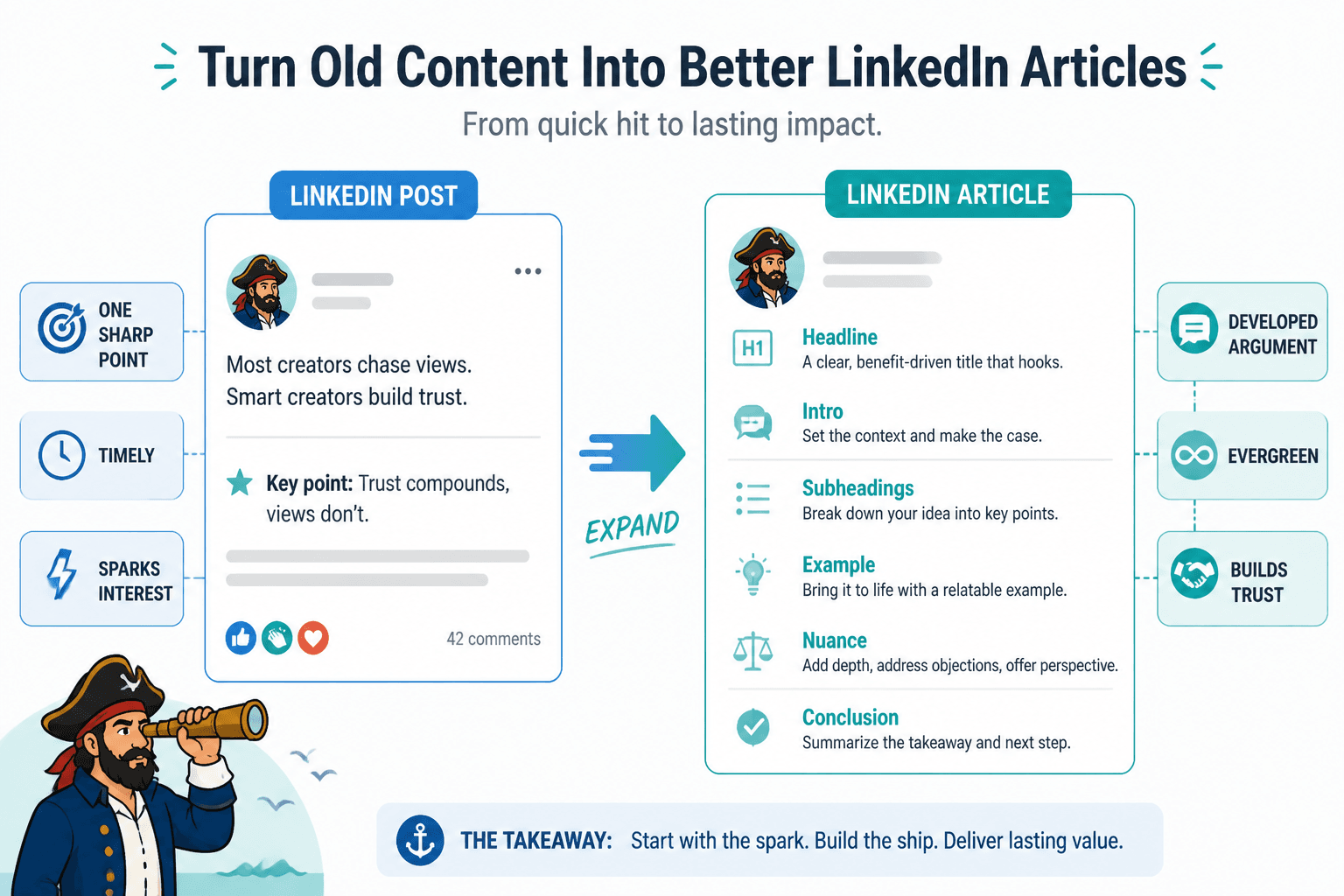
A LinkedIn post needs to earn fast attention. A LinkedIn article needs to reward deeper attention. Posts can be punchy, quick, and narrow. Articles should go further. They should help the reader understand something more clearly, make a better decision, or apply a framework with less guesswork.
So when you turn old content into an article, do not just add more words. Add more value.
- A post can make one sharp point.
- An article should develop that point with structure, examples, nuance, and a clear conclusion.
- A post can rely on energy and timing.
- An article should still work a month later.
- A post can spark interest.
- An article should build trust and authority.
If you need a stronger foundation for article structure itself, read how to write better LinkedIn articles. If your intros tend to sound like every recycled business blog on earth, this also pairs nicely with how to improve LinkedIn articles article intros without sounding generic.
Start by choosing the right old content
Not every old piece deserves resurrection. Some content should stay dead. Respectfully.
The best source material for better LinkedIn articles usually comes from content that already contains tension, clarity, and relevance. Look through your old material and ask:
- Did people respond to this? Comments, replies, saves, shares, DMs, client mentions, or repeated conversations all count.
- Is the idea still useful? If it only made sense during one trend cycle, skip it.
- Can this support depth? If the whole point fits in two sentences, it may be better as a post.
- Does it connect to my work? Authority content should not wander off into random cleverness.
- Can I add proof, examples, or process? If yes, good. If not, it may still be too thin.
Good source material to mine
- LinkedIn posts that got strong engagement from the right people
- Email newsletters that earned replies
- X threads with one clear central argument
- Client FAQs you answer repeatedly
- Workshop outlines or webinar notes
- Podcast transcripts with one solid section worth extracting
- Case study notes
- Sales call objections that reveal what people actually need to understand
Bad source material to mine
- Generic inspirational posts
- Trend commentary with no shelf life
- Loose personal updates with no takeaway
- Thin tips lists with nothing underneath them
- Anything that only worked because of outrage, novelty, or timing
The easiest way to turn old content into better LinkedIn articles
Use a simple rebuild process:
- Find the core idea
- Find the missing depth
- Restructure for reading
- Add proof and specifics
- Write a proper intro and conclusion
- Add a next step that does not sound thirsty
That is the whole job. Simple, not automatic.
1. Find the core idea
Before you expand anything, write the idea in one sentence.
Example core idea: Most LinkedIn content underperforms not because the creator lacks expertise, but because the idea is packaged too vaguely for busy readers to care.
If you cannot state the core idea clearly, you are not ready to build an article. You are still standing in the content pantry staring at ingredients and hoping dinner appears.
2. Find the missing depth
This is where repurposing becomes actual writing.
Take the original content and ask what the reader still needs in order to really use the idea. Usually the missing depth falls into a few buckets:
- Explanation: why this matters
- Diagnosis: what people are doing wrong
- Examples: what good and bad look like
- Process: how to do it step by step
- Nuance: when this advice does and does not apply
- Proof: observations, results, case examples, or practical evidence
This is the part many people skip. They take a decent old post, add four generic subheadings, and publish a very polished nothing. The article looks organized, but it does not actually help more than the original post did.
3. Restructure for reading, not posting
Articles need flow. The reader should feel guided, not dumped into a bucket of semi-related points.
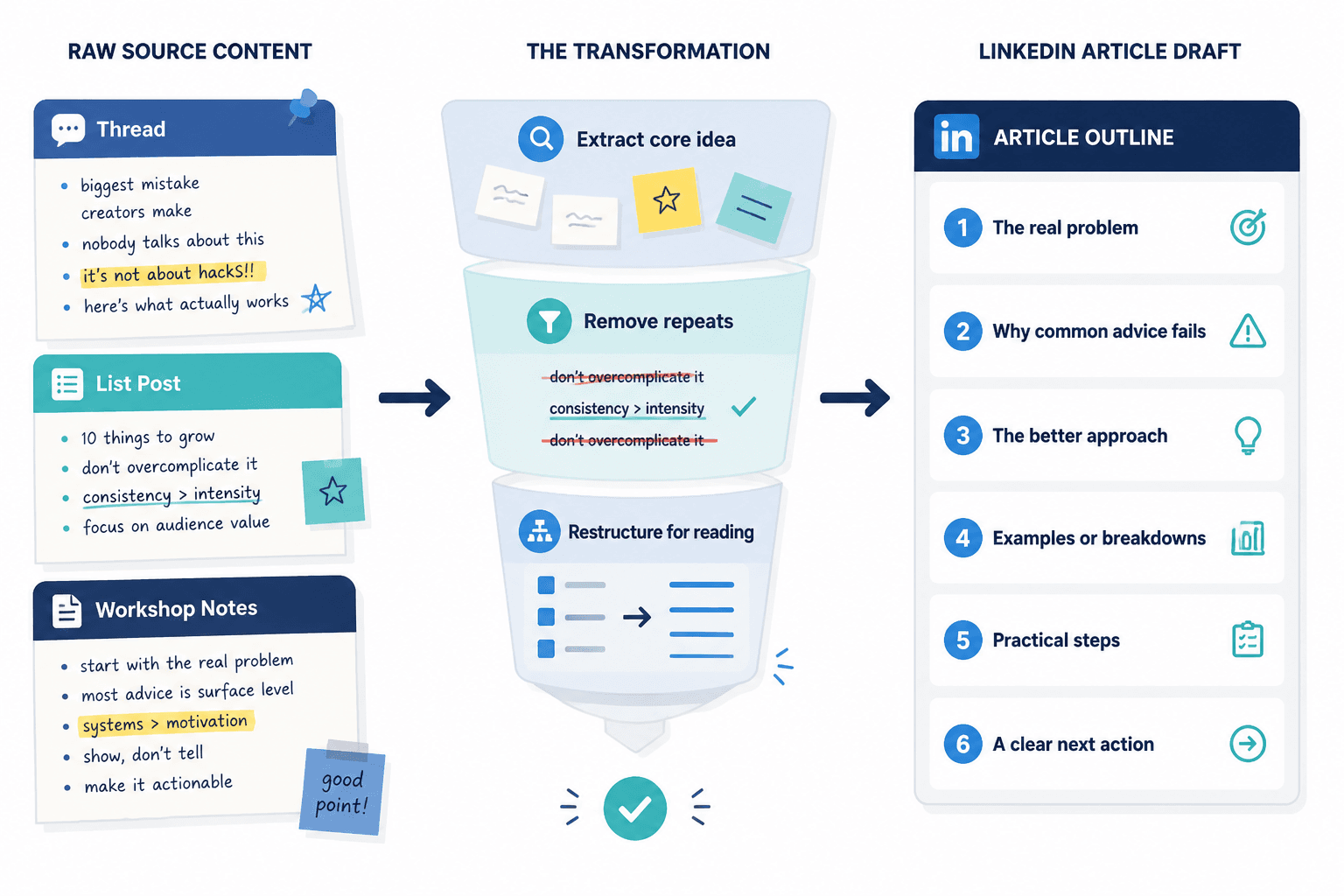
A reliable structure for most LinkedIn articles looks like this:
- The real problem
- Why common advice fails
- The better approach
- Examples or breakdowns
- Practical steps
- A clear next action
If your old content was a thread, a list post, or a workshop outline, this step matters even more. Threads often work by momentum. Articles need cleaner logic and fewer repeated beats.
4. Add proof and specifics
Specificity is what separates an article from content wallpaper.
If your original post said, “Be more specific in your content,” your article should show:
- What “specific” actually means
- How vague wording kills interest
- A weak example
- A stronger rewrite
- How to apply that rewrite logic elsewhere
Readers trust what they can see. They skim past what sounds vaguely wise.
5. Write a real intro and conclusion
Your original content probably began fast, because short-form content has to. A LinkedIn article intro still needs to be sharp, but it has a slightly different job. It needs to frame the problem, earn interest, and tell the reader why this is worth the next few minutes.
And your conclusion should not just trail off after the final tip. It should land the point and make the next step obvious. Not “Hope this helps.” Not “What do you think?” unless there is a real reason to ask.
If article CTAs are where things start to smell like stale funnel tactics, read better LinkedIn articles article CTAs for personal brands.
A before-and-after example
Here is a simple example of turning an old post into a better LinkedIn article.
Original short post
Most people think they need more content. They usually need better packaging. A smart idea with a weak hook gets ignored every time.
That is a decent post. Clear idea. Nice punch. But it is not yet an article.
What the article version could become
- Open with the real frustration: posting useful content that gets polite silence
- Explain why “just post more” is lazy advice
- Define what packaging includes: hook, framing, specificity, proof, formatting, and CTA
- Show a weak hook versus a stronger hook
- Show how one idea can be packaged for different reader intents
- Give a checklist for evaluating packaging before publishing
- End with a practical next step, such as reviewing three old posts for hidden article ideas
Same core idea. Much better article. More useful, more durable, and more likely to build authority.
Best formats to repurpose into LinkedIn articles
Some source formats convert beautifully. Others need surgery.
| Source content | Works well for articles? | Why |
|---|---|---|
| High-performing LinkedIn post | Yes | Already validated, often contains one strong central point |
| Newsletter section | Yes | Usually has more explanation and tone built in |
| X thread | Yes, with cleanup | Good structure, but often needs less repetition and more depth |
| Podcast transcript | Sometimes | Can be rich, but usually needs heavy editing |
| Client FAQ | Yes | Built on real audience interest |
| Webinar outline | Yes | Usually has enough structure and substance to expand |
| Generic listicle draft | Usually no | Often too broad and too thin |
How to improve the article instead of just stretching it
When people ask how to turn old content into better LinkedIn articles, the word that matters most is not turn. It is better.
Better usually means at least one of these happened during the rewrite:
- The point became clearer
- The examples became more concrete
- The structure became easier to follow
- The advice became more actionable
- The argument became more convincing
- The CTA became more relevant
If none of those improved, you did not repurpose. You resized.
Add a stronger angle
Old content often contains a decent topic but a weak angle. “How to write better content” is broad and sleepy. “Why useful content gets ignored when the framing is weak” is sharper. Better LinkedIn articles usually have a clearer argument, not just a larger word count.
Add examples from real situations
This does not mean inventing dramatic case studies. It means grounding your point in real scenarios your audience recognizes: a consultant trying to generate leads, a coach posting insights that get no traction, a founder repurposing newsletters into authority content. Familiarity makes advice believable.
Trim what only worked in the original format
The bigger point is simple: clearer structure and clearer writing make the piece more useful. That is usually what makes the ending land better too.
LinkedIn articles work best when the structure makes the main idea easy to follow and easy to act on. Clearer writing usually carries more weight than heavier formatting.