
Most LinkedIn article intros are not bad because the writer lacks expertise.
They are bad because they sound like the writer is clearing their throat in a conference room. Too much context. Too much politeness. Too many lifeless opening lines that could belong to literally any article about leadership, growth, branding, mindset, productivity, or whatever else got fed through the beige content machine that morning.
If you want to know how to improve LinkedIn article intros without sounding generic, the fix is not “be more creative.” That advice is useless. The real fix is to make your intro do a job. Fast. It needs to tell the reader why this article matters, who it is for, what mistake or tension it will address, and why they should trust you enough to keep going.
A good LinkedIn article intro earns attention without begging for it. It feels specific. It sounds like a person with a point. And it sets up the rest of the piece so the article can build actual authority instead of just sitting there looking professionally formatted.
This piece will show you how to write intros that are sharper, more credible, and far less likely to sound like recycled thought leadership paste. If you are also working on the bigger structure of your articles, it helps to pair this with how to write better LinkedIn articles and the broader LinkedIn articles section.
For the main guide behind this topic, visit the parent guide.
Why LinkedIn article intros go generic so fast
Generic intros happen when the writer tries to sound “professional” before they try to sound clear.
That usually creates one of four problems:
- The intro says something broad that everyone already agrees with
- The writer spends too long setting up the topic
- The opening tries to sound insightful without actually saying anything specific
- The article starts like a blog assignment instead of a strong opinion, observation, or problem
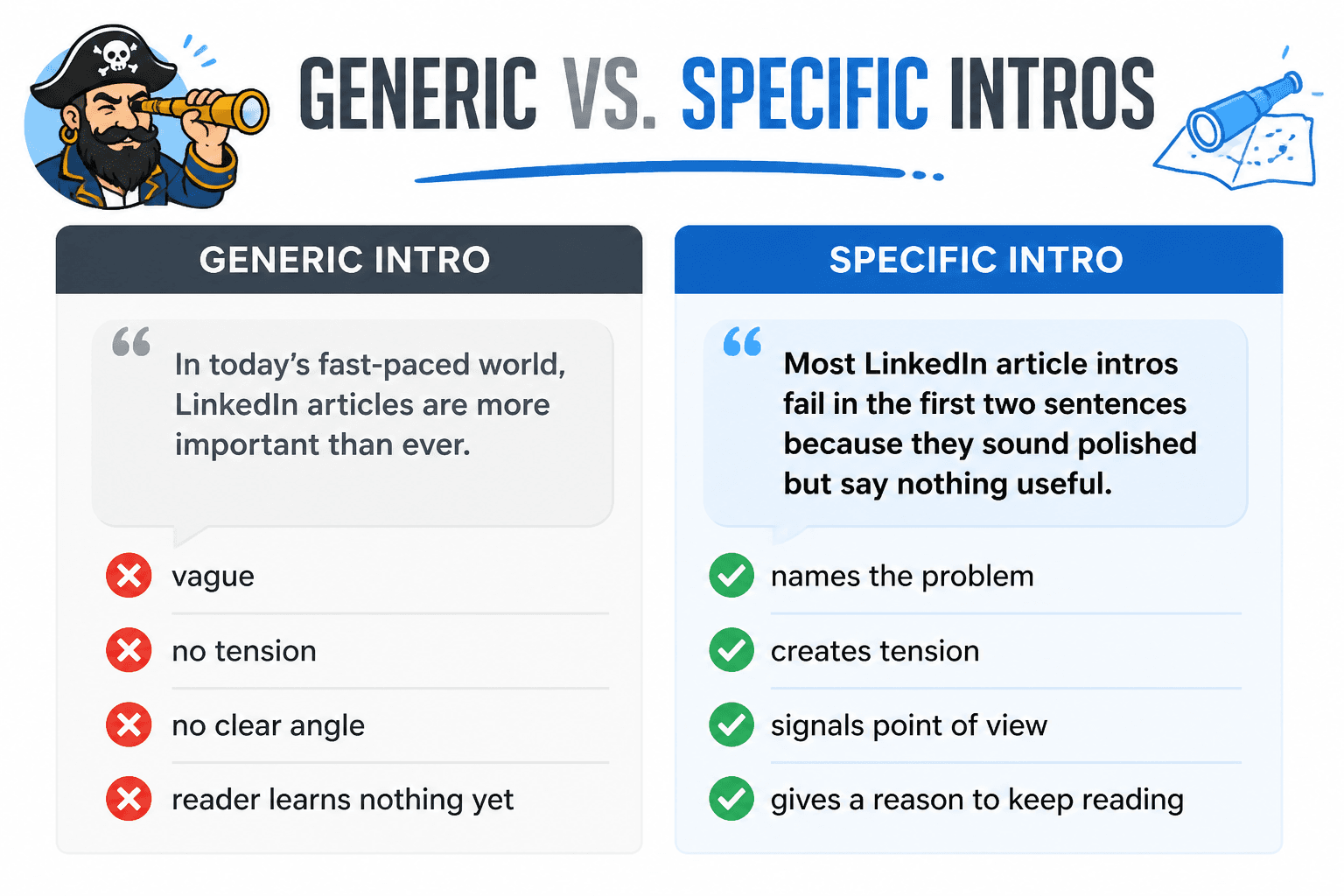
That is how you end up with openings like this:
LinkedIn has become an important platform for professionals looking to build their personal brand and share thought leadership.
Nothing is technically wrong with that sentence. It is just doing absolutely no heavy lifting.
It does not create tension. It does not identify the reader’s actual problem. It does not suggest the article contains a real point of view. It just stands there in loafers.
LinkedIn articles work best when they go deeper than posts. They are a better place for structured thinking, useful teaching, and evergreen credibility. But if the intro feels flat, people assume the rest will be flat too. Fair? Maybe not. True? Very much yes.
If your openings often feel weak, you may also want how to start LinkedIn articles without a weak opening.
What a strong LinkedIn article intro actually needs to do
You do not need a dramatic story. You do not need a shocking statistic. You definitely do not need to announce that the topic is “more important than ever.”
You need an intro that gives the reader a reason to care now, not five paragraphs from now.
At minimum, a strong intro should do most of these:
- Name a real problem, mistake, tension, or blind spot
- Make the topic feel specific rather than vague
- Signal the article’s angle or point of view
- Show the reader what they will get if they continue
- Create enough trust that the article feels worth their attention
That does not mean cramming everything into three lines. It means being deliberate. A good intro feels like someone opening a door and saying, “Here’s the actual issue,” not someone warming up for a panel discussion.
A simple formula that works
One reliable structure looks like this:
- Problem: What keeps going wrong?
- Specific angle: What is misunderstood about it?
- Promise: What will this article help the reader do better?
For example:
Most LinkedIn articles do not lose readers because the topic is boring. They lose readers because the intro takes too long to say anything useful. If your opening sounds polished but vague, readers assume the rest will be more of the same. Here is how to write an intro that sounds sharper, earns trust faster, and gives your article a real chance of being read.
That works because it identifies the problem, gives a point of view, and sets a practical expectation. No fake drama required.
How to improve LinkedIn article intros without sounding generic
Now for the useful part. These are the moves that actually improve intros, not just decorate them.
1. Start with the friction, not the topic
A generic intro usually starts by introducing the subject.
A stronger intro starts with the reason the subject matters.
Weak:
Thought leadership on LinkedIn can help professionals build visibility and authority.
Better:
A lot of smart people publish LinkedIn articles that sound credible but change nothing. The advice is fine. The structure is clean. The problem is the opening gives readers no reason to care.
See the difference? The second one gives you tension. It creates movement. It tells the reader what is going wrong in a way that feels lived-in rather than copied from a marketing textbook.
2. Be specific earlier than feels comfortable
Writers go vague because they think broad sounds smart. Usually it just sounds slippery.
If your intro could fit an article about ten different topics, it is too generic. You want enough specificity that the right reader thinks, “Yes, that’s exactly the issue.”
Weak:
Many professionals struggle to create content that resonates with their audience.
Better:
Many LinkedIn article intros fail in the first three sentences. They open with broad claims, padded context, and zero sign that the writer has an actual point.
The second version is narrower, sharper, and much easier to trust.
3. Stop writing intro sentences that anyone could have written
This is the real test.
If your opening line could be dropped into five thousand other LinkedIn articles without anyone noticing, cut it.
Watch for lines like these:
- “In a rapidly changing business environment…”
- “LinkedIn is a powerful platform for professionals…”
- “Content plays a crucial role in building visibility…”
- “Personal branding has become increasingly important…”
- “Storytelling is one of the most effective ways to connect…”
These are not openings. They are wallpaper.
A stronger intro sounds like it came from someone who has seen the problem up close and has a clear take on it.
4. Use a point of view, not just a premise
An intro gets stronger the moment it stops merely introducing a topic and starts making a case.
That does not mean acting like a hot take machine. It means having an angle.
For example:
- Premise: LinkedIn articles can help build authority.
- Point of view: LinkedIn articles build authority better when they stop copying blog intros that sound polite but empty.
One is a topic. The other is a direction.
Readers are much more likely to continue when they can sense the writer is going somewhere specific.
5. Make the promise useful, not inflated
A lot of intros collapse into hype right when they should become clear.
You do not need to promise transformation, domination, mastery, or whatever else sounds like it belongs in a funnel built by a man with three ring lights.
You just need to tell the reader what they will be able to do better.
Weak:
This article will revolutionize the way you think about LinkedIn content strategy.
Better:
By the end, you should be able to spot a weak intro quickly, rewrite it with more specificity, and open your next LinkedIn article with a lot more authority.
Useful beats impressive. Every time.
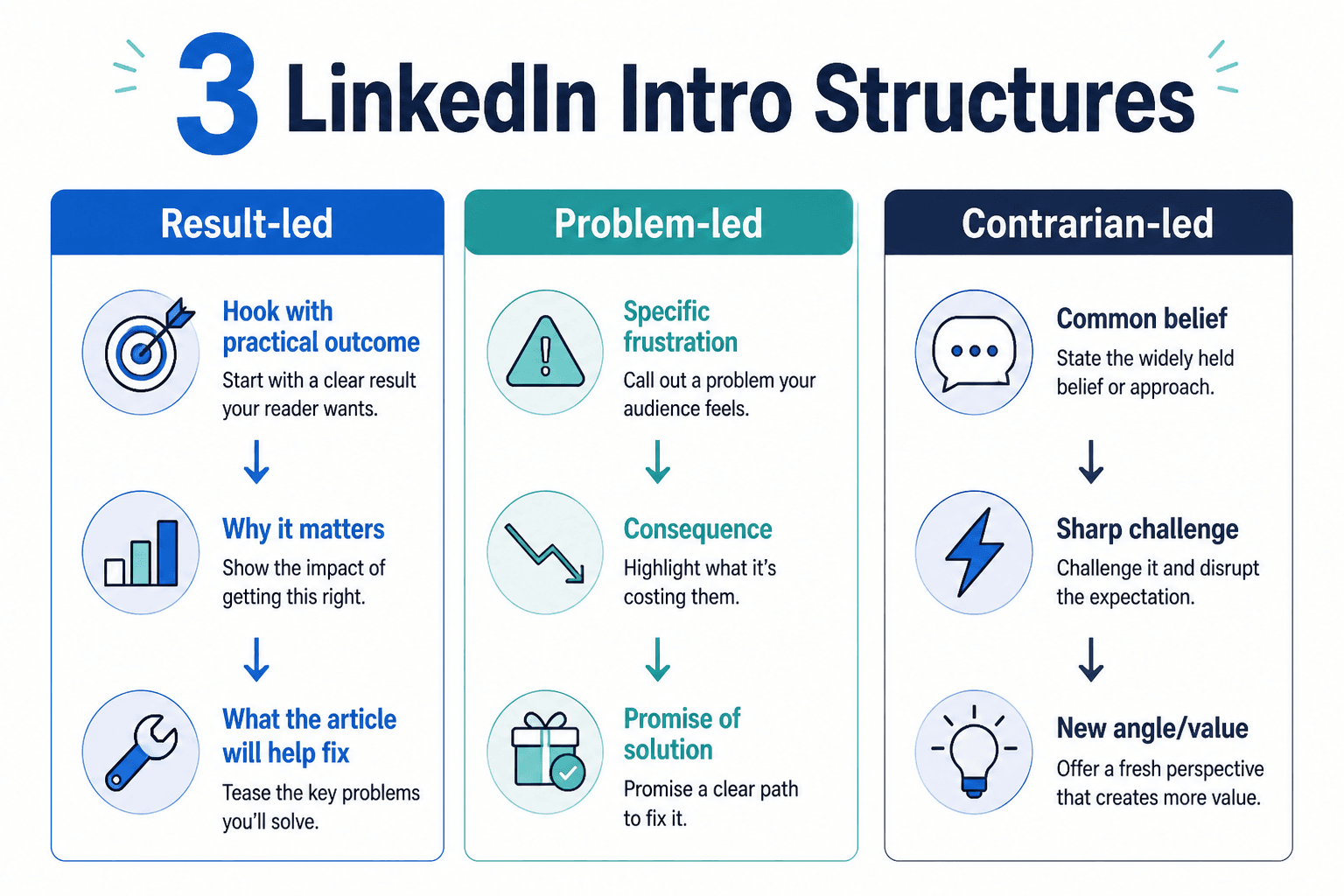
Three intro structures that work well on LinkedIn
You do not need endless formulas, but a few reliable structures can save you from defaulting to fluff.
The mistake-led intro
Best when the reader is doing something common but ineffective.
Most LinkedIn article intros try to sound polished first and useful second. That is why so many of them feel forgettable. If your opening spends four sentences warming up, readers will leave before your real point arrives.
The tension-led intro
Best when there is a clear gap between what people think works and what actually works.
People often assume a professional intro should sound broad, balanced, and polished. On LinkedIn, that usually makes it weaker. The intros that hold attention tend to be narrower, more direct, and less afraid to make a point early.
The result-led intro
Best when the reader wants a practical improvement and does not need much setup.
If you want your LinkedIn articles to feel more authoritative, fix the intro first. A stronger opening can make the whole piece easier to read, easier to trust, and much more likely to hold attention past the first screen.
None of these rely on fluff. They all move quickly toward a clear point.
Before-and-after rewrites
This is where the difference becomes obvious.
| Before | After |
|---|---|
| LinkedIn articles have become a valuable way for professionals to share insights and build authority in their field. | LinkedIn articles can build serious authority, but only if they sound like a person with a point. Too many open with generic filler that makes the whole piece feel disposable. |
| In today’s competitive digital environment, creating engaging content is more important than ever. | Creating content is not the hard part anymore. Creating content that sounds specific, credible, and not machine-washed into blandness is the hard part. |
| Storytelling is an essential skill for leaders who want to connect with their audience. | A lot of leadership articles talk about storytelling while telling no story and making no point. If your intro feels abstract, your connection problem starts before paragraph two. |
The stronger versions do not just “sound better.” They create tension, use specificity, and give the reader a reason to continue.
If you have old drafts that feel flat, how to rewrite boring LinkedIn articles will help.
A quick editing checklist for stronger intros
Before you publish, run your intro through this filter:
- Does the first paragraph name a real problem, tension, or claim?
- Could this intro belong to any article on LinkedIn? If yes, make it more specific.
- Have you cut broad throat-clearing about the platform or industry?
- Is there a clear angle, not just a topic?
- Does the intro hint at what the reader will learn or fix?
- Would this sound believable if spoken out loud by an actual human?
- Have you removed any phrase that sounds pre-approved by a committee?
If the intro fails two or three of those, do not keep polishing it. Rewrite it.
What to avoid if you want your intro to feel credible
The bigger point is simple: clearer structure and clearer writing make the piece more useful. That is usually what makes the ending land better too.
LinkedIn articles work best when the structure makes the main idea easy to follow and easy to act on. Clearer writing usually carries more weight than heavier formatting.