
Most creator funnels do not fail because the offer is terrible. They fail earlier, and more quietly, than that.
They fail at the opening.
The first post is vague. The landing page starts with a beige promise. The lead magnet intro sounds like it was assembled by three webinars and a stressed copy bot. So people skim, shrug, and leave. No outrage. No dramatic rejection. Just a soft little “not for me” and they are gone.
If you want to learn How to Start Creator Funnels Without a Weak Opening, the fix is not “be more persuasive” in some abstract way. It is much simpler and much less glamorous: say something specific, relevant, and credible right away. Give the right person a reason to keep going before they have time to wander off and check their messages.
This article will help you build stronger funnel openings across posts, landing pages, lead magnets, and email sequences so your funnel starts with traction instead of throat-clearing. We will cover what a weak opening actually looks like, how to tighten it, and how to create a first impression that earns the next click without sounding like a discount hype merchant.
For the main guide behind this topic, visit the parent guide.
What a weak creator funnel opening usually looks like
Weak openings are rarely obvious to the person who wrote them. They sound fine in draft form. Professional, even. That is part of the problem.
A weak opening often tries to sound broad, safe, and polished. Which means it ends up saying almost nothing.
- “I help creators grow online with authentic strategies”
- “Want more leads, sales, and visibility?”
- “Here is my free guide to building a funnel that converts”
- “As a creator, you need systems that work”
- “I am passionate about helping entrepreneurs succeed”
None of these lines are offensive. That is the issue. They are too generic to create traction. They do not tell the reader who this is for, what problem is being solved, why this approach matters, or why they should trust you enough to continue.
Your opening is not there to warm up the room. It is there to create alignment fast. The right person should feel seen. The wrong person should realize it is not for them. That is not a bug. That is targeting.
If your funnel opening could be pasted onto 500 other creators’ pages without anyone noticing, it is too weak.
What a strong opening needs to do
A strong funnel opening does not need to be loud. It needs to be clear.
At minimum, your opening should answer four quiet questions the reader is already asking:
- Is this for someone like me?
- Does this solve a problem I actually care about?
- Does this sound credible, or like recycled internet soup?
- Is it worth taking the next step?
If your first lines do those four jobs, the rest of the funnel gets easier. If they do not, the rest of your copy has to work overtime to recover from a weak start.
That is why so many creators obsess over lead magnets, nurture emails, and offer pages while ignoring the first ten seconds. But first impressions are doing more sales work than people want to admit.
For a broader view of how funnel systems fit together, it helps to understand the bigger structure behind creator funnels and how they connect to your content, profile, and offer.
How to Start Creator Funnels Without a Weak Opening
The easiest way to improve your opening is to stop trying to sound universally useful and start trying to sound specifically relevant.
Here is a practical framework that works across posts, landing pages, lead magnets, and email funnels.
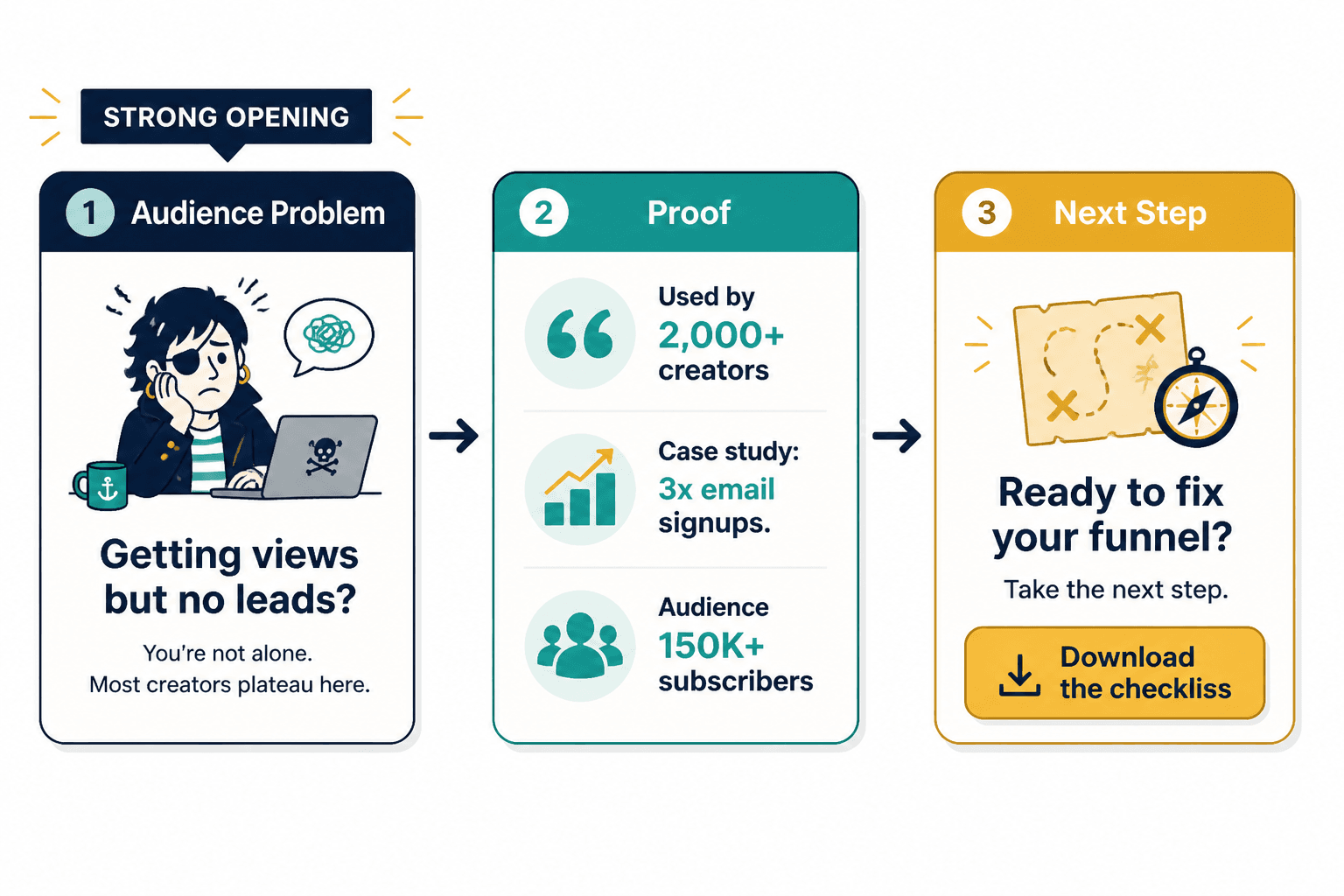
1. Lead with the real problem, not the category
Do not open with “I help creators build funnels.” That is a category label. It tells me what bucket you live in, not why I should care.
Open with the friction your audience already feels.
- “Getting views but no leads? Your funnel probably starts too late.”
- “If people like your content but never click through, your opening is likely too vague.”
- “Most creator funnels lose good prospects before the offer even appears.”
That is stronger because it meets the reader in a live problem, not a business category.
2. Make the audience visible
Specific audiences trust specific language. Broad audiences trust almost nothing.
Compare these:
- Weak: “I help entrepreneurs grow with funnels.”
- Stronger: “I help coaches and service-based creators turn educational content into qualified leads.”
The second line excludes people. Good. Exclusion creates clarity. Clarity creates clicks from the right people.
3. Show the outcome without inflating it
You do not need to promise six figures by Thursday. You do need to state the outcome in plain English.
- More booked calls
- More email signups from content
- Better-fit leads
- A cleaner path from post to offer
- Less drop-off at the top of the funnel
Quietly useful beats wildly inflated. The internet has enough dramatic nonsense already.
4. Add a reason to believe you
Credibility does not need to be chest-thumping. But you do need some kind of proof, signal, or grounded point of view.
- “After reviewing dozens of creator funnels, the same opening mistake shows up again and again.”
- “This works especially well for creators with small audiences because it reduces friction early.”
- “The difference usually is not the offer. It is how the funnel frames the problem in the first few lines.”
You are not trying to win a debate. You are trying to sound like someone who has actually seen the problem up close.
5. Give a clear next step
A funnel opening is not complete until the next move feels obvious.
- Read the guide
- Watch the walkthrough
- Download the checklist
- Join the email list
- Book the consult
If the opening creates interest but the next step is muddy, the funnel still leaks.
Where creators usually weaken the opening
Most weak openings come from one of a few repeat mistakes. Once you know them, you start seeing them everywhere.
They open with themselves instead of the reader
“Hi, I’m a creator strategist passionate about helping…” is not a strong opening. It is a bio fragment pretending to be a hook.
The reader cares about themselves first. Start there. You can introduce yourself after they know why they should stay.
They use category words instead of real tension
Words like growth, visibility, scale, success, and impact are not useless. They are just too foggy to do much heavy lifting on their own.
Tension is stronger than category language. “Posting every week and still getting weak leads” says more than “improve your visibility.”
They sound polished but not believable
There is a style of funnel writing that sounds technically correct and emotionally empty. Very clean. Very smooth. Very dead behind the eyes.
If your opening sounds like it came from a content template that has never met your audience, people can feel that. Maybe not consciously, but they feel it.
If you need help fixing that tone problem across the whole funnel, read how to write creator funnels without sounding salesy or robotic.
They try to say everything at once
One line cannot explain your audience, your philosophy, your process, your offer, your personality, and your entire worldview. Pick the most useful tension and start there.
A strong opening creates momentum. It does not attempt to win custody of every possible idea.
Better opening formulas for creator funnels
You do not need a rigid script, but a few reliable patterns can save you from fluffy nonsense.
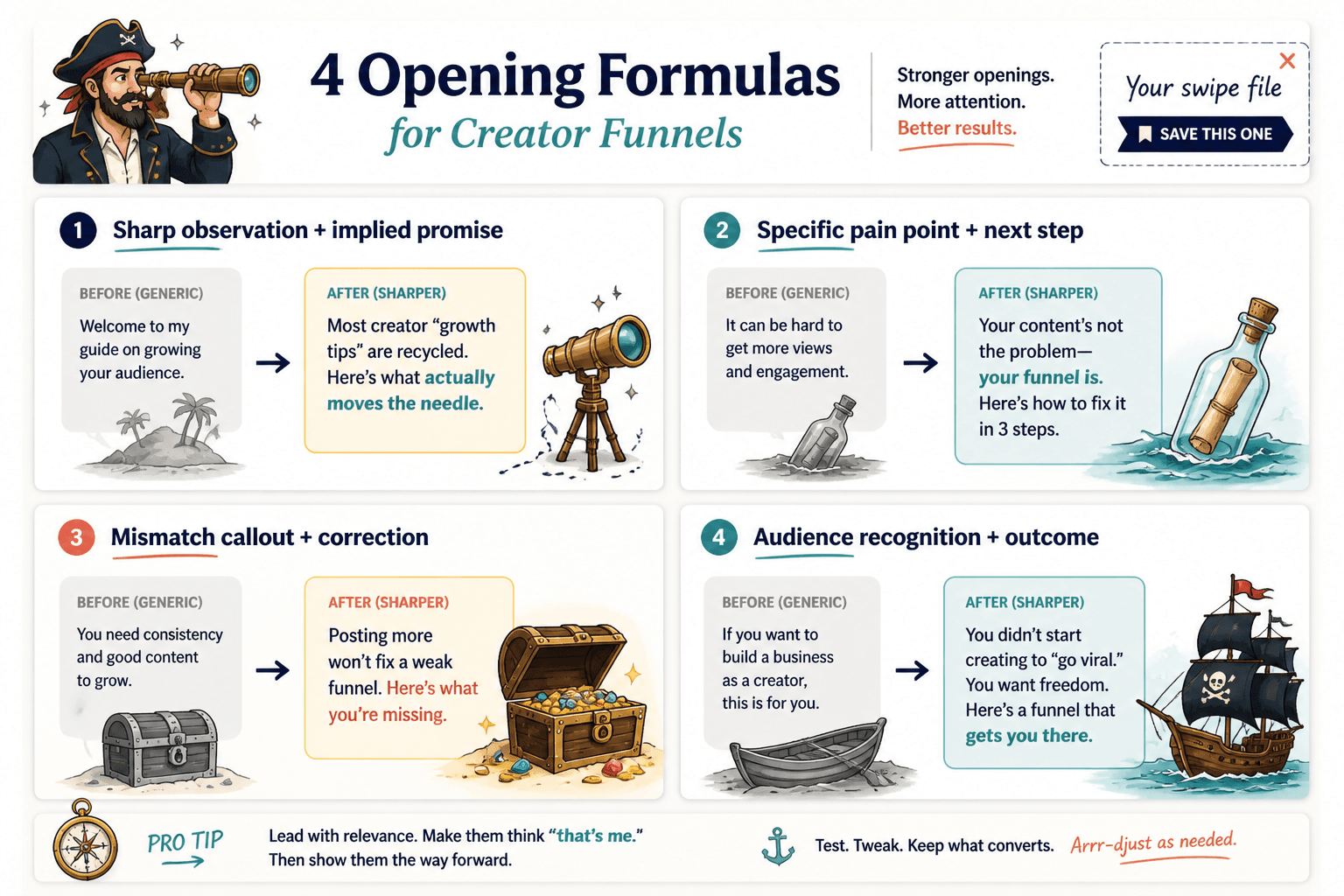
Problem + consequence + next step
Template: If you are dealing with [specific problem], you are probably losing [valuable outcome]. Here is [resource or next step] to fix it.
Example: If your content gets attention but your funnel gets ignored, you are probably losing leads at the first step. Here is a simple framework to tighten your opening and improve conversions.
Mistake + correction
Template: Most creators think [common assumption]. Usually, the real issue is [actual issue].
Example: Most creators think their funnel problem is traffic. Usually, the real issue is that the opening never makes a clear case for continuing.
Audience + desired outcome + obstacle
Template: For [specific audience] who want [outcome], the hardest part is often [obstacle].
Example: For coaches who want more consult calls from content, the hardest part is often not the offer. It is building an opening that makes the funnel feel relevant before the pitch ever arrives.
Sharp observation + implied promise
Template: [Strong observation]. Here is how to fix it.
Example: A lot of creator funnels start with a promise so broad it could fit on a tote bag. Here is how to open with something people might actually care about.
For more ways to improve the structure around those openings, this guide on how to improve creator funnels platform funnels without sounding generic will help you sharpen the rest of the journey too.
Before-and-after rewrites
Sometimes the fastest way to improve your funnel opening is to see what stronger looks like side by side.
Landing page opening
- Before: “Welcome to my funnel strategy system for creators looking to scale with ease.”
- After: “If your content is getting attention but not turning into leads, your funnel probably is asking for too much trust too early. This guide shows you how to fix the opening first.”
Lead magnet intro
- Before: “This ebook will teach you everything you need to know about funnels.”
- After: “This is for creators whose content already has value but whose funnel still feels limp at the top. You do not need more noise. You need a stronger first step.”
Email welcome sequence
- Before: “Thanks for joining my newsletter where I share tips on growth and marketing.”
- After: “You are here because you want content that leads somewhere useful, not just more likes and polite applause. Good. That is the gap we are fixing.”
Social post leading into funnel
- Before: “Want to improve your funnel? Comment below.”
- After: “If your posts get engagement but almost nobody clicks through, your funnel opening is probably too vague. I made a short guide that shows how to tighten it without sounding pushy.”
If your existing draft still sounds flat, this is a good time to use a rewrite process. How to rewrite boring creator funnels can help you strip out the safe-but-empty language and replace it with something that actually moves.
A simple opening checklist before you publish
Run your funnel opening through this quick filter.
- Does it name a real problem instead of a broad category?
- Does it sound like it is for a specific audience?
- Does it hint at a useful outcome?
- Does it feel believable, not inflated?
- Does it earn the next click or step?
- Would the right person recognize themselves in it quickly?
- Could this line belong to anyone, or does it sound like your angle?
If you answer “no” to two or three of those, do not publish yet. Tighten the opening first. The top of the funnel is not the place to be vague and hope your charm carries the rest.
How funnel openings change by format
The same principle applies across formats, but the execution should shift depending on where the opening appears.
| Format | Best opening focus | What to avoid |
|---|---|---|
| Social post | Immediate tension or observation | Soft intros and generic “tips” framing |
| Landing page | Problem, audience, and next step | Brand slogans and vague transformation promises |
| Lead magnet | Clear use case and practical payoff | Overpromising everything under the sun |
| Welcome email | Expectation setting with relevance | Cold corporate intros |
| Sales page | Pain, stakes, and fit | Pitching before the problem feels real |
Different format, same job: earn attention from the right person and make the next step feel worth it.
Do not confuse clever with strong
This is worth saying because creators love clever. A clever opening can be fun. It can also quietly tank your funnel if the reader has to decode it before understanding the point.
Strong beats clever. Clear beats stylish. Relevance beats performance.
You can absolutely have personality. You should. But if your opening sounds like a riddle wrapped in a brand voice, people will leave before they discover how witty you were being.
And if your real goal is leads or sales, not compliments on your prose, this matters quite a lot.
How to connect a strong opening to actual conversions
A strong opening is not the whole funnel. It is the part that makes the rest possible.
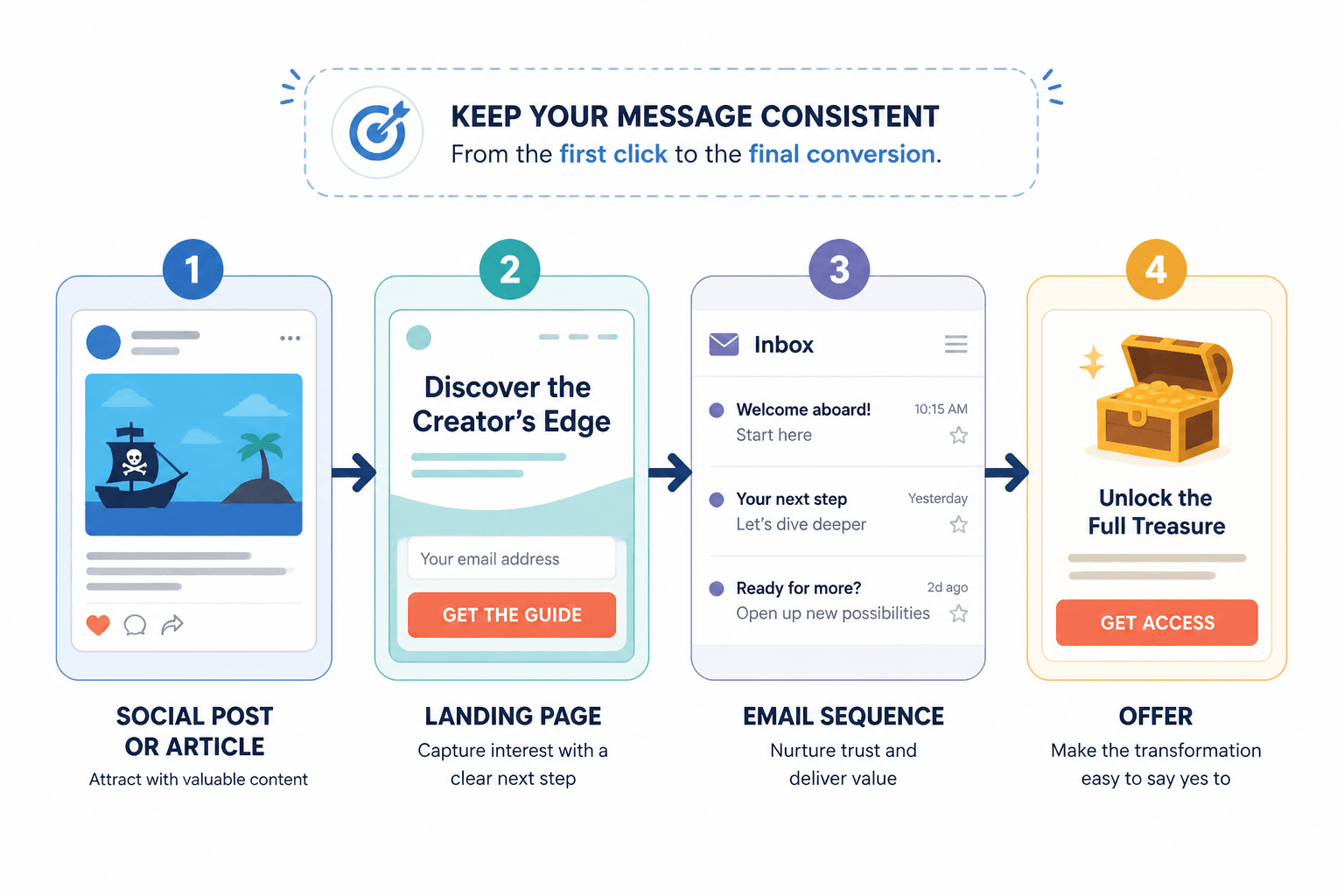
Once the opening works, the rest of the funnel needs to keep the same promise. The landing page should match the post. The lead magnet should solve the problem the opening named. The emails should deepen trust instead of swerving into random sales energy. The offer should feel like the next logical step, not a trap door.
That alignment matters more than people think. A strong opening followed by a weak handoff still loses people. The message has to feel consistent all the way through.
If your goal is not just a better top-of-funnel line but more actual business from it, read how to turn creator funnels into more leads or sales. That is where the opening starts paying rent.
It also helps to explore the broader funnel structure through the site’s monetization content, including the main areas on monetization funnels and funnel systems.
FAQ
How long should a funnel opening be?
Usually shorter than you think. One to three sharp lines is often enough to create relevance and momentum.
Should I start with a question?
Only if it is a real, specific question. “Want more leads?” is tired. “Posting consistently but still getting weak-fit inquiries?” is much better.
Can a creator funnel opening be personal?
Yes, if the personal detail helps frame the reader’s problem. Personal is useful when it adds context, not when it delays the point.
What is the biggest mistake in creator funnel openings?
Trying to sound broadly professional instead of specifically relevant. It feels safer, but it converts worse.
Start tighter, not louder
If you want to get better at How to Start Creator Funnels Without a Weak Opening, do not chase louder copy, fancier hooks, or more dramatic promises. Start tighter.
Name the real problem. Speak to the right person. Make the payoff clear. Give them a believable reason to continue.
That is what strong funnel openings do. They do not perform. They connect.
Creator funnels get better when the path feels simpler and the writing makes each next step obvious. A cleaner message usually fixes more than extra funnel complexity ever will.