
Most welcome emails waste the best moment in your email relationship.
Someone just subscribed. They are paying attention right now. They are curious right now. And a lot of creators respond with a welcome email that says, in essence, “Hey friend, thanks for being here,” followed by a vague life story and no clue what happens next.
That is not a welcome. That is administrative drift.
If you want Simple Welcome Emails Reader Expectations Templates for Busy Creators to actually do their job, the goal is not to sound warm and profound. The goal is to help new subscribers quickly understand what they signed up for, why it is worth opening, and what they should do next.
That is what this article covers: how to set reader expectations in a simple welcome email, what to include, what to skip, and ready-to-use templates you can adapt fast without sounding like a robot in a cardigan.
For the full path around this topic, head to the parent guide.
Why reader expectations matter more than your brand backstory
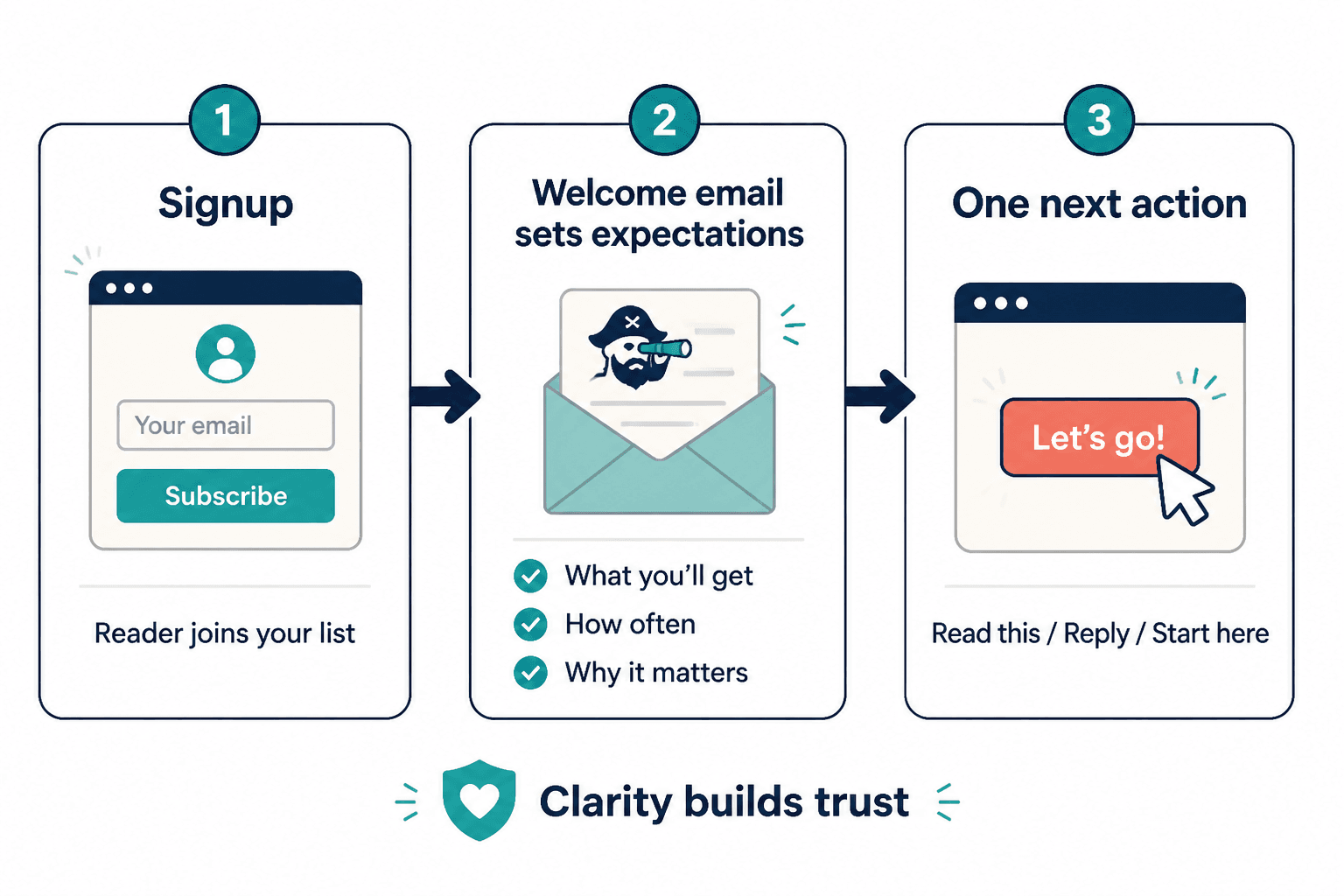
When someone joins your list, they usually have three immediate questions:
- What am I going to get?
- How often will you email me?
- Is this worth paying attention to?
Your welcome email should answer those quickly.
Busy creators often overcomplicate this because they think the first email needs to impress people. It does not. It needs to orient them. A clear, useful welcome beats a “beautifully written” email that leaves the reader unsure what they just subscribed to.
In other words, your first job is not charm. It is clarity.
That does not mean your email should sound sterile. It just means you should stop making people work to understand your newsletter. If the reader has to decode your vibe before they understand the value, you are already adding friction where you should be building trust.
What a simple welcome email should actually do
A strong welcome email usually handles five things:
- Confirms the signup mattered
- States what kind of emails the reader will get
- Sets frequency expectations
- Gives one simple next step
- Establishes your tone and relevance without rambling
That is the core structure. Not ten sections. Not a founder memoir. Not three links, two asks, and a soft pitch pretending not to be a pitch.
If you want a broader overview of how these emails fit into your newsletter system, this email newsletter writing guide and the section on creator email systems will help. For more welcome-email-specific strategy, see welcome emails for creators.
The minimum viable structure
If you are busy and need the stripped-down version, here it is:
- Thank them for joining
- Tell them what they will receive
- Tell them how often you will send it
- Tell them what to do next
That alone puts you ahead of a lot of welcome emails floating around the internet.
What to include in your reader expectations email
Let’s make this practical. These are the pieces worth including in a welcome email that sets expectations well.
1. A quick, grounded welcome
You do not need a grand opening. A simple line works:
Thanks for subscribing. Glad you are here.
Or:
You are in. Thanks for joining the list.
Short is fine. The point is to confirm the action and move forward.
2. A clear description of what they signed up for
This is where many creators get vague. They say things like “I share thoughts on creativity, business, and life.” That tells the reader almost nothing.
Try something more specific:
- Each week, I send one short email on writing sharper content, building trust online, and turning expertise into clients.
- You will get practical newsletter tips, welcome email ideas, and simple systems for creators who do not want to live inside a marketing dashboard.
- I send quick lessons on email strategy, reader trust, and writing that sounds like a person, not a funnel template.
Specificity makes the subscription feel real. It also reduces unsubscribes from people who were expecting something else entirely.
3. Frequency expectations
This is simple and surprisingly important. Tell people how often they will hear from you.
- Every Tuesday
- Once a week
- Usually 2 emails a month
- A few times a month when I have something worth sending
You do not need military precision if your schedule is flexible. But “I will email sometimes” feels sloppy. “Usually once a week” feels normal and human.
And if you also send launch emails or occasional promos, say so. Not in a creepy legal-disclosure way. Just plainly. People handle honesty far better than surprise.
4. A reason to keep opening
This part answers the silent question: why should I care?
You can frame it around outcomes, usefulness, or the kind of perspective you bring. For example:
- I keep these emails short, practical, and focused on things you can actually use.
- Expect examples, templates, and the occasional opinion about what creators keep overcomplicating.
- I write for people who want better emails without sounding fake, fluffy, or weirdly over-optimized.
This is where your voice earns its keep. You are not just describing the content. You are telling the reader what kind of experience to expect.
5. One next action
Give them one thing to do. One.
- Read your best starter article
- Reply with what they are working on
- Download the promised freebie
- Add your email to their primary inbox or contacts
If you stack four requests in the first email, you create clutter. Pick the next action that most helps the relationship.
What to skip in a simple welcome email
Some things are not wrong exactly. They are just not helping.
- Your full origin story. Save it for later unless it directly explains the value of the newsletter.
- Too much throat-clearing. “I have been thinking a lot lately…” is usually a sign you should cut the first paragraph.
- Multiple offers. A welcome email is not a buffet line.
- Fake intimacy. “We are on this journey together” is a lot for minute one.
- Vague promises. “Insights, inspiration, and value” is content wallpaper.
A welcome email should reduce uncertainty, not introduce new forms of it.
Simple welcome email reader expectations templates for busy creators
Here are practical templates you can use as-is or adapt. Keep the bones. Change the tone to fit your brand.
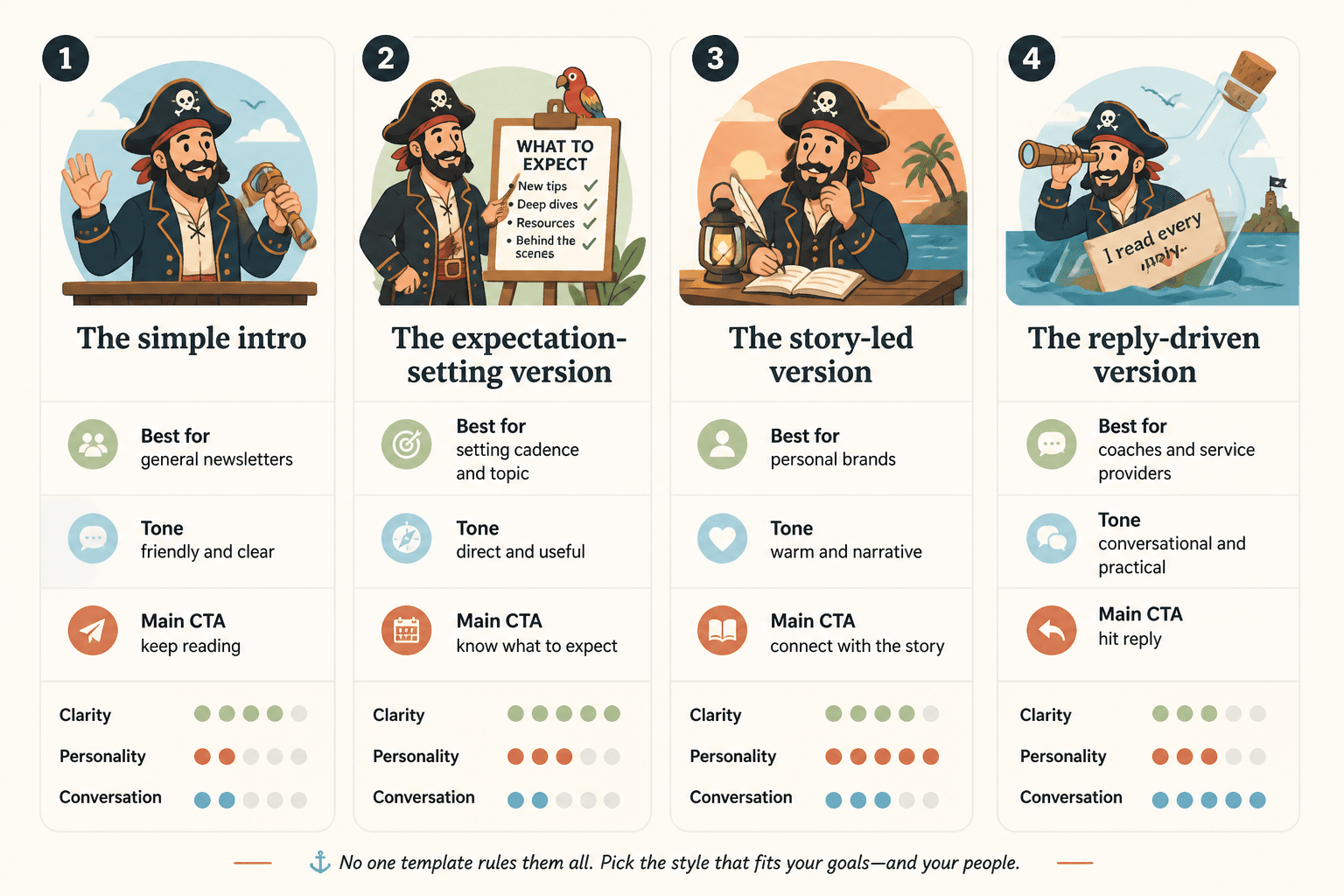
Template 1: The clean and simple version
Subject: You’re in
Thanks for subscribing.
Here’s what to expect: I send one short email each week with practical ideas on [topic]. The focus is simple: [outcome].
No endless rambling. No recycled fluff. Just useful stuff you can apply fast.
To start, here’s a good place to begin: [link/resource]
Glad you’re here,
[Name]
This works well for writers, consultants, and creators who want a straightforward, low-maintenance first email.
Template 2: The personality-forward version
Subject: What you signed up for
You just joined a newsletter about [topic], so here is the useful version of the welcome email.
I send [frequency] emails with [type of value]. Think [examples], not generic “thought leadership” that says a lot and means nothing.
If you stay subscribed, expect [tone/format benefit].
First step: [one action]
If you ever want to reply and tell me what you’re working on, I read those.
— [Name]
This one is good if your brand voice is sharper and a little more opinionated.
Template 3: The lead magnet follow-up version
Subject: Your [freebie] + what comes next
Here’s your [freebie]: [link]
Also, so you know what happens next: I send [frequency] emails on [topic]. They are designed to help you [result].
You’ll usually get [format/examples]. Occasionally I will also share paid offers when they are relevant. No constant pitching.
If you want the best next read, start here: [link]
— [Name]
This is useful when someone subscribed for a checklist, guide, template, or workshop replay and you want to transition them into the actual newsletter without making it awkward.
Template 4: The reply-driven version
Subject: Quick welcome
Glad you joined.
I send [frequency] emails about [topic], with a focus on helping [audience] do [result].
They are usually short, practical, and built around examples you can steal without guilt.
If you want, hit reply and tell me the main thing you are trying to improve right now. I cannot answer every email instantly, but I do read them.
— [Name]
This is a smart option if conversation and audience research matter to your business. It works especially well for coaches, consultants, and service providers.
Before and after: a weak welcome email fixed
Here is the kind of welcome email people write when they are trying to sound thoughtful instead of useful.
Before
Hi friend,
I’m so excited to welcome you to my little corner of the internet. This newsletter has been on my heart for a long time, and I cannot wait to share insights, inspiration, personal stories, and so much more with you on this journey.
I believe deeply in authenticity, alignment, and building a life that feels true. Stay tuned for future emails.
What is wrong with it?
- No clear topic
- No expectations
- No frequency
- No next step
- Way too much vague emotional frosting
After
Hi,
Thanks for subscribing.
I send one email a week on writing better newsletters and welcome emails that feel human and actually get read.
Expect practical examples, simple templates, and honest advice on what creators should stop doing immediately.
If you want a good place to start, read this next: welcome emails guide for creators who want better results.
Glad you’re here,
[Name]
Not glamorous. Much better.
A quick framework you can use in 10 minutes
If you need to write your welcome email today and move on with your life, use this fill-in structure:
- Welcome: Thanks for subscribing.
- Content promise: I send [frequency] emails about [topic].
- Reader benefit: The goal is to help you [result].
- Style expectation: Expect [format/tone/examples].
- Next step: Start here / reply here / download this.
Example:
The bigger point is simple: clearer structure and clearer writing make the piece more useful. That is usually what makes the ending land better too.