
A welcome email that gets opened but does not move anyone forward is expensive in the most annoying way possible: it burns trust, produces weak leads, and leaves sales looking harder than they should. The inbox gave you attention. The sequence then spent it on polite nothing. That is not automation. That is busywork with a dashboard.
The fix is not to make welcome emails louder. It is to make them clearer. A good sequence confirms the signup, proves the reader made a smart choice, gives one useful next step, and earns the right to ask for a deeper action. That is the whole job. Everything else is decoration with better branding.
If you want the broader system around this, start with the welcome emails parent guide. If you want the writing side, see how to write better welcome emails. For more sequence examples, browse the welcome email examples roundup. For tooling, there is also a practical guide to AI tools for welcome emails.
What a welcome email has to do before it can sell
A welcome email is not just a receipt with manners. It is the first real chance to answer three questions:
- Did I sign up for the right thing?
- Can I trust this person or brand?
- What should I do next?
If the sequence fails any of those, the sale gets weaker later. Conversion usually does not die in one dramatic moment. It leaks away through vague positioning, too many CTAs, and offers that show up before the reader understands why they matter.
The cleanest welcome sequence usually follows a simple arc:
- Confirm the promise – remind the reader what they joined for.
- Build credibility – show enough proof to reduce hesitation.
- Give immediate value – help them get a win quickly.
- Introduce the next step – offer a logical path forward.
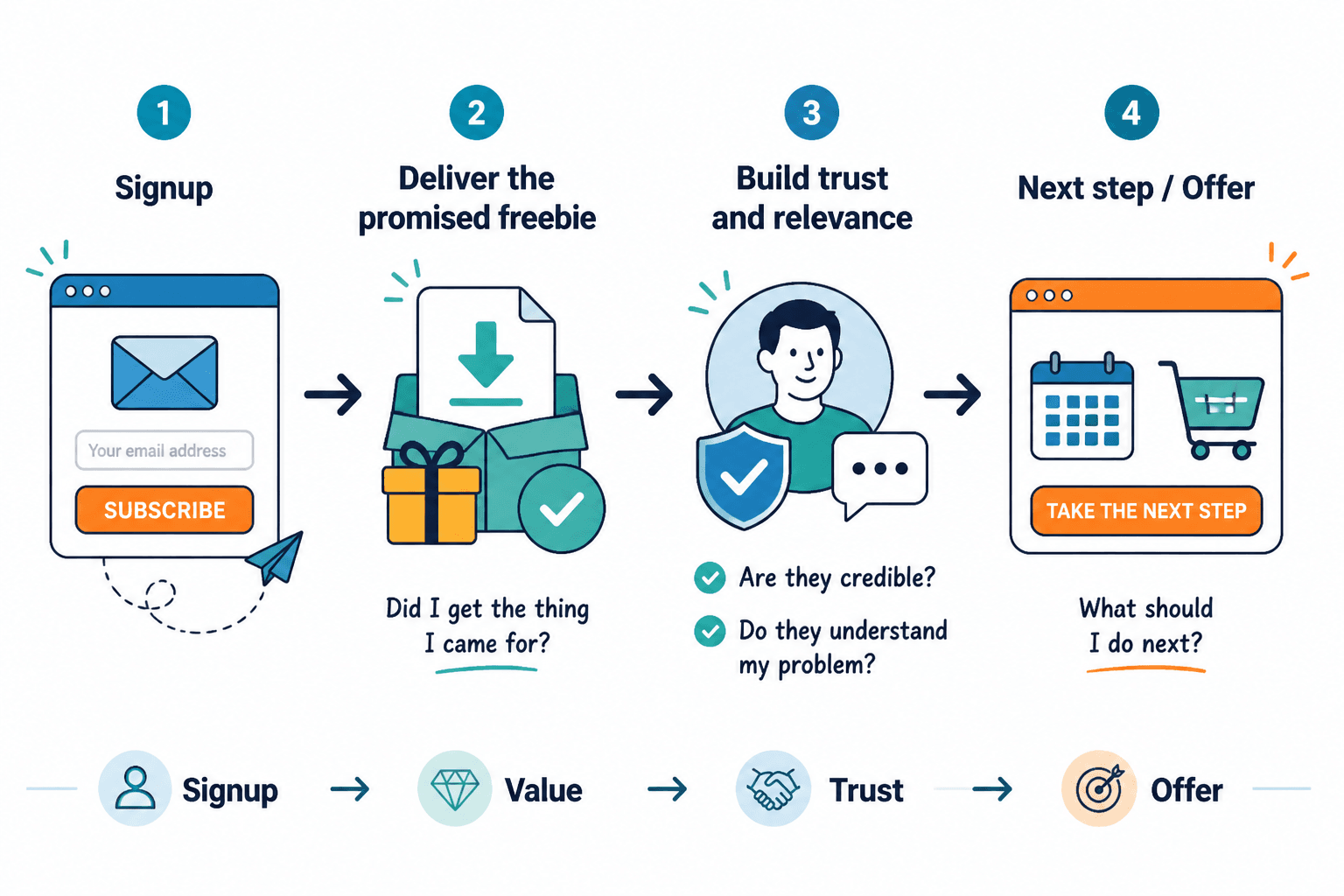
The simplest conversion path: promise, proof, value, next step
If the sequence feels fuzzy, this is the structure to use. It works because it matches how people decide. First they check relevance. Then they look for evidence. Then they look for a useful result. Only after that do they want the offer.
Here is a practical version:
- Promise: “You signed up for X, so here is what you will get.”
- Proof: a short credential, result, or reason to trust the method.
- Value: one action, insight, or resource they can use now.
- Next step: one clear CTA that matches the email’s purpose.
That last part matters. The CTA should feel like the next sensible move, not a nervous sales apology.
What to say in the first email
The first email has the most leverage and the least patience. It should do a few things well, not eight things badly.
Use it to:
- thank the subscriber without wasting the first screenful on filler,
- remind them what they asked for,
- set expectations for what happens next,
- give one quick win, and
- point them toward a single next step.
That next step can be a content link, a reply prompt, a resource download, or a direct offer, depending on the sequence goal. The main rule is simple: do not make the reader choose between five equally average paths.
How to choose the right CTA
Most welcome emails do not fail because the writing is bad. They fail because the CTA is weirdly timid, muddy, or trying so hard not to sound “salesy” that it stops being useful. A soft CTA is only useful if it still points somewhere.
Good CTAs in welcome emails usually do one of these jobs:
- invite the reader to read a best-fit resource,
- ask them to reply with a need or goal,
- move them into a short funnel,
- offer a small paid next step, or
- invite them to book, buy, or compare.
What to avoid:
- being soft by being vague,
- offering too many next steps at once,
- hiding the CTA in polite mush,
- asking for a big commitment too early,
- using a CTA that does not match the email’s point, and
- making the CTA sound like a legal disclaimer.
If you want a deeper breakdown of the CTA problem, see welcome email soft CTA mistakes that hurt performance.

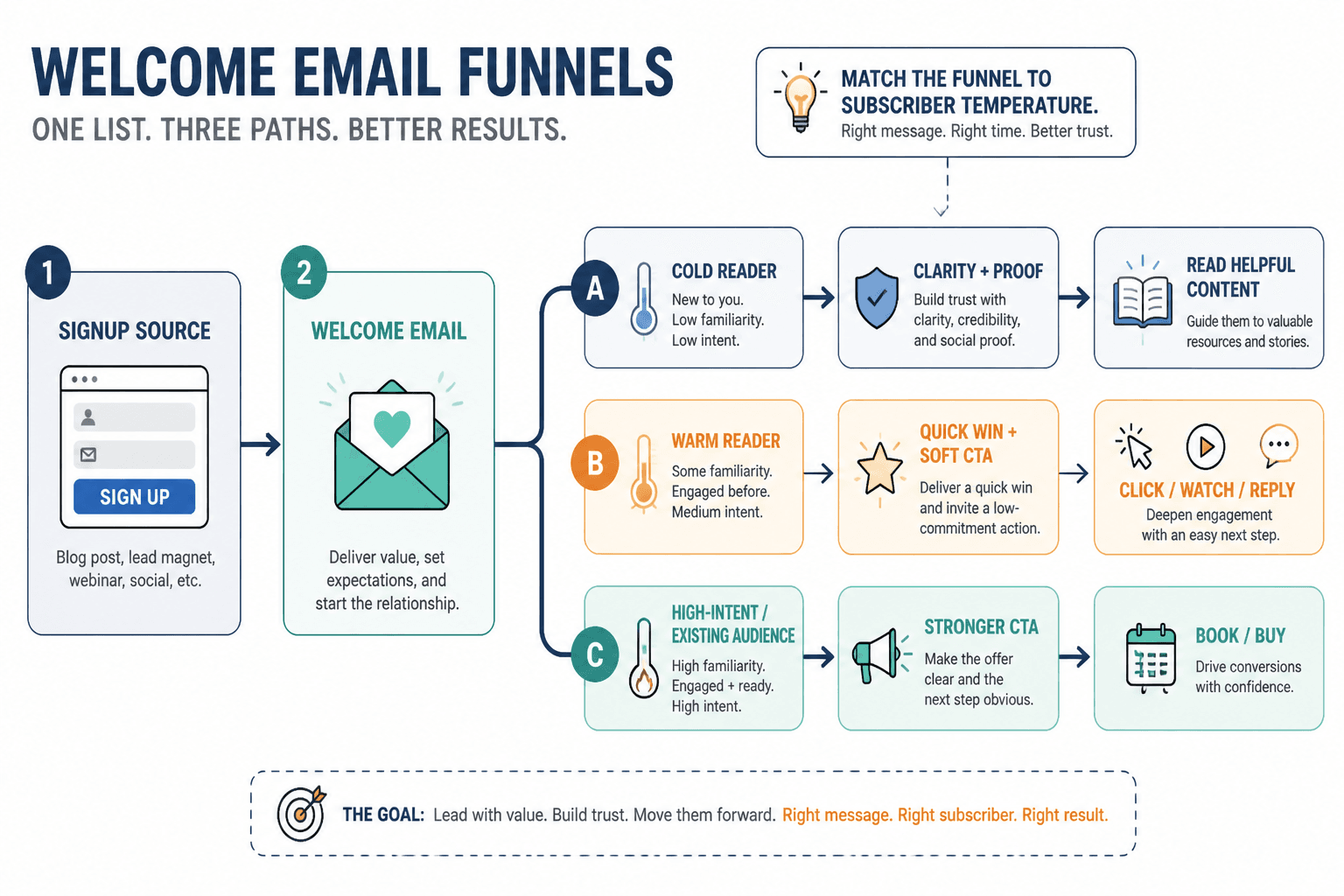
Best funnel paths to pair with welcome emails
Not every welcome email should sell directly. Sometimes the right move is to route the reader into a better-fit funnel first. That keeps the sequence aligned with intent instead of forcing a purchase before the relationship is ready.
Use the right funnel for the job:
1. The best-of content funnel
Best when the subscriber is still orienting themselves. Send them to your strongest related pieces so they can see the depth of your thinking without getting overwhelmed.
2. The quick-win resource funnel
Best when the signup promise was practical. Give them one fast result they can use right away, then point to a paid path if the problem is bigger than the free fix.
3. The segmentation funnel
Best when subscriber intent varies. Ask a short choice question or link to paths by goal, then tailor the next email based on the answer.
4. The reply-and-conversation funnel
Best when trust matters more than speed. A reply prompt can surface objections, qualify needs, and start a real conversation instead of a cold push.
5. The case study funnel
Best when the product or service needs proof. Use a concrete example, then send the reader to a relevant offer or deeper explanation.
If you want to compare these in more detail, see best funnel ideas to pair with welcome emails.
How to monetize without wrecking trust
The rule is not “never sell in welcome emails.” The rule is lead with alignment, not extraction. If the reader just signed up because they want help with a problem, the sequence should show that you understand the problem before it starts asking for money.
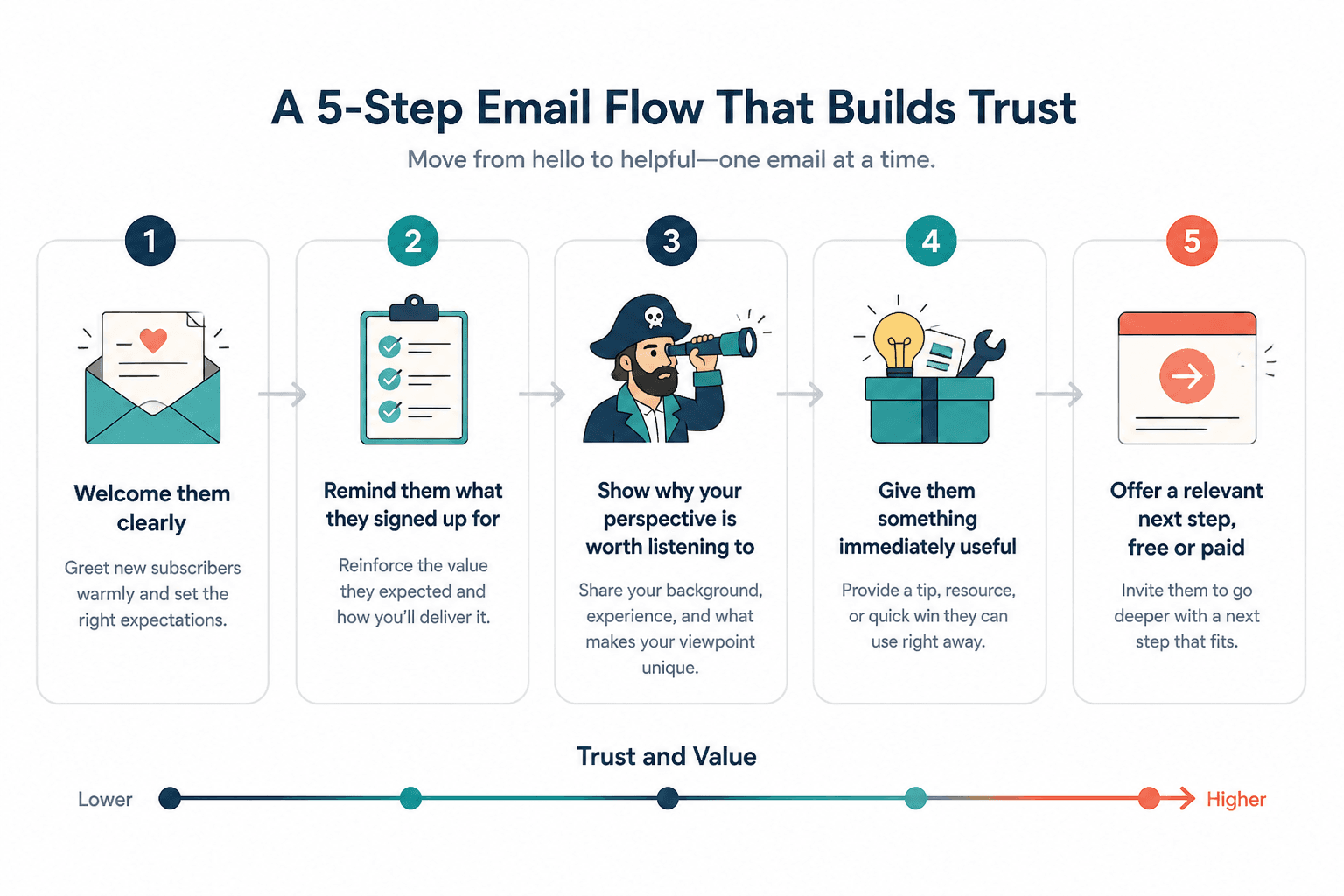
A monetized welcome email should usually do four things:
- Confirm the promise
- Build credibility fast
- Give immediate value
- Introduce a paid path that feels like a logical next step
That paid path can be a product, service, paid resource, consultation, or course. The exact offer matters less than whether it fits the reason the subscriber joined in the first place.
A useful test: if you removed the product name, would the email still feel helpful? If not, it probably leans too hard on the sale and too lightly on the substance.
For a deeper guide to the trust side of this, see how to monetize welcome emails without wrecking trust.
When it makes sense to sell in the first welcome email
Sometimes the first email should include a direct offer. That is fine when the signup intent is already commercial. Examples include:
- someone requested pricing,
- someone joined from a product page,
- someone downloaded a buyer-intent lead magnet, or
- someone subscribed specifically to hear about services, memberships, or launch updates.
In those cases, the goal is not to pretend the sale does not exist. The goal is to make the offer feel expected, relevant, and easy to evaluate.
If the signup was low-intent, keep the first email lighter. Earn the sale with sequence logic, not a surprise invoice in the inbox.
Common mistakes that kill conversion
Welcome emails usually lose money in predictable ways. The good news is that they are fixable.
- Too many goals: one email trying to educate, sell, segment, and entertain usually does none of them well.
- Too much softness: vague CTAs create hesitation instead of reducing it.
- Too much reassurance: endless hedging can make the offer feel suspicious.
- Too much haste: pushing a big sale before trust exists makes the sequence feel needy.
- Too little structure: without a clear progression, the emails read like isolated notes instead of a path.
That “path” part is where the money lives. A sequence that earns attention but never directs it is just a nicer inbox distraction.
How to measure whether the sequence is working
Open rates matter less than the behavior that follows them. Look at the metrics that show whether the sequence is moving people forward.
- Click-through rate: are people taking the next step?
- Reply rate: are they engaging in a way that signals trust?
- Conversion to lead: are they booking, downloading, or opting into a deeper path?
- Conversion to sale: are the right people buying?
- Drop-off by email: where do readers stop moving?
If the first email opens well but clicks poorly, the issue is usually the CTA or the offer match. If clicks happen but sales do not, the landing page or offer promise may be misaligned. The sequence is often blamed for problems that belong to the entire funnel. Annoying, but not mysterious.
For delivery and inbox placement basics that affect whether welcome emails get seen at all, use the guidance from Google’s email sender guidelines, Mailchimp’s deliverability resources, and Campaign Monitor’s deliverability guide. Those will not write the email for you, but they do help keep good emails out of the weeds.
A simple checklist for turning welcome emails into leads or sales
- State the promise clearly in the first screenful.
- Give one useful action or resource quickly.
- Use one primary CTA per email.
- Match the CTA to the signup intent.
- Introduce the paid path only after the reader has context.
- Keep the sequence moving in a clear order.
- Measure clicks, replies, and downstream conversions, not just opens.
If you want more examples after this, the sibling pieces on soft CTA mistakes, funnel pairings, and trust-safe monetization are the natural next stops.
Welcome emails are usually treated like a courtesy. That is a waste. They are one of the few places where attention is already earned, context is fresh, and the next step can still feel obvious. Use that window well and the sequence starts doing real business work instead of just looking organized.