
Most welcome emails do one of two bad things.
They either act like a limp handshake with no direction at all, or they sprint straight into a pitch before the subscriber even remembers why they signed up. One is forgettable. The other feels a bit like getting invited in for tea and being handed a contract at the door.
If you want to know how to monetize welcome emails without wrecking trust, the answer is not “never sell.” It is “sell in a way that makes sense for the relationship, the timing, and the promise you just made.”
A good welcome email can absolutely make sales. It can point people toward a paid offer, a consultation, a product, a membership, a template pack, or a next step in your funnel. But it has to earn that move. If the email feels helpful, relevant, and sane, monetization feels like service. If it feels rushed, vague, or thirsty, it feels like bait-and-switch.
Here’s how to make welcome emails pull their commercial weight without sounding like a greased-up funnel from 2019.
For the full path around this topic, head to the parent guide.
Why welcome emails are such a touchy place to sell
Welcome emails sit in a weird little emotional window. Someone has just said yes to hearing from you. That is good. But they have not said yes to everything else yet.
They are curious, not committed. Interested, not loyal. They might be warm, but they are not yours. That means the first job of a welcome email is not maximizing revenue at all costs. It is reducing uncertainty.
Your reader wants to know:
- Did I sign up for the right thing?
- What am I going to get from this?
- Is this person actually useful?
- Are they going to spam me, pitch me constantly, or waste my time?
- What should I do next?
If your email answers those questions well, trust goes up. Once trust goes up, monetization gets easier. Not because you used a sneaky trick. Because people buy faster when they feel oriented.
This is also why a lot of creators get welcome monetization wrong. They focus on what they want the email to do instead of what the subscriber needs in order to stay engaged long enough to buy.
The rule: lead with alignment, not extraction
If you remember one thing, make it this: your welcome email should first confirm the signup decision, then deliver value, then introduce the right paid next step.
That sequence matters.
Too many welcome emails go straight from “thanks for subscribing” to “book a call” or “buy now.” That can work if someone signed up specifically because they were already sales-ready. But for most creator businesses, consultants, coaches, and personal brands, it is too abrupt.
A better order looks like this:
- Welcome them clearly
- Remind them what they signed up for
- Show them why your perspective is worth listening to
- Give them something immediately useful
- Offer a relevant next step, free or paid
Notice what is missing: panic. You do not need to force the sale into sentence three like rent is due by noon.
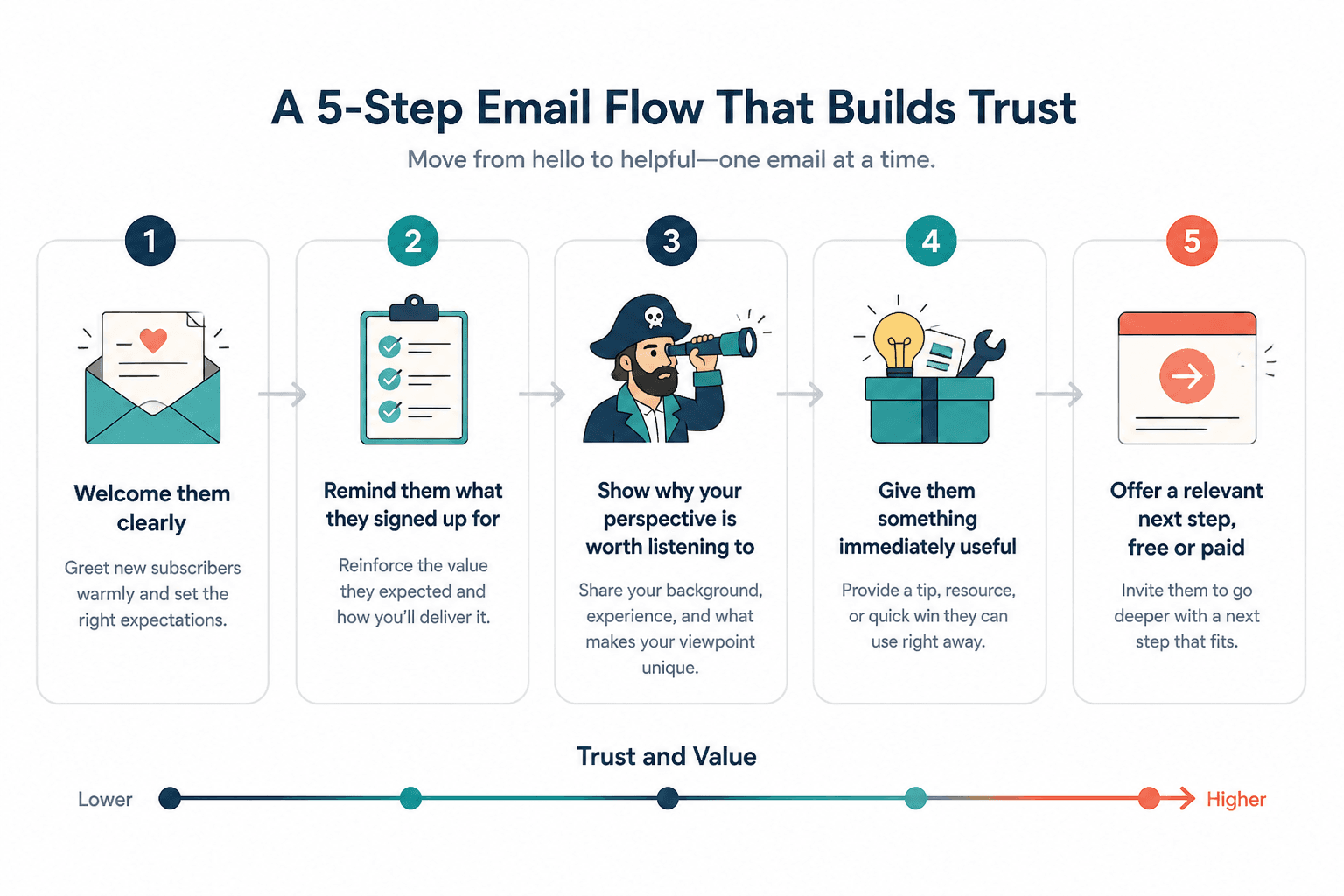
What a monetized welcome email should actually do
A welcome email that monetizes well usually does four jobs at once.
1. Confirm the promise
Remind people what they signed up for and what they can expect. This sounds basic because it is basic. It is also weirdly underdone.
Example:
You’re in. Over the next few weeks, I’ll send practical email and content advice for creators who want more leads without sounding like an overcaffeinated funnel goblin.
That line does a lot. It welcomes, positions, and sets tone. It tells the reader what kind of communication they are opting into.
2. Build credibility fast
You do not need a life story. You do need enough proof or perspective to make your advice feel grounded.
That proof might be:
- a quick result you have helped clients get
- your own area of expertise
- a clear opinion shaped by experience
- a useful framework that shows you know what you are doing
Keep it tight. Credibility in a welcome email should feel reassuring, not like a TED Talk audition.
3. Give immediate value
This is where trust gets real. A small but useful insight often does more for conversion than a giant “special offer” banner with fake urgency glued to it.
Immediate value could be:
- one practical tip they can apply today
- a short checklist
- a common mistake to avoid
- a framework for diagnosing their problem
- a link to your best relevant resource
For more on making welcome emails useful without making them stiff or robotic, this companion piece helps: How to Write Welcome Emails Without Sounding Salesy or Robotic.
4. Introduce a paid path that feels like a logical next step
This is the monetization part. It works best when it feels connected to the subscriber’s likely reason for signing up.
If they joined your list for help with email strategy, then offering an email audit, messaging template pack, or deeper resource makes sense. If they signed up for leadership tips and you immediately pitch a random workshop on productivity, the trust problem is not the pitch itself. It is the mismatch.
When it makes sense to monetize in the first welcome email
Yes, you can monetize in the first email. No, you should not always do it the same way.
Here is the simple version: the warmer the signup intent, the earlier you can sell.
If someone signed up after:
- reading your content for months
- attending a webinar
- downloading a highly specific lead magnet
- clicking from a sales-adjacent page
- inquiring about working with you
…then a direct paid next step can be perfectly reasonable.
If someone signed up from a cold social post, a broad homepage opt-in, or a generic “join my newsletter” box, they probably need a little more trust before you ask for money.
This is where nuance matters. Monetization is not just about where the offer appears. It is about how much context and fit the reader has when they see it.
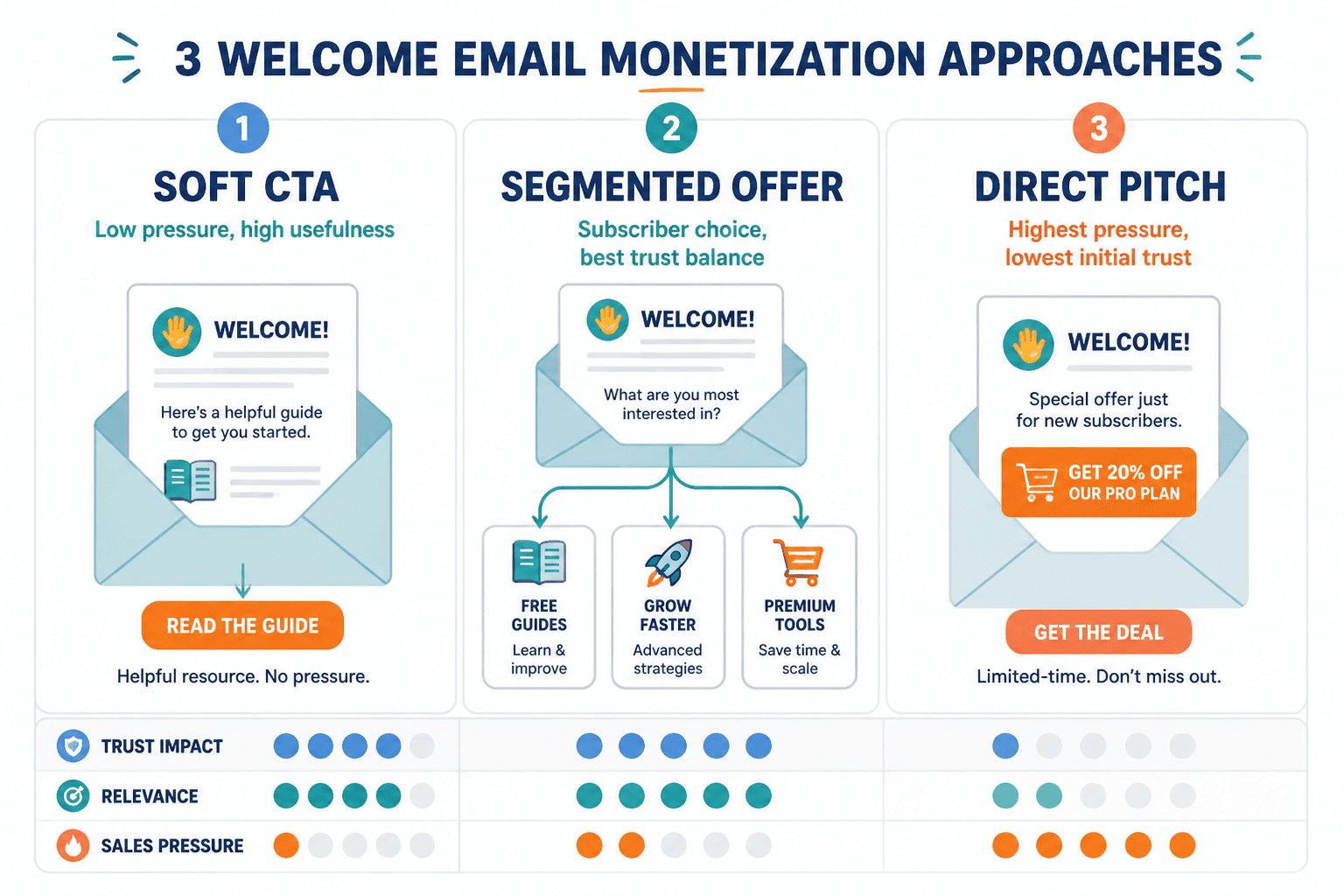
Three trust-safe ways to monetize welcome emails
If your goal is to make welcome emails profitable without making people regret subscribing, these are the three safest models.
The soft mention
This is the easiest one to get right. You deliver the welcome, give value, then lightly mention the paid offer as an optional next step.
Example:
If you want help applying this to your own welcome sequence, I also offer a welcome email teardown here. No pressure. It is just there if you are at that stage.
This works because it does not hijack the email. The sale is present, but it is not stomping around in boots.
The relevant resource bridge
Instead of pitching the main offer immediately, you send them to a helpful article, guide, or resource that naturally leads toward monetization.
For example, you might welcome the subscriber, explain what they will receive, then point them to:
This works especially well if your audience needs a bit more education before buying. It keeps the first interaction useful while still nudging people toward a commercial path.
The segmented offer
This is stronger and often more effective, but it needs a little care. You present a small set of relevant next steps based on where the subscriber is.
Example:
- If you are just getting your email system set up, start here
- If you want more leads from your welcome sequence, read this
- If you want hands-on help, here is my paid offer
Now the subscriber has agency. You are not forcing one path. You are helping them choose the right one. That feels more respectful, which usually helps conversion anyway.
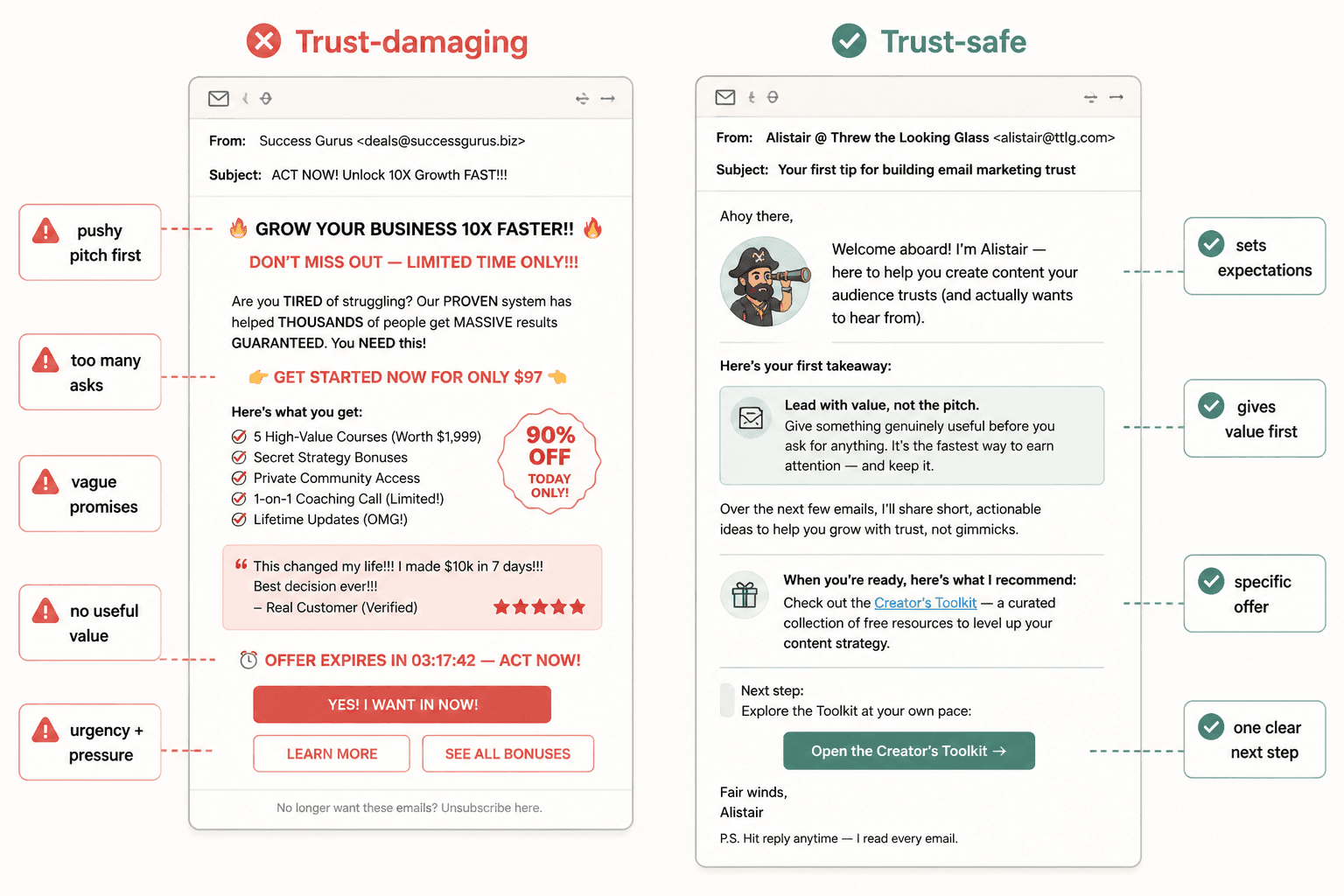
What wrecks trust fast
Some things make welcome email monetization feel gross almost immediately.
Pitching before delivering anything useful
If the first meaningful thing in your email is a paid ask, the subscriber has no reason to believe future emails will be any better.
Even one useful insight can change the feel of the whole email. It signals that you are here to help, not just harvest attention.
Acting like urgency exists when it clearly does not
“This offer expires tonight” in a welcome email sequence is often nonsense, and readers can smell nonsense. You do not need to cosplay scarcity to make sales.
If there is a real deadline, fine. Use it honestly. If there is not, do not invent one because some funnel template told you to.
Making the offer feel disconnected from the signup reason
Relevance is trust. Irrelevance is friction.
If the paid offer does not clearly relate to the subscriber’s intent, it feels opportunistic. You may still get a few purchases from highly motivated buyers, but you will quietly train everyone else to ignore you.
Writing in polished corporate paste
People are often more forgiving of a pitch than they are of fake warmth. If your welcome email sounds suspiciously “optimized,” trust drops before the offer even appears.
Say what you mean. Sound like a person. You are not writing airline safety instructions.
Trying to monetize every email in the sequence the same way
One welcome email can softly introduce the offer. Another can show proof. Another can answer objections. Another can simply give value and deepen trust.
If every message says “buy this” in slightly different fonts, subscribers will get the idea. And not the one you want.
A simple structure for monetized welcome emails
If you want something practical, here is a structure that works well for creators, consultants, coaches, and service businesses.
- Opening: welcome them and confirm the signup
- Expectation setting: say what they will get from your emails
- Quick value: teach one useful thing or point them to one strong resource
- Credibility cue: a short line that signals why your perspective is worth following
- Offer: present one relevant next step, ideally with low friction
- Close: reassure them and make the CTA feel optional but clear
That sequence is simple because simple tends to work. A welcome email does not need six psychological tricks and a paragraph of fake intimacy.
Template
You’re in.
Thanks for signing up for [what they joined for]. Over the next few emails, I’ll send you [specific value they can expect].
Quick thing before anything else: [one useful tip, framework, or mistake to avoid].
I help [audience] do [specific outcome], usually by fixing [relevant problem]. So that is the lens these emails will come from.
If you already know you want help with [specific problem], I have [paid offer] here: [CTA]
If not, no rush. Start with [free resource] and I’ll send more useful stuff soon.
Filled example
You’re in.
Thanks for joining for more practical email strategy. Over the next few weeks, I’ll send you sharper ways to write welcome emails, sell more cleanly, and stop losing leads to vague messaging.
Quick tip: most underperforming welcome emails do not fail because they are too short. They fail because they never make a clear transition from “thanks for joining” to “here is what to do next.”
I help creators and small service brands turn email subscribers into actual leads and sales without making the whole thing sound like a manipulative funnel experiment.
If you want help building or fixing your sequence, you can check out my welcome email review here: [CTA]
If you are not there yet, start with this instead: How to Write Welcome Emails Without Sounding Salesy or Robotic.
How to choose the right offer for a welcome email
Not every offer belongs in a welcome email. The best welcome-email offers share three traits:
- They solve a problem adjacent to the reason the person subscribed
- They are easy to understand quickly
- They do not require a giant trust leap
That usually makes these offers easier to introduce early:
- template packs
- mini offers
- audits
- entry-level workshops
- paid newsletters
- diagnostic calls for high-intent subscribers
- small digital products
These can still work, but often need more warming up first:
- high-ticket coaching
- done-for-you services with a longer sales cycle
- complex memberships
- offers that need heavy education before purchase
That does not mean you cannot mention a premium offer early. It means you should usually frame it as an option, not a forced destination.
Before-and-after: the same welcome email, two very different vibes
Weak version
Hi there,
Thanks for subscribing to my newsletter. I’m so excited to have you here. I help ambitious entrepreneurs unlock growth through authentic marketing strategies.
I currently have space for 1:1 coaching and I’d love to support you on your journey. Book a call now before spots fill up.
What is wrong with it?
- vague positioning
- no meaningful value
- instant pitch
- generic language
- trust leap is too big
Stronger version
Glad you’re here.
You signed up for practical content and email advice, so that is what you’ll get. Short lessons, sharper examples, and better ways to turn attention into actual business without posting like a borrowed thought leader.
One quick fix you can use now: if your welcome email ends with “stay tuned,” add a clear next step instead. Read something, reply to a question, book something, or use a resource. Direction beats politeness.
I help creators and consultants tighten their messaging and email funnels so subscribers do not just sit there looking decorative.
If you already want hands-on help, you can check out my welcome email audit here. If not, start with this: How to Turn Welcome Emails Into More Leads or Sales.
Same goal. Very different feel. The second version earns the offer by being specific, useful, and sane.
If you have a full welcome sequence, spread the monetization out
One reason people wreck trust is that they try to cram every job into one email. You do not always need to do that.
If you have a 3 to 5 email welcome sequence, distribute the work more intelligently.
- Email 1: welcome, expectation setting, useful insight, soft next step
- Email 2: stronger value, common mistake, proof or case-study angle
- Email 3: introduce or deepen the offer with context
- Email 4: handle objections or explain who the offer is for
- Email 5: final invitation or redirect to the best ongoing content path
This is usually a smarter way to monetize welcome emails without wrecking trust because it mirrors how trust actually builds. Not all at once. In layers.
If you want the bigger picture around welcome-email systems, these related pages are worth exploring: Welcome Emails, Creator Email Systems, and the broader Email Newsletter Writing section.
Small details that make monetized welcome emails feel more trustworthy
The bigger point is simple: clearer structure and clearer writing make the piece more useful. That is usually what makes the ending land better too.
Welcome emails work best when they set expectations clearly and move the relationship forward without overperforming. Clarity and trust do more than extra cleverness.