
Most offer messaging sounds bad for one of two reasons.
It is either aggressively salesy, full of inflated promises and funnel fumes, or it is so cautious and polished that it sounds like it was assembled by a committee of beige blazers. In both cases, the same thing happens: people read it, feel nothing, and move on.
If you want to learn how to write offer messaging & positioning without sounding salesy or robotic, the fix is not “use softer words.” It is not “sound more premium.” And it definitely is not adding three more lines about transformation, alignment, or impact.
The real fix is this: say something clear, specific, and believable about who you help, what you help them do, and why your way is worth paying attention to. That is positioning. Then express it like a competent human, not a pitch deck with a pulse.
This article will help you tighten your offer messaging, sharpen your positioning, and stop writing copy that sounds like it wandered out of a webinar funnel from eight years ago. We’ll cover what makes messaging feel robotic, what makes it feel trustworthy instead, and how to rewrite your words so they actually sound like you know what you do.
For the broader learning path, visit our parent guide.
Why offer messaging gets weird so fast
People usually do not write robotic messaging because they are bad at writing. They write robotic messaging because they are trying to sound legitimate.
So they reach for phrases that sound “professional,” “high-converting,” or “brand-forward,” and they end up with copy like this:
I help visionary entrepreneurs unlock aligned growth through bespoke strategic solutions.
That sentence is not impressive. It is fog wearing expensive shoes.
The problem is not just that it is vague. It also asks the reader to do too much interpretation. They have to guess who it is for, what you actually do, what kind of growth you mean, and whether “bespoke strategic solutions” is consulting, coaching, ghostwriting, or mild emotional manipulation.
Good offer messaging reduces mental effort. Bad messaging increases it. And online, people do not reward effort. They leave.
What strong offer messaging actually needs to do
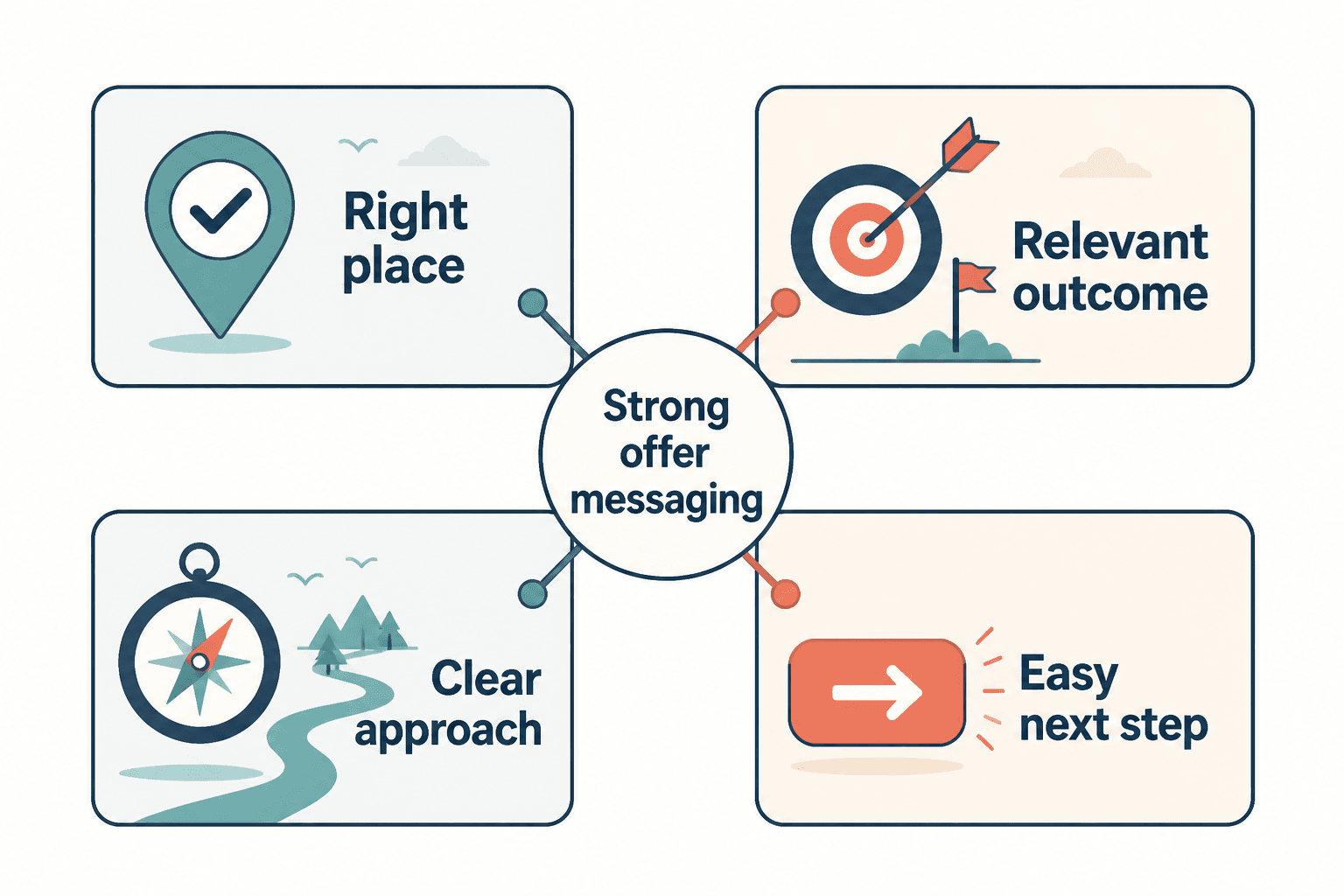
Your messaging does not need to sound clever. It needs to do four practical jobs fast:
- Show the reader they are in the right place
- Make the outcome feel relevant and concrete
- Explain your angle or approach clearly enough to feel distinct
- Make the next step feel easy and reasonable
That is it. Not a poem. Not a manifesto. Not a personality test disguised as a homepage.
If your offer messaging does those four things, it will usually feel more natural, more persuasive, and less salesy without trying too hard to be any of those things.
The simplest structure for offer messaging that sounds human
If you tend to overcomplicate your copy, use this basic structure:
- Who it is for
- What problem or goal they care about
- What you help them do
- How your approach is different or better
- What they should do next
That structure works on websites, landing pages, service pages, sales pages, profile bios, LinkedIn featured sections, and even short offer blurbs.
For example:
I help coaches and consultants tighten their website messaging so visitors understand the offer fast, trust it faster, and are more likely to book. No vague brand fog. No overdesigned word salad. Just clearer positioning and sharper copy that sells without sounding pushy.
That works because it is specific enough to picture. You know who it is for. You know the outcome. You know the style. You know the difference.
Notice what is missing: inflated identity language, dramatic promises, and random jargon trying to cosplay as sophistication.
How to write positioning without sounding like a template factory
Positioning is where many offers fall apart. Not because people ignore it, but because they flatten it into the same recycled line everyone else is using.
A positioning line should not just say what you do. It should help the right person quickly understand why your offer is relevant and why your version is worth a second look.
Bad positioning usually has one of these problems
- It is too broad
- It sounds like everybody else
- It focuses on your process before the buyer cares
- It uses vague aspirational words instead of concrete outcomes
- It tries to sound premium by becoming unreadable
Here is a weak line:
I help ambitious business owners scale with authentic marketing.
That tells me almost nothing. Which business owners? What kind of marketing? Scale from what to what? And “authentic” has been dragged through so much marketing mud that it barely means anything on its own anymore.
Now a stronger version:
I help service-based founders turn unclear website and content messaging into sharper positioning that attracts better-fit leads and makes selling easier.
Not flashy. Just useful. That is the point.
If you want more help with this part specifically, the pieces on improving positioning lines without sounding generic and writing better offer messaging and positioning are the natural next reads.
Use specificity, not hype, to make your offer sound stronger
One reason people become salesy is that they do not trust specificity enough. They think if they stop saying “transform,” “elevate,” or “unlock,” the offer will sound smaller.
Usually the opposite happens. Specificity makes the offer sound more real, and real is what buyers trust.
Compare these
- Salesy: Transform your brand presence and unlock sustainable business growth
- Specific: Clarify your messaging, sharpen your website copy, and make it easier for the right clients to understand why they should hire you
The second one works because the reader can imagine it. They can connect it to actual problems they have now: unclear copy, weak differentiation, low conversion, confusing offers.
This matters more than people think. Buyers do not trust vague promises because vague promises are cheap. Anyone can make them. Clear outcomes require actual understanding.
How to make your messaging sound less robotic
If your copy sounds robotic, it is usually because it is overprocessed. You are smoothing every line until all the life comes out of it.
Here is how to fix that without swinging into messy, oversharing “just being real” nonsense.
1. Write the way you explain it out loud
Imagine a smart client asks, “What exactly do you help with?” Your answer in a normal conversation is often better than the polished version on your website.
Why? Because spoken explanation tends to be clearer, more grounded, and less infected by brand language.
Try this: record yourself answering these questions naturally.
- Who do you help?
- What are they struggling with?
- What do you help them change?
- Why do clients choose your approach?
Then turn the strongest phrases from that recording into copy. Not every spoken sentence belongs on the page, but your natural phrasing usually contains better raw material than your over-edited version.
2. Stop replacing simple words with “professional” ones
People do this constantly:
| Say this | Not this |
|---|---|
| help | facilitate transformation |
| improve | optimize at scale |
| clearer | more aligned |
| sales | revenue acceleration |
| book more calls | increase qualified conversion opportunities |
You are not dumbing your copy down by using plain language. You are removing friction. There is a difference.
3. Add a real opinion or point of view
Robotic messaging often sounds bland because it is trying not to offend anyone. But a little perspective makes your copy feel more human and more trustworthy.
Examples:
- “You probably do not need a full rebrand. You need clearer words.”
- “Most low-converting service sites do not have a design problem first. They have a messaging problem.”
- “If people keep asking what you do, your offer page is being polite instead of clear.”
That kind of line gives your messaging a spine. Not fake controversy. Just visible thinking.
A practical rewrite process for salesy or robotic offer copy
If your current messaging feels off, do not start from scratch immediately. Rewrite it in passes.
Pass 1: Find the actual point
Take a sentence like this:
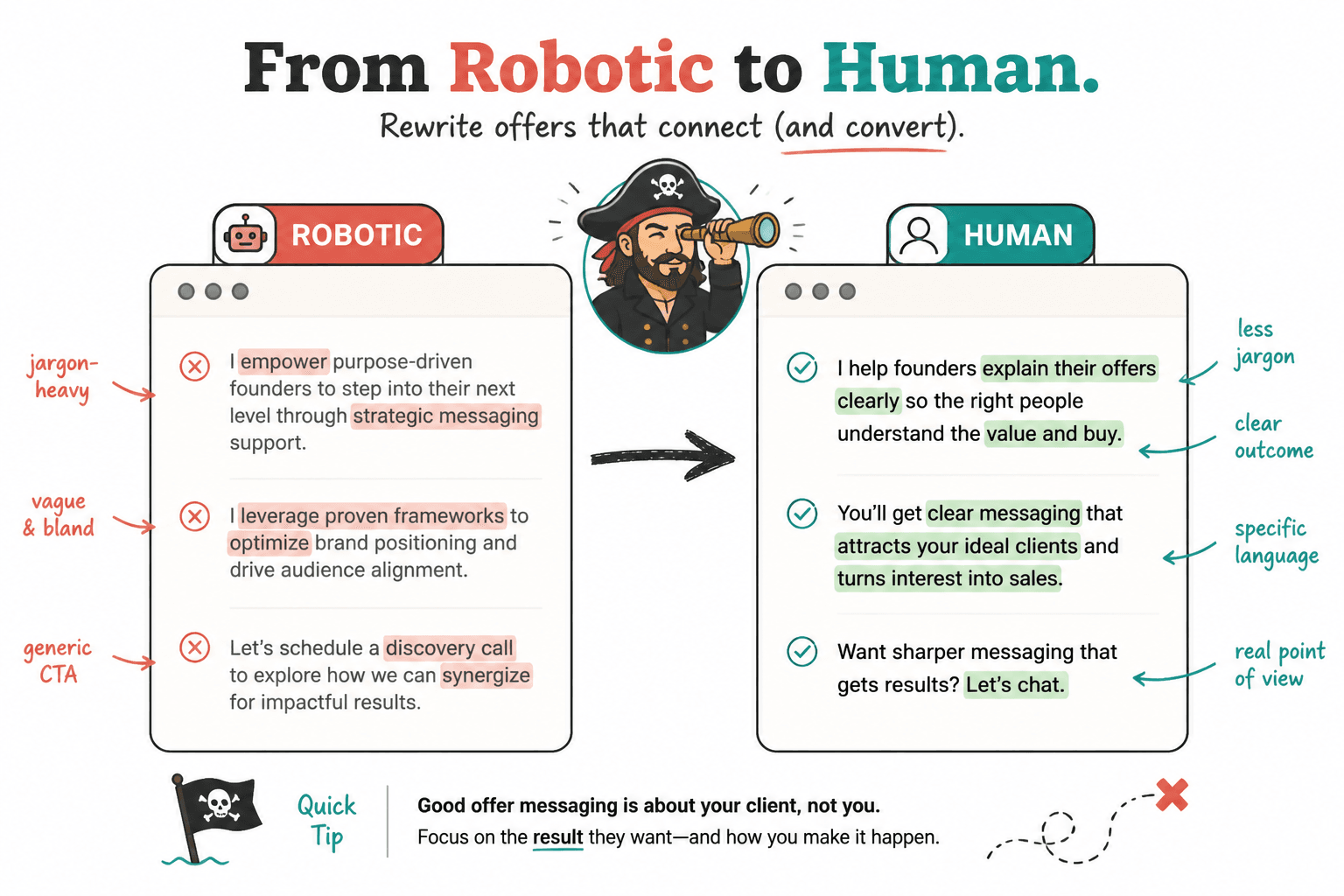
I empower purpose-driven founders to step into their next level through strategic messaging support.
Ask: what are we really trying to say here?
Maybe the real point is: “I help founders explain their offers more clearly so more of the right people understand the value and buy.” Good. That is something you can work with.
Pass 2: Cut the inflated language
Remove words that make the sentence feel bigger but say less.
- empower
- elevate
- aligned
- next level
- impactful
- bespoke
- magnetic
These words are not always illegal. They are just guilty a lot.
Pass 3: Make the outcome concrete
What changes after someone buys?
- Do they book more calls?
- Do they attract better-fit leads?
- Do they explain their offer faster?
- Do they shorten the path from visitor to inquiry?
- Do they stop getting ghosted by confused prospects?
Name the change in terms people already care about.
Pass 4: Add your angle
Why your way?
This does not need to be grand. It just needs to be identifiable.
- Do you simplify complex offers?
- Do you focus on conversion without using aggressive sales tactics?
- Do you blend messaging strategy with actual implementation?
- Do you work especially well with experts who struggle to explain nuanced work clearly?
Pass 5: Tighten the next step
Do not end good messaging with a limp generic CTA like “learn more” if the context calls for more precision.
Try:
- See how the process works
- Read the service details
- Book a fit call
- Get the messaging audit
- Start with the offer page review
If your opening is also weak, read how to start offer messaging and positioning without a weak opening. A lot of “salesy” copy is really just unclear copy trying to compensate with louder language.
Before-and-after examples
Example 1: Coach
Before:
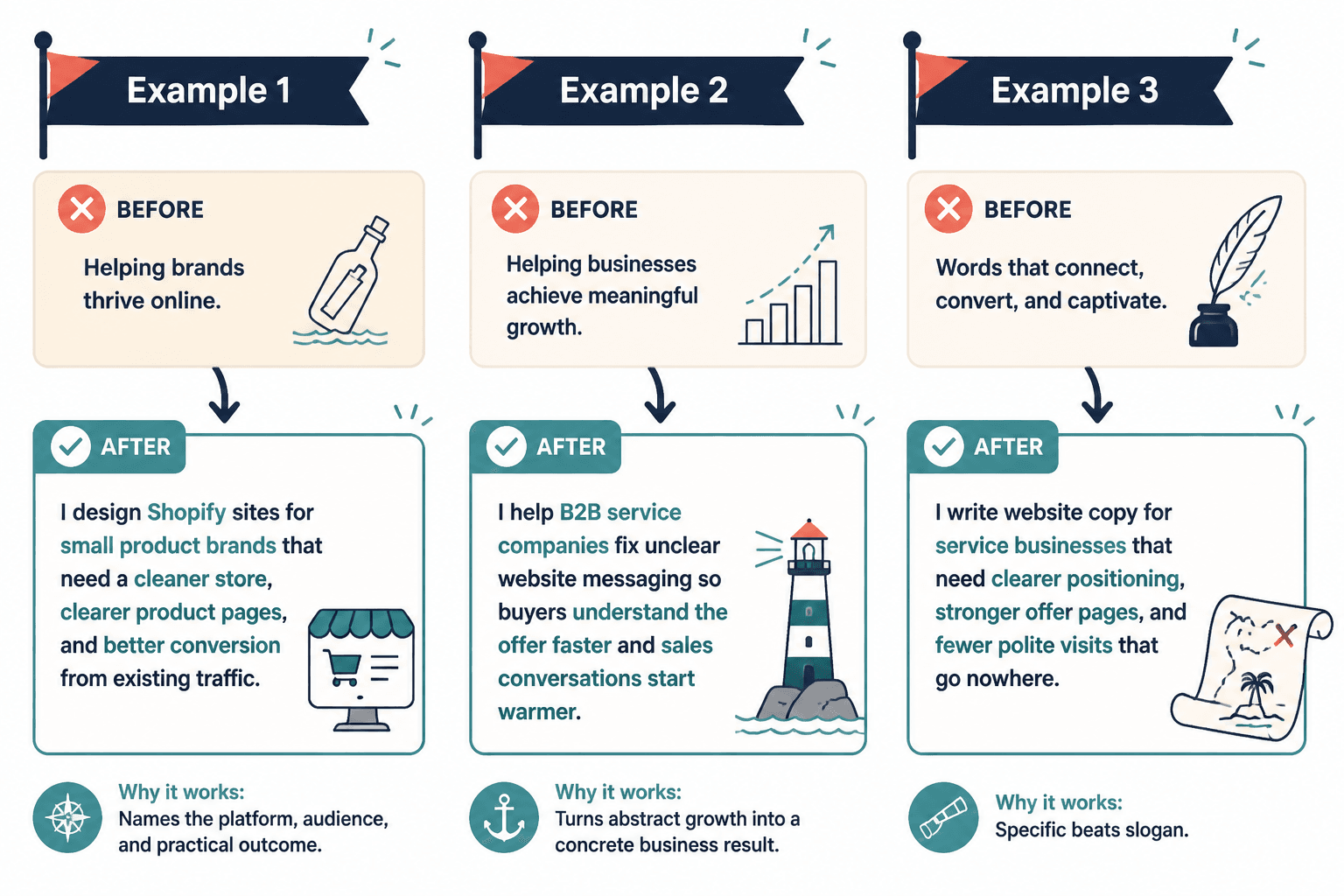
I help ambitious women unlock their fullest potential and create aligned success in business and life.
After:
I help independent coaches simplify their offers, tighten their messaging, and sell their services with more clarity and less awkwardness.
Why it works: clearer audience, clearer service, less fog, no motivational wallpaper language.
Example 2: Consultant
Before:
I partner with scaling brands to deliver bespoke strategic solutions that drive meaningful growth.
After:
I help B2B service companies fix unclear website messaging so buyers understand the offer faster and sales conversations start warmer.
Why it works: “meaningful growth” became a practical business result.
Example 3: Copywriter
Before:
Words that connect, convert, and captivate.
After:
I write website copy for service businesses that need clearer positioning, stronger offer pages, and fewer polite visits that go nowhere.
Why it works: specific beats slogan almost every time.
What to include on your site if you want your offer to feel trustworthy
Messaging is not just the headline. Positioning is reinforced by the rest of the page. If the words sound good but the page gives no proof, the copy still feels slippery.
Add things like:
- Specific examples of what you help with
- Short bullets on who the offer is and is not for
- A brief explanation of your process
- Common objections answered plainly
- Results, case-study snippets, or client proof
- A CTA that matches buyer readiness
This is where good messaging stops being decorative and starts carrying commercial weight. The page should make the offer easier to trust, not just nicer to read.
The bigger point is simple: clearer structure and clearer writing make the piece more useful. That is usually what makes the ending land better too.