
Most sales page proof sections are trying to do one job and accidentally doing the opposite.
They are supposed to build trust. Instead, they sound like a pile of polished compliments, vague outcomes, and suspiciously enthusiastic praise from people named Sarah. You know the type. “This changed everything.” “Highly recommend.” “Amazing experience.” Great. For what, exactly?
If you want to know how to improve sales page proof sections without sounding generic, the fix is not “add more testimonials.” It is to make your proof more specific, more believable, and more connected to the buyer’s actual decision.
A strong proof section does not just say people liked working with you. It shows what kind of person they were, what problem they had, what changed, and why that change matters. It reduces doubt. It answers the silent objections. It gives your claims some bones.
Here’s how to make your proof section sharper, less fluffy, and far more useful to the people hovering over your buy button with mild trust issues.
For the broader learning path, visit our parent guide.
Why most proof sections feel generic in the first place
Generic proof usually comes from one of three problems:
- The testimonial says nice things but proves nothing
- The copy around the proof is doing all the talking
- The proof is not matched to the buyer’s real objections
A lot of sales pages treat proof like decorative parsley. It gets sprinkled in because sales pages are supposed to have testimonials. But proof is not there to make the page look complete. It is there to make belief easier.
That means your proof section should not be built around “how lovely this client thought I was.” It should be built around evidence.
Evidence can be quantitative, qualitative, reputational, observational, or situational. The format matters less than the clarity. If a reader finishes your proof section still thinking “yes, but would this work for someone like me?” then the section is not doing its job.
What a good sales page proof section actually needs to do
Before you rewrite anything, get clear on the job.
A good proof section should help the reader do at least four things:
- See themselves in the examples
- Understand the specific value of your offer
- Trust that the result is real and not massaged into marketing soup
- Move past the objections keeping them stuck
Notice what is not on that list: sounding impressive.
If your proof section is trying too hard to look high-status, polished, or “premium,” it often gets less persuasive. Buyers are not asking, “Can this person write elegant testimonial headers in gold script?” They are asking, “Do I believe this will help me?”
That is why strong proof tends to feel concrete. It is anchored in details. It speaks like a person, not a brochure.
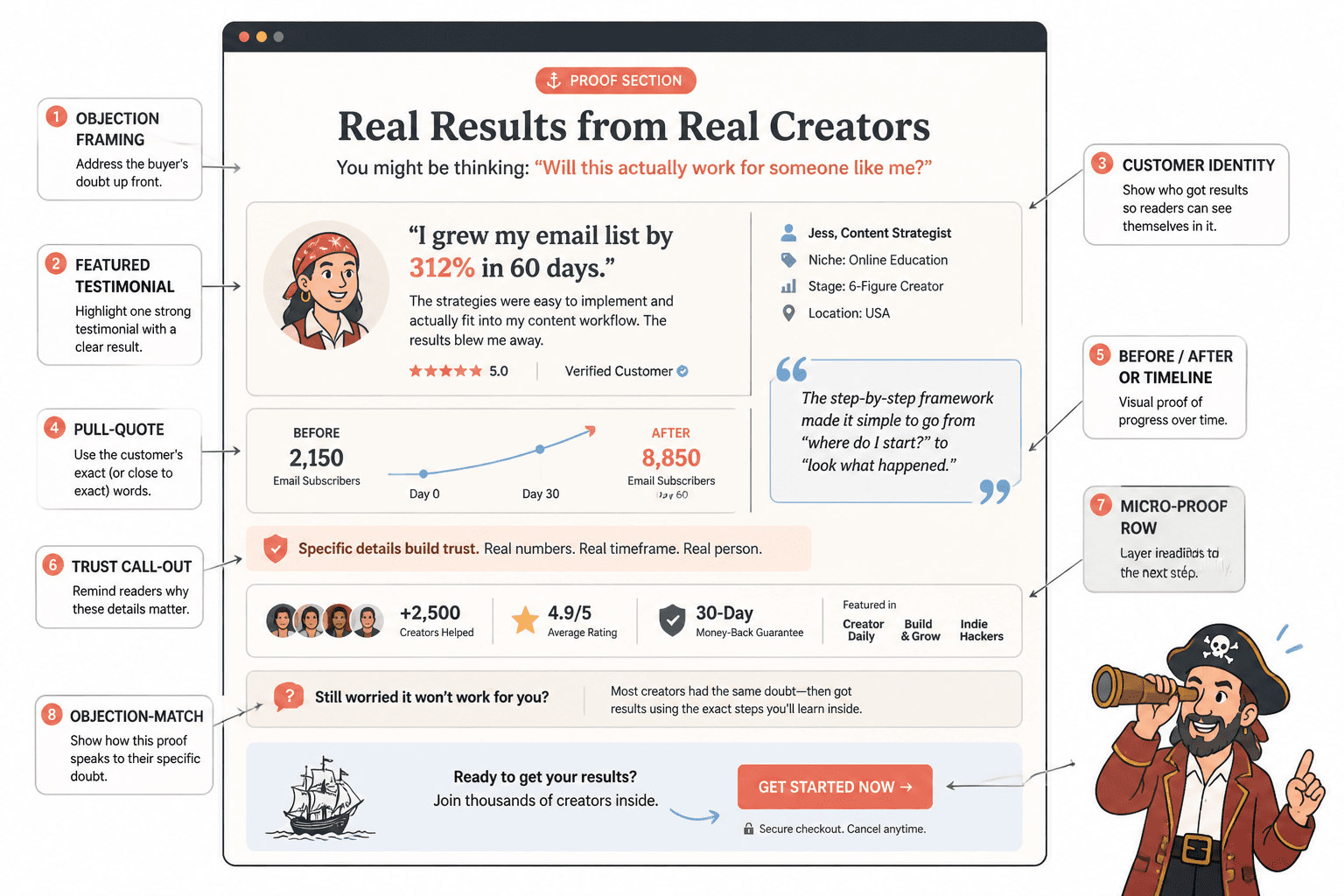
Start by matching proof to objections, not just outcomes
This is where a lot of otherwise decent sales pages fall apart.
They include testimonials that talk about the end result, but ignore the doubts the buyer has right now. And buyers usually need help with the doubt first.
For example, if you sell a coaching offer, your prospect might be wondering:
- Will this actually work for someone in my niche?
- Is this too advanced or too basic for me?
- Is this person just good at marketing themselves?
- Will I get clear strategy or vague mindset pep talks?
- Can I trust the process if I have been burned before?
Your proof section should answer those questions indirectly through the evidence you choose.
That means one testimonial about revenue growth is fine, but a better set of proof might include:
- A client in a similar niche
- A client who started skeptical
- A client who explains what the process was like
- A client who mentions a specific result
- A quick case-study style example showing before, decision, after
Now the reader is not just seeing “good results happened.” They are seeing “this could make sense for someone like me.” That is much more persuasive.
A simple objection-to-proof method
List your top five buyer objections. Then assign proof to each one.
| Buyer objection | Best kind of proof |
|---|---|
| “I am not sure this works in my situation” | Testimonial from a similar client or use case |
| “This sounds good, but I need specifics” | Case study with concrete before-and-after details |
| “I have tried things before” | Testimonial mentioning skepticism and what was different |
| “I do not want fluff” | Proof describing process, clarity, implementation, or decision support |
| “It sounds expensive” | Evidence of meaningful business or time-saving outcomes |
This one shift alone makes your proof section less random and a lot more convincing.
Use proof with texture, not just praise
Praise is easy to collect and weak on its own.
Texture is what makes proof credible. Texture means details that sound like real life rather than marketing paste. It includes things like timing, context, constraints, decisions, and specifics about what changed.
Compare these two examples.
“Amazing experience. Highly recommend. So helpful and insightful.”
Nice. Also useless.
“Before this, my sales page sounded polished but flat. Within two rounds, the messaging got much clearer, the proof section finally sounded believable, and three leads mentioned they booked because the page felt more specific and trustworthy.”
That second one works because it tells us what was wrong, what changed, and why it mattered. It has texture.
When you collect testimonials, do not ask, “Can you write a few words about your experience?” That is how you get generic compliments and a smiley face.
Ask better prompts instead:
- What problem were you trying to solve before we worked together?
- What were you unsure about before buying?
- What changed during or after the work?
- What specific part of the process helped most?
- What result, decision, or shift stands out?
- Who would this be especially useful for?
That gives people something real to respond to. It also helps them say the things future buyers actually need to hear.
Mix different types of proof so the section does not feel one-note
If your entire proof section is five nearly identical testimonials stacked like pancakes, the reader’s brain starts skimming by testimonial two.
You want variety. Not for decoration, but for persuasion. Different proof types answer different doubts.
Useful proof types to include
- Direct testimonials: Best for voice, emotion, and experience
- Mini case studies: Best for showing problem, intervention, and result
- Specific outcomes: Best for concrete credibility
- Process proof: Best for showing how you work, not just what happened
- Client snapshots: Best for audience fit and relatability
- Reputation markers: Best for supporting trust, as long as they do not become chest-thumping wallpaper
A smart proof section often combines two or three of these.
For example, you might open with a short case-study style proof block, follow with a few specific testimonials, and then include a line about who you have worked with or what kind of results patterns clients commonly report. That feels stronger than “Here are 14 nice things people said.”
If you want stronger overall page structure too, it helps to review broader sales page strategy and avoid the sequencing issues covered in sales pages page flow mistakes that hurt performance.
Rewrite proof blurbs so they sound like evidence, not decoration
Sometimes the testimonial itself is decent, but the way you present it drains all life from it.
Bad proof-section copy tends to overframe. It tells the reader what to think before they even read the evidence.
“Our clients get extraordinary, transformational results that speak for themselves.”
If they spoke for themselves, you would not need that sentence.
Try cleaner framing:
- “A few examples of what changed for clients”
- “What clients said after the work”
- “Not vague praise. Actual outcomes and specifics.”
That kind of intro gets out of the way. It also sets the tone. You are not asking for applause. You are presenting evidence.
Before and after proof-section rewrites
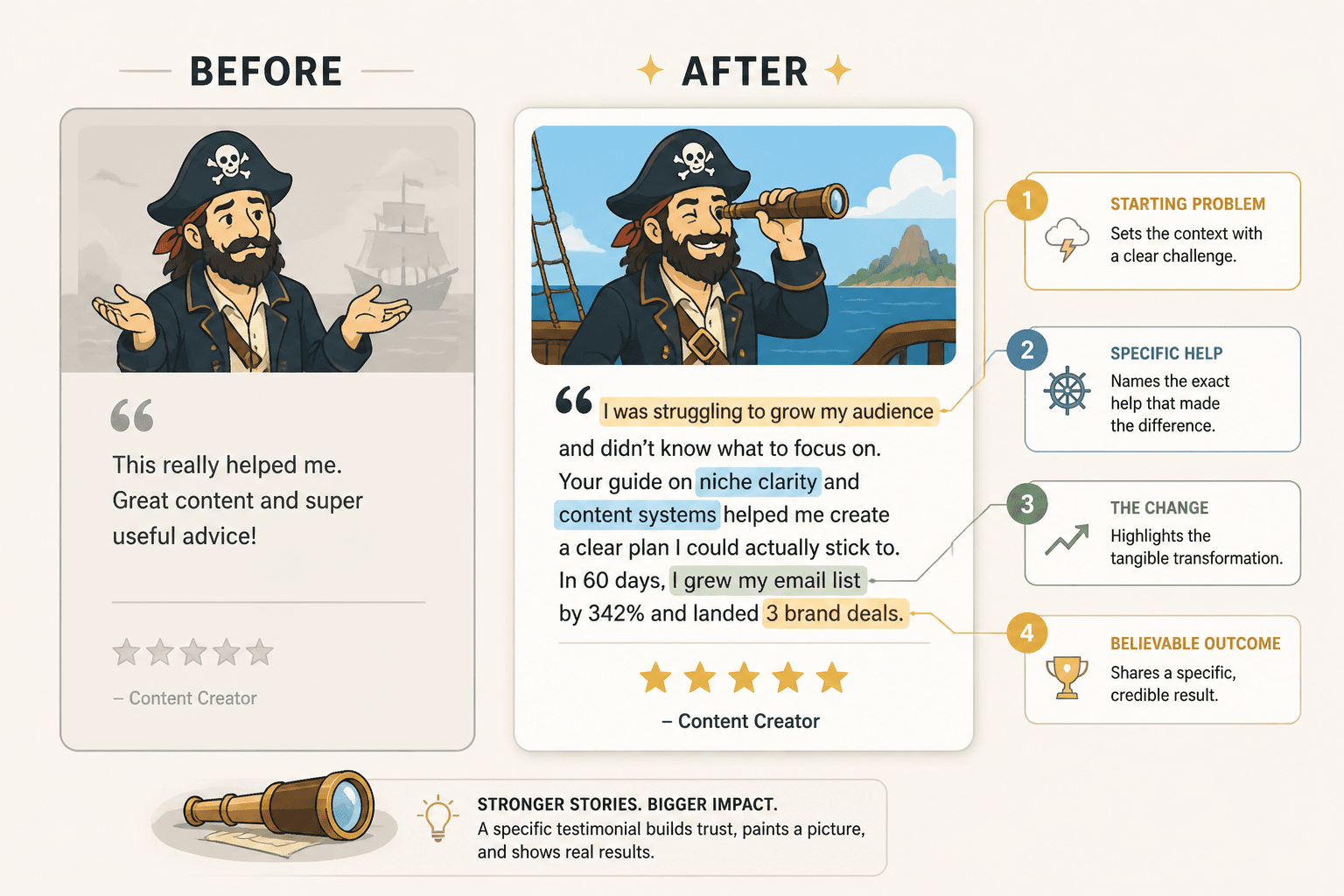
Before: “I loved working with her. She was brilliant, strategic, and so supportive throughout the process.”
After: “I came in with a sales page that sounded polished but generic. She helped me tighten the positioning, rewrite the proof section, and make the offer much clearer. Two inquiry calls mentioned the page specifically, which had never happened before.”
Before: “This program exceeded my expectations and gave me so much clarity.”
After: “I thought I needed more traffic. Turned out I needed a sales page people could actually trust. The biggest shift was not more hype. It was clearer proof, sharper messaging, and a much stronger flow from problem to offer.”
Notice the pattern. The stronger version includes:
- The starting problem
- The specific help
- The change
- A believable outcome or observation
That is what gives proof persuasive weight.
Do not hide the good stuff inside long testimonial walls
Some testimonials are gold, but readers will not dig for it.
If a client gave you a long response, do not just paste the entire thing into a beige rectangle and hope for the best. Pull out the strongest line as a headline, then support it with one or two shorter lines beneath it.
For example:
“The page finally sounded like an actual expert wrote it.”
Before, the copy was polished but vague. After the rewrite, the message was clearer, the proof was stronger, and leads started referencing specific parts of the page on calls.
Now the reader gets the point fast. Then they get supporting detail.
This matters because proof sections are skimmable by nature. Readers are not studying your page with a highlighter. They are scanning for reasons to trust or reasons to leave.
Make the proof sound like the buyer, not your brand voice team
One sneaky reason proof sections sound generic: they have been edited so heavily that every testimonial sounds like the business owner wrote it.
Clean it up, sure. Fix obvious typos if needed. Trim for clarity. But do not iron out all the humanity. Slightly messy, natural phrasing is often more believable than polished testimonial perfume.
If every quote says things like “transformational support,” “next-level clarity,” and “aligned strategy,” your proof section starts sounding less like client feedback and more like it was assembled in a scented content cave.
Keep the language close to how real buyers speak. Especially if they mention:
- What they were frustrated by
- What surprised them
- What they had misunderstood before
- What changed in practical terms
That kind of language is persuasive because it sounds lived-in.
Add context labels that actually help
A quote without context can still feel thin, even if it is specific.
Small labels can help the reader understand why the proof matters. You do not need to turn each testimonial into a LinkedIn résumé. Just include enough to make the example useful.
Good context labels might include:
- Role or business type
- Offer type
- Stage of business
- What they hired you for
For example:
- Business coach launching a new group offer
- Freelance copywriter rewriting a services page
- Consultant with strong referrals but weak conversion from website traffic
That tiny bit of context makes the quote much easier to map onto the reader’s own situation.
Use mini case studies when testimonials alone are not enough
If your offer is high-ticket, strategic, nuanced, or not instantly understood, plain testimonials often are not enough. You need mini case studies.
A mini case study does not need to be long. In fact, shorter is often better on a sales page. But it should show the arc clearly.
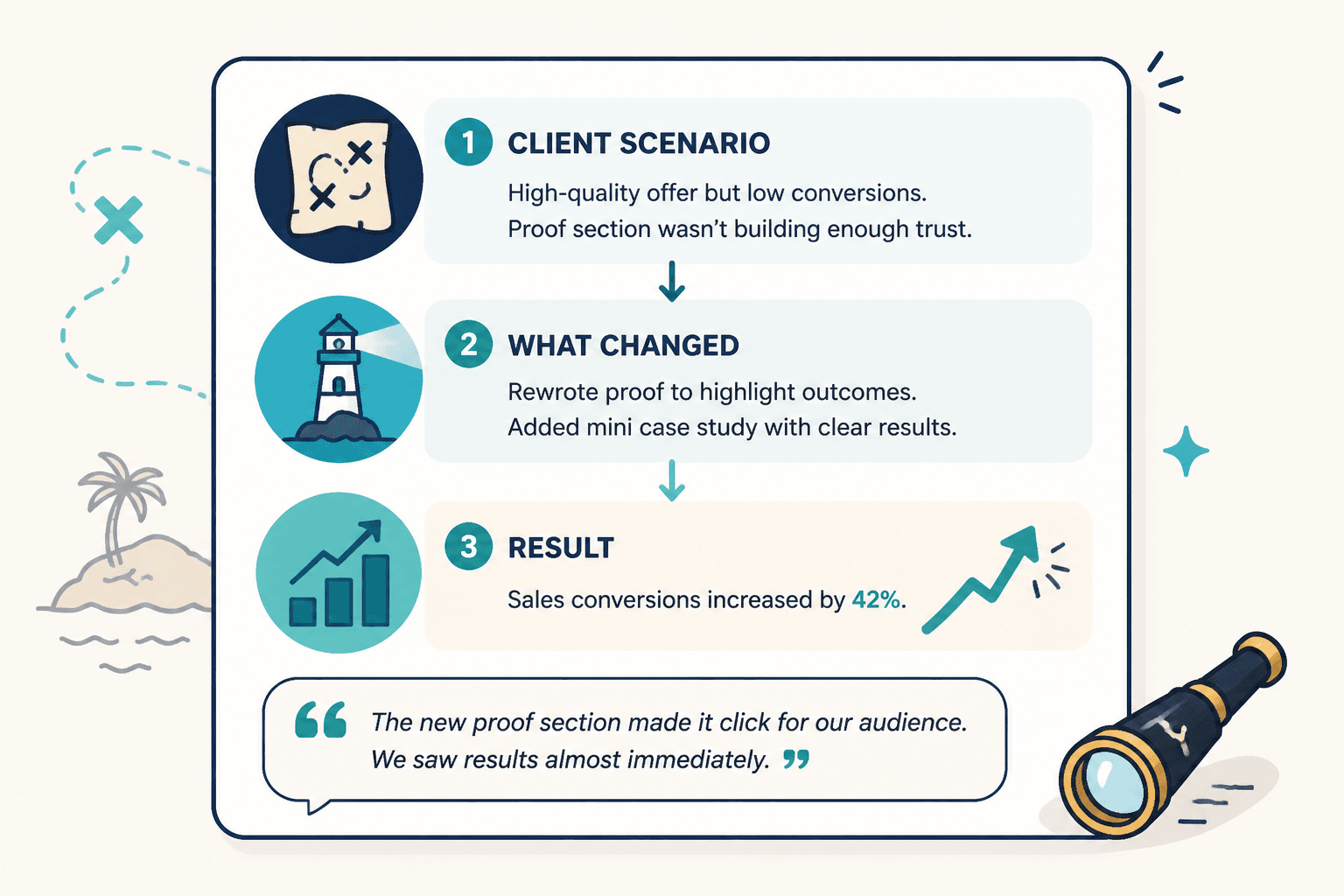
A simple mini case study structure
- Situation: Who they were and what was not working
- Problem: The friction, confusion, or bottleneck
- Work: What you changed or focused on
- Result: What improved, in concrete terms where possible
Example:
Before: A consultant had steady traffic to her sales page but very few inquiry calls.
Problem: The offer sounded credible, but the proof section was vague and did not resolve the reader’s doubts.
What changed: We rewrote the proof section around specific client scenarios, added one short case study, and cut the polished filler language.
Result: Inquiry quality improved, and leads started referencing the page’s examples instead of asking basic trust questions on calls.
That is proof with movement. It gives the buyer something to hold onto.
If you need help seeing how this fits into a complete page, it is worth reviewing sales page examples for coaches, consultants, and personal brands and how to start sales pages without a weak opening, because proof works best when the page around it is also pulling its weight.
Cut proof that is flattering but strategically weak
This part is annoying, but necessary.
The bigger point is simple: clearer structure and clearer writing make the piece more useful. That is usually what makes the ending land better too.