
If you have a small audience, weak offer messaging gets exposed fast.
There is no big reach machine to hide behind. No flood of impressions to compensate for vague positioning. No army of casual followers liking things because they vaguely know your face. If your message is fuzzy, your audience feels it immediately. They do not ask questions. They do not click. They do not buy.
That is the good news, actually. Small audiences force you to get sharper. And when your offer messaging & positioning for creators with small audiences is clear, relevant, and specific, you do not need thousands of people watching. You need the right people understanding what you do, why it matters, and why you are a credible choice.
Here’s how to fix the usual mess: vague promises, broad audience claims, overpolished bios, and offer pages that sound impressive but say almost nothing. We’ll get into how to position your offer so a small audience can actually turn into conversations, leads, and sales instead of polite silence.
For the main guide behind this topic, visit the parent guide.
Why small audiences cannot afford vague positioning
Big creators can get away with a lot. They can post generic advice, slap a soft promise on a service page, and still get leads because attention itself creates momentum.
Small creators do not have that luxury.
If you are a coach, consultant, freelancer, writer, or solo founder with a smaller audience, your message has to do more work. It has to create clarity quickly. People need to understand:
- who you help
- what problem you solve
- what kind of outcome you help create
- why your approach is worth paying attention to
- what to do next if they want help
That does not mean your positioning needs to sound stiff or hyper-optimized. It means it needs to stop hiding behind vague words like clarity, alignment, transformation, or visibility unless you explain what those mean in the real world.
People rarely ignore offers because they hate them. They ignore them because they cannot tell what the offer is really for.
The real job of offer messaging
Most people treat messaging like branding wallpaper. A few nice phrases. A polished tagline. Maybe a neat one-liner for the homepage hero.
That is not the job.
Your offer messaging is there to reduce confusion and increase relevance. It should help the right person think, oh, this is for me, without needing to decode three paragraphs of elegant nonsense.
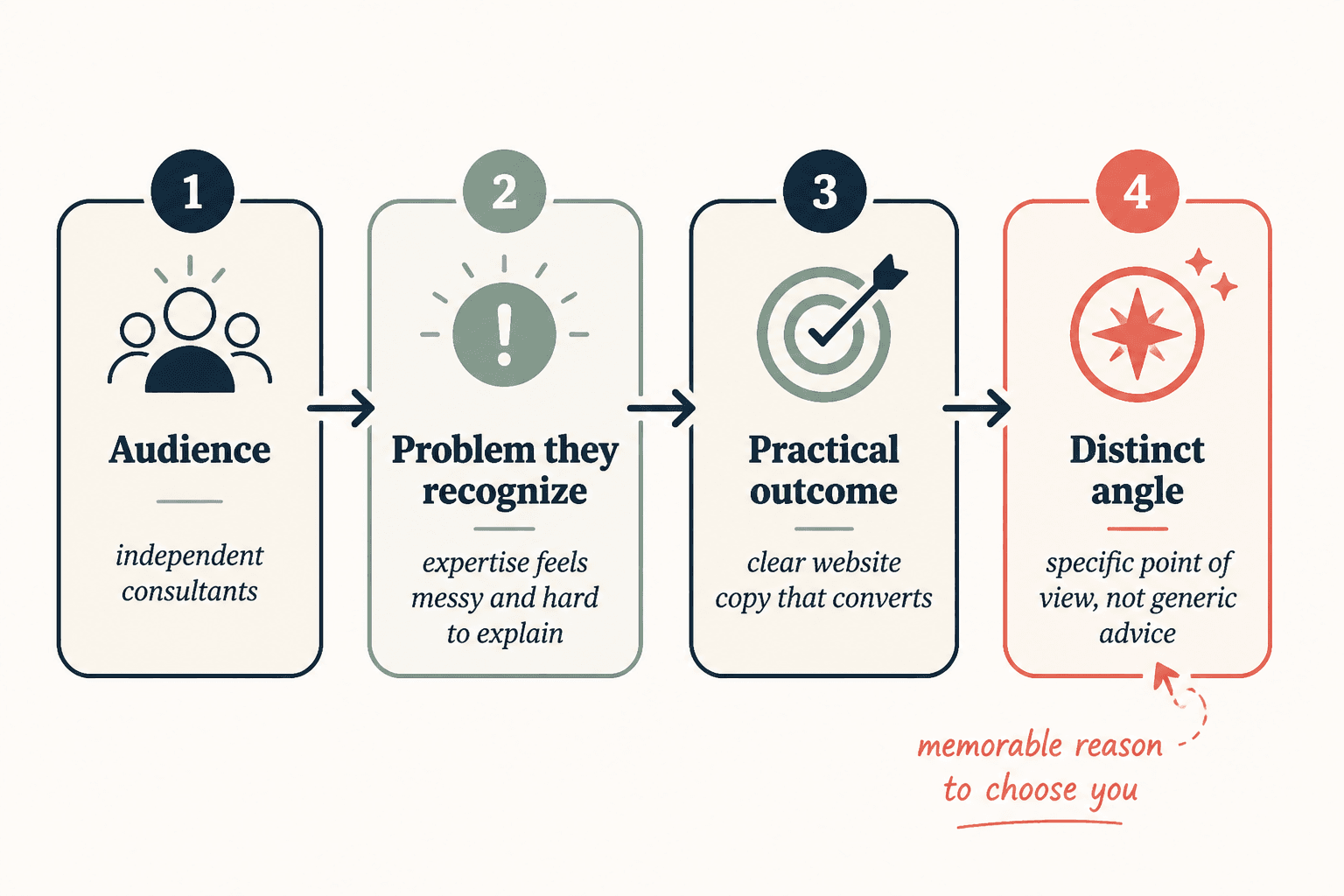
Strong messaging usually does four things well:
- Names the audience clearly without trying to include everyone
- Frames the problem in a way the reader actually recognizes
- Describes the outcome in practical terms, not floaty ones
- Signals an angle that makes your approach feel distinct enough to remember
If your audience is small, that fourth point matters a lot. You do not need a fake revolutionary framework with twelve trademark symbols. But you do need some kind of point of view. Otherwise your offer sounds like the other 700 offers in your niche, just with slightly different beige.
For a broader foundation, it helps to read the main offer messaging and positioning guide, especially if your current copy is trying very hard to sound smart while quietly failing to convert.
The 5 positioning mistakes small creators keep making
1. Trying to sound bigger by getting broader
This is one of the most common mistakes. Someone has a small audience, so they panic and widen the message.
They go from “I help independent consultants turn messy expertise into high-converting website copy” to “I help entrepreneurs grow their brand online.”
That second version sounds bigger. It is also weaker, blurrier, and much easier to ignore.
Small audiences usually grow faster when the message gets more specific, not less. Specificity gives people a reason to care.
2. Leading with the method instead of the pain
Your audience probably does not wake up thinking, “I need a strategic messaging audit.”
They wake up thinking:
- “My content gets attention, but nobody inquires.”
- “People keep liking my stuff and not buying anything.”
- “My site sounds decent, but it does not create trust.”
- “I know what I do, but I cannot explain it cleanly.”
Your process matters. Your framework can help. But if your messaging starts with your method and skips the reader’s actual frustration, you are making them do too much work.
3. Promising outcomes that are too abstract
Words like confidence, clarity, and alignment are not useless. They are just incomplete.
If you say you help creators “gain clarity and confidence,” what does that actually change?
Better:
- clarity about what offer to lead with
- confidence explaining your value in plain English
- a homepage message that attracts better-fit inquiries
- content that points people toward a paid next step
Abstract outcomes are fine as supporting language. They are terrible as the whole pitch.
4. Sounding polished but unconvincing
A lot of creator messaging sounds like it was scrubbed until no actual human opinion survived.
It is smooth. It is professional. It is also forgettable.
If your offer copy sounds like this, there is a problem:
I help visionary entrepreneurs align their message with their mission so they can expand their impact authentically.
Nothing there is technically wrong. But almost none of it is concrete. It sounds expensive and empty at the same time, which is not a charming combo.
5. Forgetting that trust matters more when reach is low
When you do not have giant numbers, people look harder at the details. They notice whether your message feels grounded. They notice proof. They notice whether your offer sounds designed for a real problem or copied from a coaching template folder somewhere on the internet.
Small audiences convert through trust, fit, and relevance. Not volume. Not vague authority theatre.
A practical positioning framework for small creators
If your current offer message feels messy, use this simple structure:
- Audience: Who is this for?
- Problem: What frustrating thing is happening now?
- Outcome: What better state are they trying to reach?
- Approach: How do you help, and what is different about your angle?
- Proof: Why should they trust you?
- Next step: What should they do if they want help?
That is it. No need to write a mythological founder saga about your mission to disrupt the future of personal brand transformation.
Example: weak vs stronger positioning
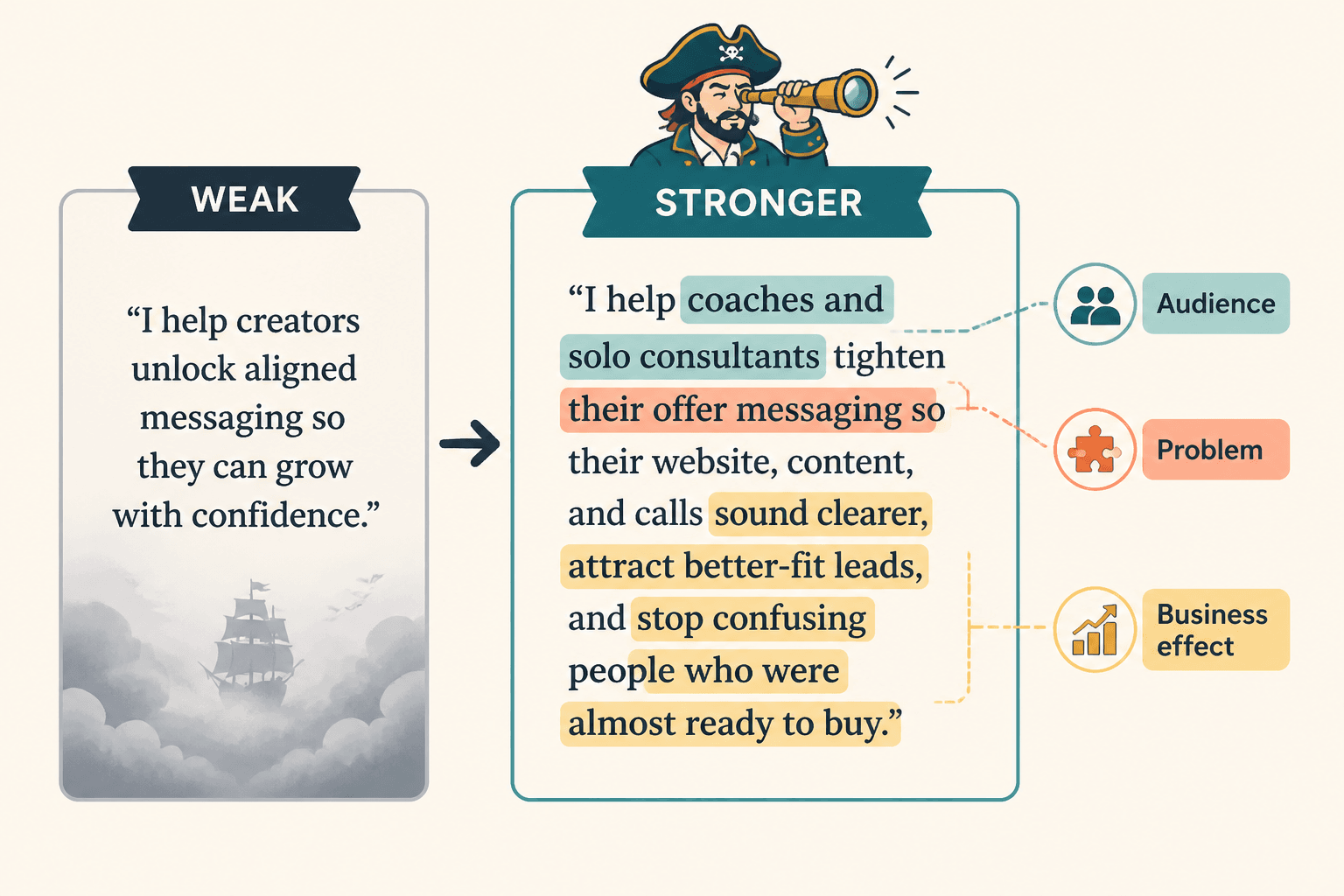
Weak:
I help creators unlock aligned messaging so they can grow with confidence.
Stronger:
I help coaches and solo consultants tighten their offer messaging so their website, content, and calls sound clearer, attract better-fit leads, and stop confusing people who were almost ready to buy.
The stronger version is not magic. It is just more useful. It names the audience, problem, and business effect without floating off into self-help fog.
If you want more examples like that, these offer messaging and positioning examples for creators can help you see what sharper phrasing looks like in practice.
How to make your offer feel relevant to a small but right audience
Relevance beats broad appeal. Especially early on.
You do not need everyone to think your offer sounds nice. You need the right people to feel mildly called out in the best possible way. The message should reflect their real situation closely enough that they stop skimming and start paying attention.
Use situation-based language
Generic claims are easy to ignore. Situational language is harder to shrug off.
Compare these:
- Generic: Improve your brand message
- Situational: Fix the homepage copy that gets polite compliments but weak leads
- Generic: Clarify your offer
- Situational: Turn the thing you explain well on calls into something your site can explain before the call
Specific situations make people feel seen. They also make your offer easier to trust because it sounds like it came from observing actual clients, not rearranging buzzwords for sport.
Pick a narrower problem than feels comfortable
If your audience is small, narrowing the problem often makes the offer stronger.
Instead of:
- I help creators grow online
- I help service providers improve their business
- I help people show up with confidence
Try something like:
- I help coaches fix muddled offer messaging that makes their content sound useful but unsellable
- I help consultants position premium services more clearly on their website and LinkedIn profile
- I help freelancers turn scattered skills into one offer clients can understand quickly
You can always expand later. Early on, tighter positioning is usually the smarter move.
Make the outcome tangible
People do not only buy outcomes. They buy signs that those outcomes are real.
So instead of promising “more alignment” or “a stronger presence,” describe what changes in visible terms:
- a clearer homepage hero section
- better-fit inquiries
- shorter explanation time on sales calls
- content that leads more naturally to offers
- less confusion between your services
- fewer ghosted leads after discovery calls
Tangible outcomes feel more believable. And believable sells better than grand.
Messaging formulas that actually help
Formulas are useful if you treat them like scaffolding, not scripture. They help you get to clarity faster. They are not there to make everyone sound identical.
Formula 1: audience + problem + business effect
I help [audience] fix [specific problem] so they can [practical business result].
Example:
I help solo consultants fix vague website messaging so more of their visitors turn into qualified inquiries.
Formula 2: what is happening now + what should happen instead
If your [asset or activity] is [current frustrating state], I help you turn it into [better state].
Example:
If your content sounds smart but does not lead people toward your offer, I help you tighten the message so attention turns into actual sales conversations.
Formula 3: problem framing with tension
You do not need more [common assumed solution]. You need [better framing or real fix].
Example:
You do not need more content ideas. You need sharper positioning so the content you already create points to something people can actually buy.
If you want more fill-in structures, these simple problem framing templates are useful when your current copy feels broad, repetitive, or suspiciously AI-scented.
Where your positioning should show up
A lot of creators do the hard work of clarifying their offer, then hide it in one paragraph on a sales page nobody visits.
Your positioning should show up everywhere the audience is making a quick judgment about fit.
- Homepage hero: say what you do in plain English
- About page: connect your angle and credibility to the reader’s problem
- Service page: explain what is broken, what changes, and what the process includes
- Social bio: compress your positioning into a useful one-liner
- Content topics: reinforce the problem and your angle repeatedly
- Calls to action: invite the next step without sounding like a funnel goblin
This is where consistency matters. Not robotic consistency. Conceptual consistency. The same core message should keep showing up from slightly different angles so people can remember what you do without needing a corkboard and red string.
For broader support on website copy, you can also explore the site’s website conversion copy resources and the more focused guide for creators who want better results.
How to know if your positioning is working
You do not need massive traffic to test positioning. You need signals.
Look for things like:
- people repeating your offer back to you accurately
- better-fit inquiries
- fewer “so what exactly do you do?” questions
- content attracting comments or replies from the right audience type
- sales calls starting with more trust and less explanation
- lead quality improving, even if lead volume is still modest
The bigger point is simple: clearer structure and clearer writing make the piece more useful. That is usually what makes the ending land better too.