
Most sales pages do not lose the sale because the design is ugly or the button color is wrong. They lose because the buyer hits a quiet little objection, gets no help resolving it, and leaves.
Not dramatically. Not with a big angry rant. They just think, “Maybe later,” which is conversion-copy code for “probably never.”
If you are a busy creator, coach, consultant, or solo business owner, you probably do not have time to write a 6,000-word persuasion opera every time you launch an offer. Fair enough. You do still need to handle objections on the page, though. Cleanly. Credibly. Without sounding like a late-night infomercial with a Canva subscription.
This is where simple sales page objection handling templates earn their keep. A good template helps you address the real hesitations buyers have, without stuffing your page with defensive waffle, fake urgency, or those weirdly aggressive FAQ sections that read like they were written during a hostage negotiation.
Here’s how to build objection handling into your sales page in a way that feels calm, useful, and actually persuasive.
To see how this fits into the wider strategy, open the parent guide.
What objection handling is actually doing
Objection handling is not about “overcoming” people like they are annoying little barriers standing between you and Stripe.
It is about reducing decision friction.
When someone lands on your sales page, they are usually asking some version of:
- Is this for someone like me?
- Will this work for my specific situation?
- Is it worth the money?
- Can I trust you?
- Will I actually use this?
- What happens if it is not a fit?
Your job is not to swat those questions away. Your job is to answer them before they become exit clicks.
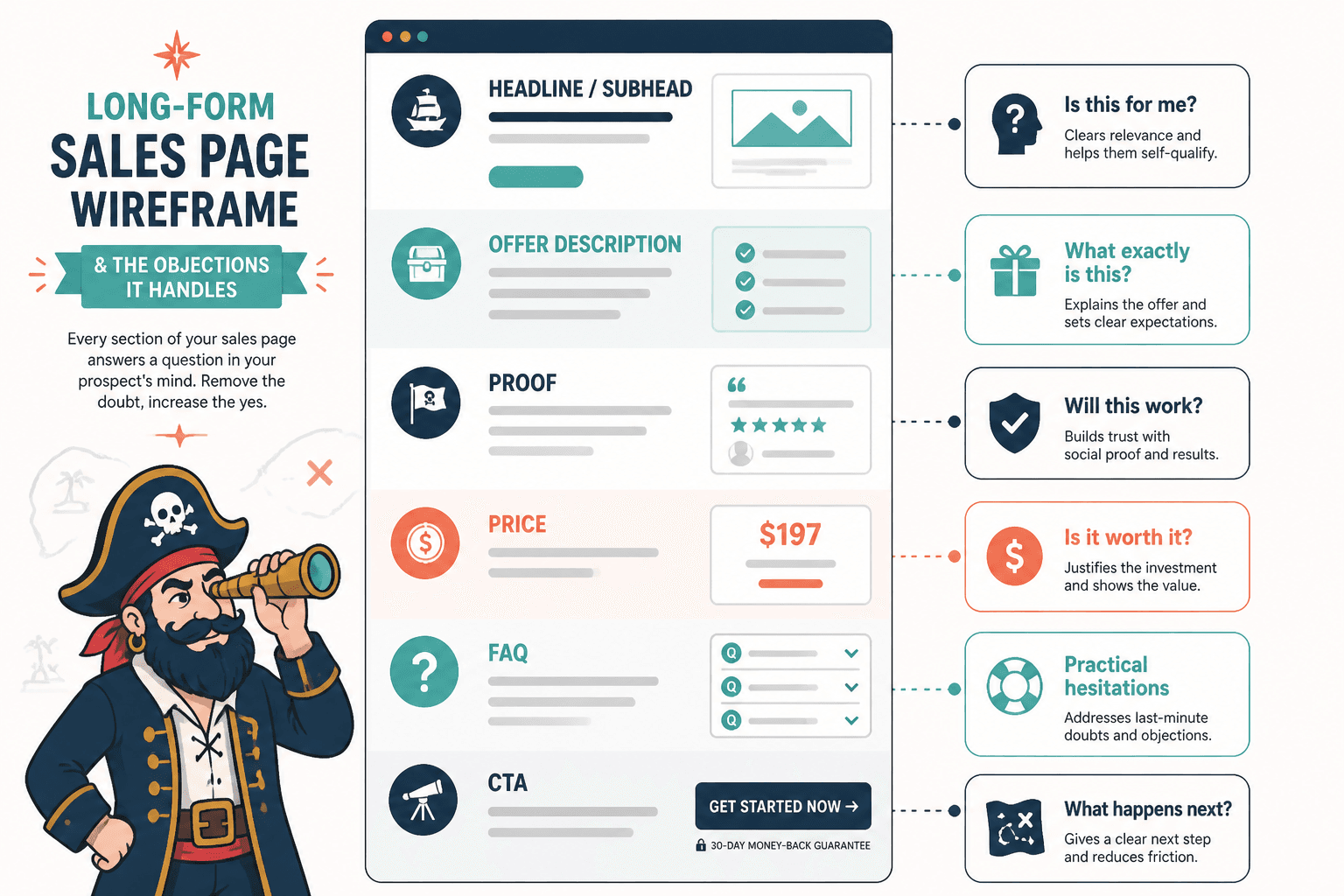
That means good objection handling is not a random FAQ bolted onto the bottom of a page. It should be threaded throughout the page: in the headline, the offer description, the proof, the pricing section, the FAQ, and the CTA area.
If you want the bigger picture on structuring a page that converts without acting desperate, this pairs nicely with sales pages for creators who want better results and the broader sales pages hub.
The 7 objections most busy creators need to handle
You do not need 31 micro-objections and a psychological map of your buyer’s inner child. Start with the common ones.
- I do not have time.
- I am not sure this is for me.
- I am not convinced it will work.
- It costs too much.
- I have tried similar things before.
- I am worried it will be overwhelming.
- I do not know what happens next.
That is enough to make a simple sales page much stronger.
And no, you do not need to address every objection with a giant paragraph. Some are best handled with one sharp sentence in the right place. A lot of weak sales copy becomes weak because it tries to reassure everyone about everything and ends up sounding nervous.
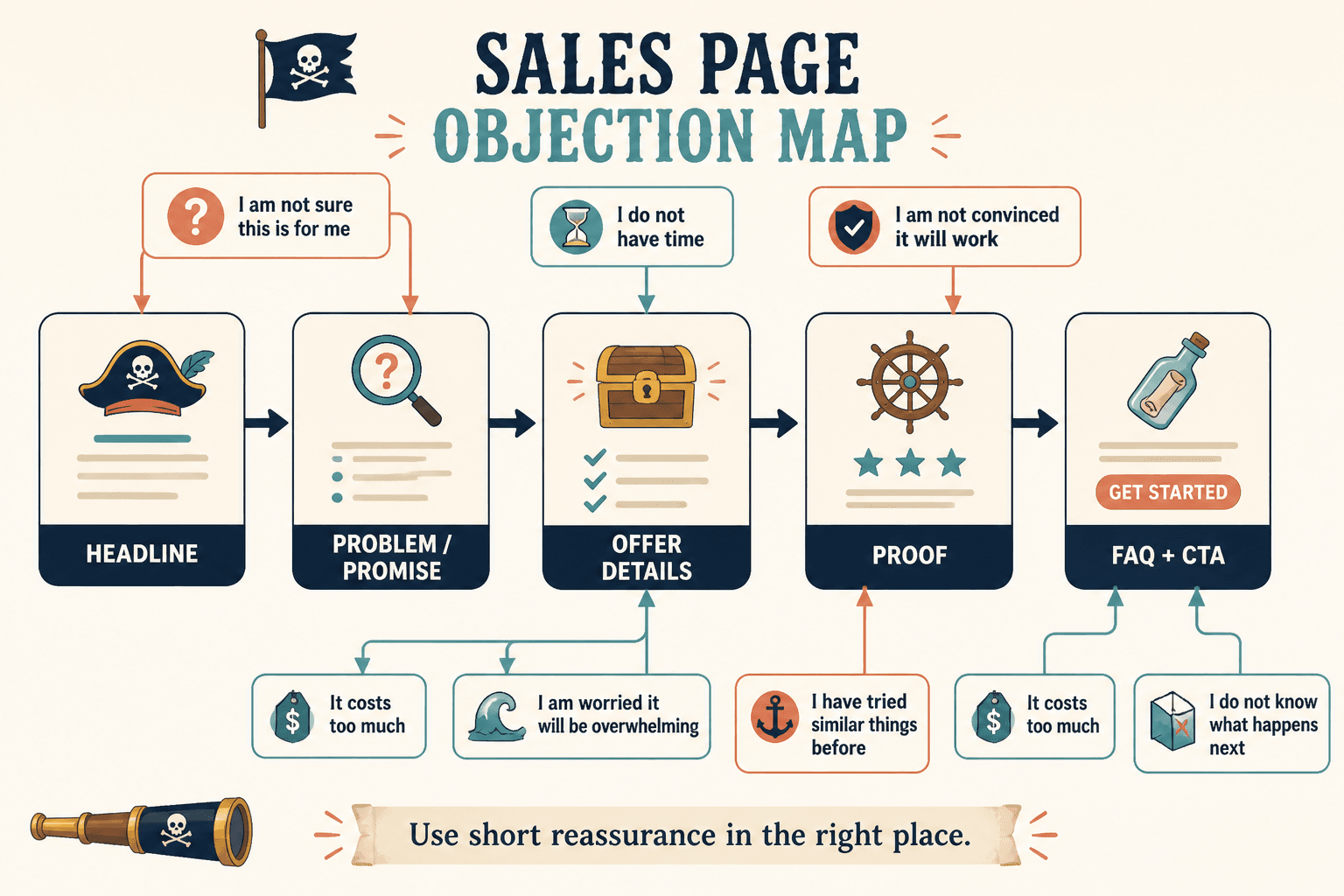
Simple sales page objection handling templates for busy creators
Use these as building blocks, not copy-paste sedatives. The point is to adapt them to your offer, audience, and voice.
1. The time objection template
People do not buy things they imagine becoming another abandoned tab in their life.
Template: This was designed for [specific type of busy person]. You can [get result / use the offer] in [realistic time frame] without [painful thing they fear].
Example: This workshop was built for busy consultants who need sharper sales copy fast. You can work through it in under 90 minutes without rebuilding your entire website from scratch.
Why it works: It lowers the perceived effort. It also signals that you understand the buyer’s real life, not some fantasy schedule where they have six free hours and a fresh notebook.
2. The “is this for me?” template
This objection is often caused by vague positioning. If the page tries to be for everyone with a pulse and Wi-Fi, people cannot see themselves in it.
Template: This is for [specific audience] who want to [specific result], especially if they are currently [common situation]. It is not for [clear non-fit].
Example: This template pack is for creators selling services, coaching, consulting, or digital offers who want cleaner sales pages without hiring a copywriter. It is especially useful if your current page sounds professional enough but does not actually move people to buy. It is not for enterprise ecommerce teams trying to optimize 400 product pages.
Why it works: Specificity creates trust. Exclusion helps too. A page that never says who it is not for often looks less confident, not more inclusive.
3. The proof objection template
People are tired of promises. Reasonable of them.
Template: This approach helps [audience] do [result] by [mechanism]. You can see that in [proof type: client result, before/after, testimonial, usage outcome, case example].
Example: This framework helps service-based creators write sales pages that answer buyer hesitation before the CTA. You can see that in the included before-and-after examples, where weak pages become clearer, tighter, and easier to trust.
If you have client proof, use it. If you do not, use process proof, example proof, or transformation proof. Show how the thing works. Show what changes. Show what the buyer gets to stop guessing about.
4. The price objection template
Price objections are rarely solved by shouting “worth every penny” in a larger font.
Template: Instead of [expensive / frustrating alternative], this gives you [practical value] so you can [specific outcome] faster / more clearly / with less waste.
Example: Instead of paying for a custom sales page rewrite before you even know what is broken, this gives you a practical objection-handling structure you can apply today, so your page gets clearer before you spend more money on polish.
Why it works: It reframes price around comparison and utility. It does not pretend the offer is free. It just makes the decision easier to evaluate.
5. The “I tried something similar” template
This one matters more than people think. Many buyers are not skeptical because they are cynical. They are skeptical because they have already bought the tidy PDF, watched three modules, and changed absolutely nothing.
Template: If you have tried [similar thing] before and it did not help, the problem may not have been effort. It was probably missing [specific ingredient]. This offer is built to solve that with [specific feature / structure / support].
Example: If you have bought sales page templates before and still ended up with a page that felt generic, the issue probably was not laziness. It was that the templates gave you format without helping you think through positioning, proof, and objections. This pack is built to solve that with guided prompts, rewrite examples, and specific objection-handling blocks.
6. The overwhelm objection template
If your offer looks useful but exhausting, people stall.
Template: You do not need to use everything at once. Start with [first simple step], then use [next part] when you are ready.
Example: You do not need to rewrite your full page in one sitting. Start with the objections section and CTA block, then tighten the headline and offer stack once the core message is clearer.
This is especially useful for template packs, courses, resource libraries, and anything with multiple parts. More value is not always perceived as more helpful. Sometimes it just looks like homework wearing better branding.
7. The next-step objection template
People hesitate when they do not know what happens after purchase.
Template: After you [buy / book / join], you will [step one], then [step two], then [step three].
Example: After you purchase, you will get immediate access to the templates, a short walkthrough on how to use them, and a simple order for updating your page without starting from zero.
Small clarity win. Big trust boost.
Where to place objection handling on a sales page
A lot of creators dump all objections into one FAQ section at the bottom and call it strategy. It is not illegal, but it is lazy.
The stronger move is to place each objection near the part of the page where that doubt naturally appears.
| Sales page section | Best objection to handle there | What to include |
|---|---|---|
| Headline/subhead | Is this for me? | Audience + result + clear use case |
| Offer description | What exactly is this? | Simple explanation of deliverables and benefit |
| Proof section | Will this work? | Testimonials, examples, before/after, outcomes |
| Price section | Is it worth it? | Value framing, comparison, what it replaces |
| FAQ | Practical hesitations | Time, fit, access, support, refund, logistics |
| CTA area | What happens next? | Clear next steps and low-friction reassurance |
That structure matters. Good objection handling feels like guidance. Bad objection handling feels like copy trying to tackle the reader before they leave.
Before and after: weak objection handling vs better objection handling
Weak
This course is perfect for anyone who wants more sales and success. If you are serious about your business, this investment will absolutely pay off. Do not miss out.
Problems:
- “Anyone” is useless targeting.
- There is no real objection being answered.
- “Serious about your business” is guilt copy in a blazer.
- Nothing concrete reduces risk.
Better
This is for service-based creators who already have an offer but need a clearer sales page to convert the traffic they are already getting. If you have been putting off a rewrite because it feels too big or too vague, start with the objection and CTA templates first. You will know exactly what to change, in what order, without rebuilding the whole page at once.
That version handles fit, overwhelm, and next steps in one compact block. Much better.
A simple objection handling framework you can reuse
If you want a repeatable method, use this 4-part formula:
- Name the hesitation without making the buyer feel foolish.
- Reframe the issue around what is actually causing the hesitation.
- Reduce the risk with clarity, proof, process, or scope.
- Move them forward with a next step.
Plug-and-play template: If you are worried about [objection], that usually comes from [real concern]. This offer helps by [specific reassurance]. Start with [simple next step].
Example: If you are worried this will just give you more sales-page theory, that concern makes sense. Most copy resources are heavy on advice and light on usable structure. This pack helps by giving you editable sections, examples, and objection prompts you can apply directly to your page. Start with the section that is currently costing you the most clarity: headline, offer stack, or CTA.
That is really the whole game. You are not trying to hypnotize someone into buying. You are helping a qualified buyer make a cleaner decision.
How to find the right objections for your specific offer
If you are guessing, you will write generic reassurance. If you listen, you will write sales copy that sounds like it belongs on your page.
Pull objections from places like:
- Sales calls
- Discovery call notes
- DMs and email replies
- Client onboarding forms
- Past refund requests
- Comments like “I am interested, but…”
- Your own abandoned-cart friction points
Then sort them into three categories:
- Fit objections: Is this for me?
- trust objections: Will it work?
- friction objections: Time, money, effort, process, logistics
That gives you enough raw material to build a strong page without turning it into a legal deposition.
The bigger point is simple: clearer structure and clearer writing make the piece more useful. That is usually what makes the ending land better too.