
Most boring offer messaging is not boring because the offer is bad.
It is boring because the copy is trying so hard to sound polished, strategic, and credible that it sands off every useful edge. You end up with phrases like “helping ambitious founders scale with clarity” and “done-for-you solutions for sustainable growth,” which sound professional right up until nobody remembers them five seconds later.
If your positioning feels beige, vague, or suspiciously similar to twelve other people in your niche, this is fixable. You do not need a total rebrand. You need to rewrite the message so people can quickly understand what you do, who it is for, why it matters, and why your version is worth caring about.
This is how to rewrite boring offer messaging & positioning so it sounds clearer, sharper, and more buyable without turning into hypey nonsense. We’ll cover what usually goes wrong, how to find the real point of your offer, and how to turn flat copy into language people can actually feel.
For the full path around this topic, head to the parent guide.
Why offer messaging gets boring in the first place
Boring messaging usually comes from one of four problems:
- You are describing the category, not your actual offer.
- You are using abstract outcomes instead of visible ones.
- You are trying to sound impressive instead of useful.
- You are hiding the sharp parts because you do not want to exclude anyone.
That last one causes a lot of damage. The second you try to make your offer sound right for everyone, the language goes soft. “I help businesses grow” is technically not false. It is also close to meaningless.
Good positioning has edges. It names a specific problem, a specific person, a specific result, or a specific method. Sometimes all four. Not because niche advice is trendy, but because people trust what they can picture.
If someone reads your offer copy and thinks, “Yes, that sounds nice,” you probably still have work to do. You want, “Oh. That is exactly the problem I have been trying to fix.”
Start by finding the real point of the offer
Before you rewrite a single line, get brutally clear on what the offer actually helps someone do. Not the broad category. Not the aspirational umbrella. The real job.
For example, “brand strategy” is a category. “Clarify your positioning so your homepage stops sounding like every other consultant site” is closer to a real job. One is a service label. The other is a problem with a pulse.
Ask these questions:
- What was happening right before someone needed this offer?
- What are they frustrated by in plain English?
- What changes after they use it?
- What gets easier, faster, clearer, cleaner, simpler, or more profitable?
- Why would they pick this instead of winging it, waiting, or hiring someone else?
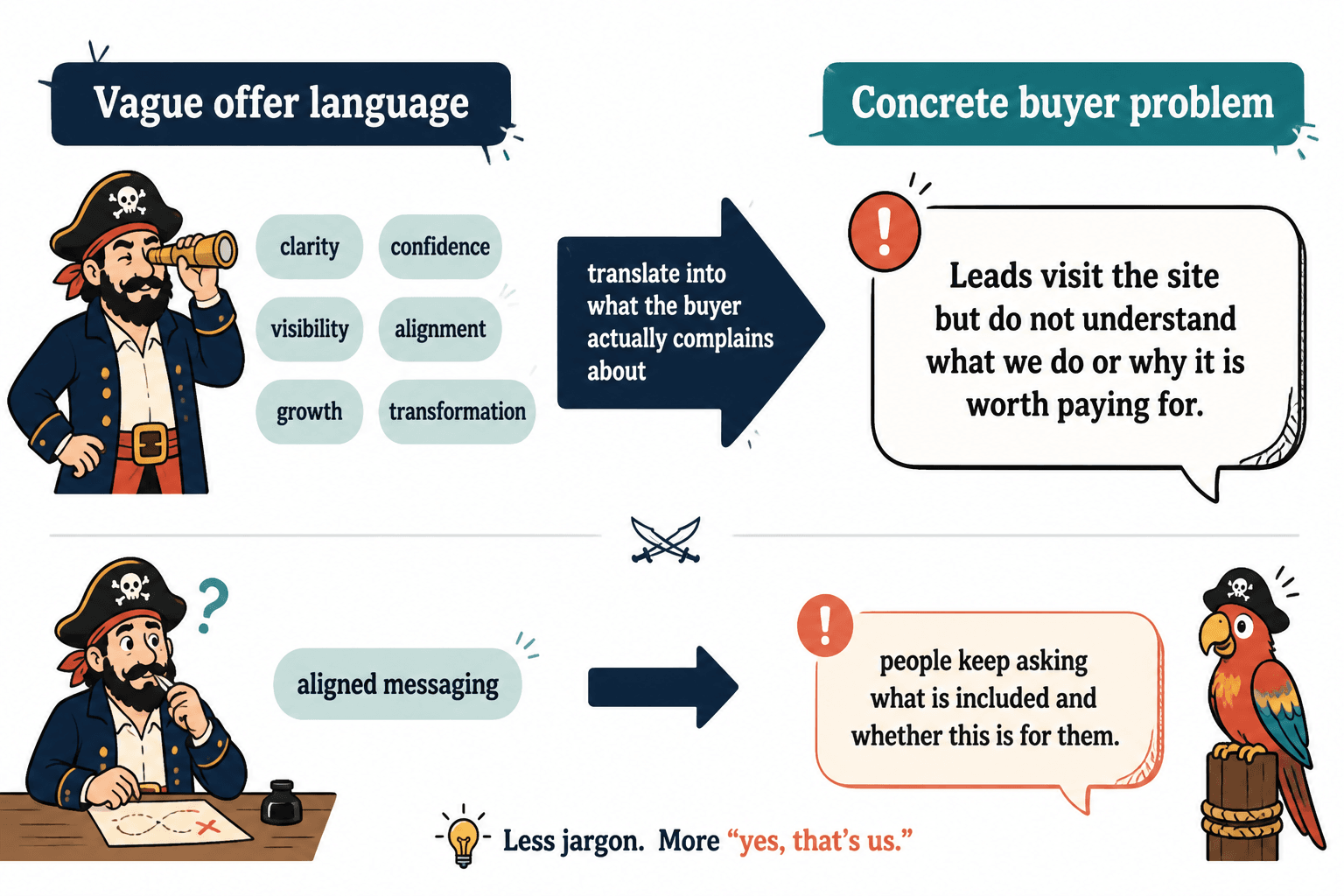
If your answers are still full of foggy words like clarity, confidence, visibility, alignment, growth, elevation, transformation, or impact, keep going. Those words are not forbidden, but they are often placeholders people use instead of saying something concrete.
A good rewrite often starts by replacing “nice business words” with “things a real buyer would actually complain about.”
If you need more help tightening the broader message before rewriting it, this guide on how to write better offer messaging and positioning is a useful next step.
Cut the vague opener and get to the useful part faster
A lot of offer messaging dies in the opening line. It starts with throat-clearing, soft philosophy, or broad claims about helping people thrive.
That kind of opening is usually trying to sound elevated. What it actually sounds like is delayed. Readers should not have to excavate your point like they are doing brand archaeology.
Weak opening:
I help purpose-driven business owners step into their next level with aligned messaging that reflects their brilliance.
Better opening:
I help coaches and consultants rewrite vague website copy so more of the right people understand the offer and inquire.
The second version is not poetic. Good. It is doing a job.
If your opening line is weak, the rest of the page has to work way too hard. For more help fixing that specific problem, read how to start offer messaging and positioning without a weak opening.
Use a simple rewrite framework that actually helps
Here is a practical process for how to rewrite boring offer messaging & positioning without making it more complicated than it needs to be.
1. Find the dead phrases
Look for language that sounds polished but says almost nothing.
- Empower
- Elevate
- Amplify
- Unlock
- Authentic brand presence
- Sustainable success
- Aligned growth
- Impact-driven messaging
Some of these words can survive in the right sentence. But when your copy leans on them heavily, it starts sounding like a mood board in a blazer.
2. Replace abstractions with specifics
Take every vague promise and ask, “What does that actually look like?”
| Vague line | Stronger rewrite |
|---|---|
| Clarify your message | Turn a fuzzy offer into copy people understand in one read |
| Attract aligned clients | Bring in more inquiries from people who already fit the offer |
| Build authority online | Publish content that makes your expertise easier to trust |
| Stand out in your market | Stop sounding interchangeable with everyone using the same templates |
3. Add the tension
Bland copy often describes the happy ending without naming the annoying middle. That is a mistake. Buyers usually recognize themselves in the friction first.
Instead of saying:
I help service providers create compelling messaging that converts.
Try:
I help service providers fix the “this sounds fine but nobody is buying” problem by rewriting the offer message from the ground up.
That line has tension. It names the frustrating thing people are already dealing with.
4. Show the mechanism
Specificity gets stronger when people understand how your offer works. Not every detail. Just enough to make your process feel real.
Instead of:
A transformative messaging intensive for visionary founders.
Try:
A 90-minute messaging intensive where we tighten your positioning, rewrite your homepage promise, and turn vague value bullets into clearer reasons to buy.
Now the offer has shape. You can picture it. That matters more than people admit.
5. Make the result easier to imagine
“Better messaging” is true but incomplete. Better for what?
- Better so your website stops leaking interest
- Better so your sales calls start warmer
- Better so your offer feels easier to explain
- Better so content and sales pages stop sounding disconnected
Visible outcomes usually outperform abstract promises because they feel more immediate. People want the transformation, sure, but they often buy the cleaner next step.
Before-and-after rewrites of boring positioning
Here are a few examples of what this looks like in practice.
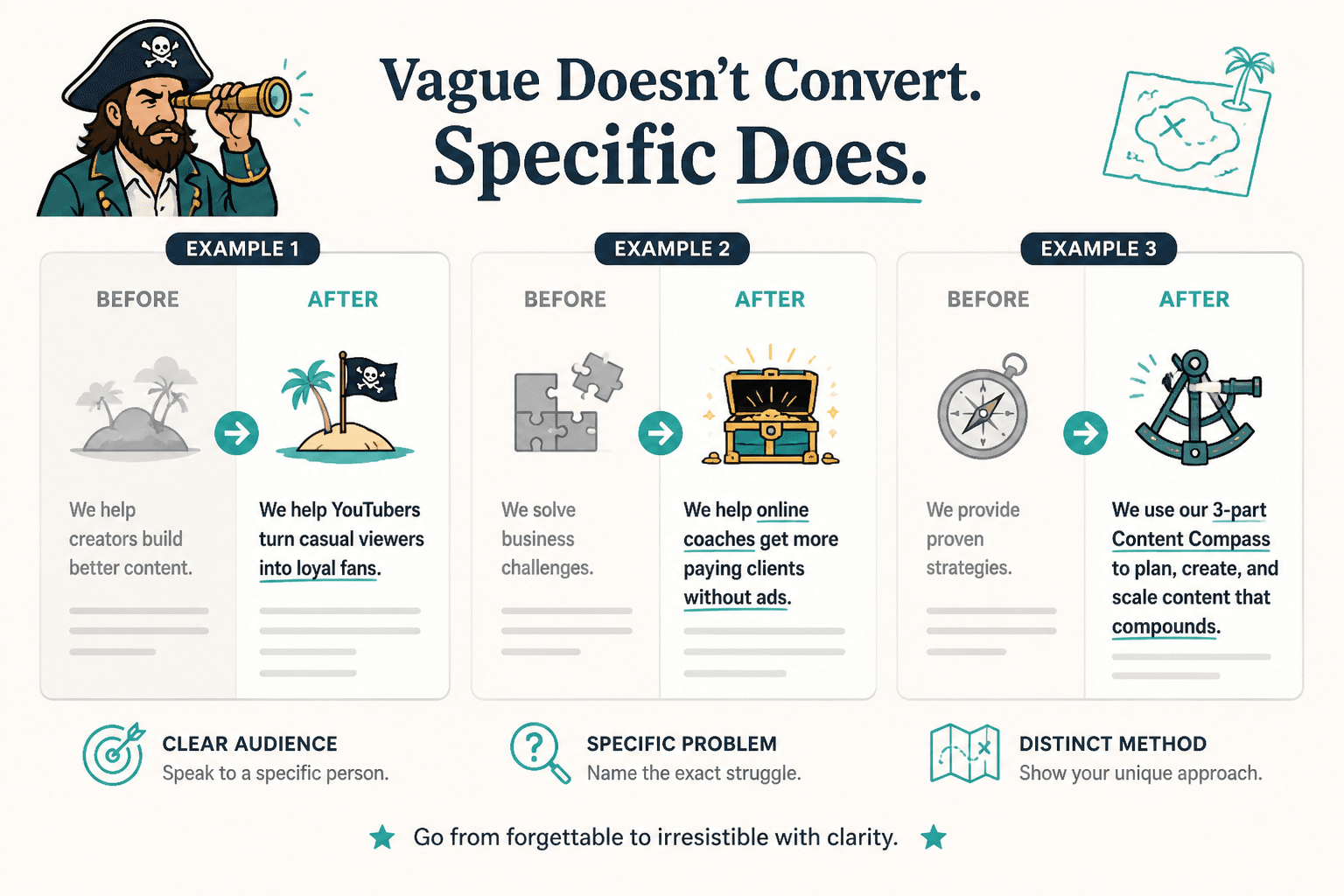
Example 1: Generic strategist language
Before: I help entrepreneurs build authentic brands that align with their vision and attract dream clients.
After: I help consultants and coaches tighten their brand message so their site, content, and offers stop sounding vague and start pulling in better-fit leads.
Why it works better: It names the audience, the problem, the assets being fixed, and the business outcome without sounding like it swallowed a workbook.
Example 2: Soft transformation language
Before: My program helps women step into confidence and own their message.
After: My program helps new coaches stop second-guessing their niche, message, and offer so they can explain what they do without rambling or rewriting their bio every week.
Why it works better: Confidence is implied through the result, not used as a vague headline accessory.
Example 3: Overly broad agency promise
Before: We provide full-service marketing solutions to help brands grow online.
After: We help small service businesses fix the gap between traffic and trust with clearer homepage copy, stronger offers, and simpler follow-up funnels.
Why it works better: “Marketing solutions” could mean anything from email setup to interpretive dance. The rewrite narrows the job and shows where the growth problem actually lives.
How to sharpen your positioning line without sounding robotic
A lot of people overcorrect when they rewrite. They remove the vagueness, but they also remove all rhythm, personality, and readability. You want clarity, not copy that sounds like it was assembled by a committee with matching tote bags.
A strong positioning line usually includes four things:
- Who it is for
- What problem it solves
- What result it helps create
- What makes your angle or method distinct
Simple formula:
I help [specific audience] solve [specific problem] so they can [specific outcome] through [specific method, angle, or offer type].
Example:
I help experienced freelancers turn loose, underperforming service offers into clearer packages and sales copy so more leads actually convert.
Then, if it feels a little stiff, loosen the wording without losing the point:
I help experienced freelancers clean up messy offers and rewrite the sales copy so more of their leads turn into real clients.
That is usually the move: get the strategy right first, then make it sound like a person said it.
For more help with this piece specifically, see how to improve offer messaging and positioning lines without sounding generic.
Do not stop at the headline: your value bullets need rewriting too
Even when the top line improves, the supporting bullets often stay sleepy.
Weak value bullets usually do one of three annoying things:
- Repeat the headline in slightly different words
- List features with no buyer relevance
- Promise outcomes so broad they feel fake
Instead of this:
- Personalized support
- Tailored messaging strategy
- Authentic brand alignment
Try this:
- Rewrite the parts of your offer page that sound smart but do not make people care
- Turn broad service descriptions into cleaner, easier-to-buy packages
- Make your message consistent across your site, content, and sales conversations
The second set gives the reader something to hold onto. They can picture what is being improved.
If your bullets are doing the usual vague-copy dance, read offer messaging and positioning value bullets mistakes that hurt performance.
A quick editing checklist for rewriting boring copy
Run your messaging through this filter:
- Can a stranger tell what the offer actually does in one read?
- Have you named a real problem, not just a category?
- Are the outcomes visible and believable?
- Did you cut filler words that only sound impressive?
- Would the right buyer recognize themselves in the language?
- Does the copy sound like a person, not a brand mood board?
- Is there a clear reason to choose your angle over a generic alternative?
If too many answers are no, the good news is your copy is not broken beyond repair. It is probably just under-specific.
Where this fits in your bigger website copy strategy
Offer messaging does not live alone. It affects your homepage, service page, CTAs, lead magnets, sales emails, content topics, profile copy, and how confidently you talk about what you sell.
The bigger point is simple: clearer structure and clearer writing make the piece more useful. That is usually what makes the ending land better too.