
Most value bullets do not fail because bullets are a bad format. They fail because the copy inside them is vague, padded, and trying way too hard to sound impressive.
You have probably seen the usual mess before: “clarity,” “confidence,” “transformation,” “support,” “customized strategy.” It reads like someone blended a coaching sales page, three LinkedIn posts, and a business-casual fever dream. Nothing sounds wrong exactly. Nothing sounds useful either.
That is the real problem behind Offer Messaging & Positioning Value Bullet Mistakes That Hurt Performance. Your bullets are supposed to help people understand the offer fast. What they often do instead is create fog. And fog does not convert.
This article will help you fix that. We are going to cover the biggest value bullet mistakes, why they quietly tank response, and how to rewrite them so people can actually see the offer, want the offer, and trust the offer. If your sales page, services page, landing page, or proposal feels technically fine but oddly flat, this is usually one of the leaks.
Want the broader roadmap? Start with the parent guide.
What value bullets are actually supposed to do
Value bullets are not decoration. They are not there to “break up the page” or make your offer look full.
They have a job: translate your offer into quick, believable reasons to care.
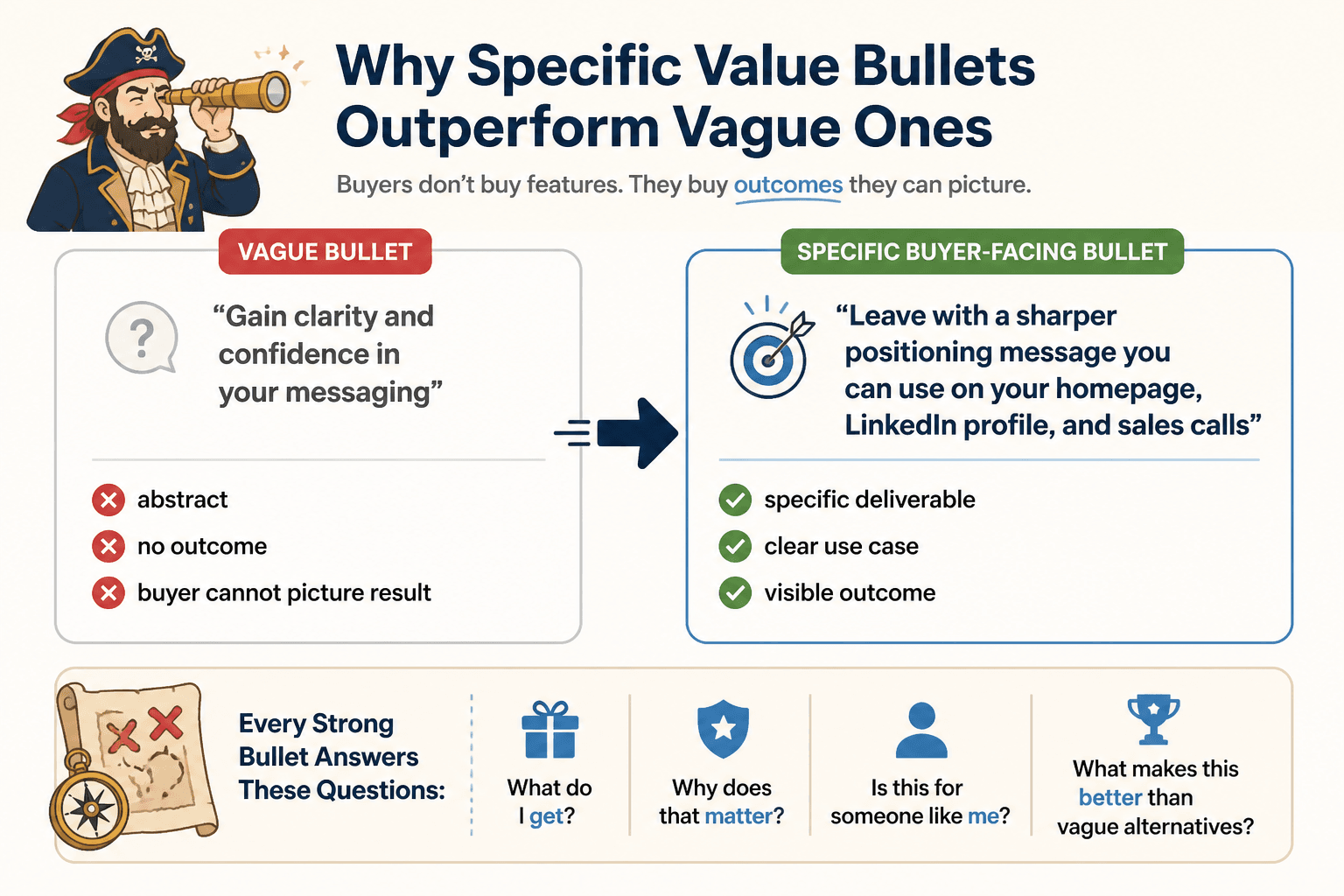
Good bullets help a reader answer a few questions almost instantly:
- What do I get?
- Why does that matter?
- Is this for someone like me?
- What makes this better than the vague alternatives I have already seen?
That means good bullets are usually specific, outcome-aware, and grounded in reality. They do not need to be long. They do need to say something.
If your offer positioning is still fuzzy at the top level, bullets will not save it. But if your core message is decent and the bullets are weak, tightening them can improve clarity fast. That is why this sits right in the middle of offer messaging and positioning, not just page formatting.
The value bullet mistakes that hurt performance most
1. Leading with abstract fluff instead of concrete value
This is the classic one.
Abstract bullets sound polished but land weak because the reader cannot picture what they actually mean.
“Gain clarity and confidence in your messaging”
Fine. About what? Through what? So I can do what better?
A stronger version gives the promise some shape:
“Leave with a sharper positioning message you can use on your homepage, LinkedIn profile, and sales calls without rambling through what you do.”
Now the value is visible. It sounds more useful because it is more useful.
If your bullets are full of words like clarity, alignment, empowerment, momentum, authenticity, confidence, support, transformation, and strategy, slow down. Those words are not banned. They just cannot carry the whole sentence on their own. Most of the time, they are hiding a missing point.
2. Writing bullets from your perspective instead of the buyer’s
A lot of value bullets are really process notes in disguise.
“Includes a 90-minute strategy session”
“Customized framework and expert guidance”
That tells me what is in the box. It does not yet tell me why I should care.
The buyer is not shopping for your internal delivery structure. They are trying to reduce uncertainty and get a result.
Try this instead:
- “A 90-minute positioning session to fix the part that makes people say ‘sounds interesting’ and then do absolutely nothing.”
- “Custom messaging guidance built around your actual offer, so you stop borrowing generic language from people with completely different businesses.”
Notice the difference. Same offer. Better angle.
3. Listing features with no attached outcome
Features matter. But a naked feature rarely pulls its weight.
Compare these:
| Weak bullet | Stronger bullet |
|---|---|
| 3 messaging reviews | 3 rounds of messaging review so your homepage, offer page, and lead magnet are saying the same thing instead of competing with each other |
| Done-for-you copy deck | A done-for-you copy deck you can pull lines from for your site, profile, pitch, and sales content without rewriting from scratch every week |
| Voice of customer research | Voice-of-customer insights that help you describe the problem in language your audience already recognizes |
You do not need to turn every bullet into a paragraph. But you do need to connect the thing to the value of the thing. Otherwise it reads like a grocery list.
4. Making every bullet sound equally important
One weirdly common mistake: a stack of bullets where each line has the same weight, same rhythm, same bland tone, and same vague promise. The result is that nothing stands out.
Good value bullets are not just individually strong. They also work as a sequence. Usually you want some mix of these:
- Core result or transformation
- Practical deliverables
- Specific friction removed
- Proof or credibility signals
- Ease, speed, or usability benefit
If all six bullets say roughly “you will feel more clear and aligned,” your page is doing laps in a kiddie pool.
A better set has contrast. One bullet may define the result. Another may show what gets fixed. Another may make the implementation feel easier. Another may reduce doubt. That variety helps the reader build conviction.
5. Hiding the best part halfway down
People do this constantly. The strongest, most buyer-relevant point is buried under three polite warm-up bullets.
No one needed the throat-clearing.
If one of your bullets says something genuinely sharp like:
“A clean positioning message that helps prospects understand your offer in under 10 seconds”
Do not place that after:
- “Tailored support”
- “High-touch collaboration”
- “Strategic insight”
Lead with the strongest thing. This is not modesty hour.
6. Using generic benefits that could belong to any offer
This mistake quietly destroys positioning.
If your bullet could appear on a coach’s package, a course sales page, a SaaS landing page, and a freelance service page without changing a word, it is probably too generic.
Examples:
- “Save time and energy”
- “Get unstuck”
- “Build confidence”
- “Stand out in your market”
- “Achieve your next level”
These are not benefits so much as business wallpaper.
Specificity is what turns a generic benefit into an actual buying reason. “Stand out in your market” becomes much stronger when turned into “Position your service clearly enough that the right prospects can tell why you cost more without needing a 20-minute explanation.”
If your positioning needs help before your bullets can improve, read how to improve positioning lines without sounding generic. A weak top-line message usually trickles down into weak bullets.
7. Stuffing too much into one bullet
Specific does not mean bloated.
Sometimes people realize their bullets are too vague, panic, and then write tiny essays.
“Includes collaborative strategic brand and messaging deep-dive sessions, customized market-aware positioning development, audience pain point unpacking, and aligned content direction for sustainable visibility and growth.”
That is not a bullet. That is a suitcase someone sat on to get it closed.
Break bulky bullets into cleaner ideas. One value point per line is usually enough. If a bullet needs a short second clause to explain why it matters, great. If it needs life support, rewrite it.
8. Sounding dramatic when the offer is practical
Not every offer needs cinema.
If you are offering messaging strategy, copy review, positioning help, funnel guidance, or content consulting, you do not need bullets that sound like someone is about to emerge from a cocoon under moonlight.
Over-dramatic bullets create trust issues because the emotional tone and the actual service do not match.
For example:
“Radically transform the way you show up and step into your most powerful message”
Maybe. But if the real outcome is cleaner homepage copy and a sharper sales narrative, just say that. Calm confidence converts better than inflatable intensity.
9. Ignoring objections your bullets could be handling
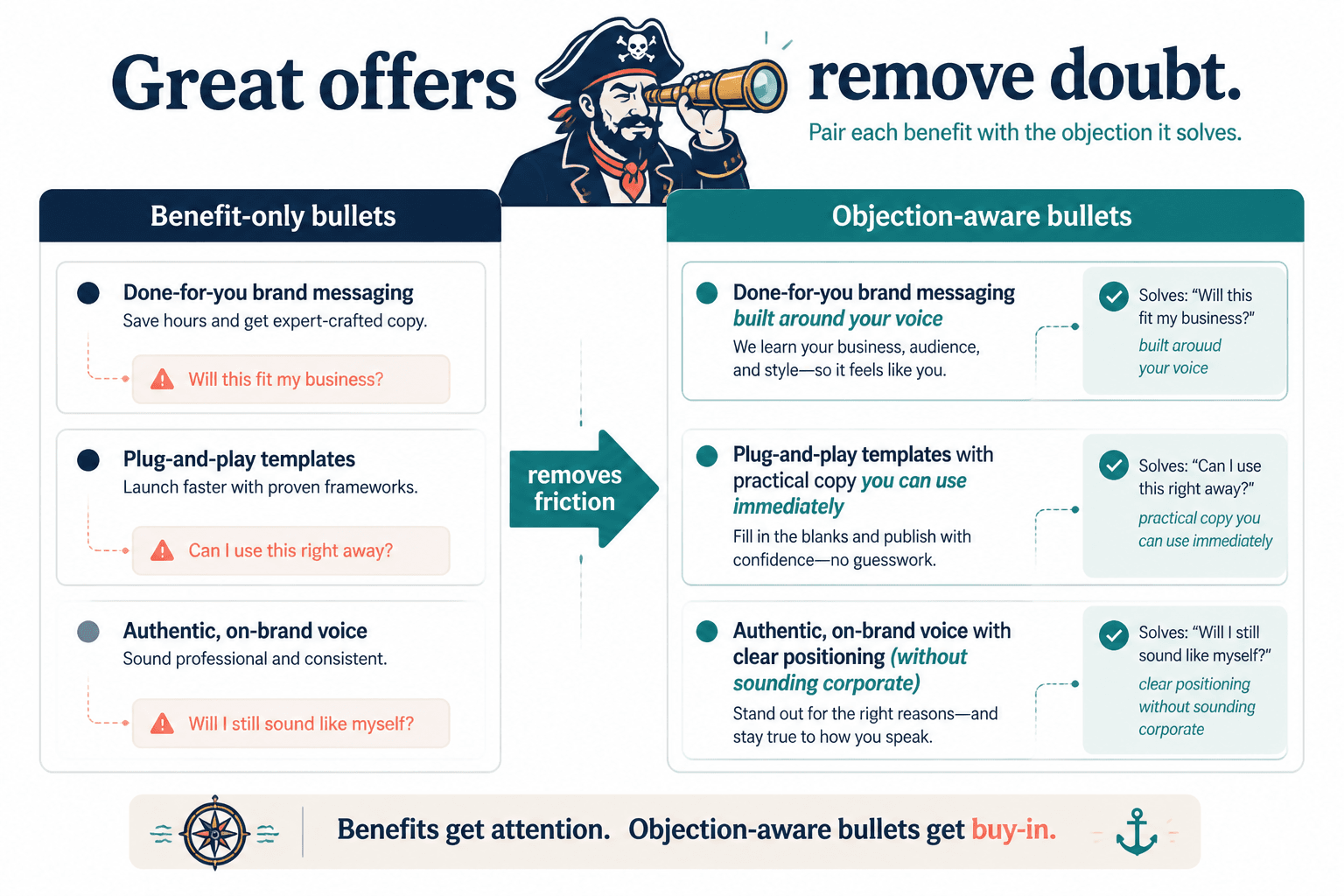
Value bullets are not only for benefits. They can also reduce hesitation.
Smart bullets often answer concerns the buyer is already carrying:
- Will this be generic?
- Will I actually be able to use this?
- Will this fit my kind of business?
- Am I paying for theory or something practical?
- Will I still sound like myself?
So instead of only writing shiny outcomes, include bullets like:
- “Messaging built around your voice and business model, not pasted from a template built for louder people on the internet.”
- “Practical copy you can use immediately on your homepage, offer page, email opt-in, and sales materials.”
- “Clear positioning without turning your brand voice into polished corporate soup.”
Those lines do not just promise value. They remove friction.
How to write better value bullets without making them sound robotic
If your current bullets feel stale, here is a simple rewrite process that works surprisingly well.
Step 1: Start with the raw truth of the offer
Before you write polished bullets, answer these plainly:
- What does the client actually get?
- What problem does that solve?
- What gets easier, faster, clearer, or more effective because of it?
- What result do clients usually care about most?
- What doubt or resistance keeps them from buying?
This gives you source material with actual substance. Which is useful, because polished nothing is still nothing.
Step 2: Turn features into buyer-facing value
Use this simple formula:
Feature or element + why it matters + practical outcome
Example:
- Feature: Homepage messaging rewrite
- Why it matters: your current copy is too broad
- Practical outcome: visitors understand your offer faster and bounce less
Bullet version:
“A homepage messaging rewrite that makes your offer easier to understand fast, so qualified visitors are less likely to leave confused.”
Step 3: Remove generic words that are doing fake work
Scan your bullets and highlight every word that sounds nice but says little on its own.
Common offenders:
- clarity
- confidence
- alignment
- authentic
- impact
- empowering
- strategic
- supportive
- transformative
You do not always need to delete them. But you usually need to pin them down.
Instead of “strategic messaging support,” say what the support helps the buyer do. Instead of “authentic positioning,” say how their voice stays intact while the message gets sharper. Specificity is what gives these words a pulse.
Step 4: Make the bullets sound like your actual offer, not The Internet
This matters more than people think.
If your bullets sound imported from a generic sales page template, the offer feels less trustworthy. The language should fit your market, your buyer, and the level of sophistication they have.
A consultant helping B2B founders should not sound exactly like a spiritual coach selling a voice activation intensive. And the reverse is also true. Positioning is partly what you say, but also how you say it.
If you want a cleaner system for this, this guide on how to write better offer messaging and positioning is the logical next step.
Step 5: Edit the bullets as a set, not just one by one
Once you have a draft, check the group.
- Are they repetitive?
- Do they all start the same way?
- Is the strongest point near the top?
- Do they cover both value and friction reduction?
- Is there at least one concrete, practical line?
- Could a buyer skim them and understand the offer fast?
That last question is the one that matters. Bullets are a scanning tool. If they only make sense after a full reading and interpretive dance, they are underperforming.
Before-and-after examples of value bullet rewrites
Sometimes the easiest way to fix weak bullets is to see the contrast clearly. Here are a few common rewrites.
Example 1: Messaging service
- Before: Gain clarity around your brand message
- After: Clarify your brand message so prospects can understand what you do, who it is for, and why it matters without needing a follow-up explanation
Example 2: Positioning offer
- Before: Strategic positioning support
- After: Sharpen your positioning so your offer stops sounding interchangeable with every other “customized solution” in your niche
Example 3: Copy package
The bigger point is simple: clearer structure and clearer writing make the piece more useful. That is usually what makes the ending land better too.
Offer messaging improves when the problem, promise, and fit become easier to understand. Better positioning usually fixes more than extra copy flourishes.