Most sales pages do not fail because they are too short, too long, or missing some mystical conversion trick. They fail because they make the reader work too hard to understand what is being sold, why it matters, and why they should trust the person selling it.
Creators do this constantly. They spend hours polishing the design, tweaking button colors, and stuffing testimonials into every available corner, while the actual message still sounds foggy. The offer is buried. The value is vague. The page reads like it was assembled from five half-remembered online business templates and one mild identity crisis.
This sales page guide for creators who want better results is here to fix that. Not with funnel theater. Not with manipulative nonsense. Just with the parts that actually matter: a clear offer, sharp messaging, believable proof, useful structure, and a call to action that does not sound like it escaped from a webinar in 2018.
If you sell coaching, consulting, services, templates, digital products, or a creator-led offer, your sales page has one job: help the right person make a confident decision. That is it. Not impress them with your vocabulary. Not bury them in abstract promises. Not “nurture” them into a coma.
If you want the bigger picture, start with the parent guide.
What a sales page is actually supposed to do
A good sales page reduces hesitation.
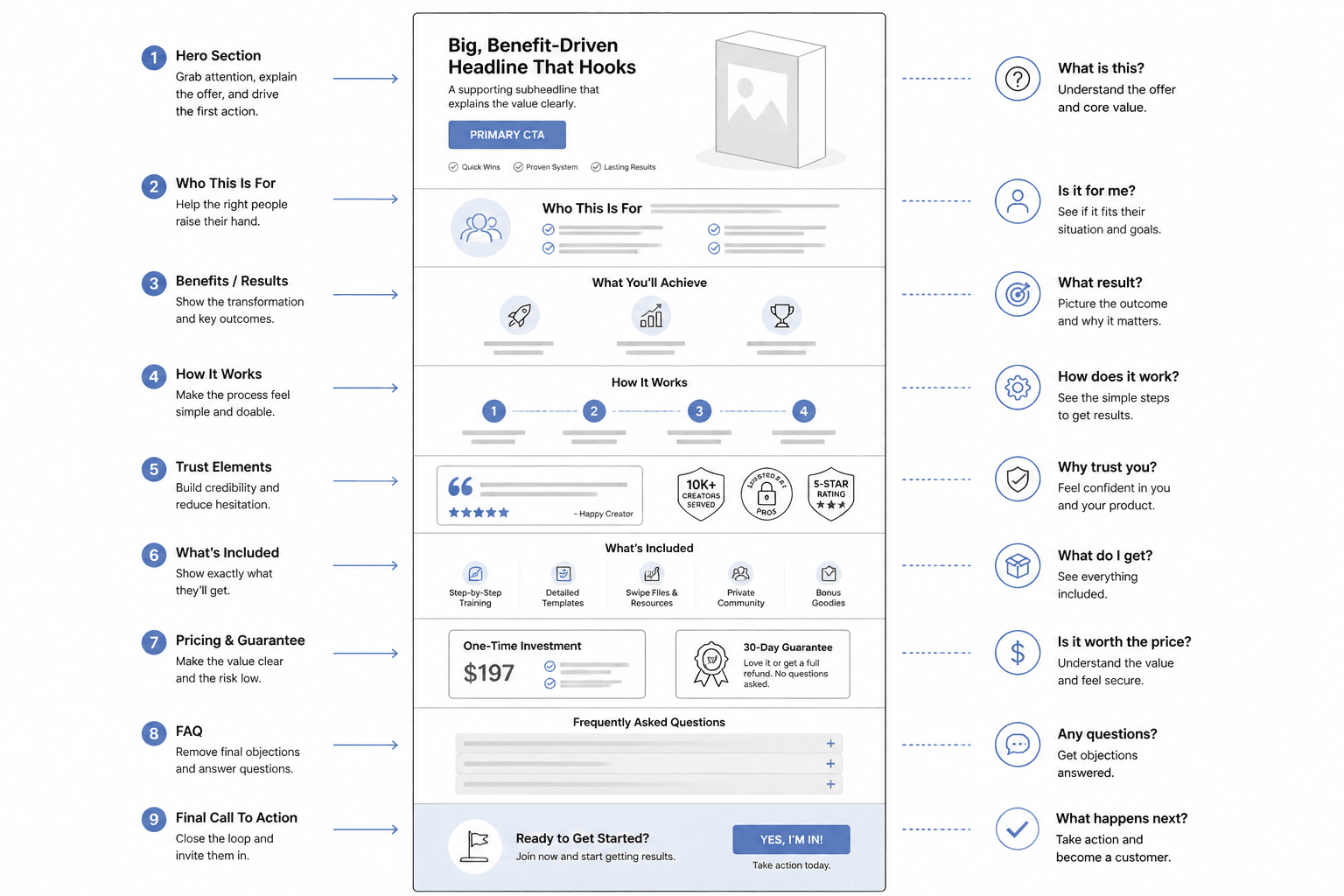
It answers the questions people already have, usually in this order:
- What is this?
- Is it for me?
- What result does it help with?
- How does it work?
- Why should I trust you?
- What exactly do I get?
- What happens next?
- Is this worth the price?
That is the real frame. If your page skips those answers or delivers them in a mush of vague “transformation” language, conversions tend to get ugly fast.
The cleaner your page is, the less persuasion you need. Clarity does a lot of heavy lifting. More than hype, usually.
The biggest sales page mistakes creators keep making
Before fixing the page, it helps to know what usually breaks it.
1. Lead with themselves instead of the buyer
A surprising number of creators open with a mini autobiography. The reader does not need your origin story in the first screen. They need to know if this page is relevant to their problem.
You can absolutely include personality and story later. Just do not force people to dig through your emotional scrapbook before they know what you sell.
2. Use broad promises that mean nothing
“Grow your brand.” “Step into alignment.” “Create more freedom.” Fine. Lovely. Also useless on a sales page unless you make them concrete.
Specific beats inspiring almost every time. Tell people what gets better, faster, easier, clearer, or more profitable.
3. Explain features without translating them into outcomes
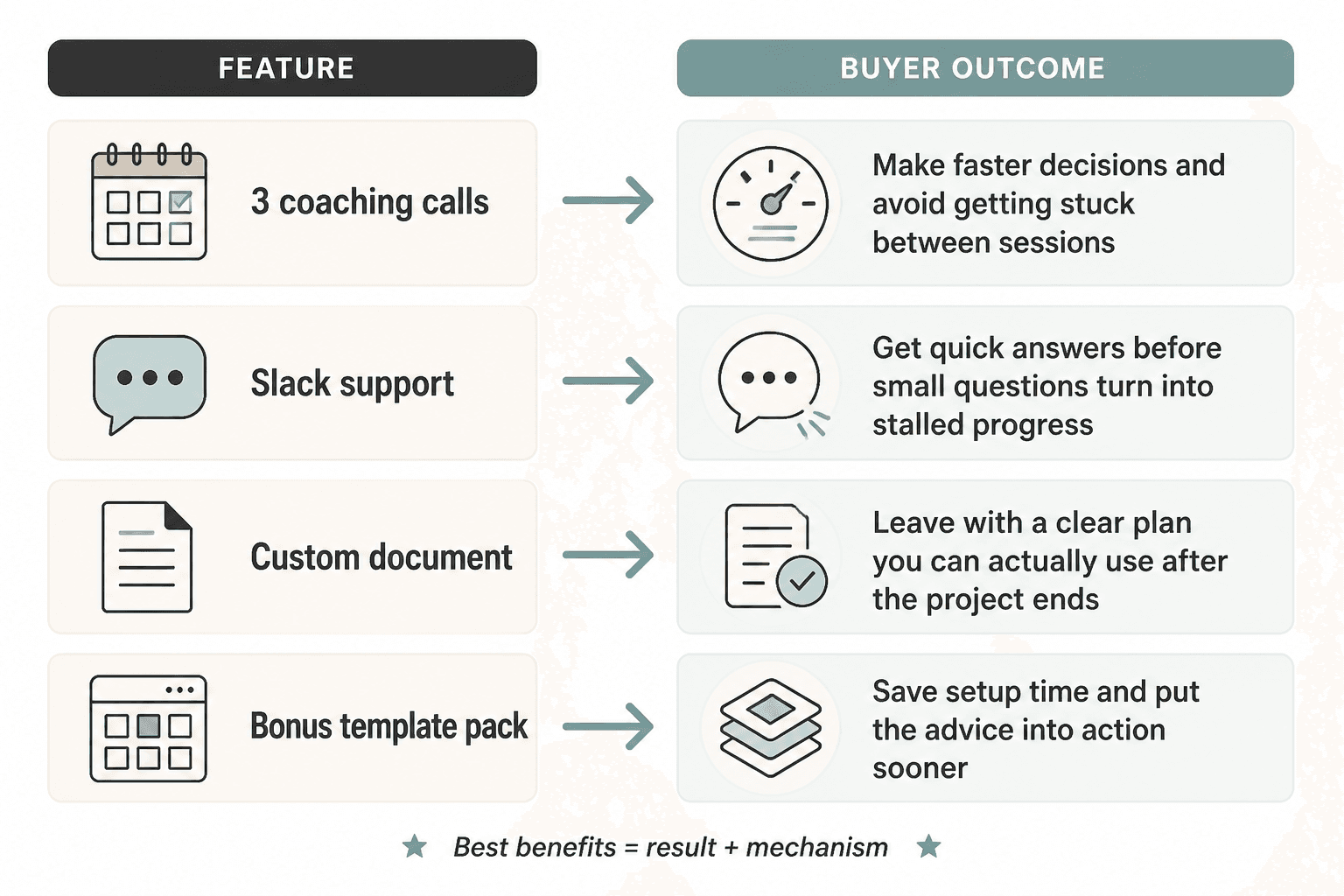
Buyers do need logistics. They also need context. A Notion dashboard, three calls, a private Slack channel, or twelve modules are not benefits by themselves. They are containers. Explain what those things help someone do.
4. Throw proof in randomly
Proof is not confetti. It works best when placed next to a claim it supports. If you say your process helps clients clarify their positioning fast, show evidence right there. A testimonial ten scrolls later does not pull its weight nearly as well.
5. Make the CTA weirdly dramatic or weirdly passive
Your CTA does not need to sound life-changing, and it definitely should not sound apologetic. “Transform your future now” is a bit much. “If you maybe want to learn more, click here I guess” is not much better.
Just tell people the next step clearly.
A simple sales page structure that works
You do not need a wildly original layout. Most high-converting pages follow a familiar logic because readers need familiar decision support. Reinventing the wheel is fun until your wheel looks avant-garde and nobody can drive it.
Here is a practical structure you can use for most creator offers.
- Hero section: what the offer is, who it is for, why it matters, CTA
- Problem and stakes: what is going wrong now and why it matters
- Offer overview: what the product or service does
- Benefits and outcomes: what improves for the buyer
- How it works: process, steps, modules, timeline, delivery
- What is included: concrete deliverables
- Proof: testimonials, case studies, examples, credibility markers
- Objections and FAQs: address concerns directly
- CTA section: price, next step, urgency if real
That structure can flex depending on what you sell. A low-ticket template page will usually be shorter. A high-ticket consulting offer may need more proof and objection handling. But the bones stay pretty similar.
How to write the hero section without fumbling the first impression
The hero section does most of the sorting. The right people should feel recognized. The wrong people should understand it is not for them. Both outcomes are useful.
A strong hero section usually needs four things:
- A clear headline
- A useful subheadline
- A simple CTA
- A small amount of credibility or specificity
Weak headline vs stronger headline
Weak: Build a business that feels aligned and profitable
Stronger: Sales page messaging and conversion support for creators who are tired of sending paid traffic to pages that confuse people
The stronger version is not poetic. Good. Sales pages are not judged like indie film scripts. It tells people what the offer is about and why they should care.
A practical hero formula
You can use this:
[Offer type] for [specific audience] who want to [specific result] without [common frustration]
Example:
Sales page strategy and copy support for coaches, consultants, and personal brands who want more qualified buyers without sounding like a recycled internet marketer
Under that, add a subheadline that makes the result more tangible:
Get a sharper message, clearer offer positioning, and a page that helps the right people say yes with less hesitation.
Make the problem feel real, not theatrical
This section is where many pages either become compelling or become unbearable.
You are not trying to manufacture pain. You are trying to articulate the buyer’s current frustration more clearly than they have managed to say it themselves. There is a difference.
Good problem copy often includes:
- What they have already tried
- What keeps not working
- What that costs them
- Why the issue is happening
Example:
You have traffic, referrals, or content bringing people in, but the page itself is doing a terrible job closing the gap between interest and action. Visitors skim, get a vague sense that you might be good, then leave because the offer feels blurry, generic, or harder to understand than it should be.
That lands better than melodramatic copy about “staying stuck in your struggle” for the next twenty years. Relax.
Position the offer clearly
After you name the problem, explain your offer like an adult.
This is where you answer:
- What exactly is it?
- Who is it for?
- What does it help with?
- How is it delivered?
- What makes it different or useful?
If someone has to reread the page to understand what they are buying, the copy is not ready.
Simple positioning template
[Offer name] is a [service/product/program] for [specific audience] that helps them [specific result] through [brief mechanism].
Example:
The Sales Page Rework is a copy and strategy service for creators and consultants who already have an offer but need a clearer page that turns more visitors into qualified leads and buyers.
Notice how much cleaner that is than “an immersive container for offer expansion and magnetic messaging.” Which, to be fair, sounds expensive. Just not in a good way.
Focus on outcomes people can picture
Benefits need to feel concrete. Not because buyers are dull, but because vague outcomes create uncertainty, and uncertainty slows action.
Instead of listing broad aspirations, tie the offer to visible improvements.
| Weak benefit | Stronger benefit |
|---|---|
| Feel more confident in your offer | Explain your offer faster and answer buyer objections before they bounce |
| Improve your messaging | Replace vague copy with clearer language that helps the right people recognize themselves |
| Increase conversions | Turn more page visits into bookings, applications, or purchases with less confusion |
| Stand out online | Make your page sound specific enough that it does not blend into every other expert-with-a-framework page |
The best benefits combine result plus mechanism. What gets better, and why.
Explain what is included without making it read like packaging filler
This section matters more than people think. Buyers want to know what they are getting, yes, but they also want help interpreting the value of each piece.
Bad version:
- 3 calls
- Slack support
- Custom document
- Bonuses
Better version:
- One 90-minute strategy session to sharpen the offer, buyer fit, and page angle before rewriting anything
- Full sales page copy review and rewrite recommendations so the page says what it actually needs to say, not just more words in a nicer font
- Asynchronous support for 7 days to answer follow-up questions while you implement changes
- CTA and objection-handling suggestions to reduce hesitation near the buying decision
That second version does more than list deliverables. It tells the buyer why each one exists.
Use proof that supports the actual claims
Proof is where trust gets less theoretical.
For creators, good proof can include:
- Client testimonials
- Short case studies
- Before-and-after examples
- Audience or client results
- Named credentials if relevant
- Examples of your work
- Experience in a specific niche or business model
What matters is relevance. A testimonial saying you are “amazing to work with” is nice. A testimonial saying your new page helped clarify the offer and increase qualified inquiries is much more useful.
How to place proof well
- Near the headline if you have strong credibility markers
- After major claims
- Near pricing if price resistance is likely
- Inside objection-handling sections
Try to match proof to concern. If readers worry the offer is too generic, show specificity. If they worry it will be hard to implement, show ease. If they worry you do not understand their kind of business, show examples from similar clients.
For more breakdowns and reference points, it helps to study strong sales page ideas and examples for creators and more targeted sales pages examples for coaches, consultants, and personal brands.
Handle objections before they become exits
People do not arrive on a sales page empty-headed. They bring concerns with them. Price, timing, fit, trust, complexity, effort, whether this is just another polished promise with no spine behind it.
Good sales pages do not avoid those concerns. They answer them.
Common objections include:
- Will this work for my situation?
- How much time will this take?
- What if I have a small audience?
- Why is this worth the price?
- How is this different from cheaper alternatives?
- What happens after I buy?
You can address objections with short sections, FAQ entries, testimonials, process explanations, or direct copy near the CTA.
Example:
If you do not have a huge audience: Good. This offer is built for creators who need clearer conversion, not vanity metrics. A smaller audience of relevant people can still convert well when the page makes the offer easy to understand and trust.
If that is your situation, this guide pairs nicely with sales pages for creators with small audiences.
Write CTAs that sound confident, not sticky
A call to action should reduce friction, not add performance art.
Good CTA copy is usually clear about one thing: what happens next.
Examples of solid CTA language
- Book your strategy session
- Apply for the program
- Get the template
- Start the audit
- Reserve your spot
- See pricing and next steps
If the next step needs context, add one short line beneath the button:
You will answer a few fit questions first. If it looks like a match, I will send next steps within 2 business days.
That small bit of clarity can do more than ten paragraphs of “high-converting” persuasion tricks.
How long should a sales page be?
There is no magic length. A sales page should be as long as the decision requires and no longer.
Length depends on:
- Offer price
- Audience awareness
- Complexity of the offer
- Amount of trust already built
- How many objections need answering
- Whether the offer is impulse-friendly or considered
A $29 template can usually convert on a shorter page. A $3,000 service probably needs more context, proof, and objection handling. Not because long automatically converts better, but because expensive decisions usually need more reassurance.
If you want a broader foundation on structure and page writing, see how to write better sales pages and the main sales pages topic hub.
A simple sales page checklist before you publish
- Can a stranger understand what you sell within a few seconds?
- Does the page clearly say who the offer is for?
- Are the outcomes specific enough to picture?
- Have you translated features into benefits?
- Is there proof near important claims?
- Are likely objections answered somewhere obvious?
- Is the CTA clear and easy to act on?
- Does the page sound like a human with taste wrote it?
- Did you remove vague fluff, filler, and generic hype?
That last one matters. A lot.
If your sales page still is not converting, check these first
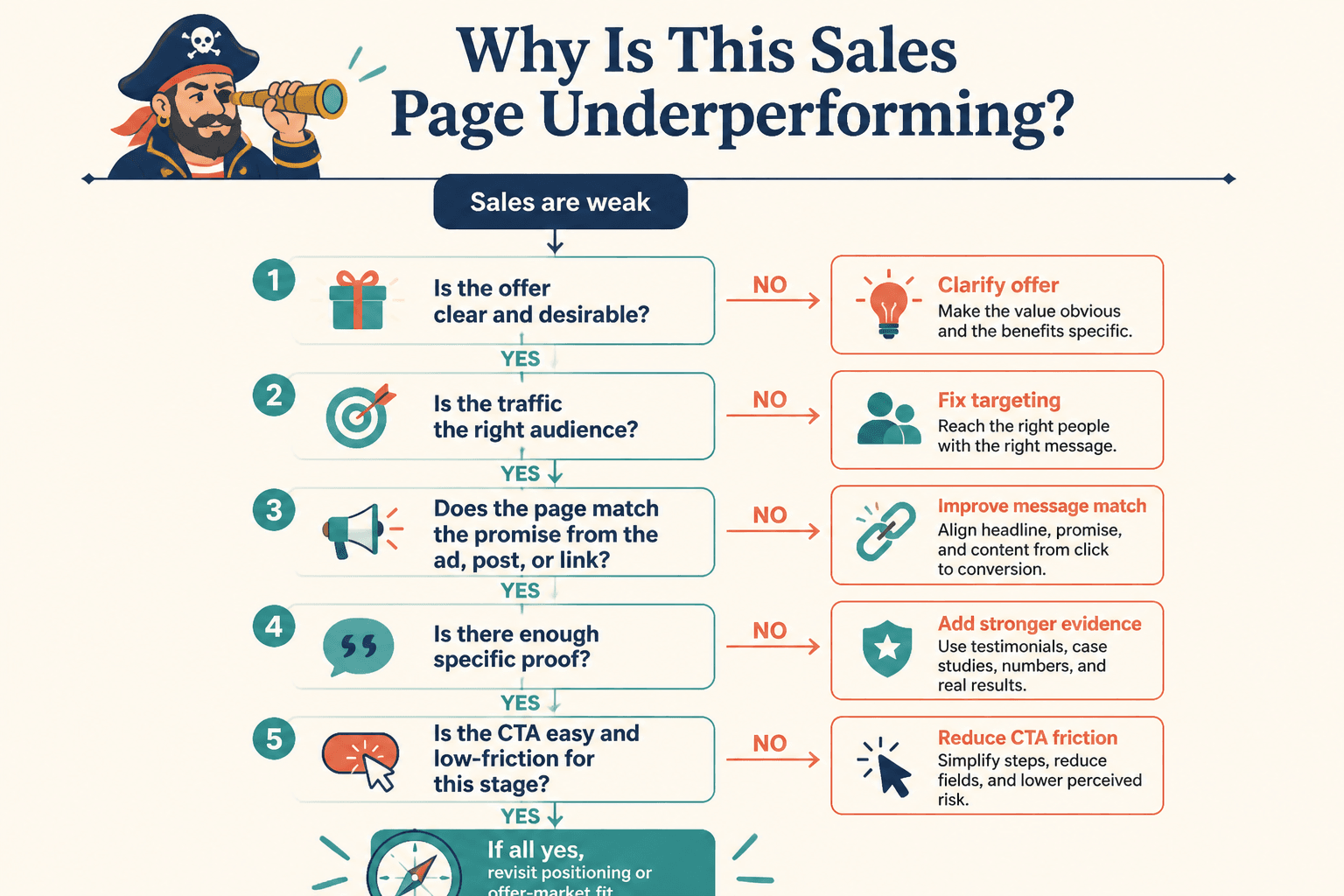
Sometimes the page is the problem. Sometimes the offer is fuzzy, the traffic is mismatched, or the audience is not ready yet. Do not blame the copy for everything. It is good, but it is not a necromancer.
Check these:
- Offer clarity: is the actual offer easy to understand and easy to want?
- Audience fit: are the people landing there the right people?
- Message match: does the page align with the promise made by the content, ad, or link that brought them in?
- Proof quality: are you asking for trust without enough evidence?
- CTA friction: is the next step too vague, too complicated, or too committal for this stage?
Sometimes small changes matter. Sometimes you need to reposition the whole page. Hard to hear, but useful.
FAQ
Do creators need a separate sales page for every offer?
Usually, yes. If the audience, promise, or buying decision changes, the page should too.
Should a sales page tell a story?
Sometimes. Story helps when it supports relevance or trust. It does not help when it delays clarity.
How many testimonials should I include?
Enough to support the decision. Fewer strong, specific testimonials beat a wall of bland praise.
Should pricing be on the page?
In many cases, yes. If you hide it, make sure there is a good reason and a clear next step.
Can a short sales page convert well?
Absolutely. If the offer is simple, low-risk, and easy to understand, short can work beautifully.
Final thought
The best sales page guide for creators who want better results is not really about persuasion tricks. It is about making the decision easier for the right person.
If your page is clear, specific, credible, and honest about what the offer does, you are already ahead of a depressing amount of the internet. Start there. Tighten the message. Cut the fluff. Answer the real questions. Then ask for the sale like you mean it.
If you want to keep improving this area, browse the broader website conversion copy category, the conversion copy section, and the parent sales pages pillar for related breakdowns.